




- Automation & Robotics
- Bagging Equipment Market
Bagging Equipment Market Size, Share, and Growth Forecast, 2026 – 2033
Bagging Equipment Market by Product Type (Integrated Bagging Lines, Standalone Equipment), End-user (Food Industry, Construction, Pharmaceuticals, Homecare, Personal Care), and Regional Analysis for 2026 – 2033

Bagging Equipment Market Size and Trends Analysis
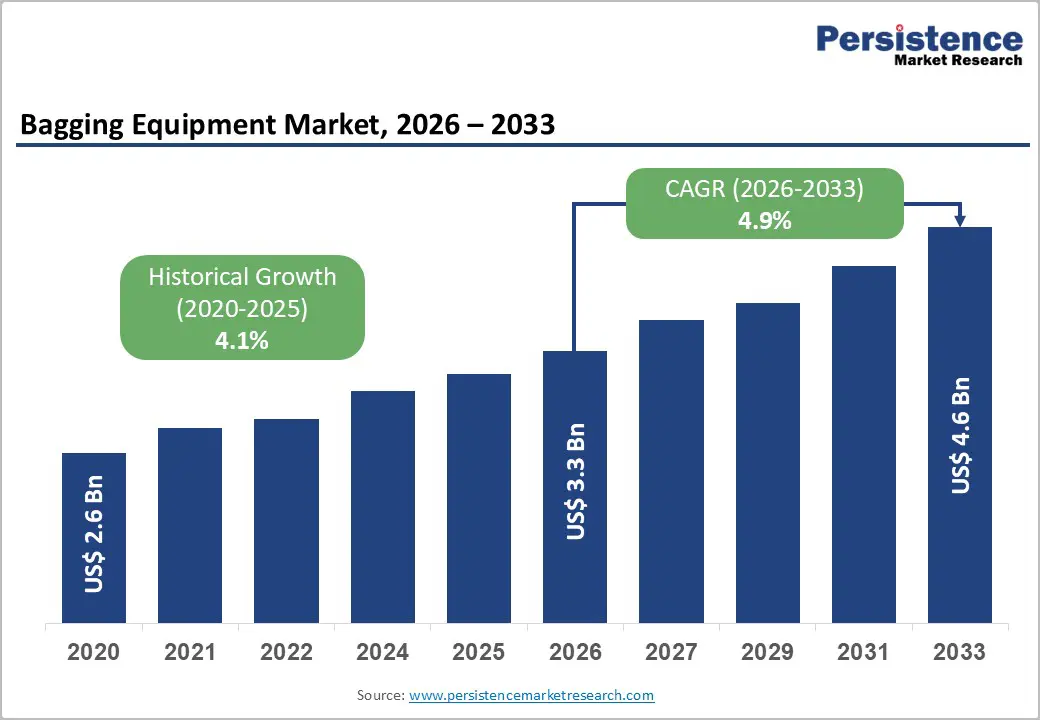
The global bagging equipment market size is likely to be valued at US$3.3 billion in 2026 and is expected to reach US$4.6 billion by 2033, growing at a CAGR of 4.9% during the forecast period from 2026 to 2033, driven by increasing adoption of automated and semi-automated bagging systems to improve operational efficiency, reduce labor dependency, and ensure consistent packaging quality.
Rising demand for packaged food, pharmaceuticals, construction materials, and consumer goods, along with a shift towards integrated bagging lines that combine weighing, filling, sealing, and palletizing, is driving adoption. Smart sensors and modular designs are supporting replacements and capacity upgrades, especially in emerging markets. These trends are further fueled by ongoing investments in packaging automation and supply-chain optimization.
Key Industry Highlights:
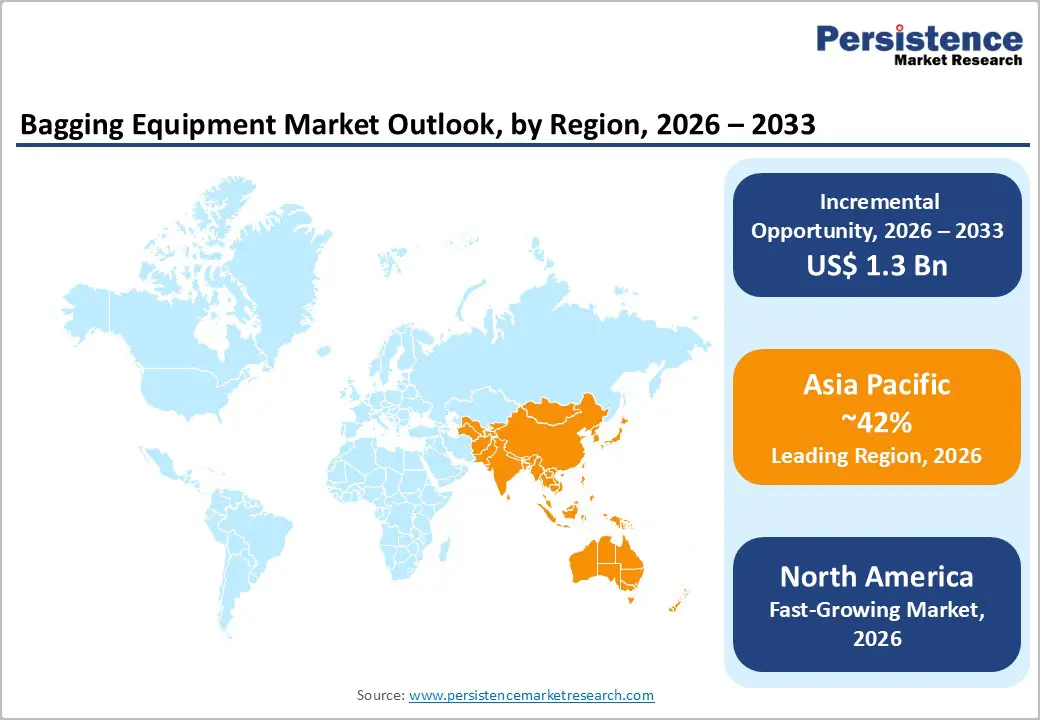
- Leading Region: Asia Pacific is expected to lead the market with a 42% share in 2026, driven by rapid industrialization, growing packaged food demand, rising automation, and strong manufacturing in China, Japan, India, and ASEAN.
- Fastest-growing Region: North America is expected to be the fastest-growing region for bagging equipment in 2026, driven by strong regulations, ongoing investments in food and pharmaceutical packaging, and rising demand for smart, sustainable solutions.
- Leading Product Type: Integrated bagging lines are projected to represent the leading product type in 2026, accounting for 32% of the revenue share, driven by their efficiency and suitability for high-volume food and construction applications.
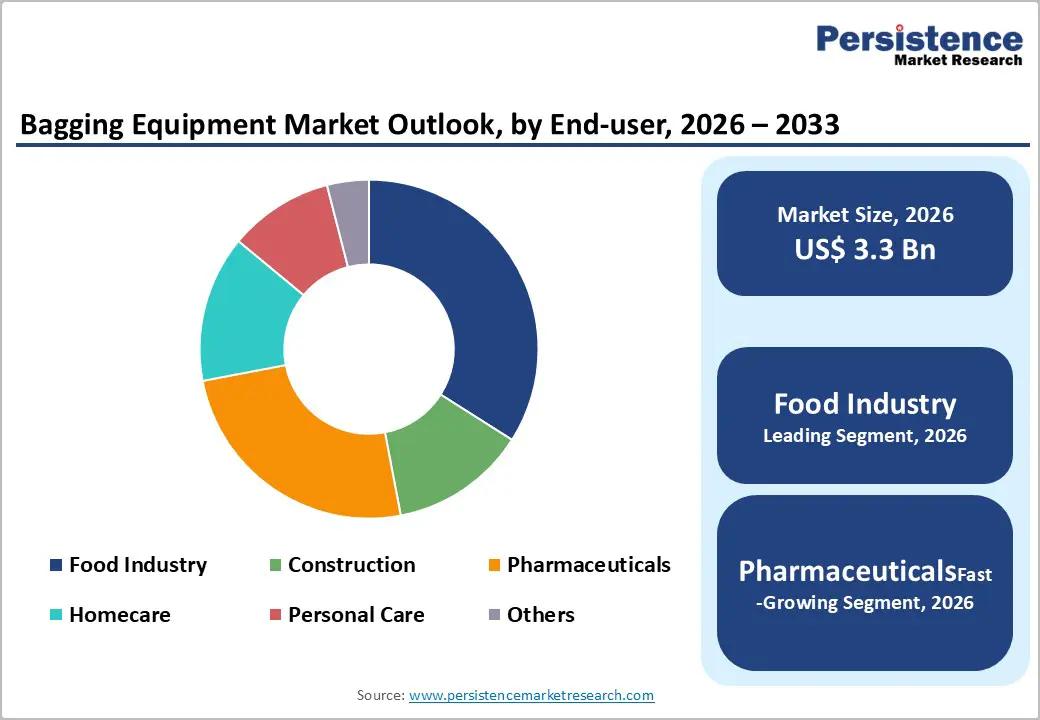
- Leading End-user: The food industry is anticipated to be the leading end-user, accounting for over 38% of the revenue share in 2026, supported by high demand for hygienic, high-speed packaging of processed foods and bulk commodities.
| Report Attribute | Details |
|---|---|
|
Bagging Equipment Market Size (2026E) |
US$3.3 Bn |
|
Market Value Forecast (2033F) |
US$4.6 Bn |
|
Projected Growth (CAGR 2026 to 2033) |
4.9% |
|
Historical Market Growth (CAGR 2020 to 2025) |
4.1% |
Market Factors – Growth, Barriers, and Opportunity Analysis
Growth Analysis - Automation and Efficiency Demands in Key Industries
Manufacturers across the food, construction, and pharmaceutical industries seek higher efficiency, consistency, and throughput. Rising labor costs and workforce shortages are accelerating the shift from manual and semi-automatic processes to fully automated bagging lines.
Automated systems integrate weighing, filling, sealing, and labeling functions, reducing human error and material wastage while ensuring uniform packaging quality. In high-volume applications such as grains, cement, and chemicals, automation enables faster cycle times and continuous operation, helping producers meet large-scale demand while maintaining cost competitiveness and operational reliability in increasingly consolidated supply chains.
Efficiency demands are amplified by the need for regulatory compliance, product traceability, and sustainability. Advanced bagging equipment supports precise weight control, hygienic handling, and reduced product loss, which are critical in regulated sectors such as food and pharmaceuticals. Integration with digital monitoring, sensors, and Industry 4.0 platforms allows real-time performance tracking and predictive maintenance, minimizing downtime.
Energy-efficient designs and compatibility with recyclable packaging materials align with sustainability goals. As companies focus on optimizing production footprints and improving overall equipment effectiveness.
Rising Demand for Packaged Products and Sustainability Focus
Increased consumption of packaged food, pharmaceuticals, construction materials, and homecare products has intensified the need for reliable, high-speed bagging solutions. Manufacturers are investing in advanced bagging equipment to handle higher volumes, diverse product types, and varying bag formats while maintaining consistency and shelf-life requirements. This demand is particularly strong in the food and beverage and pharmaceutical sectors, where hygiene, accuracy, and throughput are critical for meeting consumer expectations and regulatory standards.
Sustainability considerations are increasingly shaping purchasing decisions within the bagging equipment market. End-users are seeking machines compatible with recyclable, biodegradable, and lightweight packaging materials to reduce environmental impact. Equipment manufacturers are responding by developing energy-efficient systems that minimize material waste and optimize resource usage. Precise filling technologies reduce overfilling and product loss, while modular designs extend equipment life through upgrades rather than replacements.
Barrier Analysis - Supply Chain Constraints and Skilled Labor Shortages
Supply chain disruptions, including shortages of critical components such as sensors, motors, and control systems, have increased manufacturing costs and delayed equipment delivery. Longer lead times and fluctuating raw material prices particularly affect small and mid-sized manufacturers, which struggle to absorb cost increases or maintain large inventories. This results in backlogs and delayed installations, temporarily limiting market growth.
Skilled labor shortages hinder the adoption and effective use of advanced bagging equipment. Many regions face a lack of trained technicians for installation, maintenance, and programming, raising training costs and reducing operational efficiency. As a result, some manufacturers delay automation investments, slowing market penetration despite growing demand for efficiency and productivity improvements.
Complexity of Integrating New Systems with Existing Production Lines
Older filling, conveying, and palletizing equipment often lacks compatibility with modern automated bagging systems, necessitating custom interfaces and software modifications. This increases installation time, engineering effort, and project costs. In industries such as food processing and construction, where continuous operations are vital, integration challenges can disrupt production schedules and deter upgrades.
Variations in control systems, data protocols, and plant layouts across facilities make seamless communication difficult, requiring specialized expertise. Limited standardization among equipment vendors further complicates integration, increasing reliance on system integrators. Downtime during integration can lead to short-term productivity losses, which is a significant concern for high-volume operations, delaying automation despite its long-term efficiency benefits.
Opportunity Analysis - Technological Convergence and Automation Upgrades
Manufacturers increasingly integrate automation, digital controls, and smart technologies into packaging lines. Advanced bagging systems now combine weighing, filling, sealing, labeling, and palletizing with centralized control platforms, improving throughput and consistency. The convergence of robotics, sensors, and software enables higher accuracy and reduced material waste, which is especially valuable in food, pharmaceutical, and construction applications. End-users modernize production facilities, and demand is rising for next-generation bagging equipment that delivers scalable performance, faster changeovers, and seamless integration within automated manufacturing environments.
Automation upgrades enhance market opportunities by enabling predictive maintenance, real-time monitoring, and data-driven decision-making. Integration with Industry 4.0 platforms allows manufacturers to track performance metrics, reduce downtime, and optimize overall equipment effectiveness.
Energy-efficient designs and compatibility with sustainable packaging materials strengthen the value proposition of upgraded systems. Many companies are replacing or retrofitting older equipment to extend asset life while achieving higher productivity. This trend is particularly strong in high-volume and regulated industries, where automation upgrades support compliance, cost efficiency, and long-term operational resilience.
Customization of Bagging Equipment for Diverse Industry Needs
Industries demand solutions tailored to specific product characteristics and operating conditions. Food processors require hygienic designs and rapid changeovers, while construction and chemical sectors need rugged systems capable of handling heavy, abrasive materials. Pharmaceutical and personal care manufacturers prioritize precision, contamination control, and regulatory compliance.
Customized bagging equipment enables manufacturers to address varying bag sizes, materials, weights, and throughput requirements, allowing end-users to optimize efficiency while maintaining product quality across different applications.
The growing emphasis on modular and configurable equipment supports customization opportunities. Manufacturers are increasingly offering adaptable bagging lines that can be easily upgraded or reconfigured as production needs evolve. This flexibility reduces long-term capital expenditure and improves return on investment for end-users. Custom automation levels, software interfaces, and integration options also allow companies to align equipment with existing production systems. Demand diversifies across emerging and mature markets, and customized bagging solutions are becoming a key competitive differentiator, driving adoption among small, mid-sized, and large-scale manufacturers.
Category-wise Analysis
Product Type Insights
Integrated bagging lines are expected to lead the bagging equipment market, accounting for approximately 32% of revenue in 2026, driven by their ability to deliver end-to-end automation across weighing, filling, sealing, and palletizing processes.
These systems are widely adopted in high-volume industries such as food processing and construction materials, where operational efficiency, consistency, and throughput are critical. By consolidating multiple packaging functions into a single line, integrated solutions reduce manual handling, minimize product loss, and improve quality control. For example, a large cement producer may deploy integrated bagging lines to streamline bulk packaging operations while ensuring consistent bag weight and faster dispatch.
Standalone equipment is likely to represent the fastest-growing segment in 2026, supported by increasing demand from small and mid-sized manufacturers seeking flexibility and lower entry costs. Unlike fully integrated lines, standalone systems allow end-users to upgrade specific packaging functions without overhauling entire production lines. This makes them particularly attractive for facilities with space constraints, varied product portfolios, or phased automation strategies.
Growth is supported by modular designs that enable easy retrofitting and future scalability. For example, a regional food processor may adopt a standalone bagging unit to automate one product line while maintaining manual operations elsewhere.
End-user Insights
The food industry is projected to lead the market, capturing around 38% of the revenue share in 2026, supported by strong demand for hygienic, high-speed packaging of powders, grains, snacks, and processed foods. Rising consumption of packaged and convenience foods has increased the need for efficient and contamination-free bagging solutions. Food manufacturers prioritize equipment that offers precise weighing, fast changeovers, and compliance with strict food safety standards.
Automated bagging systems also help reduce labor dependency and improve shelf-life consistency. For example, a snack food manufacturer may rely on advanced bagging equipment to ensure uniform portioning and sealed packaging across large production volumes.
The pharmaceuticals segment is likely to be the fastest-growing end-user in 2026, driven by stringent regulatory requirements and increasing production of generic medicines. Pharmaceutical manufacturers demand high-precision bagging solutions that support contamination control, traceability, and compliance with evolving safety standards. Automated bagging equipment enables accurate dosing, secure sealing, and integration with serialization and inspection systems.
Growth is supported by rising investments in pharmaceutical manufacturing and packaging infrastructure. For example, a generic drug manufacturer may adopt specialized bagging equipment to package active ingredients under controlled conditions while meeting regulatory audit requirements.
Regional Insights
North America Bagging Equipment Market Trends
North America is likely to be the fastest-growing region in the bagging equipment market in 2026, driven by an ongoing shift toward automation and digital integration, as manufacturers in the U.S. and Canada invest in smart, high-speed packaging solutions to increase throughput and reduce dependency on manual labor. This trend is closely tied to broader packaging automation growth across the region, where advanced control systems, robotics, and integrated monitoring platforms are increasingly standard in bagging lines to meet diverse product requirements across food, chemical, and industrial segments.
Sustainability and compliance trends are also influencing market direction in North America, as environmental regulations and corporate ESG goals accelerate the adoption of eco-friendly packaging machinery. Equipment that supports recyclable materials and minimizes waste aligns with increasing regulatory scrutiny and end-user expectations, especially in the food and pharmaceutical sectors.
For example, a corporate engagement with automation in the region is Printpack, a U.S. based packaging company that integrates advanced packaging and bagging technologies across food, beverage, and pharmaceutical lines to meet evolving production and safety standards.
Europe Bagging Equipment Market Trends
Europe is likely to be a significant market for bagging equipment in 2026, due to sustainability and regulatory compliance, as stringent EU packaging waste directives and national laws push manufacturers toward eco-friendly and recyclable packaging solutions. This trend is particularly pronounced in countries such as Germany, France, and the U.K., where industrial regulations and consumer expectations for reduced environmental impact accelerate demand for bagging systems compatible with biodegradable materials and energy-efficient designs.
European producers are also modernizing production lines through the adoption of smart, automated bagging technologies that support precise filling, reduced waste, and seamless integration with digital monitoring systems, helping drive operational efficiency while meeting circular economy goals.
The integration of advanced automation and Industry 4.0 technologies enables real-time data analytics, predictive maintenance, and improved overall equipment effectiveness. Manufacturers are investing in digital connectivity and flexible bagging systems capable of handling varied products and formats to support diverse end markets such as food, chemicals, and pharmaceuticals. For example, Bobst Group SA, a Swiss packaging machinery supplier, incorporates cutting-edge automation and digital solutions across its packaging equipment portfolio to enhance throughput and reduce downtime for European producers.
The competitive landscape is also characterized by collaborations and technological partnerships that emphasize interoperability, open control standards, and scalable automation.
Asia Pacific Bagging Equipment Market Trends
Asia Pacific is anticipated to be the leading region, accounting for a market share of 42% in 2026, driven by industrial growth, rising demand for packaged products, and accelerating adoption of automation technologies across manufacturing sectors. Robust industrialization in China, India, Japan, and Southeast Asia has bolstered demand for efficient packaging solutions in food, pharmaceuticals, agriculture, and construction materials, prompting manufacturers to invest in high-speed and integrated bagging systems.
Urbanization and growth in retail and e-commerce amplify the need for standardized and protective packaging solutions, encouraging equipment upgrades and digital modernization.
Sustainability and customization are also key regional trends shaping the Asia Pacific bagging equipment market, with end-users prioritizing eco-friendly materials, lightweight packaging formats, and modular system designs that align with environmental goals and regulatory pressures. The growing focus on recyclable and biodegradable packaging materials is prompting equipment suppliers to develop compatible bagging lines that reduce material waste and energy consumption.
For example, of regional participation in advanced packaging technologies is Ishida Co., Ltd., a Japanese manufacturer known for its weighing, packing, and inspection systems, which supports diversified packaging requirements across food and non-food industries with integrated line solutions.
Competitive Landscape
The global bagging equipment market exhibits a moderately fragmented structure, driven by the presence of multiple domestic and multinational manufacturers that vary in size, specialization, and regional focus. Competition is shaped by product innovation, automation capabilities, and comprehensive service networks as firms seek to differentiate through advanced technologies, efficiency gains, and sustainability features.
With increasing demand for automated bagging solutions across food, pharmaceutical, construction, and consumer goods industries, market players are expanding their portfolios and geographic reach to capture growing opportunities.
With key leaders including Premier Tech Chronos, I.M.A. Industria Macchine Automatiche S.p.A., Bosch Packaging Technology, and Nichrome India Ltd., the competitive landscape reflects both powerhouses and strong regional specialists. These firms leverage robust R&D, broad equipment portfolios, and strategic investments in digitalization to secure customer loyalty and drive adoption of next-generation bagging systems. These players compete through continuous technological innovation, strategic partnerships, acquisitions, and enhanced after-sales support to strengthen market positioning and address diverse end-user demands.
Key Industry Developments:
- In August 2025, Pakona introduced low-power, high-speed packaging machines that reduce energy consumption by 30% while maintaining performance, helping manufacturers cut operating costs and meet sustainability goals in food, pharmaceutical, and consumer goods packaging.
- In August 2024, Premier Tech launched the upgraded CHRONOS OMR Series robotic bagging machines, enhancing its former PTH and PTW Series to meet growing automation and labor demands. The new system, designed for free-flowing products such as animal feed and grains, boosts robotic payload capacity by 30%, increasing throughput and ensuring 98% uptime. It also features an intuitive HMI for easy recipe creation and operation management.
Companies Covered in Bagging Equipment Market
- Automated Packaging Systems, Inc.
- Innovative PackTech Machines Pvt Ltd
- Technoweigh
- POWERVAC
- E-PAK Machinery, Inc.
- Rennco LLC
- Pakona
- Matrix Packaging Machinery, LLC
- Autopack Machines Pvt. Ltd
- SEPACK
- CMD Corporation
- Alligator Automations
- Syntegon Technology GmbH
- STATEC BINDER GmbH
- MONDIAL PACK
- Choice Bagging Equipment Ltd.
- PAYPER
Frequently Asked Questions
The global bagging equipment market is projected to reach US$3.3 billion in 2026.
The bagging equipment market is driven by rising automation demand to improve efficiency and reduce labor costs, growing consumption of packaged products across industries, and increasing focus on sustainable and high-throughput packaging solutions.
The bagging equipment market is expected to grow at a CAGR of 4.9% from 2026 to 2033.
Key market opportunities include the adoption of smart and automated bagging systems, customization for diverse end-use industries, retrofitting and modular upgrades of existing lines, and the growing demand for energy-efficient and sustainable packaging solutions.
Automated Packaging Systems, Inc., Innovative PackTech Machines Pvt Ltd, and Technoweigh are the leading players.


