




- Automation & Robotics
- Baggage Handling System Market
Baggage Handling System Market Size, Share, and Growth Forecast, 2026 - 2033
Baggage Handling System Market by Product Type (Destination Coded Vehicle (DCV), Conveyor), Application (Airport, Railway, Marine), and Regional Analysis for 2026 - 2033

Baggage Handling System Market Size and Trends Analysis
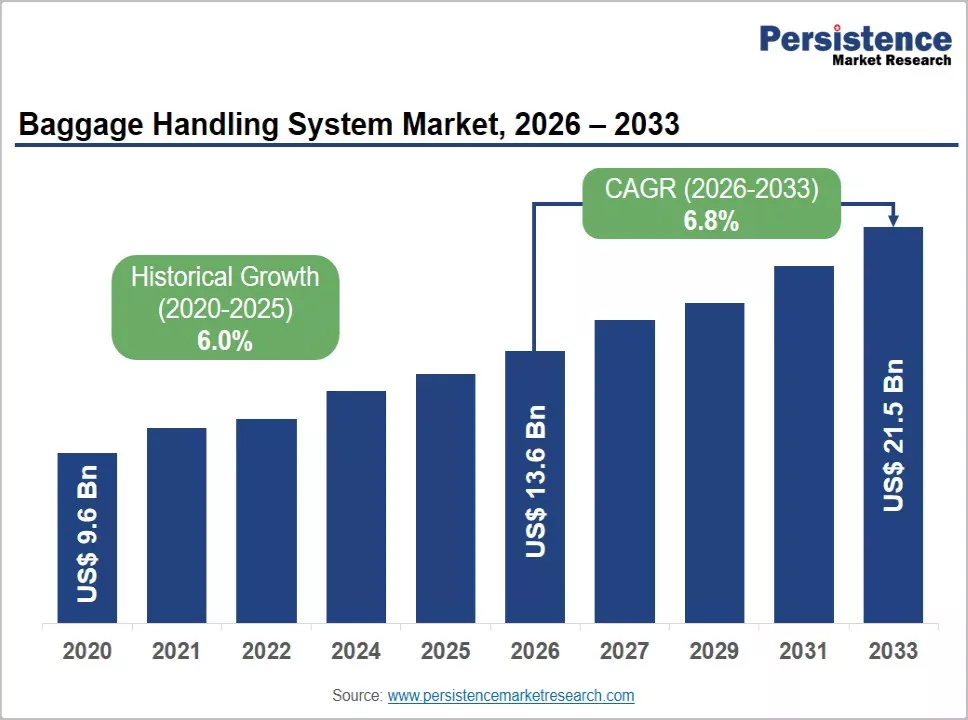
The global baggage handling system market size is likely to be valued at US$13.6 billion in 2026 and is expected to reach US$21.5 billion by 2033, growing at a CAGR of 6.8% during the forecast period from 2026 to 2033, driven by rising air passenger traffic, airport infrastructure modernization, and growing demand for automated baggage sorting, tracking, and transfer solutions.
According to Airports Council International (ACI) World, global airports handled a record 9.8 billion passengers in 2025, highlighting the increasing operational demands on baggage handling infrastructure.
Key Industry Highlights:
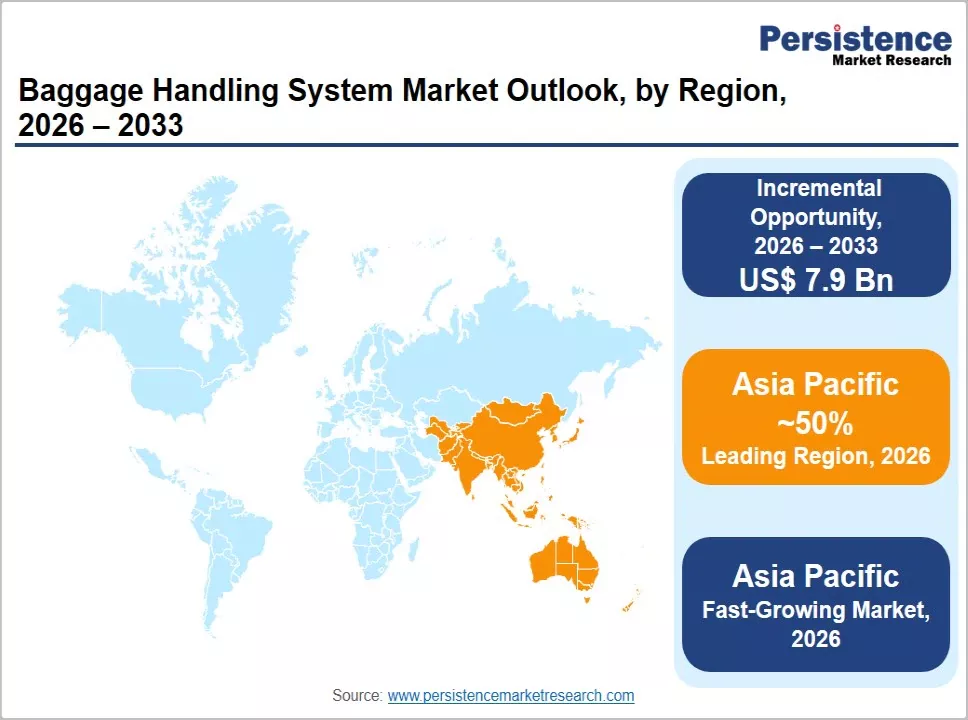
- Leading Region: Asia Pacific is anticipated to be the leading region, accounting for a market share of 50% in 2026, driven by airport expansion and rising passenger traffic across China and India.
- Fastest-growing Region: Asia Pacific is likely to be the fastest-growing region, supported by major airport development projects and investments in automated baggage infrastructure.
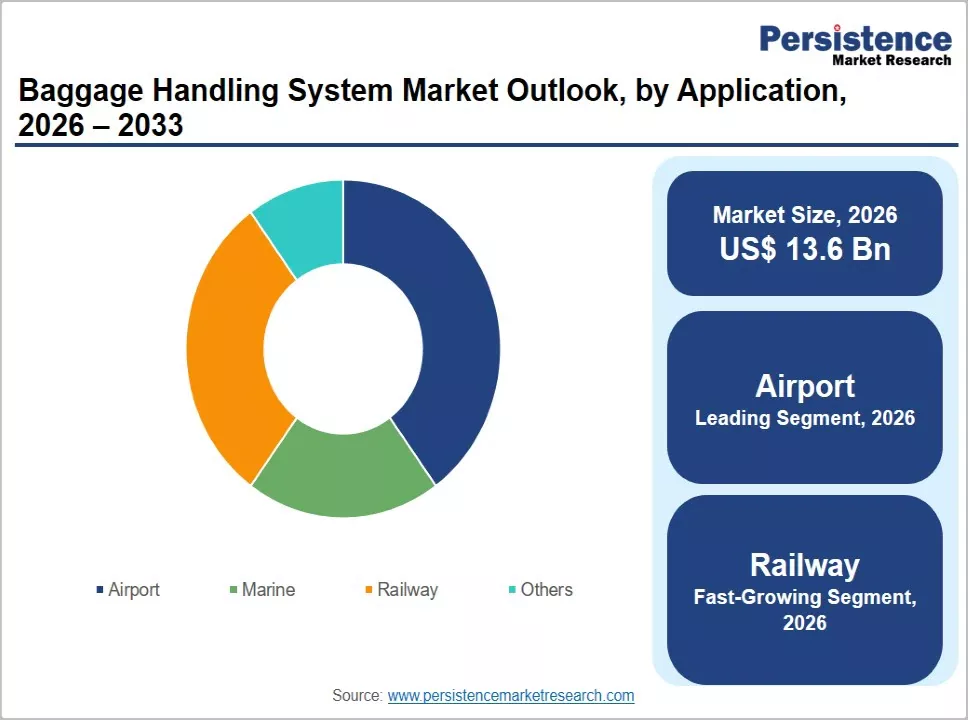
- Leading Product Type: Conveyor systems are projected to represent the leading product type in 2026, accounting for 60% of the revenue share, for their widespread use in baggage transportation, sorting, and reclaim operations.
- Leading Application: Airports are anticipated to be the leading application, accounting for over 75% of the revenue share in 2026, supported by rising passenger traffic, terminal expansions, and increasing investments in automated baggage infrastructure.
- Key Opportunity: Expanding airport infrastructure and multimodal transportation hubs create significant opportunities for AI-enabled automated baggage handling, real-time tracking, and integrated sorting systems that improve operational efficiency and baggage security.
DRO Analysis
Driver - Technological Advancement in Automation and Tracking
Airports are increasingly investing in automated conveyor networks, destination-coded vehicles (DCVs), radio-frequency identification (RFID), barcode scanning, and real-time baggage monitoring to improve operational efficiency. These technologies enable accurate baggage identification, faster sorting, and smoother transfers between flights, reducing manual intervention and handling errors.
Growing passenger volumes and increasingly complex airport operations are strengthening the need for reliable baggage management infrastructure. Consequently, airlines and airport operators are prioritizing intelligent handling systems that support efficient baggage movement and improve passenger satisfaction.
Artificial intelligence, machine vision, and integrated tracking platforms are further enhancing baggage handling capabilities by enabling predictive maintenance, automated identification, and real-time operational monitoring. These solutions help airport operators identify bottlenecks, manage peak-period baggage flows, and minimize equipment downtime. Integration with airline departure control systems and airport operational databases also improves coordination across check-in, screening, sorting, and baggage reclaim processes.
Restraint - Legacy IT Systems and Interoperability Challenges
Older conveyor controls, baggage tracking applications, and sorting systems may rely on outdated communication protocols that are difficult to integrate with modern automation platforms. Replacing these components can require extensive engineering, system testing, and operational adjustments. Airport operators must also maintain baggage processing during upgrades to avoid flight disruptions and passenger inconvenience.
Interoperability challenges become more pronounced when baggage handling equipment, security screening devices, airline systems, and airport management platforms are supplied by different vendors. Inconsistent data formats and communication standards can limit information sharing, complicate troubleshooting, and reduce the effectiveness of integrated tracking solutions. Cybersecurity requirements and concerns about protecting operational data further increase the complexity of connecting older infrastructure with networked systems.
Opportunity - Expansion into Multimodal Hubs and Marine Terminals
Airports increasingly connect with railway stations, metro networks, and other transport facilities, creating demand for coordinated baggage movement across different travel modes. Automated conveyors, tracking technologies, and integrated baggage management software can help streamline transfers, improve visibility, and reduce manual handling requirements.
Investments in intermodal terminals and passenger transport infrastructure create opportunities for suppliers to develop flexible systems capable of serving multiple operators. These installations can also support future capacity expansion, enabling transport hubs to accommodate growing passenger flows without extensive operational disruption. Marine terminals, particularly cruise ports, offer additional opportunities as cruise tourism and passenger terminal modernization encourage more efficient baggage processing.
Cruise facilities handle substantial volumes of luggage during embarkation and disembarkation, creating demand for automated transportation, screening, sorting, and tracking solutions. Suppliers can adapt conveyor technologies and baggage management software to address terminal layouts, security requirements, and operational schedules. Partnerships with port authorities, cruise operators, airport integrators, and infrastructure developers can support entry into these applications.
Category-wise Analysis
Product Type Insights
Conveyor systems are expected to lead, accounting for 60% of revenue in 2026, due to their extensive use in transporting, sorting, screening, and delivering passenger luggage across airport terminals. These systems provide continuous baggage movement between check-in counters, security checkpoints, sorting areas, and reclaim belts, making them essential to airport operations. For example, Vanderlande Industries supplies integrated baggage handling solutions incorporating conveyor systems for airport operations.
Destination coded vehicle systems (DCV) are likely to represent the fastest-growing segment, supported by increasing demand for precise, flexible, and high-speed baggage transportation at major international airports. These systems use individually controlled carriers to move luggage along designated routes, supporting accurate sorting and efficient transfers between processing stages. Their ability to manage complex baggage flows makes them suitable for busy hub airports facing capacity constraints and tight flight connections.
Application Insights
Airports are projected to lead the market, capturing around 75% of the revenue share in 2026, supported by reflecting the extensive use of automated equipment across check-in, security screening, baggage sorting, transfer, and reclaim operations. Airports require integrated systems to manage passenger luggage efficiently while maintaining security and minimizing delays. Rising air travel, terminal expansion, and modernization of existing facilities continue to support demand for conveyor networks, automated sorters, tracking software, and baggage storage solutions.
The railway segment is likely to be the fastest-growing application due to investments in high-speed rail networks, modern passenger terminals, and integrated transportation hubs. As rail operators seek to improve passenger convenience and operational efficiency, opportunities are emerging for automated baggage conveyors, screening equipment, tracking technologies, and coordinated luggage transfer solutions. These systems can streamline baggage movement in stations connected to airports and other transport facilities, particularly where passenger volumes and intermodal connections are increasing.
Regional Insights
North America Baggage Handling System Market Trends
North America is likely to be a significant market for baggage handling systems, supported by airport modernization, aging equipment replacement, stringent security requirements, and investments in operational efficiency. Airports are upgrading conveyor networks, baggage screening equipment, sorting controls, and tracking technologies to improve reliability and passenger experience.
U.S. Baggage Handling System Market Trends
The U.S. is expected to dominate the regional market, accounting for approximately 80% of the market share in 2026, driven by airport infrastructure renewal and modernization. The Federal Aviation Administration's airport terminal funding programs address aging facilities and support improved passenger processing. In May 2026, the FAA published selections for its fiscal-year airport terminal program, including baggage handling upgrades at eligible airports.
Canada Baggage Handling System Market Trends
Canada is likely to be a significant market for baggage handling system, holding approximately 20% of the market share in 2026, supported by airport capacity planning, security screening requirements, and terminal infrastructure investment. Toronto Pearson International Airport is advancing its Long-Term Investment in Facilities and Terminals program, which includes proposed improvements to baggage handling infrastructure. In September 2026, the federal impact assessment authority published a notice concerning a proposed baggage handling systems building at Toronto Pearson.
Europe Baggage Handling System Market Trends
Europe is likely to be a significant market for baggage handling systems, due to modernization of established airports, increasing automation, baggage security requirements, and efforts to improve system reliability. Airport operators are investing in upgraded sorting infrastructure, baggage tracking software, and more efficient conveyor systems while maintaining existing terminal operations.
U.K. Baggage Handling System Market Trends
The U.K. is expected to account for 15% of the European baggage handling systems market in 2026, supported by major international airports and ongoing terminal infrastructure investments. In December 2025, Heathrow Airport announced plans for infrastructure improvements in 2026, including the commencement of construction on a dedicated baggage handling system for Terminal 2. Once completed, the system is expected to enhance operational resilience and improve baggage processing efficiency.
Germany Baggage Handling System Market Trends
Germany is expected to account for approximately 37% of the European baggage handling systems market in 2026, supported by ongoing airport infrastructure modernization and investments in operational efficiency. In January 2026, Hamburg Airport initiated a major baggage handling modernization project involving the construction of a new sorting hall and upgrades to existing processing infrastructure. These improvements are intended to streamline baggage movement, expand handling capacity, and enhance automation, supporting demand for advanced baggage handling systems in Germany.
Asia Pacific Baggage Handling System Market Trends
The Asia Pacific region is anticipated to be the leading region, accounting for a market share of 50% in 2026. Its expanding airport networks, rising passenger traffic, new terminal construction, and modernization of existing facilities. Governments and airport operators are investing in automated baggage sorting, RFID-enabled tracking, advanced screening, and integrated transfer systems to improve processing efficiency. The region's large aviation markets create opportunities for both global system integrators and domestic suppliers.
China Baggage Handling System Market Trends
China is set to lead the regional market, accounting for approximately 30% of the market share in 2026. Growth is supported by airport infrastructure expansion, rising passenger traffic, and increasing adoption of smart airport technologies. The Civil Aviation Administration of China reported record passenger throughput at mainland transport airports in 2025. In July 2026, construction commenced on the baggage handling system for the Terminal 3 expansion at Shanghai Pudong International Airport, reflecting continued investment in airport baggage processing infrastructure.
India Baggage Handling System Market Trends
India is set to account for approximately 22% of the market in 2026, supported by airport capacity expansion, new terminal development, and modernization of aviation infrastructure. The Airports Authority of India has issued tenders for baggage handling systems across multiple airports. In April 2026, it published a tender for baggage handling equipment and associated operations and maintenance services at Imphal Airport, reflecting continued investment in airport baggage processing infrastructure.
Competitive Landscape
The global baggage handling system market exhibits a moderately fragmented structure, driven by increasing airport modernization, rising passenger traffic, and growing demand for automated baggage transportation and tracking solutions.
With key leaders including Vanderlande Industries, Daifuku Co., Ltd., BEUMER Group, Siemens, SITA, Fives, and Pteris Global Limited, competition spans integrated equipment, sorting technologies, baggage software, and maintenance services. These players compete through technological innovation, system reliability, project execution capabilities, and comprehensive lifecycle support.
Key Industry Developments:
- In September 2026, Auckland Airport announced a major international baggage system overhaul, with construction beginning on a new system featuring conveyor upgrades and automated early baggage storage using robotic cranes. The project is designed to modernize check-in and baggage processing infrastructure.
Companies Covered in Baggage Handling System Market
- Vanderlande Industries
- Siemens
- Daifuku Co., Ltd.
- BEUMER GROUP
- Pteris Global Limited
- SITA
- Fives
- Babcock International Group PLC
- Smith’s Detection Group Ltd.
- G&S Airport Conveyor
- B2A Group
- Logplan
Frequently Asked Questions
The global baggage handling system market is projected to reach US$13.6 billion in 2026.
Rising air passenger traffic and increasing adoption of automated baggage sorting, tracking, and screening technologies drive the baggage handling system market.
The baggage handling system market is expected to grow at a CAGR of 6.8% from 2026 to 2033.
Expansion of smart airports, multimodal transportation hubs, and marine terminals creates opportunities for advanced automated baggage handling and tracking solutions.
Vanderlande Industries, Siemens, Daifuku Co., Ltd., BEUMER Group, and Pteris Global Limited are the leading players.


