




- Automation & Robotics
- Valve Remote Control System Market
Valve Remote Control System Market Size, Share, and Growth Forecast 2026 - 2033
Valve Remote Control System Market by Product Type (Pneumatic Valve Remote Control System, Electric Valve Remote Control System, Hydraulic Valve Remote Control System, Electro-Hydraulic Valve Remote Control System), Valve Type (Ball Valve, Diaphragm Valve, Butterfly Valve, Globe Valve, Gate Valve, Plug Valve, Check-Safety Valve), Application (Manufacturing, Power Generation, Chemicals & Petrochemical, Oil & Gas, Marine), and Regional Analysis for 2026 - 2033

Valve Remote Control System Market Size and Trends Analysis
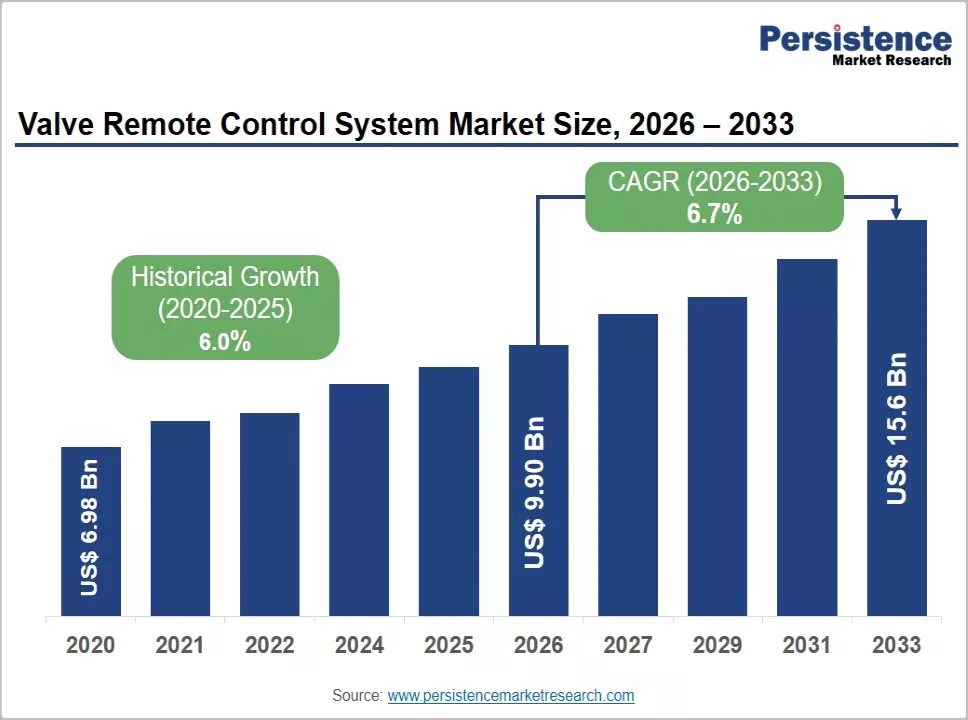
The global valve remote control system market is likely to be valued at US$ 9.90 billion in 2026 and is projected to reach US$ 15.6 billion by 2033, growing at a CAGR of 6.7% during the forecast period between 2026 and 2033.
Market growth is primarily driven by sustained capital expenditure in marine vessel construction, where remote actuation of ballast, cargo, and bilge valves is a regulatory requirement rather than an optional upgrade. The International Maritime Organization (IMO) has progressively strengthened automation and safety standards for commercial shipping under its SOLAS (Safety of Life at Sea) Convention, making certified valve remote control systems an essential procurement requirement for new vessel construction and retrofit programs alike.
Key Industry Highlights
- Leading Region: Asia Pacific is likely to lead the global market, accounting for around 45% of the market share in 2026, supported by the concentration of shipbuilding orders in China, South Korea, and Japan. The region's structural advantage is further reinforced by automation targets under China's 14th Five-Year Plan, supporting valve remote control system procurement across Chinese petrochemical facilities.
- Leading Product Type: Hydraulic valve remote control systems represent the leading product type segment, holding a 38.0% share in 2026, supported by their torque performance capabilities and established use across very large crude carriers (VLCCs) and bulk carriers. Electrification trends are expected to gradually moderate this dominance; however, the technology's established type-approval credentials from classification societies such as Lloyd's Register and DNV support a gradual transition rather than rapid displacement.
- Dominant Application: Marine applications account for 50.0% of the global market share in 2026, as SOLAS and MARPOL conventions establish requirements for remote valve actuation across various vessel systems. Global fleet renewal and retrofit cycles sustain demand for marine valve remote control systems throughout the 2026–2033 forecast period.
- Fastest-Growing Product Type: Electric valve remote control systems represent the fastest-growing product type segment, with solutions such as Rotork's IQ3 series and Wärtsilä's hybrid-electric vessel programs highlighting the growing adoption of electric actuation across marine and offshore applications. This trend is further supported by the IMO's 2023 Revised GHG Strategy and its emissions reduction targets.
Market Dynamics
Drivers - Rising Global Shipbuilding Activity and SOLAS Compliance Requirements
Commercial shipbuilding orders reached their highest volume in over a decade by 2023, per data published by the Korea Shipbuilding & Offshore Engineering (KSOE) group, with South Korean yards alone securing contracts for more than 320 vessels across LNG carriers, bulk carriers, and container ships. Every new commercial vessel above a defined gross tonnage threshold must install a certified valve remote control system to comply with SOLAS Chapter II-1 structural and mechanical requirements.
This compliance-driven demand is structurally insulated from discretionary spending cycles. Retrofit demand adds a parallel revenue stream: the global commercial fleet of vessels over 20 years old represents a substantial upgrade opportunity, particularly as port state control authorities intensify inspection regimes.
Restraints - High Capital Cost and Complex Integration Requirements
Installing a valve remote control system across a large vessel or process plant is not a plug-and-play exercise. A full hydraulic or electro-hydraulic system for a VLCC (Very Large Crude Carrier) can require integrating several hundred actuated control points with bridge-level supervisory consoles, demanding bespoke engineering hours that significantly inflate total project cost.
For smaller shipping operators and mid-tier process manufacturers, these upfront integration costs create genuine procurement friction, particularly when vessel utilisation rates compress margins.
Opportunities - Electrification of Marine Vessel Systems and Green Shipping Mandates
The IMO's 2023 Revised GHG Strategy sets binding emissions reduction targets for international shipping, with a net-zero goal by approximately 2050. Achieving these targets is accelerating the adoption of electrically actuated valve remote control systems as shipbuilders reduce reliance on hydraulic circuits that consume auxiliary engine power.
Wärtsilä and Kongsberg Maritime have both publicly announced hybrid-electric vessel architecture programmes in which electric valve actuators are integrated directly into low-emission propulsion and ballast management systems. This electrification wave creates a substantial expansion opportunity for electric valve remote control system suppliers capable of meeting the IEC 60092 series requirements for electrical installations in marine vessels.
Category-wise Analysis
Product Type Insights
Hydraulic valve remote control systems are projected to lead the product type category, commanding a 38% market share in 2026, supported by their high torque delivery and reliable performance in demanding marine environments. Large tanker operators and bulk carrier fleets specify hydraulic systems for cargo valve control because the technology delivers consistent actuation force across extreme temperature ranges without relying on a stable electrical supply. Classification societies, including Lloyd's Register and DNV, have long-established type-approval frameworks for hydraulic RCS installations, reinforcing buyer confidence and reducing certification risks.
Electric valve remote control systems are likely to be the fastest-growing product type segment, driven by the marine industry's transition toward electrification. Rotork's IQ3 intelligent electric actuator series and its integration capabilities with vessel energy management platforms demonstrate the growing potential of electric actuation to meet the response time and redundancy requirements traditionally served by hydraulic technology.
Valve Type Insights
Which Valve Type Holds the Largest Share of the Global Market?
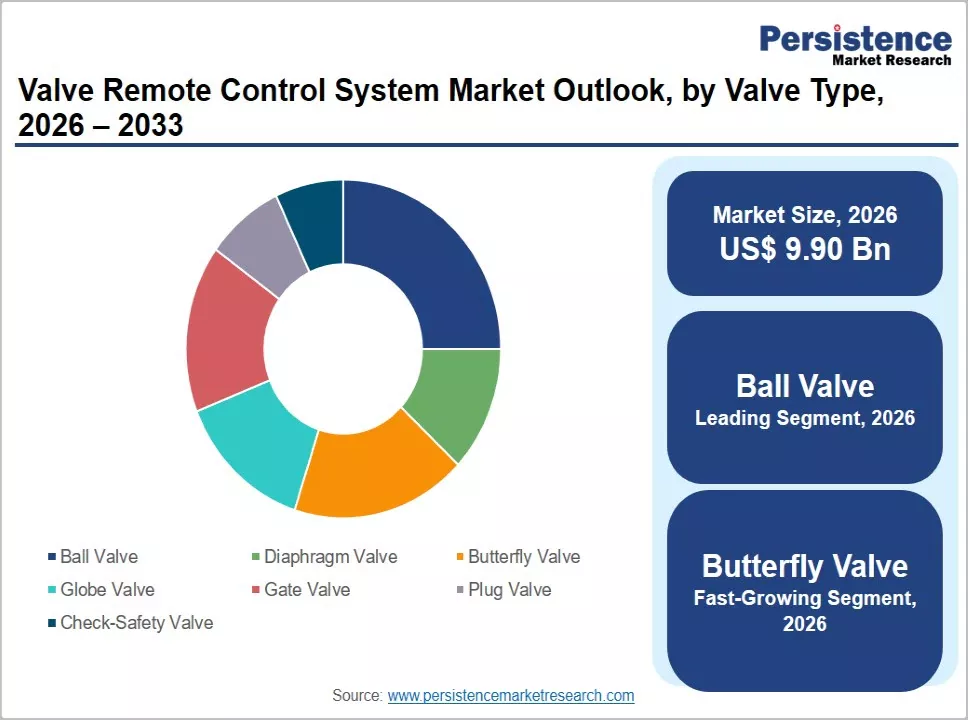
Ball valves are expected to dominate the market, accounting for 25% of the market share in 2026, driven by their effective flow control characteristics and bidirectional sealing performance across high-pressure applications. Refineries and LNG terminal operators select remotely actuated ball valves for emergency isolation applications because their quarter-turn operation enables rapid, full-bore shutoff, an important requirement under API 607 fire-safe testing standards. The design also supports frequent cycling while maintaining sealing performance, helping reduce maintenance requirements in high-throughput process streams.
Butterfly valves are likely to be the fastest-growing valve type, gaining traction in large-diameter pipelines and power generation cooling water systems. Emerson's Fisher butterfly valve portfolio, supported by product introductions between 2022 and 2024, has strengthened adoption in combined-cycle gas turbine plants, where compact installation footprints and low-pressure-drop characteristics are important selection criteria.
Application Insights
Marine applications are projected to lead the segment, accounting for a 50.0% market share in 2026, reflecting the sector's established regulatory requirements for remote valve actuation across various vessel classes. Ballast water management systems, cargo loading and unloading circuits, and engine room seawater cooling lines require reliable valve control capabilities on vessels subject to applicable SOLAS and MARPOL requirements.
Oil & gas is likely to be the fastest-growing application segment. TotalEnergies' Mozambique LNG project, alongside renewed deepwater exploration activity across Brazil's pre-salt Santos Basin, is supporting procurement of explosion-proof pneumatic and electro-hydraulic RCS for subsea wellhead and topside valve management applications.
Regional Analysis
North America Valve Remote Control System Market Trends And Insights
North America is expected to hold nearly 16.0% share of the market in 2026. Regional demand is anchored by the extensive network of onshore and offshore oil and gas processing infrastructure along the Gulf of Mexico, where Bureau of Safety and Environmental Enforcement (BSEE) regulations govern safety and automated shutoff systems on offshore producing platforms. The U.S. Department of Energy's continued support for LNG export terminal expansion, including facilities at Sabine Pass and Calcasieu Pass, provides a sustained demand outlook for automated valve management systems throughout the forecast period.
U.S. Valve Remote Control System Market Size
The U.S. is anticipated to lead the North American market, accounting for nearly 85% of the regional market share in 2026. The recovery in upstream capital expenditure since 2020, particularly across the Permian Basin and deepwater Gulf of Mexico, is sustaining demand for pneumatic and electro-hydraulic remote actuation in wellhead and separator valve applications. Expanding LNG export capacity through FERC-approved terminal projects is expected to support additional demand through 2033.
Canada Valve Remote Control System Market Size
Canada is expected to account for 15% of the North American market share in 2026. Oil sands operators in Alberta, including Suncor Energy and Canadian Natural Resources Limited (CNRL), are investing in process automation upgrades to reduce per-barrel operating costs, creating additional procurement opportunities for remotely actuated isolation and control valve systems. Stricter environmental assessment and monitoring requirements under Canada's Impact Assessment Act are further supporting the adoption of automated valve management systems throughout the forecast period.
Europe Valve Remote Control System Market Trends And Insights
Europe is projected to account for a 26.0% share of the global market in 2026. The region benefits from a concentration of technologically advanced shipyards, refinery operators, and process engineering firms that consistently specify high-performance valve remote control systems. The European Union's Fit for 55 legislative package is encouraging investments in hydrogen infrastructure and carbon capture facilities, both of which require reliable remote valve actuation systems for use in potentially explosive atmospheres under applicable ATEX Directive 2014/34/EU requirements. Germany and the United Kingdom represent the region's two largest individual markets.
Germany Valve Remote Control System Market Size
Germany is estimated to lead the European market, accounting for a 35% of the regional market share in 2026. Germany's chemical and petrochemical manufacturing base, anchored by operators such as BASF SE at its Ludwigshafen complex, generates consistent demand for precision remote valve control systems in continuous process environments. Accelerating investments in hydrogen production facilities under the German National Hydrogen Strategy are expected to create additional procurement opportunities for RCS suppliers through 2033.
U.K. Valve Remote Control System Market Size
The U.K. is projected to hold nearly 28.0% share of the European market in 2026. North Sea oil and gas operators, including Harbour Energy and Ithaca Energy, are investing in life-extension programs for mature platforms that require remote valve actuation system upgrades to meet Health and Safety Executive (HSE) safety case requirements. The UK's expanding offshore wind sector is also emerging as a secondary demand driver for automated valve management systems across offshore infrastructure and associated cooling applications.
Asia Pacific Valve Remote Control System Market Trends And Insights
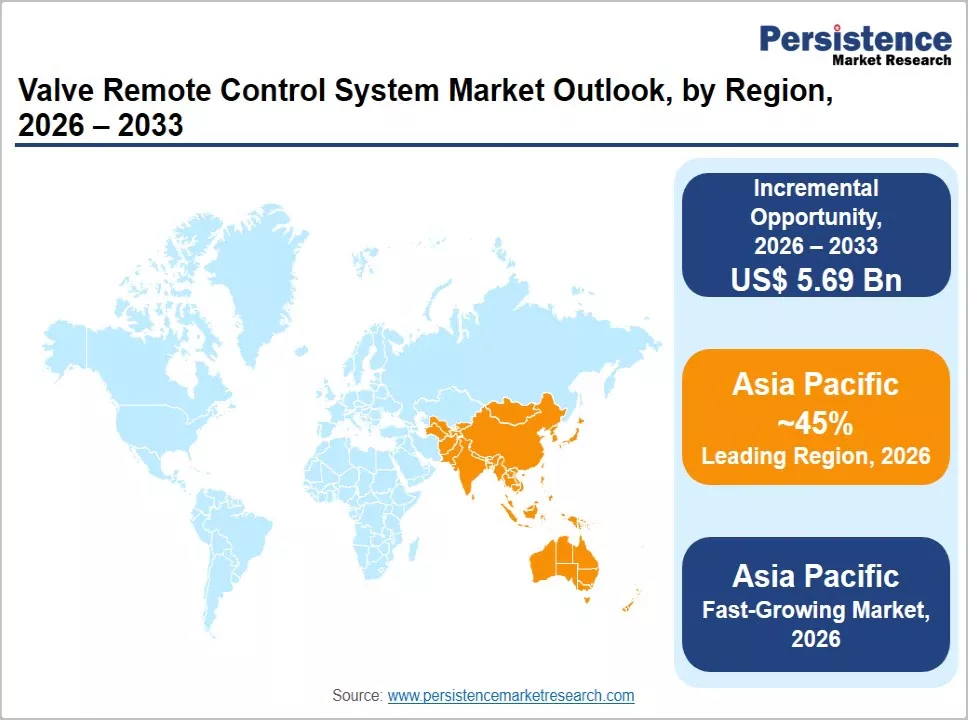
Asia Pacific is projected to dominate the global market by holding a 45.0% share in 2026. The region's dominance is supported by three concurrent structural factors: the world's highest concentration of commercial shipbuilding capacity, substantial refinery and petrochemical capacity additions across China and India, and government-led industrial automation programs in South Korea and Japan. China's 14th Five-Year Plan (2021–2025) explicitly targets manufacturing automation and process industry digitalization, supporting RCS procurement across refinery and chemical plant upgrade cycles.
China Valve Remote Control System Market Size
China is anticipated to dominate the Asia Pacific market, capturing around 40% of the regional market share in 2026. China's shipbuilding industry, which accounts for a substantial share of global new vessel orders, generates the largest single-country procurement demand for marine valve remote control systems. Continued expansion of SINOPEC and PetroChina refinery complexes along the eastern seaboard provides an additional industrial demand stream, supporting market growth beyond the current shipbuilding cycle.
Japan Valve Remote Control System Market Size
Japan is expected to hold nearly 33% of the Asia Pacific market share in 2026. Japanese shipyards, led by Imabari Shipbuilding and Japan Marine United, continue to produce high-value LNG carriers and car carriers, where advanced valve remote control system specifications are standard. Japan's Green Innovation Fund, administered by NEDO (New Energy and Industrial Technology Development Organization), is supporting investments in ammonia-fueled vessel development, creating demand for next-generation RCS architectures compatible with alternative fuel handling systems.
Competitive Landscape
The global valve remote control system market is moderately consolidated at the premium tier and fragmented across regional mid-market suppliers. Emerson, Wärtsilä, and Rotork collectively anchor the high-specification segment, competing on actuator performance certification, DCS integration capability, and global service network coverage. KSB SE & Co. KGaA, Scana Skarpenord AS, and Nordic Group Limited hold strong positions in marine RCS, where classification society type-approval and long-standing shipyard relationships create durable switching costs.
Victory in competitive tenders increasingly depends on protocol interoperability with vessel automation systems and lifecycle service contracts, rather than unit price alone. Pleiger Group and BESI Marine Systems GmbH compete effectively in European marine account through engineering customisation depth.
Key Industry Developments
- In July 2026, Emerson launched the TESCOM RC-X motorized injection rate control valve to improve chemical dosing accuracy and reduce operating costs for offshore refineries. The valve supported precise and repeatable chemical injection, helping operators minimize chemical waste, reduce downtime, and maintain flow assurance in demanding offshore environments. It operated at pressures up to 15,000 psi and supported flow rates ranging from 0.02 to 500 liters per hour. Its electric actuation eliminated the need for compressed air, while its compact design and fewer moving parts helped reduce equipment maintenance requirements and mechanical failure risks.
Companies Covered in Valve Remote Control System Market
- Emerson
- Wärtsilä
- Nordic Group Limited
- KSB SE & Co. KGaA
- Scana Skarpenord AS
- Sander Marine, Rotork
- BESI Marine Systems GmbH
- Hansun, Pleiger Group
- Selma
Frequently Asked Questions
The global valve remote control system market size is estimated at US$ 9.90 billion in 2026.
Mandatory remote valve actuation requirements under IMO SOLAS conventions for commercial vessels, and industrial automation investment by major process operators complying with IEC 61511 functional safety standards in oil, gas, and chemical facilities.
Marine applications hold the largest market share of 50% in 2026, owing to SOLAS and MARPOL maritime conventions that legally mandate remote valve actuation on commercial vessels above defined gross tonnage thresholds.
Asia Pacific is likely to dominate the market with around 45% share, supported by two structural advantages: the world's highest concentration of commercial shipbuilding capacity across China, South Korea, and Japan, and large-scale petrochemical and refinery capacity additions across the region.
The most significant opportunity lies in digitally integrated valve remote control systems compatible with IIoT plant architectures specifically solutions supporting HART and FOUNDATION Fieldbus protocols that connect into existing distributed control systems.
Some of the leading players in the market include Emerson, Wärtsilä, Rotork, KSB SE & Co. KGaA, Scana Skarpenord AS, and Nordic Group Limited.


