




- Automation & Robotics
- Oilfield Predictive Maintenance Market
Oilfield Predictive Maintenance Market Size, Share, and Growth Forecast, 2026 - 2033
Oilfield Predictive Maintenance Market by Component Type (Software, Services), Application (Onshore Drilling, Offshore Drilling), and Regional Analysis for 2026 - 2033

Oilfield Predictive Maintenance Market Size and Trends Analysis
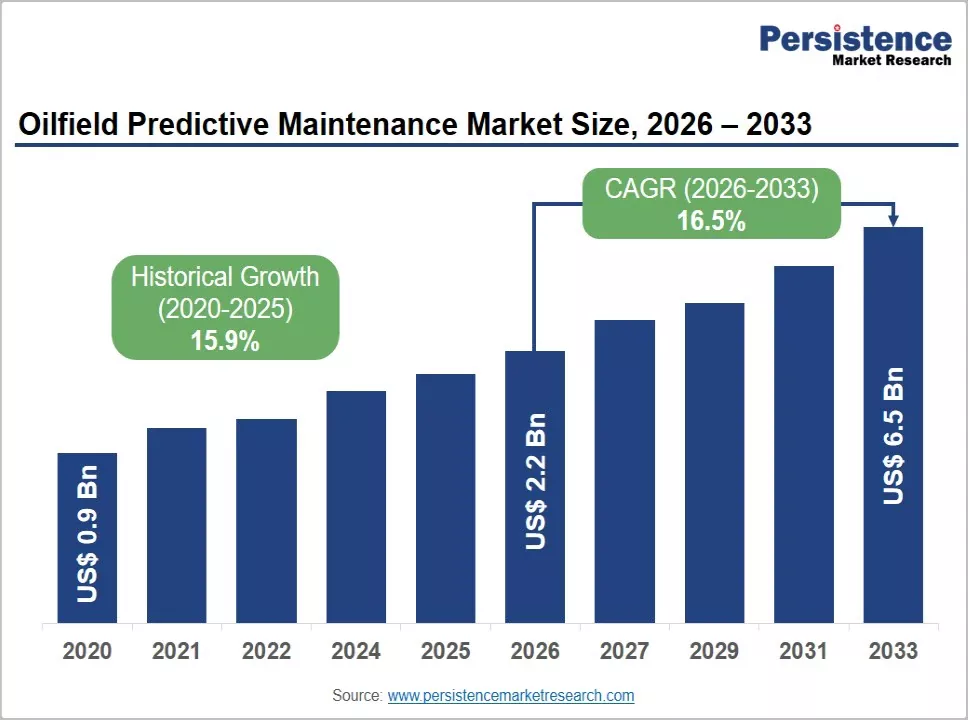
The global oilfield predictive maintenance market size is likely to be valued at US$ 2.2 billion in 2026 and is expected to reach US$ 6.5 billion by 2033, growing at a CAGR of 16.5% during the forecast period from 2026 to 2033.
Market growth is driven by the growing adoption of industrial analytics, artificial intelligence, and real-time equipment monitoring across drilling and production operations. Predictive maintenance solutions help oil and gas operators identify equipment degradation, reduce unexpected failures, and improve asset reliability across onshore and offshore environments.
Key Industry Highlights:
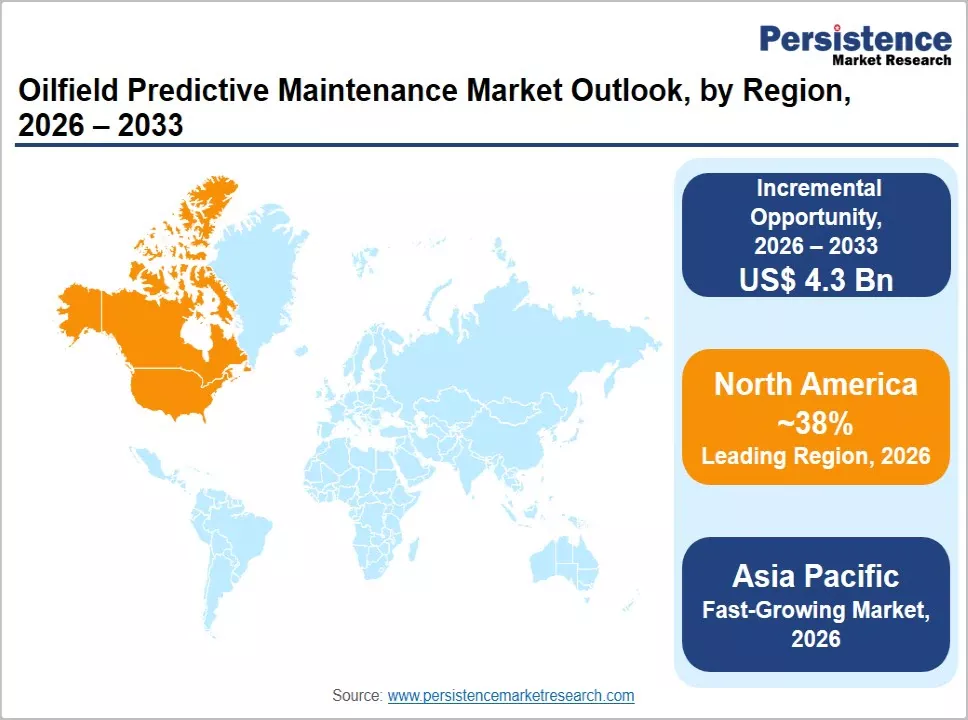
- Leading Region: North America is anticipated to be the leading region, accounting for a market share of 38% in 2026, driven by advanced digital infrastructure, extensive oilfield operations, and strong adoption of AI-based equipment monitoring.
- Fastest-growing Region: Asia Pacific is likely to be the fastest-growing region in the market, supported by expanding oil and gas exploration and increasing digital oilfield investments.
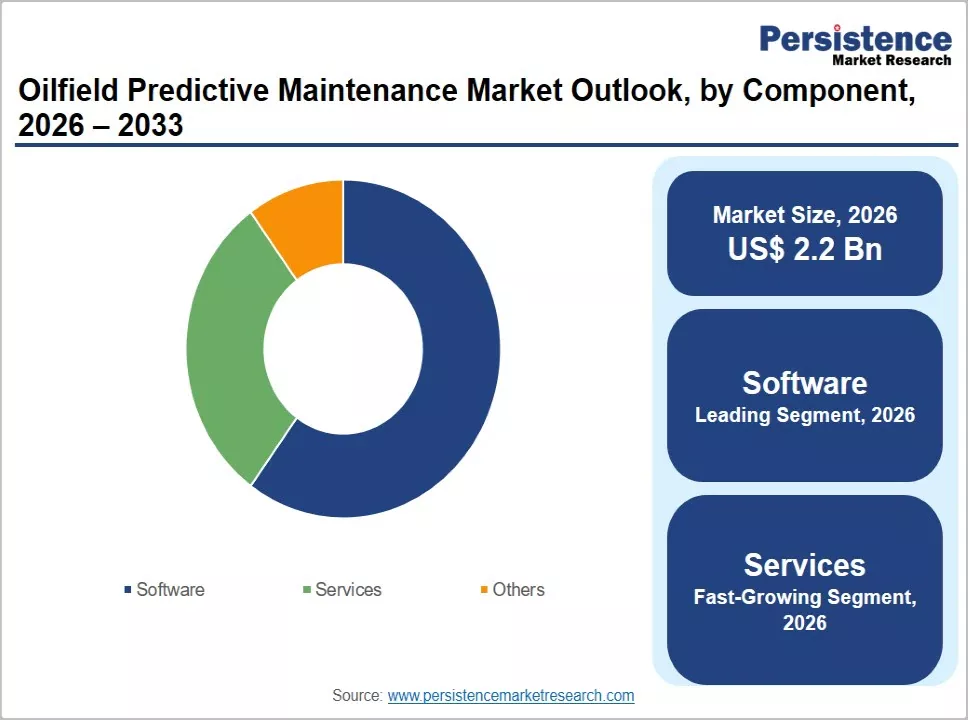
- Leading Component Type: Software represents the leading component type, accounting for 60% of the market share in 2026, driven by rising demand for predictive analytics, real-time monitoring, and automated equipment failure detection.
- Leading Application: Onshore drilling is anticipated to be the leading application, accounting for around 65% of the market share in 2026, supported by extensive well operations, accessible infrastructure, and widespread adoption of equipment monitoring.
- Key Opportunity: The key market opportunity lies in integrating AI-driven predictive analytics, digital twins edge computing, and remote monitoring to enable real-time equipment failure detection, reduce unplanned downtime, and optimize asset performance across onshore and offshore oilfield operations.
DRO Analysis
Driver - Need to Optimize Asset Performance and Reduce Operational Disruptions
Drilling rigs, pumps, compressors, turbines, and other critical equipment operate under demanding conditions that accelerate wear and increase failure risks. Unexpected breakdowns can interrupt production, delay drilling activities, and require costly emergency repairs. Predictive maintenance solutions use sensor data, equipment histories, and advanced analytics to identify abnormal operating conditions before failures occur.
By enabling condition-based maintenance planning, these technologies help operators improve equipment availability, allocate maintenance resources efficiently, and minimize operational disruptions across onshore and offshore oilfield environments. The growing complexity of oilfield operations strengthens demand for predictive maintenance software and services.
Operators increasingly require continuous equipment monitoring, early fault detection, and actionable maintenance recommendations to support informed operational decisions. Machine learning algorithms can identify performance deviations and help maintenance teams prioritize interventions according to equipment condition and failure risk. These capabilities are particularly valuable for organizations managing geographically dispersed assets and capital-intensive infrastructure.
Restraint - Data Quality, Integration, and Legacy System Challenges
Data quality and system integration challenges can restrict the adoption of predictive maintenance solutions across oilfield operations. Reliable predictions depend on accurate, consistent, and timely information from sensors, control systems, equipment logs, and maintenance records. However, missing readings, inconsistent formats, sensor calibration issues, and incomplete historical records can undermine analytical accuracy. False alerts or missed warnings may reduce operator confidence in predictive maintenance platforms.
Legacy infrastructure creates additional implementation difficulties for oil and gas operators seeking to deploy modern predictive maintenance technologies. Many facilities rely on older control systems and equipment that lack standardized connectivity or compatible data interfaces. Integrating these assets with cloud platforms, enterprise applications, and advanced analytics software can require customized engineering and substantial technical expertise.
Opportunity - Convergence of Digital Twins, Edge AI, and Remote Operations
Digital twins replicate physical equipment through continuously updated digital models, enabling operators to evaluate performance, identify developing faults, and assess maintenance scenarios. When combined with predictive analytics, these models can improve understanding of equipment degradation under different operating conditions.
Edge AI processes sensor information near the equipment, supporting faster detection of abnormal behavior without depending entirely on centralized cloud infrastructure. These capabilities are particularly valuable in remote oilfields, where connectivity limitations and delayed maintenance responses can increase operational risks and equipment downtime.
Remote operations centers provide another avenue for expanding predictive maintenance adoption across geographically dispersed oilfield assets. By combining real-time equipment data, digital twins, and edge-based analytics, operators can monitor performance, prioritize maintenance activities, and coordinate interventions without requiring constant on-site inspection.
Category-wise Analysis
Component Type Insights
Software is the leading component type segment, accounting for 60% of the market share in 2026, driven by the growing demand for predictive analytics, real-time equipment monitoring, and automated fault detection. These platforms analyze sensor readings, operating conditions, and historical maintenance records to identify potential equipment failures before they disrupt drilling and production activities. For example, C3.ai, Inc. provides enterprise AI applications for predictive maintenance and asset performance management.
Services represent the fastest-growing segment, supported by as oilfield operators require specialized expertise to implement, integrate, and maintain predictive maintenance systems. Service providers support data integration, analytics configuration, platform deployment, employee training, and continuous model optimization. These capabilities are important for operators managing legacy equipment, complex industrial networks, and changing operating conditions. For instance, IBM Corporation provides asset management and predictive maintenance capabilities through its enterprise software and industrial analytics solutions.
Application Insights
Onshore drilling is projected to lead the application category, capturing around 65% of the market share in 2026, supported by extensive well operations and widespread deployment of drilling and production equipment. Operators use predictive maintenance technologies to monitor pumps, compressors, drilling motors, and other critical assets, helping identify abnormal operating conditions before costly breakdowns occur. The accessibility of onshore facilities supports sensor installation, equipment inspection, and integration with existing monitoring systems.
Offshore drilling is likely to be the fastest-growing application due to as operators increasingly adopt predictive maintenance to manage complex equipment and reduce unplanned interruptions in demanding marine environments. Offshore platforms, floating production units, and subsea systems depend on reliable pumps, compressors, turbines, and critical control equipment. For example, General Electric Company, through GE Vernova, provides industrial technologies and digital monitoring capabilities relevant to offshore energy equipment.
Regional Insights
North America Oilfield Predictive Maintenance Market Trends
North America is anticipated to be the leading region, accounting for a market share of 38% in 2026, supported by extensive unconventional oil and gas production, established oilfield service networks, and widespread digital technology adoption. Operators increasingly use artificial intelligence, sensor-based monitoring, and predictive analytics to improve equipment reliability and minimize unplanned shutdowns. Baker Hughes provides industrial and digital technologies for asset performance management and equipment reliability across energy operations.
U.S. Oilfield Predictive Maintenance Market Trends
The U.S. is expected to dominate the regional market, accounting for around 80% of the market share in 2026. Operators across major basins increasingly use remote monitoring and equipment analytics to improve operational reliability. Artificial intelligence can help identify equipment abnormalities and optimize maintenance schedules. Demand is particularly relevant to operators managing distributed drilling and production assets. Integration with existing industrial systems remains important for scaling deployments.
Canada Oilfield Predictive Maintenance Market Trends
Canada is likely to be a significant market for oilfield predictive maintenance and holds around 20% of the North American market share in 2026. Canada’s oil and gas industry offers opportunities for predictive maintenance across oil sands facilities, conventional fields, and pipeline infrastructure. Remote operating locations increase the value of continuous equipment monitoring and early fault detection. Operators can use analytics to improve maintenance planning and reduce unnecessary site visits.
Europe Oilfield Predictive Maintenance Market Trends
Europe is likely to hold a significant share of the market in 2026, due to offshore oil and gas operations, mature engineering capabilities, and increasing emphasis on operational efficiency and asset integrity. Operators in the North Sea are potential adopters of predictive maintenance because offshore equipment failures can require costly interventions and disrupt production. Aging assets also create demand for improved reliability and maintenance planning.
U.K. Oilfield Predictive Maintenance Market Trends
The U.K. accounts for 15% of the European market share in 2026. Continued asset stewardship increases the relevance of condition monitoring and maintenance optimization. Remote diagnostics can help engineering teams prioritize offshore interventions. Predictive systems can also support emissions monitoring and equipment performance management.
Germany Oilfield Predictive Maintenance Market Trends
Germany is anticipated to hold around 37% share of the European market in 2026, due to industrial automation, engineering expertise, and sophisticated process-monitoring capabilities. Although domestic oil and gas production is relatively limited, gas infrastructure, processing facilities, and industrial energy systems support demand for equipment reliability technologies. Predictive analytics can help operators identify degradation, plan maintenance, and improve equipment availability.
Asia Pacific Oilfield Predictive Maintenance Market Trends
Asia Pacific is likely to be the fastest-growing region in the oilfield predictive maintenance market. Rising energy demand, mature oilfields, offshore development, and investments in industrial artificial intelligence are supporting adoption of predictive maintenance software and services. Operators increasingly deploy sensor networks, cloud analytics, automated diagnostics, and remote monitoring to improve equipment availability and production efficiency.
China Oilfield Predictive Maintenance Market Trends
China is projected to dominate the regional market, holding around 30% share of the market in 2026. The system supports intelligent diagnosis of abnormal operating conditions and faster identification of problematic wells. This development demonstrates growing domestic capabilities in data-driven oilfield operations. Predictive maintenance providers can benefit from demand for automated diagnostics and equipment monitoring. Integration with existing production systems remains important.
India Oilfield Predictive Maintenance Market Trends
India is expected to emerge as a significant market, as oil and gas companies strengthen digital infrastructure and improve operational efficiency across upstream assets. Its digital oilfield program incorporates real-time IoT data, AI, machine learning, and predictive maintenance to optimize well performance and support equipment reliability. These developments demonstrate a direct move toward data-driven maintenance practices.
Competitive Landscape
The global oilfield predictive maintenance market exhibits a moderately fragmented structure, driven by increasing adoption of artificial intelligence, industrial analytics, and asset performance management solutions across upstream oil and gas operations. Competition includes established technology providers, oilfield service companies, and specialized software developers offering equipment monitoring, failure prediction, and maintenance optimization capabilities.
With key leaders including TaylorMade Golf Company, Inc., and Wilson Sporting Goods Co., the market features competition across premium and entry-level product categories. These players compete through advanced materials, and strategic marketing. These players compete through technological innovation, strategic partnerships, platform integration, and expansion of AI-driven asset monitoring capabilities.
Key Industry Developments:
- In June 2026, Oil India Limited and Kellton successfully launched a large-scale digital wellhead monitoring system using Kellton’s Optima Digital Oilfield Platform.
Companies Covered in Oilfield Predictive Maintenance Market
- C3.ai, Inc.
- General Electric Company
- IBM Corporation
- MapR Technologies, Inc.
- Microsoft Corporation
- Nokia Corporation
- SAP SE
- Siemens AG
- Uptake Technologies, Inc.
Frequently Asked Questions
The oilfield predictive maintenance market is projected to reach US$ 2.2 billion in 2026.
The market is driven by the need to minimize equipment failures, reduce unplanned downtime, optimize asset performance, and improve operational efficiency.
The oilfield predictive maintenance market is expected to grow at a CAGR of 16.5% from 2026 to 2033.
Key opportunities include integrating digital twins, edge AI, and remote monitoring with predictive maintenance systems across onshore and offshore oilfields.
C3.ai, Inc., General Electric Company, IBM Corporation, MapR Technologies, and Microsoft Corporation are the leading players.


