




- Automotive Components & Materials
- Automotive Ignition Switch Market
Automotive Ignition Switch Market Size, Share, and Growth Forecast, 2026 - 2033
Automotive Ignition Switch Market by Product Type (Key Type, Button Type), Application (Passenger Vehicle, Commercial Vehicle), End-user (OEM, Aftermarket), and Regional Analysis for 2026 - 2033

Automotive Ignition Switch Market Size and Trends Analysis
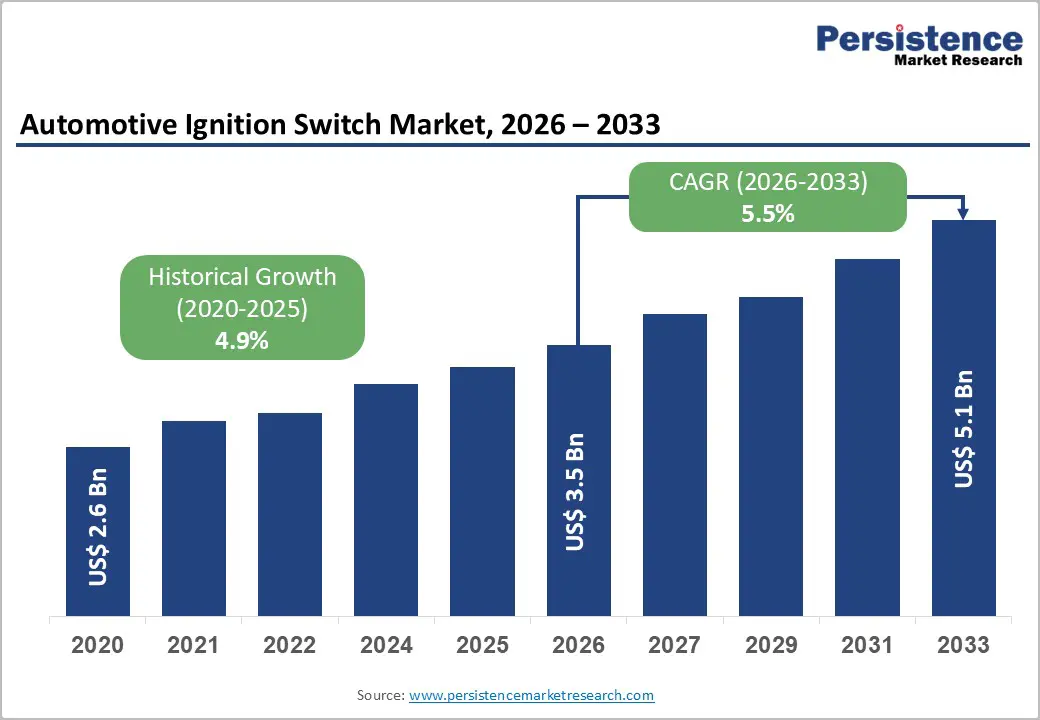
The global automotive ignition switch market size is likely to be valued at US$3.5 billion in 2026, and is expected to reach US$5.1 billion by 2033, growing at a CAGR of 5.5% during the forecast period from 2026 to 2033, driven by rising global vehicle production, increasing demand for convenient and secure starting systems, and the shift toward advanced electronic features in modern automobiles. Increasing preference for push-button ignition systems in passenger vehicles and steady aftermarket demand for replacements remain major drivers of the automotive ignition switch market growth.
Key Industry Highlights:
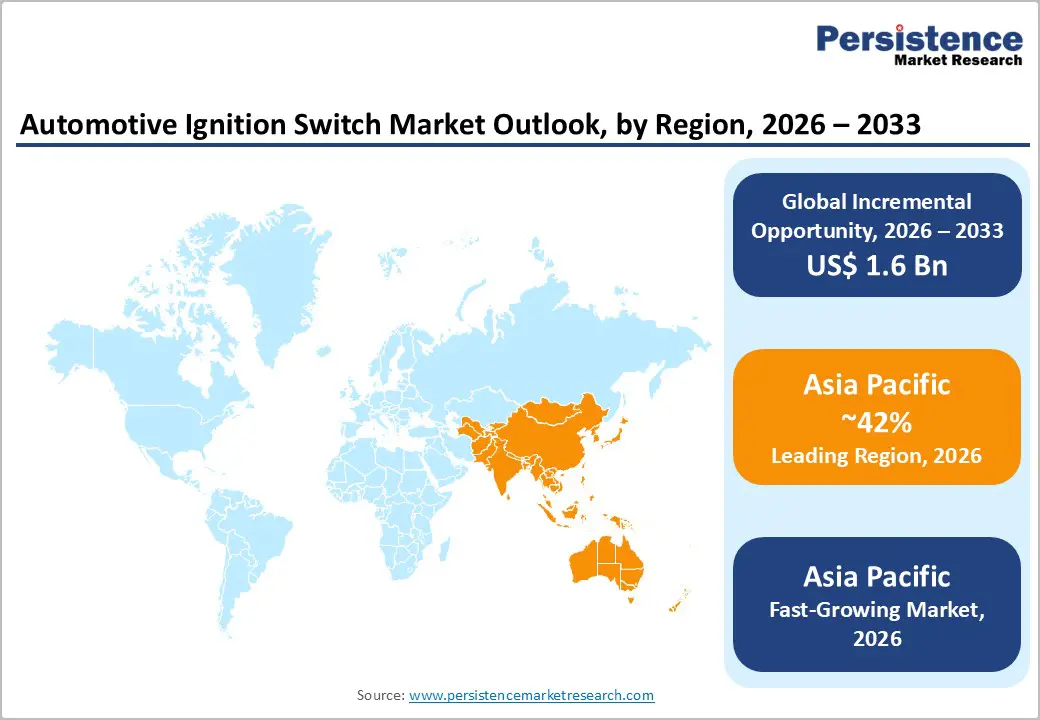
- Leading Region: Asia Pacific, anticipated to account for a 42% market share in 2026, driven by high vehicle production volumes in China and India.
- Fastest-growing Region: Asia Pacific, fueled by expanding automotive manufacturing and rising consumer demand for premium features.
- Dominant Product Type: Button type, to hold approximately 55% of the market share, as it offers superior convenience and modern appeal.
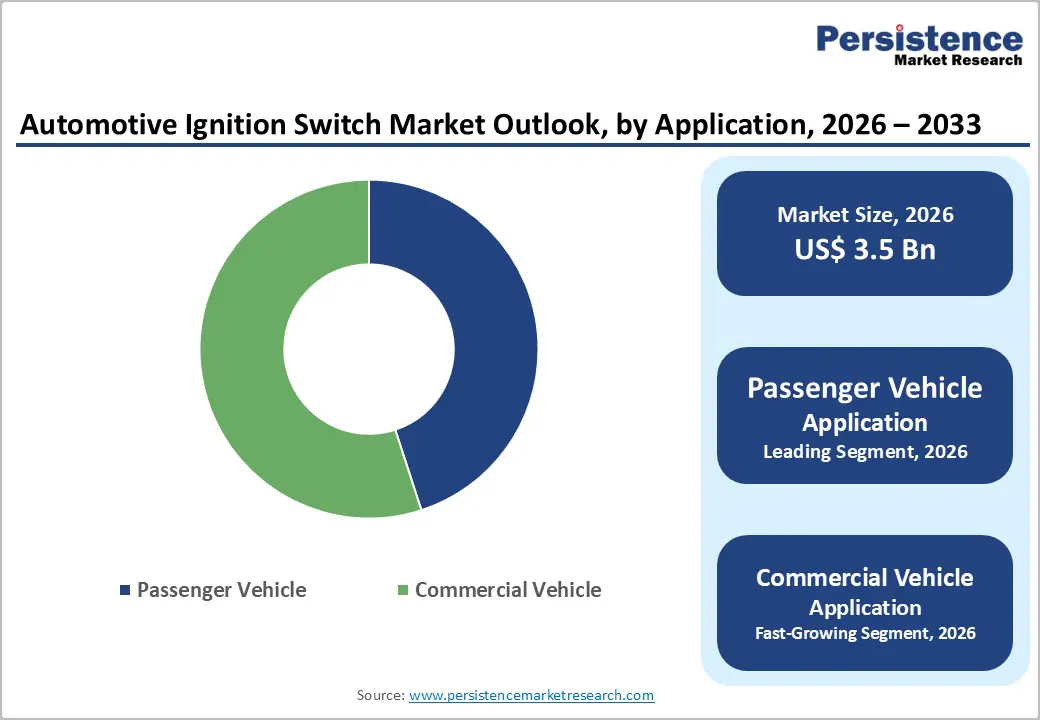
- Leading Application: Passenger vehicle, to dominate with 45% share in 2026, due to higher production and consumer preference for advanced ignition systems.
| Key Insights | Details |
|---|---|
|
Automotive Ignition Switch Market Size (2026E) |
US$3.5 Bn |
|
Market Value Forecast (2033F) |
US$5.1 Bn |
|
Projected Growth CAGR (2026-2033) |
5.5% |
|
Historical Market Growth (2020-2025) |
4.9% |
DRO Analysis
Driver Analysis - Rising Vehicle Production
The increasing global production of vehicles is significantly influencing the demand for automotive ignition switches. As the automotive industry continues to expand, particularly in emerging economies such as India, China, and Southeast Asia, more passenger cars, commercial vehicles, and two-wheelers are being manufactured each year. Every newly produced vehicle requires an ignition system, whether mechanical or electronic, making ignition switches an essential component of the production process.
In addition to the quantity of vehicles being produced, there is a growing emphasis on quality, safety, and technological integration. Modern vehicles are no longer simple mechanical systems; they incorporate electronic controls, security features, and connected technologies that rely on reliable ignition systems. This drives automakers to adopt advanced ignition solutions, such as keyless entry and push-button start systems, to meet consumer expectations. Production expansion is often accompanied by the growth of supporting supply chains, which increases the volume of components like ignition switches being manufactured and distributed.
Focus on Vehicle Security
With the growing sophistication of vehicle theft and unauthorized access, ensuring the security of automobiles has become a critical concern for manufacturers and consumers alike. Modern vehicles increasingly incorporate advanced electronic systems, and ignition switches play a central role in protecting these assets. By integrating anti-theft mechanisms and immobilizers directly into ignition systems, manufacturers can prevent unauthorized engine starts, safeguarding both the vehicle and the personal belongings inside.
Consumers today prioritize security features when purchasing vehicles, which drives demand for ignition systems that offer enhanced protection. Traditional mechanical keys are gradually being replaced by electronic key fobs, smart keys, and push-button start systems, all of which include encrypted communication to prevent tampering or hacking. These innovations not only improve security but also contribute to user convenience, creating a dual advantage for automakers and suppliers of ignition components.
Restraint Analysis - High Competition and Price Pressure
The automotive ignition switch market faces significant challenges due to intense competition among manufacturers and suppliers. Numerous players, ranging from established OEM component suppliers to smaller specialized firms, compete to secure contracts with automakers, leading to aggressive pricing strategies. This competition often forces companies to lower prices to maintain or grow their market share, which can put pressure on profit margins and limit opportunities for large-scale investments in research and development.
Price-sensitive customers, particularly in emerging markets, prioritize affordability alongside quality, further amplifying the pressure on suppliers to offer cost-effective solutions. Companies are therefore compelled to balance product innovation with cost efficiency, ensuring that advanced ignition systems, such as electronic or keyless solutions, remain competitively priced without compromising reliability or safety.
Technological Obsolescence
Rapid advancements in automotive technology have created a risk of certain components becoming outdated, and ignition switches are no exception. Traditional mechanical ignition systems are gradually being replaced by electronic and keyless alternatives, such as push-button start and mobile-controlled ignition. As automakers adopt these advanced systems, demand for older mechanical switches declines, limiting growth opportunities for manufacturers who have not modernized their product lines.
This shift also creates a challenge for suppliers to continuously invest in research and development to keep pace with evolving vehicle designs and consumer expectations. Failure to innovate can result in a loss of market relevance and decreased competitiveness. The pace of technological change in connected and smart vehicles means that components must integrate seamlessly with complex electronic architectures.
Opportunity Analysis - Growth of Keyless and Electronic Ignition Systems
The shift toward keyless and electronic ignition systems presents a significant opportunity for the automotive ignition switch market. Traditional mechanical keys are increasingly being replaced by advanced technologies such as push-button start, smart keys, and electronic fobs. These systems offer enhanced convenience, allowing drivers to start and stop their vehicles without physically inserting a key, which improves user experience and aligns with modern consumer expectations.
Automakers are adopting these technologies not only to meet customer demand but also to enhance vehicle security. Electronic ignition systems can incorporate encryption, authentication protocols, and integration with immobilizers, making it more difficult for unauthorized users to start the vehicle. This dual benefit of convenience and security makes electronic ignition systems highly attractive for both new vehicles and premium segments. The proliferation of connected and smart vehicles further increases the scope for electronic ignition systems. These systems can integrate with mobile apps, telematics, and fleet management platforms, offering remote start, monitoring, and control capabilities.
Integration with Connected and Smart Vehicles
The increasing adoption of connected and smart vehicle technologies offers a substantial opportunity for the automotive ignition switch market. Modern vehicles are becoming more sophisticated, incorporating advanced electronics, telematics, and IoT-enabled systems that allow for remote monitoring, diagnostics, and control. Ignition switches now play a critical role in these ecosystems, serving as the gateway for vehicle activation and integration with broader digital functionalities.
Electronic and keyless ignition systems can be linked to mobile applications, enabling features such as remote start, vehicle tracking, and personalized driver settings. This integration enhances convenience for users while also supporting fleet management and security functions. For example, fleet operators can remotely control vehicle access, monitor usage patterns, and prevent unauthorized operation through connected ignition systems. As automakers move toward autonomous and semi-autonomous vehicles, ignition systems must seamlessly interact with multiple electronic subsystems, including braking, navigation, and safety controls.
Category-wise Analysis
Product Type Insights
Button type is anticipated to dominate and the fastest growing segment, accounting 55% share in 2026, due to their ease of use and contemporary design. Unlike traditional key-based systems, they allow drivers to start and stop the engine with a simple push, enhancing convenience and reducing physical effort. Their sleek appearance also complements the interior aesthetics of new cars, making them popular among automakers and consumers alike. Button-type systems can be easily integrated with electronic security features, such as smart keys and immobilizers, providing enhanced protection against unauthorized use. The Toyota Venza, a mid-size crossover SUV from Toyota Motor Corporation, comes equipped with a push-button start ignition system as part of its Smart Key feature, allowing drivers to start and stop the engine by pressing a button rather than using a traditional key.
Application Insights
Passenger vehicles are projected to dominate, with 45% share in 2026, fueled by their high production volumes and widespread use worldwide. Each passenger vehicle requires a reliable ignition system, whether mechanical or electronic, making this segment a primary contributor to overall demand. Increasing consumer preference for advanced features such as keyless entry and push-button start in cars further boosts the adoption of modern ignition systems. The Hyundai Venue, a widely popular passenger car from Hyundai Motor Company, features a push-button start keyless ignition system in most of its trims. This system allows drivers to start the engine simply by pressing a button instead of using a traditional key, highlighting the growing adoption of modern ignition technologies in mainstream passenger vehicles.
Commercial vehicles are likely to be the fastest-growing segment, propelled by their essential role in transportation, logistics, and industrial operations. Trucks, buses, and vans require reliable ignition systems to ensure consistent performance and minimize downtime, as any failure can disrupt operations and incur high costs. Many commercial vehicles are now equipped with advanced electronic ignition systems, including keyless and push-button start options, to enhance security and ease of use for drivers. Mitsubishi Fuso Super Great, a heavy-duty truck model equipped with a multi-function key that includes a push start/stop button, allowing the engine to be started and stopped electronically without inserting a traditional key.
Regional Insights
North America Automotive Ignition Switch Market Trends
The North America market is experiencing a shift driven by technological innovation and evolving consumer preferences. Vehicles in the region are increasingly equipped with advanced ignition systems, including keyless entry, push-button start, and electronic fobs, reflecting the demand for convenience, security, and modern design. Automakers in the United States and Canada are focusing on integrating these systems with broader vehicle electronics, such as anti-theft features, immobilizers, and connected car technologies, to enhance both safety and user experience.
Consumer expectations in North America also emphasize seamless interaction between vehicles and digital devices. Ignition systems that integrate with mobile apps or telematics platforms allow remote vehicle access, monitoring, and personalized settings, which appeals to both private car owners and commercial fleets. The trend toward connected and semi-autonomous vehicles further drives the need for ignition solutions capable of interacting with complex electronic architectures.
Europe Automotive Ignition Switch Market Trends
The Europe market is evolving alongside broader trends in vehicle technology, safety, and sustainability. In many European countries, consumers expect modern features such as keyless entry, push-button start, and advanced electronic systems even in mainstream vehicles. These technologies enhance convenience and are frequently paired with enhanced anti-theft measures, such as encrypted communication between key fobs and onboard systems, to meet stringent safety expectations.
Europe’s strong emphasis on vehicle safety and emissions standards also influences ignition system design. Automakers are increasingly integrating ignition switches with other electronic subsystems, including immobilizers and vehicle access controls, to prevent unauthorized use and reduce theft. The rise of connected vehicles in Europe, with greater use of telematics and digital interfaces, encourages ignition systems that can interface smoothly with infotainment and remote access platforms. This integration supports features like remote start, vehicle health monitoring, and driver customization, which align with consumer demand for smarter mobility.
Asia Pacific Automotive Ignition Switch Market Trends
Asia Pacific is projected to dominate and be the fastest growing, capturing 42% revenue in 2026, powered by rapid growth in vehicle production, particularly in countries like China, India, and Southeast Asian nations. As more consumers in these regions enter the middle class, demand for personal vehicles is increasing, which in turn drives the need for reliable and modern ignition systems. Beyond basic functionality, buyers are showing growing interest in features that enhance comfort and usability, such as keyless entry and push-button start, even in affordable vehicle segments.
Automakers operating in the region are responding by offering a wider range of ignition system options to meet diverse customer expectations. In addition to passenger cars, the booming two-wheeler and commercial vehicle segments are also adopting electronic and keyless ignition technologies to improve convenience, security, and integration with digital vehicle features. This trend is supported by the increasing availability of connected vehicle technologies, where ignition systems interact with mobile apps and telematics platforms for remote access, vehicle tracking, and personalized driver settings.
Competitive Landscape
The global automotive ignition switch market is highly competitive, driven by the presence of both established Tier-1 suppliers and specialized component manufacturers. These companies are continually investing in research and development to innovate and offer advanced ignition solutions, such as electronic keyless systems, push-button start, and smart ignition technologies. Product reliability is a critical differentiator, as ignition switches are essential for vehicle safety and functionality, prompting suppliers to ensure high-quality standards and durability.
Strategic partnerships with original equipment manufacturers (OEMs) are another key factor in maintaining competitiveness. Companies collaborate closely with automakers to integrate ignition systems seamlessly into vehicle designs, meeting both functional and aesthetic requirements. Technological advancements, such as integration with connected car platforms, immobilizers, and fleet management systems, also allow suppliers to differentiate themselves in the market.
Key Industry Developments:
- In March 2025, Bosch announced a strategic partnership with Aptiv to co-develop next-generation ignition switch solutions and vehicle electrical-architecture technologies, focusing on enhanced integration and performance.
- In June 2024, Valeo launched a secure ignition switch module featuring encrypted start authorization for premium vehicles, aimed at improving vehicle security and mitigating unauthorized access.
Companies Covered in Automotive Ignition Switch Market
- Alps Alpine Co. Ltd
- Valeo SA
- Robert Bosch GmbH
- Continental AG
- ZF Friedrichshafen AG
- Tokai Rika Co. Ltd
- Johnson Electric Holdings Limited
- HELLA GmbH & Co. KGaA
- Marquardt GmbH
- UNO Minda Limited
- Preh GmbH
- C&K Switches
Frequently Asked Questions
The global automotive ignition switch market is projected to reach US$3.5 billion in 2026.
The automotive ignition switch market is primarily driven by increasing global vehicle production and growing consumer preference for user-friendly push-button ignition systems.
The automotive ignition switch market is poised to witness a CAGR of 5.5% from 2026 to 2033.
Key opportunities in the automotive ignition switch market include the development of smart and connected ignition solutions, expansion of the aftermarket segment, and penetration into high-growth emerging markets.
Key players in the automotive ignition switch market include Robert Bosch GmbH, Valeo SA, Continental AG, ZF Friedrichshafen AG, and HELLA GmbH & Co KGaA.


