




- Automotive Components & Materials
- Automotive Cam Chains Market
Automotive Cam Chains Market Size, Share, and Growth Forecast, 2026 - 2033
Automotive Cam Chains Market by Product Type (Roller Chain, Silent Chain), Application (Passenger Vehicle, Light Commercial Vehicle (LCV), Heavy Commercial Vehicle (HCV)), Engine (Petrol, Diesel), and Regional Analysis for 2026 - 2033

Automotive Cam Chains Market Size and Trends Analysis
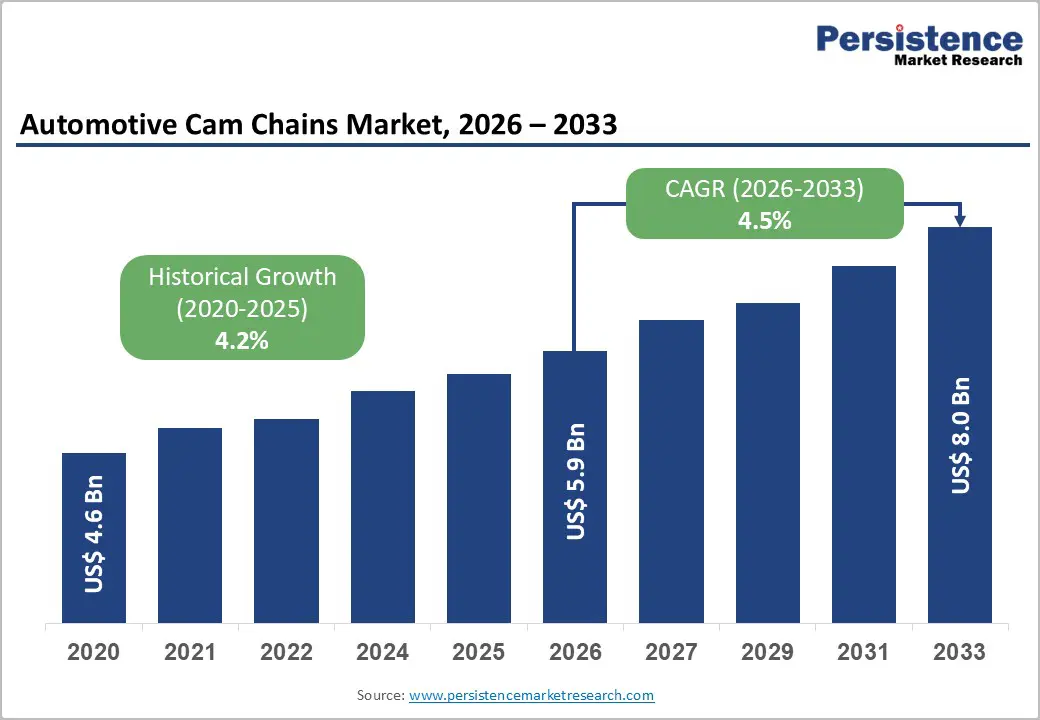
The global automotive cam chains market size is likely to be valued at US$5.9 billion in 2026 and is expected to reach US$8.0 billion by 2033, growing at a CAGR of 4.5% during the forecast period from 2026 to 2033, driven by the continued relevance of internal combustion engines and hybrid powertrains in the automotive landscape. Demand is primarily driven by the need for precise engine timing, durability, and low-maintenance components, making cam chains a preferred solution over timing belts in many modern engines. Expanding vehicle production in emerging economies, along with the sustained use of petrol and diesel engines across passenger and commercial vehicle segments, continues to underpin market stability.
Stricter emission regulations and fuel efficiency standards are encouraging the adoption of advanced cam chain systems that reduce friction, enhance performance, and support optimized combustion processes. The market also benefits from a strong aftermarket segment, as aging vehicle fleets require periodic replacement of timing components to maintain engine reliability. Technological advancements such as the development of lightweight materials, improved wear resistance, and noise reduction features are enhancing product performance and lifecycle.
Key Industry Highlights:
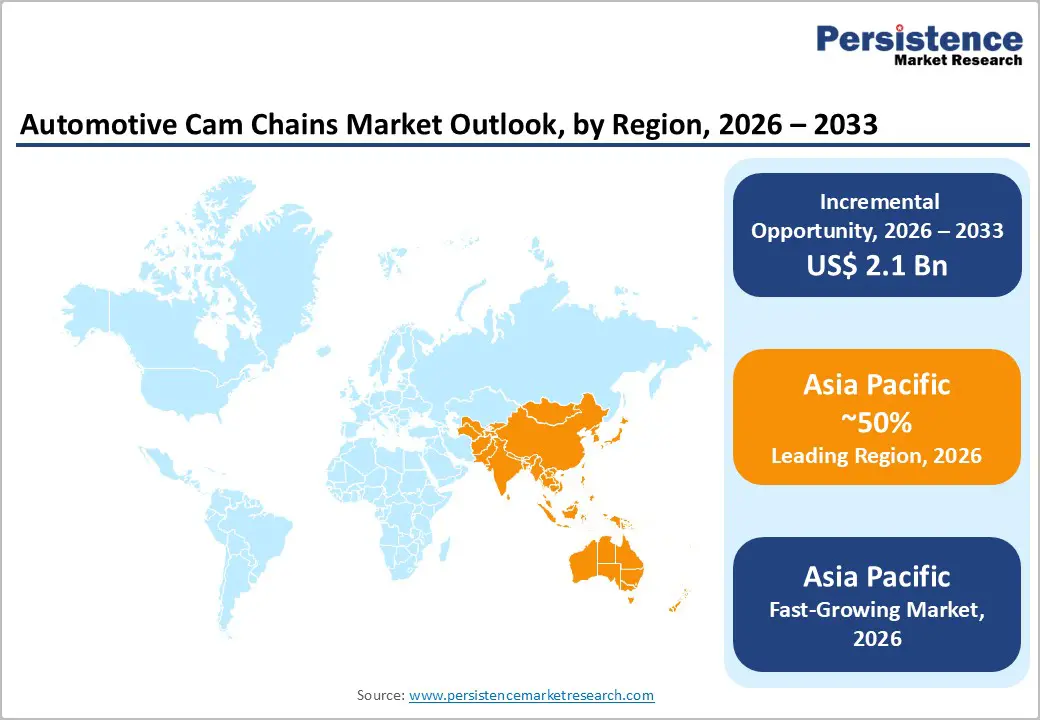
- Leading Region: Asia Pacific is anticipated to be the leading region, accounting for a market share of 50% in 2026, driven by strong automotive manufacturing hubs, high vehicle production, and robust supply chain networks across China, India, and ASEAN.
- Fastest-growing Region: Asia Pacific is likely to be the fastest-growing region, supported by rising domestic demand, expanding hybrid vehicle adoption, and increasing investments in cost-efficient production capabilities.
- Leading Product Type: Roller chains are projected to represent the leading product type in 2026, accounting for 65% of the revenue share, driven by their durability and widespread use in commercial and high-load engine applications.
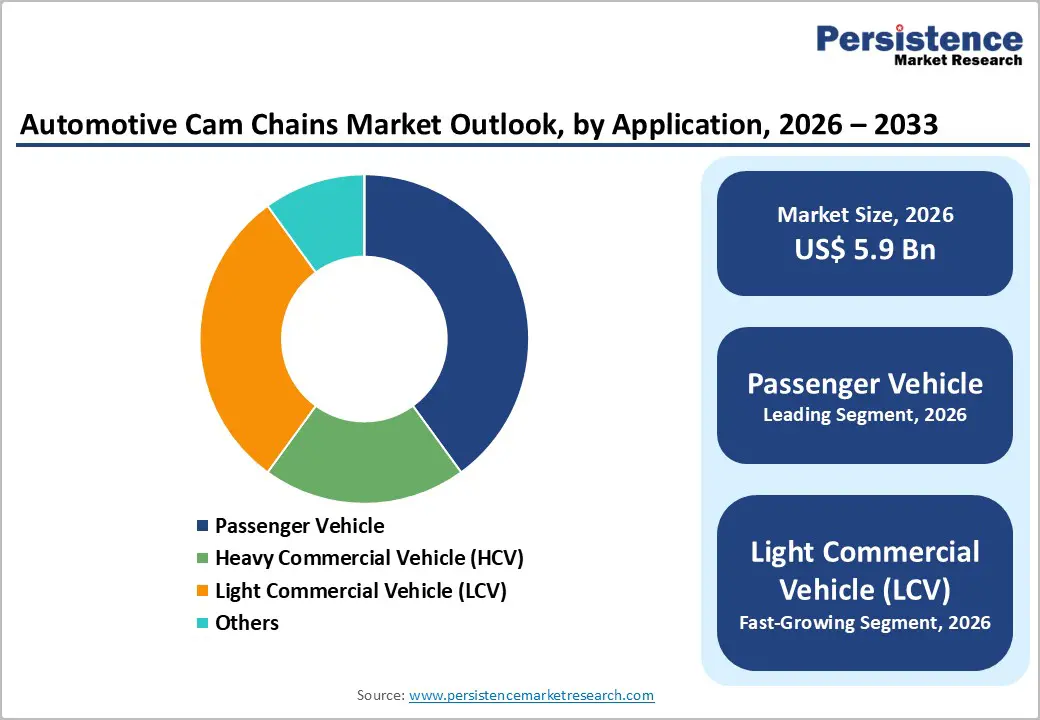
- Leading Application: Passenger vehicles are anticipated to be the leading application, accounting for over 60% of the revenue share in 2026, supported by high production volumes and extensive usage across gasoline and hybrid engines.
| Key Insights | Details |
|---|---|
|
Automotive Cam Chains Market Size (2026E) |
US$5.9 Bn |
|
Market Value Forecast (2033F) |
US$8.0 Bn |
|
Projected Growth (CAGR 2026 to 2033) |
4.5% |
|
Historical Market Growth (CAGR 2020 to 2025) |
4.2% |
Market Factors - Driver, Restraint, and Opportunity Analysis
Driver Analysis - Rising Vehicle Production and Urbanization
Expanding urban populations and improving income levels across emerging economies are accelerating vehicle ownership, directly strengthening demand for automotive cam chains. As cities grow, the need for personal mobility and commercial transportation rises, increasing production of passenger and light commercial vehicles. Cam chains remain essential in ensuring accurate engine timing and long-term durability, making them a preferred choice for manufacturers aiming to balance performance and maintenance efficiency. This sustained increase in vehicle output creates a stable demand base for timing components across multiple engine platforms.
Infrastructure development and industrial expansion are boosting logistics and freight movement, driving the production of commercial vehicles that rely on robust engine systems. Cam chains, known for their strength and reliability in high-load conditions, benefit from this trend as fleet operators prioritize long service life and reduced downtime. The growing penetration of hybrid vehicles, particularly in urban environments, also supports demand since these systems continue to utilize internal combustion engines alongside electric powertrains, reinforcing the relevance of cam chains.
Stringent Emission Regulations and Engine Efficiency Mandates
Tightening emission norms are compelling automakers to enhance engine efficiency and reduce environmental impact, which is positively influencing the adoption of advanced cam chain systems. Regulatory frameworks encourage precise engine timing to optimize fuel combustion and minimize emissions, positioning cam chains as a reliable solution due to their durability and consistent performance. Compared to alternative systems, cam chains offer improved synchronization over longer lifespans, aligning well with regulatory expectations for reduced maintenance and sustained efficiency.
Manufacturers are investing in innovative materials and low-friction coatings to improve chain performance and meet evolving standards. These advancements contribute to quieter operation, reduced energy loss, and improved fuel economy, all of which are critical under modern emission requirements. The integration of cam chains into downsized and turbocharged engines supports compliance goals, as these engines demand high precision and durability, reinforcing the importance of advanced timing systems in regulatory-driven automotive design.
Restraint Analysis - Transition to Electric Vehicles
The accelerating shift toward electric vehicles presents a structural challenge to the automotive cam chains market, as fully electric powertrains eliminate the need for traditional engine timing components. Governments and manufacturers worldwide are increasingly prioritizing electrification to reduce carbon emissions, leading to a gradual decline in internal combustion engine production. This transition directly impacts demand for cam chains, particularly in regions aggressively promoting zero-emission mobility solutions and investing heavily in EV infrastructure.
The transition is gradual, with hybrid vehicles acting as an intermediate solution that still requires cam chain systems. While EV adoption grows, the existing fleet of internal combustion engine vehicles remains substantial, sustaining aftermarket demand for replacement components. In developing regions where EV adoption is slower due to infrastructure and cost barriers, cam chains will continue to see steady demand, partially offsetting the long-term impact of electrification.
Intensifying Competition from Alternative Timing Technologies
The automotive cam chains market faces increasing competition from alternative timing technologies such as timing belts and gear-driven systems, which offer advantages in cost, weight, and noise reduction. Timing belts, in particular, are gaining traction in certain vehicle segments due to their lower initial cost and quieter operation, making them appealing for compact and economy vehicles. This competitive pressure challenges cam chain manufacturers to continuously innovate and justify their value proposition in terms of durability and long-term performance.
Advancements in belt materials and engineering are narrowing the durability gap between belts and chains, intensifying competition. Automakers are evaluating these alternatives based on specific engine requirements, cost constraints, and performance goals. Cam chain manufacturers must focus on enhancing efficiency, reducing noise, and optimizing design to remain competitive, especially in price-sensitive markets where cost considerations significantly influence component selection.
Opportunity Analysis - Technological Convergence with Smart Sensors and Predictive Maintenance
The integration of smart technologies into automotive systems is creating new opportunities for cam chain applications, particularly through predictive maintenance and real-time performance monitoring. Advanced sensors can track wear, tension, and operational efficiency, allowing early detection of potential issues and reducing the risk of engine failure. This convergence enhances the value proposition of cam chains by extending their lifecycle and improving overall engine reliability, which is increasingly important in modern connected vehicles.
The rise of digital diagnostics and vehicle telematics supports proactive maintenance strategies, enabling fleet operators and individual users to optimize service schedules. This helps lower maintenance costs and keeps the vehicle running efficiently for longer periods. As automotive systems become more intelligent and data-driven, cam chain manufacturers have the opportunity to integrate their products into broader smart ecosystems, differentiating themselves through innovation and added functionality.
Aftermarket Growth from Aging Vehicle Fleets
The growing population of aging vehicles is significantly boosting demand in the automotive cam chains aftermarket segment. As vehicles accumulate mileage, timing components experience wear and require replacement to maintain engine performance and prevent failures. Cam chains, despite their durability, are not immune to long-term wear, creating consistent demand for replacement parts. This trend is particularly strong in regions where vehicle ownership cycles are longer, and consumers prioritize maintenance over new vehicle purchases.
The expansion of independent repair networks and the increased availability of aftermarket components are making replacements more accessible and cost-effective. Fleet operators and individual vehicle owners alike are investing in maintenance to extend vehicle lifespan, especially in cost-sensitive markets. This sustained aftermarket demand provides a stable revenue stream for manufacturers, offsetting fluctuations in new vehicle production and supporting overall market resilience.
Category-wise Analysis
Product Type Insights
Roller chains are expected to lead the automotive cam chains market, accounting for approximately 65% of revenue in 2026, driven by their superior strength, durability, and ability to withstand high-load conditions in demanding engine environments. These chains are widely used in heavy commercial vehicles and light commercial vehicles, where engine performance, longevity, and resistance to wear are critical. For example, heavy-duty truck engines widely utilize roller cam chains to maintain timing accuracy under continuous high torque operations, reinforcing their importance in high-performance and commercial automotive applications.
Silent chain is likely to represent the fastest-growing segment, supported by increasing demand for reduced noise, vibration, and harshness in modern vehicles, particularly in passenger cars and hybrid models. Its design, which uses interlinked flat plates instead of rollers, allows smoother engagement with sprockets, resulting in quieter engine operation and improved efficiency. For example, many modern passenger vehicles equipped with advanced gasoline engines are shifting toward silent cam chain systems to enhance driving comfort and meet evolving performance standards.
Application Insights
Passenger vehicles are projected to lead the market, capturing around 60% of the revenue share in 2026, supported by the large-scale production of cars and the widespread use of cam chains in gasoline and hybrid engines. The increasing demand for personal mobility, coupled with rising disposable incomes and urbanization, continues to drive passenger vehicle sales, thereby increasing the demand for reliable engine components such as cam chains. For example, mid-size and compact passenger cars commonly integrate cam chain systems to provide long-lasting performance with minimal maintenance, reinforcing the segment’s dominance in the market.
Light commercial vehicle (LCV) is likely to be the fastest-growing application, driven by the rapid expansion of e-commerce, logistics, and last-mile delivery services across urban and semi-urban regions. These vehicles are increasingly used for goods transportation, requiring reliable and durable engine components capable of handling frequent start-stop operations and varying load conditions. For example, delivery vans and small cargo vehicles widely use cam chain-driven engines to ensure consistent performance and reduced downtime, supporting the rapid growth of this application segment.
Regional Insights
North America Automotive Cam Chains Market Trends
North America is likely to be a significant market for automotive cam chains in 2026, driven by the continued presence of internal combustion and hybrid vehicles across the U.S. and Canada. Consumers in this region prioritize vehicle performance, durability, and low maintenance, which supports the adoption of cam chains over alternative timing systems. Technological advancements focusing on reducing friction, improving wear resistance, and enhancing noise reduction are shaping product development trends in the region. The presence of established automotive OEMs and a well-developed supply chain ecosystem supports consistent demand for high-quality components.
Another key trend in North America is the strong aftermarket demand driven by an aging vehicle fleet and high average vehicle ownership duration. As vehicles remain in use for longer periods, the need for reliable replacement components such as cam chains continues to grow. This creates opportunities for manufacturers to expand their aftermarket presence and offer durable, performance-oriented solutions. For example, BorgWarner Inc. continues to invest in advanced timing system technologies, including high-efficiency cam chain solutions, to support modern engine requirements and strengthen its position in the North America market.
Europe Automotive Cam Chains Market Trends
Europe is likely to be a significant market for automotive cam chains in 2026, due to strong regulatory frameworks, advanced automotive engineering, and a high focus on fuel efficiency and emission reduction. Stringent emission norms such as Euro standards are pushing automakers to adopt precise and durable engine timing systems, where cam chains play a critical role. The region’s preference for high-performance and premium vehicles supports demand for silent and low-friction cam chain systems that enhance engine efficiency and reduce noise. The presence of leading automotive manufacturers and a well-established component supply chain drives continuous innovation in materials and design.
Consumers in the region tend to maintain vehicles for extended periods, increasing the need for high-quality replacement components. Manufacturers are focusing on developing lightweight, wear-resistant, and energy-efficient cam chain systems to align with environmental and performance standards. In addition, technological advancements aimed at reducing noise and improving engine refinement are gaining traction. For example, Schaeffler Group is actively developing advanced timing chain solutions with enhanced efficiency and durability, supporting European automakers in meeting stringent regulatory requirements while maintaining high engine performance standards.
Asia Pacific Automotive Cam Chains Market Trends
Asia Pacific is anticipated to be the leading region, accounting for a market share of 50% in 2026, driven by strong vehicle production, expanding automotive manufacturing hubs, and rising demand for cost-effective yet durable engine components. Countries such as China, India, and South Korea play a central role due to their large-scale vehicle output and growing domestic consumption. Increasing urbanization and rising disposable incomes are boosting passenger vehicle demand, while industrial growth supports commercial vehicle expansion. Cam chains are widely preferred in this region for their durability and low maintenance, especially in high-usage conditions. The presence of well-established supplier networks and cost-efficient manufacturing capabilities enables large-scale production and exports.
The rapid growth of hybrid vehicles and the expanding automotive aftermarket both support sustained demand for cam chains. As hybrid adoption increases, the need for reliable timing systems remains essential due to the continued use of internal combustion engines. The region also has a large base of aging vehicles, particularly in developing economies, driving replacement demand for timing components. For example, Tsubakimoto Chain Co. is strengthening its presence by developing high-performance automotive timing chain systems and expanding production capabilities to meet both domestic and demand.
Competitive Landscape
The global automotive cam chains market exhibits a moderately fragmented structure, driven by the presence of multiple regional manufacturers competing across OEM and aftermarket segments. The market is shaped by strong demand for durable and high-performance engine timing components, encouraging continuous innovation in materials, design, and manufacturing processes. Companies are focusing on improving chain efficiency, reducing friction, and enhancing noise performance to meet evolving automotive standards.
With key leaders including BorgWarner Inc., Schaeffler Group, Tsubakimoto Chain Co., Daido Kogyo Co., Ltd., and Iwis Motorsysteme GmbH & Co. KG, the competitive environment reflects a mix of established players with strong engineering capabilities and regional suppliers offering cost advantages. These players compete through product innovation, strategic partnerships with automotive OEMs, and expansion of production capacities across key regions. Emphasis is placed on developing lightweight, wear-resistant, and low-noise cam chain systems to align with stringent emission norms and performance expectations.
Key Industry Developments:
- In January 2025, BorgWarner Inc. introduced a new low-friction engine timing chain designed to improve fuel efficiency and reduce energy loss in modern engines, supporting several major automakers with advanced, high-performance timing solutions.
- In November 2025, APEC Automotive launched a new range of timing chain covers, expanding its engine component portfolio to enhance durability and performance in automotive timing systems, supporting both OEM-quality standards and aftermarket demand.
- In March 2025, Tsubakimoto Chain Co. announced its entry into the engine-powered drone market, expanding its engineering capabilities into advanced mobility solutions and leveraging its expertise in power transmission systems to support future high-load and long-distance applications.
Companies Covered in Automotive Cam Chains Market
- BorgWarner Inc.
- Schaeffler Group
- Tsubakimoto Chain Co.
- D.I.D Co., Ltd.
- Iwis Motorsysteme GmbH & Co. KG
- SKF Group
- Renold PLC
- Rockman Industries Ltd.
- Mitsuboshi Belting Ltd.
- Daido Kogyo Co., Ltd.
- Morse TEC (a subsidiary of BorgWarner)
- Aisin Seiki Co., Ltd.
- Bando Chemical Industries, Ltd.
Frequently Asked Questions
The global automotive cam chains market is projected to reach US$5.9 billion in 2026.
Rising vehicle production and increasing demand for durable, low-maintenance engine timing systems are driving the automotive cam chains market.
The automotive cam chains market is expected to grow at a CAGR of 4.5% from 2026 to 2033.
Growing hybrid vehicle adoption and increasing aftermarket demand for replacement components create key opportunities in the automotive cam chains market.
BorgWarner Inc., Schaeffler Group, Tsubakimoto Chain Co., D.I.D Co., Ltd., Iwis Motorsysteme GmbH & Co. KG, and SKF Group are the leading players.


