




- Technology
- Audiology Devices Market
Audiology Devices Market Size, Share, and Growth Forecast 2026 - 2033
Audiology Devices Market by Product (Hearing Aids, Cochlear Implants, Diagnostic Devices, Bone Anchored Hearing Systems), Technology (Digital, Analog), End User (Hospitals, Audiology Clinics, ENT Centers, Home Care Settings), by Regional Analysis, 2026 - 2033

Audiology Devices Market Share and Trends Analysis
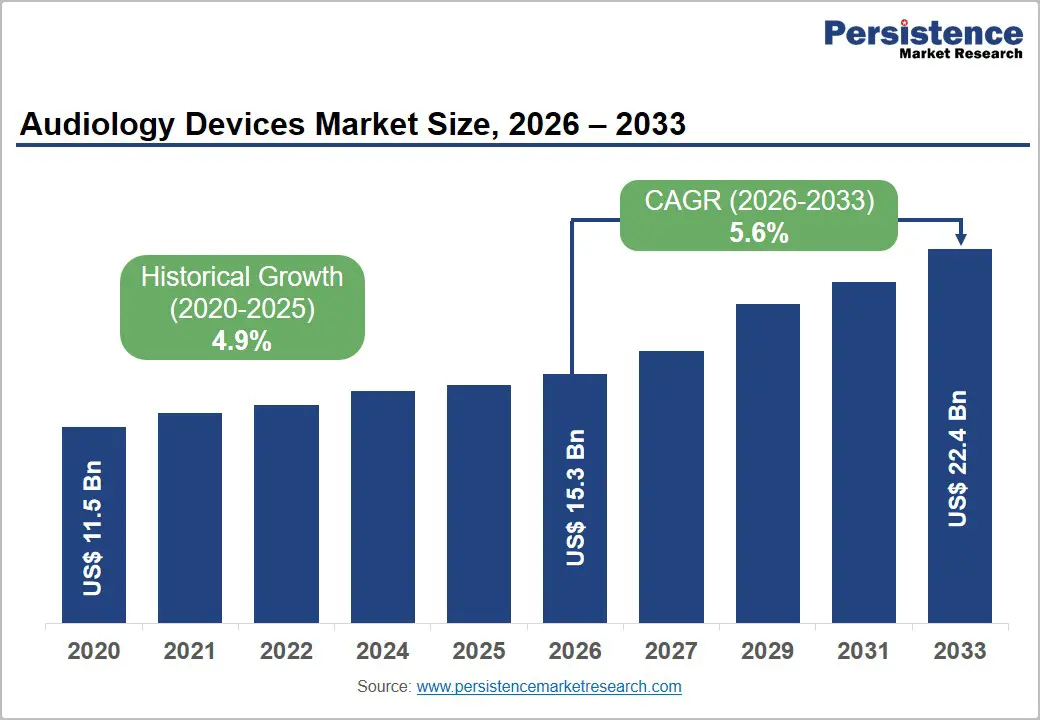
The global audiology devices market size is expected to be valued at US$ 15.3 billion in 2026 and projected to reach US$ 22.4 billion by 2033, growing at a CAGR of 5.6% between 2026 and 2033. It is witnessing steady growth driven by rising prevalence of hearing loss, an aging global population, and increasing exposure to noise pollution.
Technological advancements such as AI-enabled hearing aids, Bluetooth connectivity, and rechargeable devices are significantly improving user experience and adoption rates. Growing awareness about early diagnosis and treatment of hearing impairment is further supporting market expansion. Additionally, government initiatives for hearing screening programs and reimbursement policies in developed regions are boosting demand. The market is also benefiting from miniaturization of devices and the expansion of tele-audiology services, making hearing care more accessible, personalized, and cost-effective across diverse patient populations worldwide.
Key Industry Highlights
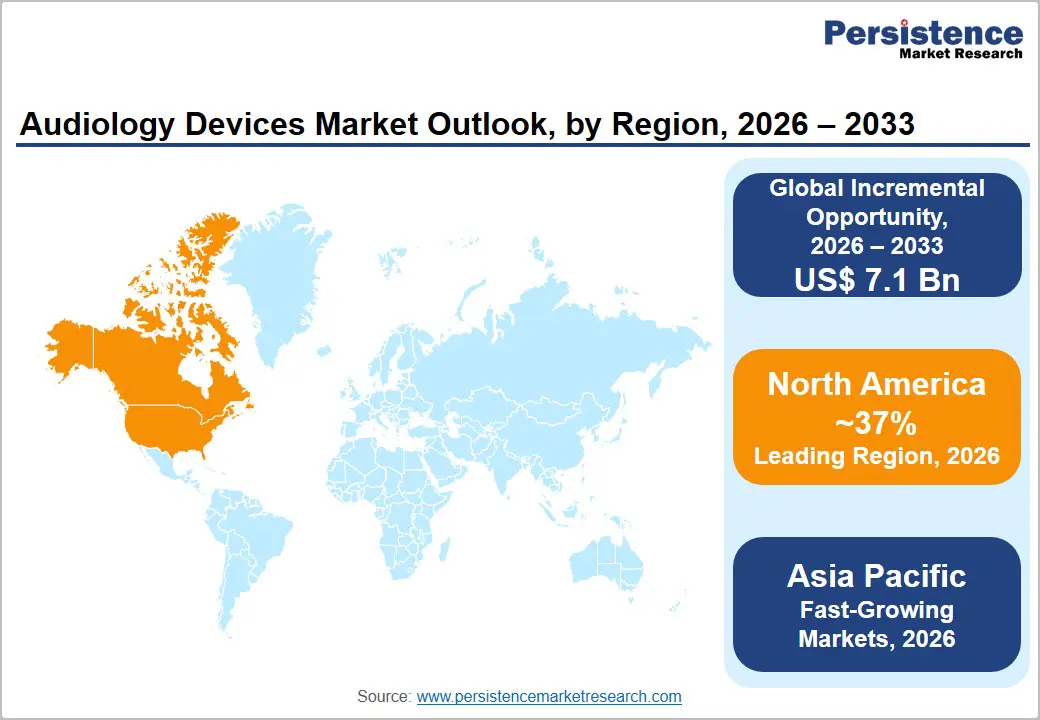
- Leading Region: North America leads the global audiology devices market with 37% market share in 2025, anchored by the FDA OTC Hearing Aid Rule (October 2022), democratizing mild-to-moderate hearing loss access, VA hearing benefit procurement, and commercial innovation leadership from Sonova, Demant, Starkey, and consumer tech entrants, including Apple and Sony.
- Fast-Growing Region: Asia Pacific is projected to register the highest CAGR during 2026 - 2033, driven by China’s mandatory newborn hearing screening under NHC guidelines, Japan’s MHLW welfare cochlear implant coverage for an aging population, India’s RBSK program, and ASEAN national hearing healthcare framework formalization.
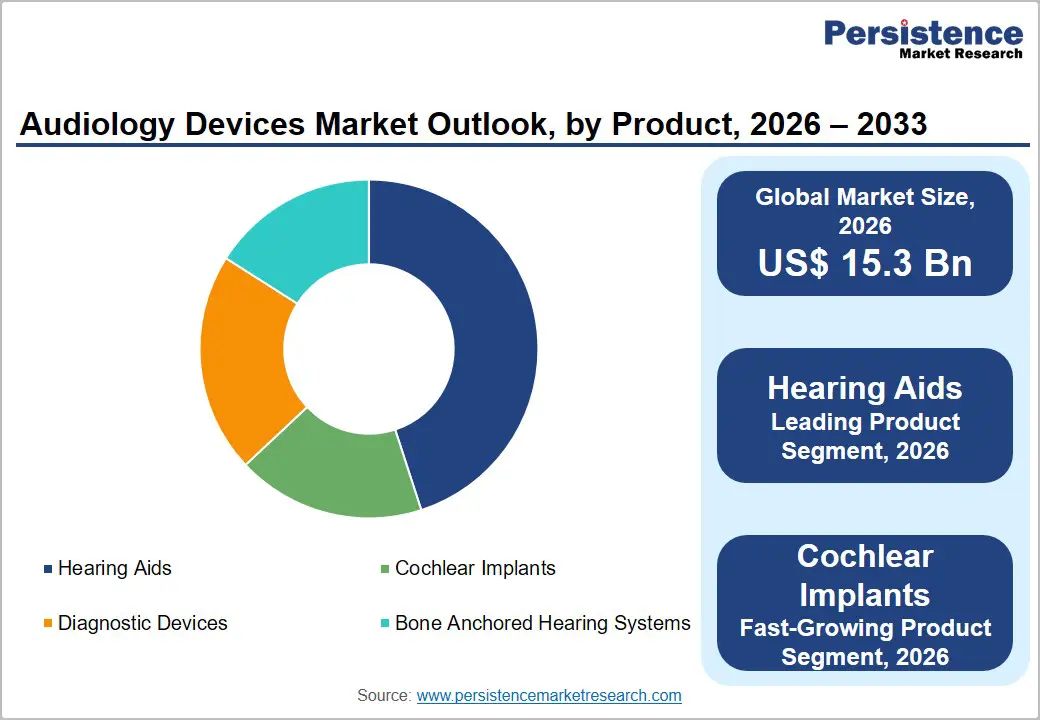
- Dominant Product Segment: Hearing Aids lead the product category with 45% market share in 2025, driven by their broad applicability across WHO’s 430 million globally under-rehabilitated hearing loss patients, VA and European GKV statutory reimbursement, and France’s 100% Santé reform-driven fitting volume surge.
- Fast-Growing Product Segment: Cochlear Implants represent the fastest growing product type over 2026 - 2033, driven by the FDA’s 2023 candidacy expansion to single-sided deafness, Cochlear Limited’s March 2025 CI632 approval, and ACIA’s estimate that fewer than 5% of U.S.-eligible candidates currently have an implant.
- Key Opportunity: The cochlear implant market’s massive under-penetration, ACIA estimates 750,000-1,000,000 U.S. qualified candidates with only ~5% implanted, combined with FDA candidacy expansion to single-sided deafness and Asia Pacific MHLW/RBSK program growth, represents a US$ 7.1 billion incremental opportunity through 2033.
Market Dynamics
Drivers - WHO-Documented Global Hearing Loss Burden Creating Structural Device Demand
The scale of unaddressed hearing loss globally is the most compelling driver for the audiology devices market. The World Health Organization (WHO) estimates that over 1.5 billion people worldwide live with hearing loss, of which more than 430 million require rehabilitation yet device adoption rates remain critically low, with WHO’s World Report on Hearing (2021) estimating that only 17% of people who could benefit from a hearing aid actually use one. This persistent treatment gap represents a massive commercial addressable market.
Aging demographics compound this challenge: the National Institute on Deafness and Other Communication Disorders (NIDCD) reports that approximately one in three people in the U.S. between 65 and 74 years has hearing loss, rising to 50% for those over 75, a demographic segment growing rapidly across all major developed economies.
FDA Over-the-Counter Hearing Aid Rule Unlocking Mass Consumer Market Access
The U.S. FDA’s OTC Hearing Aid Rule, which took effect in October 2022, represents the most significant regulatory disruption in the audiology devices market in decades, enabling adults with mild-to-moderate hearing loss to purchase hearing aids directly without a prescription or audiologist exam. This regulatory change has attracted consumer electronics giants, including Sony, Apple, and Bose, into the hearing aid space, dramatically broadening product availability and driving competitive pricing.
The NIDCD estimates approximately 28.8 million U.S. adults could benefit from hearing aids, yet the majority historically avoided purchase due to cost and access barriers. The OTC channel is now converting previously underserved mild-to-moderate patients into first-time device users, while established audiology companies, including Sonova Holding AG, Demant A/S, and GN Store Nord A/S, develop premium OTC-adjacent product lines to capture this newly accessible consumer segment.
Restraints - High Cost of Premium Hearing Aids and Cochlear Implants Limiting Adoption
Despite OTC regulatory reform in the U.S., premium prescription hearing aids and cochlear implant systems remain significant financial barriers for the majority of global hearing loss patients. Bilateral cochlear implant systems, including Cochlear Limited’s Nucleus® 8 can cost US$ 30,000-US$ 50,000 per ear, including surgical and programming services, while premium hearing aid pairs from Sonova’s Phonak Audeo® Lumity or Oticon Real™ (Demant) retail for US$ 4,000-US$ 7,000 per pair.
In low- and middle-income countries (LMICs) where 80% of the world’s hearing loss burden resides per WHO data, these price points make device access practically impossible for the majority of patients, severely limiting global adoption rates.
Shortage of Trained Audiologists Constraining Diagnostic and Fitting Service Capacity
The global shortage of audiology and hearing healthcare professionals creates a structural bottleneck in hearing device adoption beyond the OTC segment. The WHO World Report on Hearing documented that in low-income countries, there are fewer than 1 audiologist per million people, compared to 30-50 per million in high-income countries. Even in North America and Europe, the American Academy of Audiology (AAA) projects a workforce shortage as demand from aging baby boomers outpaces audiologist graduation rates, creating appointment wait times and limiting complex device programming services that constrain first-fit adoption completion rates and patient satisfaction.
Opportunities - Cochlear Implants: Fastest Growing Product Segment Through Indication Expansion
Cochlear implants represent the fastest growing product segment in the audiology devices market, driven by expanding clinical indications, improving surgical techniques enabling bilateral implantation, and compelling clinical evidence demonstrating speech perception outcomes superior to hearing aids in severe-to-profound hearing loss. Cochlear Limited’s Nucleus® System and MED-EL Medical Electronics’ SYNCHRONY® series are gaining regulatory approvals for expanded patient populations, including single-sided deafness and hearing loss in older adults previously considered unsuitable candidates.
The FDA’s 2023 guidance update broadened cochlear implant candidacy criteria from bilateral severe-to-profound to unilateral severe and single-sided deafness, significantly expanding the addressable patient pool. The American Cochlear Implant Alliance (ACIA) estimates that fewer than 5% of the 750,000-1,000,000 candidates in the U.S. who qualify for cochlear implants currently have one, representing an enormous under-penetrated market opportunity for manufacturers and audiological care providers through 2033.
Asia Pacific: Fastest-Growing Regional Market via Universal Newborn Hearing Screening Programs
Asia Pacific is the fastest-growing regional market for audiology devices, propelled by universal newborn hearing screening (UNHS) program expansion, a large under-penetrated adult hearing loss population, and government-mandated hearing healthcare infrastructure investment. China’s National Health Commission mandates newborn hearing screening across all provincial hospitals, generating consistent diagnostic device demand and early cochlear implant procedure volumes.
Japan’s Ministry of Health, Labour and Welfare (MHLW) hearing impairment disability welfare program covers cochlear implant surgery costs, sustaining high-value implant procurement. India’s Rashtriya Bal Swasthya Karyakram (RBSK), the national newborn screening program, includes hearing screening for early identification and intervention, creating demand for an audiology device pipeline. South Korea’s National Health Insurance Service (NHIS) covers hearing aid costs partially for qualifying beneficiaries, and ASEAN markets are progressively formalizing hearing healthcare delivery frameworks, generating sustained device procurement demand through the forecast period.
Category-wise Analysis
Product Insights
Hearing Aids dominate the audiology devices market by product type, accounting for approximately 45% of market share in 2025. This leading position reflects hearing aids’ broad applicability across mild, moderate, and severe hearing loss, the largest patient population segments globally, and their established reimbursement pathways in the U.S. (VA healthcare benefits), Europe, and Australia. The NIDCD documents approximately 28.8 million American adults who could benefit from hearing aids, while the WHO’s World Report on Hearing identifies hearing aids as the primary cost-effective intervention for the majority of the global hearing loss population.
Leading products, including Phonak Audeo® Lumity (Sonova), Oticon Real™ (Demant), Widex Moment® Sheer (WS Audiology), and ReSound OMNIA™ (GN Store Nord) incorporate AI-powered sound processing, Bluetooth connectivity, and rechargeable platforms that command premium price points while sustaining the segment’s dominant revenue position.
Technology Insights
Digital hearing technology is the overwhelmingly dominant technology segment in the audiology devices market, commanding the vast majority of market share in 2025. Digital hearing devices replaced analog as the clinical standard over two decades ago, and today’s premium digital hearing aids incorporate advanced machine learning algorithms for environment classification, directional microphone array processing, wireless Bluetooth streaming, smartphone app connectivity, and rechargeable battery systems.
The American Academy of Audiology (AAA) exclusively recommends digital hearing technology across all its clinical practice guidelines for hearing aid dispensing. Sonova’s Paradise™ and Lumity™ chips and GN’s Bluetooth Low Energy (LE) platform exemplify the digital innovation trajectory enabling direct audio streaming from smartphones and Made for iPhone (MFi) and Android Audio Streaming for Hearing Aids (ASHA) protocols sustaining digital technology’s complete commercial dominance through the forecast period.
End-user Insights
Audiology Clinics represent the leading end-user segment in the audiology devices market in 2025, accounting for the dominant share of hearing aid fitting and hearing device procurement revenues. Dedicated audiology clinics offer the full spectrum of audiological care, diagnostic testing, device selection, fitting, programming, and follow-up maintenance that complex hearing aid and cochlear implant users require. The American Academy of Audiology (AAA) represents over 12,000 audiologists in the U.S. practicing predominantly in private audiology clinic settings.
Large audiology retail networks, including Amplifon S.p.A.’s global clinic chain (over 9,000 points of sale in 26 countries) and Demant’s HearingLife network, exemplify the clinic-channel consolidation trend, vertically integrating device manufacturers with direct-to-patient fitting services to capture higher per-patient lifetime value and reduce dependence on independent audiologist distribution channels.
Regional Insights
North America Audiology Devices Market Trends and Insights
North America leads the global audiology devices market with 37% market share in 2025, anchored by the world’s highest per-capita hearing device adoption rates, the transformative FDA OTC Hearing Aid Rule (October 2022) democratizing mild-to-moderate hearing loss treatment, strong VA (Veterans Affairs) hearing benefit procurement for veterans, and robust private insurance coverage for diagnostic audiology services. U.S.-headquartered Starkey Laboratories, Inc. and Natus Medical Incorporated maintain strong domestic market positions alongside global competitors.
U.S. Audiology Devices Market Size
The United States accounts for approximately 88% of North American market revenues, supported by 28.8 million adults who could benefit from hearing aids per NIDCD data, VA hearing benefits representing one of the largest single government hearing device procurement programs globally, and the OTC channel attracting Sony, Bose, Apple AirPods Pro (Hearing Aid Feature), and other consumer tech entrants following FDA rule finalization.
Europe Audiology Devices Market Trends and Insights
Europe is the second-largest regional market, characterized by high hearing aid reimbursement coverage across Germany, France, the Netherlands, and Scandinavia through statutory health insurance systems, strong adoption of rechargeable and AI-powered hearing aids, and active EU MDR (2017/745) regulatory oversight. Headquarters of major players, including Sonova (Switzerland), Demant (Denmark), WS Audiology (Denmark), and GN Store Nord (Denmark), make Scandinavia a global audiology R&D epicenter.
Germany Audiology Devices Market Size
Germany accounts for approximately 25% of European market revenues, driven by statutory health insurance (GKV) coverage of hearing aids for qualifying patients, one of Europe’s largest aging populations, and a dense audiologist and hearing aid acoustic specialist (Hörakustiker) network. Siemens Healthineers’ former hearing division (now WS Audiology’s Signia®) maintains deep domestic brand equity in the German hearing aid market.
U.K. Audiology Devices Market Size
The U.K. contributes approximately 16-18% of European revenues, with the NHS (National Health Service) providing free hearing aids to qualifying patients through NHS Audiology Services—one of the world’s largest publicly funded hearing device programs, dispensing approximately 1.4 million hearing aids annually. Private audiology clinics including Specsavers Hearcare and Amplifon UK serve the premium market segment.
France Audiology Devices Market Size
France contributes approximately 14-16% of European market revenues, significantly boosted by the 100% Santé (Mon audioprothesiste et moi) reform effective 2021, which mandated full reimbursement for a basket of hearing aids under the Assurance Maladie (CPAM) national health insurance, generating a documented increase in hearing aid fitting volumes across French audioprothesiste networks and supporting market volume growth.
Asia Pacific Audiology Devices Market Trends and Insights
Asia Pacific is the fast-growing regional market for audiology devices, driven by universal newborn hearing screening program mandates, government hearing healthcare welfare frameworks, and a large under-penetrated adult hearing loss population across China, India, and ASEAN. China’s National Health Commission mandates newborn hearing screening across all provincial hospitals, creating consistent early-identification pipeline demand for diagnostic devices and cochlear implant procedures, with domestic players including RION Co., Ltd. expanding distribution across the region.
India Audiology Devices Market Size
India accounts for approximately 12% of Asia Pacific revenues, driven by WHO’s estimate of approximately 63 million Indians with significant hearing loss and the Rashtriya Bal Swasthya Karyakram (RBSK) newborn hearing screening program generating early intervention demand. Cochlear Limited and MED-EL have established India commercial operations targeting Ayushman Bharat PM-JAY cochlear implant-eligible patient populations.
Competitive Landscape
The Audiology Devices Market is highly competitive, driven by rapid technological advancements and increasing demand for advanced hearing care solutions. Market participants are focusing on developing digital, rechargeable, AI-enabled, and wireless hearing devices that improve sound quality and patient comfort. Competition is intensifying through continuous product innovation, expansion of cochlear implant technologies, and integration of smartphone connectivity features. Companies are also strengthening distribution networks through partnerships with audiology clinics, hospitals, and hearing care centers to expand global reach.
Key Developments
- In March 2026, Amplifon announced the acquisition of GN Hearing from GN Store Nord in a deal valued at approximately €2.3 billion to create a vertically integrated global audiology company. The acquisition combined Amplifon’s extensive hearing care retail network with GN Hearing’s advanced hearing aid manufacturing and R&D capabilities.
- In October 2024, Hearzap launched the AI-powered Philips HearLink 50 miniRITE hearing aid in the Indian market to expand access to advanced hearing care solutions. The device featured AI-based SoundMap technology that reduced background noise, enhanced speech clarity, and adapted automatically to different listening environments.
Companies Covered in Audiology Devices Market
- Sonova Holding AG
- Demant A/S
- WS Audiology
- Cochlear Limited
- GN Store Nord A/S
- Starkey Laboratories, Inc.
- MED-EL Medical Electronics
- Natus Medical Incorporated
- Amplifon S.p.A.
- RION Co., Ltd.
- William Demant Holding A/S
- Interacoustics A/S
- Benson Medical Instruments Co.
Frequently Asked Questions
The global audiology devices market is projected to be valued at US$ 15.3 billion in 2026.
Increasing awareness regarding early hearing diagnosis and treatment is encouraging greater adoption of hearing aids, cochlear implants, and diagnostic audiology devices.
North America leads with approximately 37% market share in 2025, anchored by the U.S. market’s 28.8 million potential hearing aid users per NIDCD data, VA hearing benefit procurement as one of the world’s largest government hearing device programs, the FDA OTC Hearing Aid Rule generating new consumer market entrants, and R&D leadership from Sonova, Demant, GN Store Nord, and Starkey Laboratories.
A key growth opportunity in the Audiology Devices Market lies in the increasing adoption of AI-enabled, wireless, and digitally connected hearing solutions across both developed and emerging economies.
Key players include Sonova Holding AG (Phonak®, Advanced Bionics®), Demant A/S (Oticon®), WS Audiology (Widex®, Signia®), Cochlear Limited, GN Store Nord A/S (ReSound®), Starkey Laboratories Inc., MED-EL Medical Electronics, Natus Medical Incorporated, Amplifon S.p.A., Interacoustics A/S, RION Co. Ltd., Benson Medical Instruments Co., Auditdata A/S, and Inventis S.r.l., among others.


