




- Inks, Coatings, Adhesives & Sealants (ICAS)
- Antimicrobial Coatings Market
Antimicrobial Coatings Market Size, Share, and Growth Forecast, 2026 – 2033
Antimicrobial Coatings Market by Product Type (Silver, Copper, Titanium Dioxide, Zinc), Application (Sanitary Facilities and Kitchen, Air Conditioning and Ventilation Systems, Others), End-user (Medical and Healthcare, Others), and Regional Analysis for 2026 – 2033

Antimicrobial Coatings Market Size and Trends Analysis
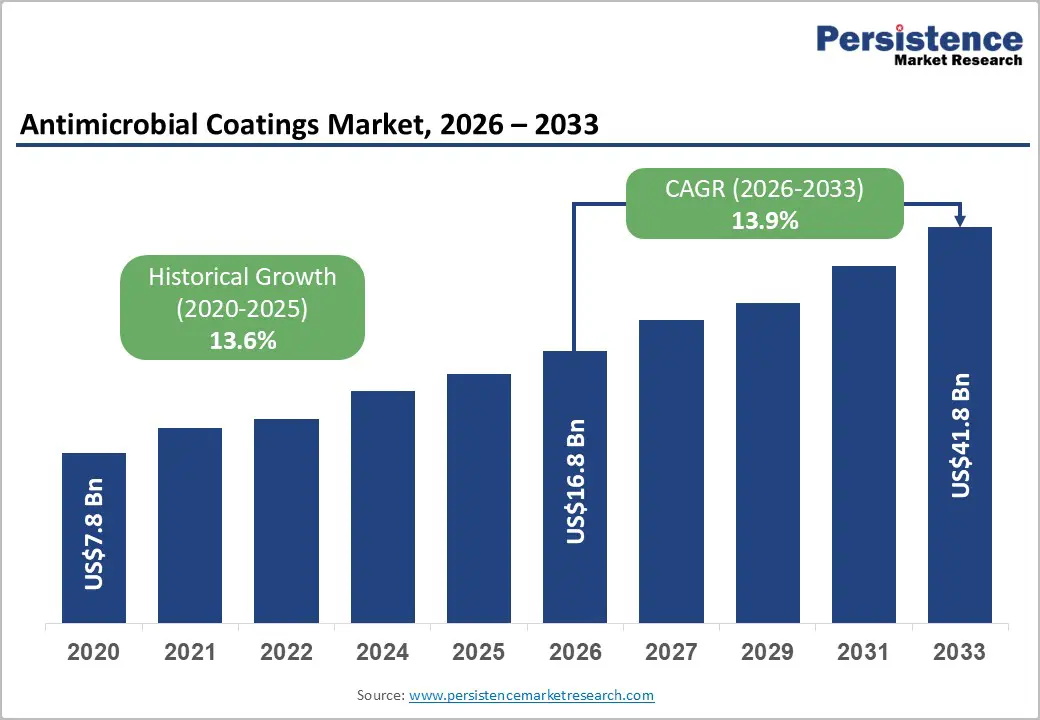
The global antimicrobial coatings market size is likely to be valued at US$16.8 billion in 2026 and is expected to reach US$41.8 billion by 2033, growing at a CAGR of 13.9% during the forecast period from 2026 to 2033, driven by an increasing focus on hygiene, sanitation, and infection control across a wide range of industries.
The heightened awareness of microbial contamination, particularly following health crises, has significantly accelerated the adoption of antimicrobial solutions in healthcare environments, food processing units, and modern infrastructure. These coatings are increasingly being applied to high-touch surfaces such as door handles, countertops, medical equipment, and public transport systems to minimize the risk of pathogen transmission. The growing demand for advanced medical devices with built-in antimicrobial protection is supporting market expansion. Technological advancements, including the development of nanotechnology-based coatings and more durable, long-lasting antimicrobial agents, are enhancing product performance and broadening application scope.
Key Industry Highlights:
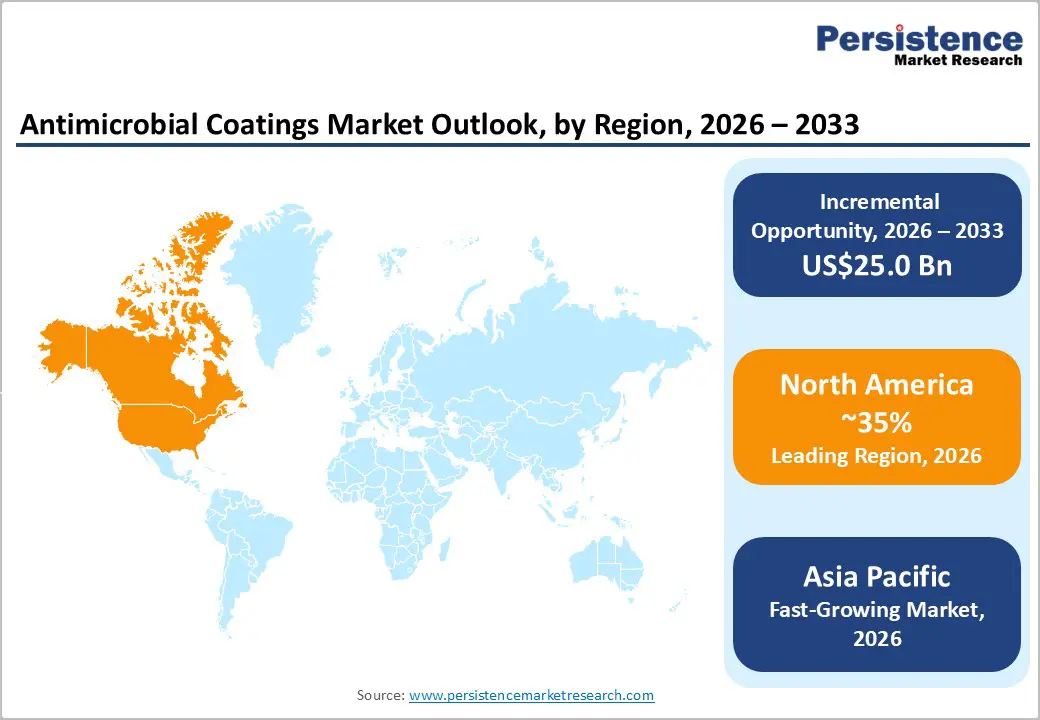
- Leading Region: North America is anticipated to be the leading region, accounting for a market share of 35% in 2026, driven by advanced healthcare infrastructure, strong regulatory support, and high awareness of infection prevention.
- Fastest-growing Region: Asia Pacific is likely to be the fastest-growing region, supported by expanding industrialization, urban development, and increasing hygiene awareness across emerging economies.
- Leading Product Type: Silver is projected to represent the leading product type in 2026, accounting for 45% of the revenue share, driven by its superior broad-spectrum antimicrobial efficacy and widespread use across healthcare, medical devices, and high-touch surface applications.
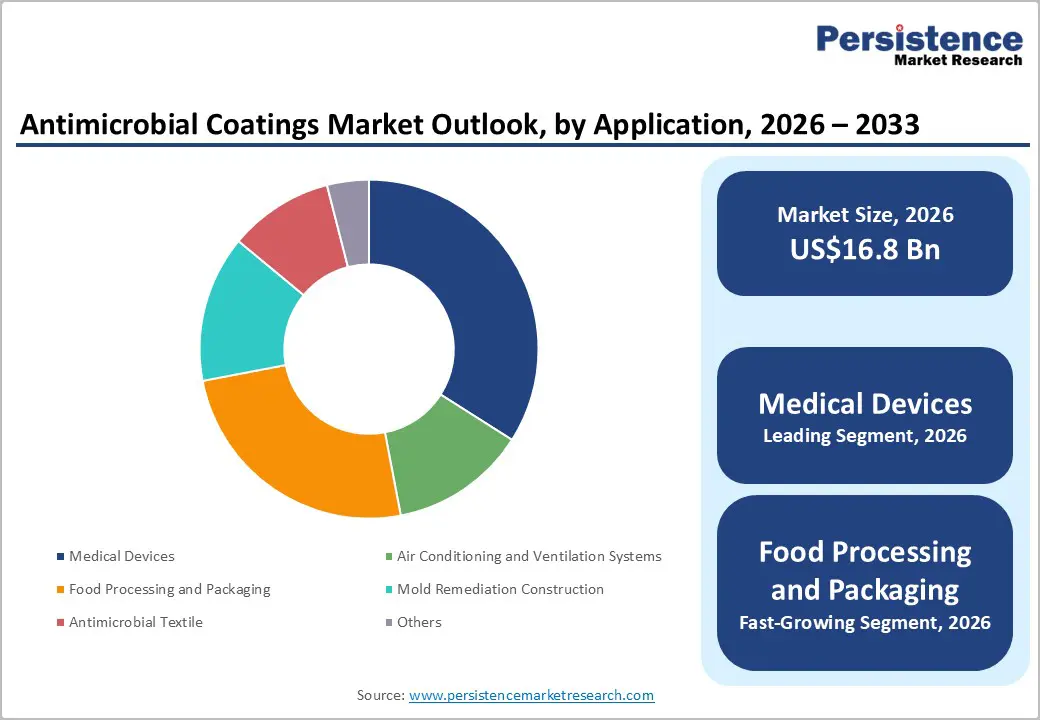
- Leading Application: Medical devices are anticipated to be the leading application, accounting for over 40% of the revenue share in 2026, supported by stringent infection control requirements and increasing demand for antimicrobial protection in healthcare environments.
| Key Insights | Details |
|---|---|
|
Antimicrobial Coatings Market Size (2026E) |
US$16.8 Bn |
|
Market Value Forecast (2033F) |
US$41.8 Bn |
|
Projected Growth (CAGR 2026 to 2033) |
13.9% |
|
Historical Market Growth (CAGR 2020 to 2025) |
13.6% |
Market Factors – Growth, Barriers, and Opportunity Analysis
Growth Analysis - Increasing Focus on Hygiene and Infection Prevention in Healthcare and Public Spaces
Rising awareness of infection control has significantly increased demand for antimicrobial coatings across hospitals, clinics, and public infrastructure. Healthcare facilities are prioritizing advanced surface protection solutions to reduce hospital-acquired infections and improve patient safety outcomes. High-touch areas such as door handles, bed rails, and medical equipment are increasingly treated with antimicrobial coatings to minimize microbial transmission. Public spaces, including transportation systems, offices, and educational institutions, are also adopting these coatings to enhance hygiene standards and reduce contamination risks, especially in densely populated urban environments.
The post-pandemic environment has accelerated investments in hygiene-focused technologies, encouraging both public and private sectors to implement long-term preventive measures. Governments and regulatory bodies are introducing stricter sanitation guidelines, supporting the integration of antimicrobial coatings in infrastructure projects. Continuous innovation in coating materials, including long-lasting and non-toxic formulations, is enhancing performance and safety. Antimicrobial coatings are becoming a critical component in modern health and safety strategies, ensuring cleaner environments and reducing the spread of harmful pathogens across multiple sectors.
Expansion in Food Processing, Packaging, and HVAC Applications
The growing emphasis on food safety and quality assurance is driving the adoption of antimicrobial coatings in food processing and packaging environments. These coatings help prevent contamination from bacteria and fungi, ensuring longer shelf life and compliance with stringent hygiene regulations. Equipment surfaces, storage units, and packaging materials are increasingly treated to maintain cleanliness and reduce foodborne illness risks. Rising food demand and supply chain expansion are supporting the integration of antimicrobial solutions in processing facilities and distribution systems.
HVAC systems are emerging as a key application area due to increasing concerns over indoor air quality and airborne pathogens. Antimicrobial coatings are applied to ducts, filters, and ventilation components to inhibit microbial growth and improve air circulation safety. Commercial buildings, healthcare facilities, and residential complexes are adopting these solutions to create healthier indoor environments. Technological advancements are enabling coatings with enhanced durability and efficiency, making them suitable for long-term use in challenging conditions, thereby expanding their role across food and air management systems.
Barrier Analysis - Potential for Microbial Resistance Development
One of the significant concerns associated with antimicrobial coatings is the potential development of microbial resistance over time. Continuous exposure of microorganisms to antimicrobial agents may lead to adaptation, reducing the effectiveness of these coatings. This challenge raises questions about long-term reliability, particularly in critical environments such as healthcare and food processing. As microbes evolve, there is a risk that certain coatings may become less effective, requiring frequent updates or replacement with more advanced formulations to maintain efficacy.
To address this issue, manufacturers are investing in research to develop multi-mechanism and non-leaching antimicrobial technologies that reduce the likelihood of resistance. Balancing effectiveness with environmental and human safety remains complex. Regulatory bodies are also closely monitoring the use of antimicrobial substances to ensure they do not contribute to broader resistance problems. This ongoing challenge necessitates continuous innovation and responsible usage practices to sustain the effectiveness of antimicrobial coatings while minimizing unintended consequences.
Integration Challenges in Existing Applications
Integrating antimicrobial coatings into existing systems and materials can present technical and operational challenges. Many industries rely on legacy equipment and infrastructure that are not compatible with new coating technologies without significant modification. Ensuring proper adhesion, durability, and performance across different surface types requires careful formulation and application processes. Variations in environmental conditions such as temperature, humidity, and exposure to chemicals can impact coating effectiveness, making standardization difficult.
Cost and implementation complexity limit widespread adoption, particularly for small and medium enterprises. Retrofitting existing facilities with antimicrobial coatings may require downtime, specialized equipment, and skilled labor, increasing overall costs. Ensuring consistent performance across large-scale applications can be challenging, especially in industries with diverse operational environments. These factors create barriers to rapid deployment, highlighting the need for more adaptable, cost-effective, and easy-to-apply coating solutions to support broader market penetration.
Opportunity Analysis - Emerging Applications in Medical Devices and Healthcare Infrastructure
The increasing use of antimicrobial coatings in medical devices and healthcare infrastructure presents significant growth opportunities. These coatings are being incorporated into devices such as catheters, implants, and surgical instruments to reduce infection risks and improve patient outcomes. Hospitals are also applying antimicrobial coatings to walls, floors, and high-contact surfaces to maintain sterile environments. As healthcare systems expand, especially in developing regions, the demand for advanced infection prevention solutions continues to rise.
Innovation in material science is enabling the development of coatings that are more durable, biocompatible, and effective over extended periods. The growing adoption of minimally invasive procedures and implantable devices supports the need for reliable antimicrobial protection. Increasing healthcare investments and infrastructure development are creating new avenues for coating applications. These trends position antimicrobial coatings as an essential component in modern healthcare systems, enhancing safety standards and supporting improved clinical performance.
Technological Convergence with Nanotechnology and Eco-Friendly Formulations
Advancements in nanotechnology are transforming the antimicrobial coatings market by enabling more effective and long-lasting solutions. Nanoparticles such as silver and copper provide enhanced surface coverage and improved antimicrobial action, even at lower concentrations. These innovations are increasing coating efficiency while reducing material usage and potential environmental impact. The integration of smart and responsive coatings that activate under specific conditions is also gaining attention, offering improved functionality across various applications.
There is a growing shift toward eco-friendly and sustainable formulations to address environmental and regulatory concerns. Manufacturers are developing non-toxic, biodegradable coatings that minimize harmful emissions and chemical exposure. This convergence of performance and sustainability is attracting interest from industries seeking greener solutions without compromising effectiveness. As environmental regulations become more stringent and consumer awareness increases, eco-friendly antimicrobial coatings are expected to play a crucial role in shaping the future direction of the market.
Category-wise Analysis
Product Type Insights
Silver is expected to lead the antimicrobial coatings market, accounting for approximately 45% of revenue in 2026, driven by its superior broad-spectrum antimicrobial efficacy and long-standing adoption across critical applications. It is widely used in healthcare environments, particularly in medical devices and high-touch surfaces, where consistent and reliable microbial protection is essential. The effectiveness of silver against a wide range of bacteria, fungi, and certain viruses has made it a preferred choice among manufacturers and end users.
For example, silver-based antimicrobial coatings are extensively applied in hospital bed rails and surgical instruments to reduce contamination risks and enhance patient safety outcomes.
Copper is likely to represent the fastest-growing segment, supported by its natural antimicrobial properties and increasing adoption across construction and HVAC applications. It is gaining popularity as a cost-effective and sustainable alternative to traditional materials, particularly in high-touch public infrastructure such as door handles and railings. Copper coatings are also being integrated into air conditioning and ventilation systems to inhibit microbial growth and improve indoor air quality.
For example, copper-coated surfaces in commercial buildings and public transport systems are increasingly used to reduce microbial transmission, demonstrating their expanding role across diverse environments and supporting their rapid growth trajectory.
Application Insights
Medical devices are projected to lead the market, capturing around 40% of the revenue share in 2026, supported by stringent infection control requirements and the critical need to reduce hospital-acquired infections. Antimicrobial coatings are extensively used in devices such as catheters, implants, and surgical instruments to prevent microbial colonization and improve patient outcomes. For example, antimicrobial-coated catheters are widely used in hospitals to minimize infection risks during prolonged usage, highlighting the segment’s strong presence and essential role in modern healthcare systems.
The food processing and packaging segment is likely to be the fastest-growing application, driven by rising concerns over food safety, hygiene regulations, and contamination control throughout the supply chain. Antimicrobial coatings are increasingly applied to food contact surfaces, packaging materials, and processing equipment to extend shelf life and ensure product safety. The expansion of food distribution networks and demand for high-quality packaged food accelerate adoption.
For example, antimicrobial-coated food packaging films are being used to prevent bacterial growth and maintain product freshness, demonstrating the segment’s rapid expansion and growing importance in ensuring safe and hygienic food handling practices.
Regional Insights
North America Antimicrobial Coatings Market Trends
North America is anticipated to be the leading region, accounting for a market share of 35% in 2026, driven by advanced healthcare infrastructure, strict hygiene regulations, and continuous innovation in surface protection technologies. The region maintains dominance due to high awareness of hospital-acquired infections and increasing adoption of antimicrobial coatings across healthcare facilities, food processing units, and public infrastructure. There is growing demand for antimicrobial-treated surfaces in medical textiles, protective apparel, and high-traffic environments such as schools and transportation systems.
For example, Sherwin-Williams Company has expanded its antimicrobial paint portfolio for healthcare and commercial environments, supporting reduced surface contamination and improved hygiene standards.
The increasing investments in research, manufacturing expansion, and advanced coating technologies are needed to meet rising demand across industries. The market is witnessing strong collaboration between coating manufacturers and end-use industries to develop customized antimicrobial solutions for specific applications such as HVAC systems, packaging, and construction materials. Technological advancements, including silver-ion and copper-based coatings, are enhancing long-term effectiveness and durability.
North America is seeing increased integration of antimicrobial coatings in smart buildings and infrastructure projects aimed at improving indoor environmental quality.
Europe Antimicrobial Coatings Market Trends
Europe is likely to be a significant market for antimicrobial coatings, due to emphasis on public health and increasing adoption across healthcare, food processing, and construction sectors. The region accounts for a significant share of the market, supported by strict compliance standards under REACH and biocidal regulations, which ensure product safety and performance. Growing concerns over healthcare-associated infections and food contamination are accelerating the use of antimicrobial coatings on medical devices, hospital surfaces, and food contact materials.
For example, AkzoNobel N.V has introduced advanced antimicrobial powder coatings designed for healthcare environments, supporting infection control and aligning with Europe’s sustainability goals.
Another key trend shaping the European market is the growing shift toward eco-friendly, bio-based, and nanotechnology-enabled antimicrobial coatings. Environmental regulations and the European Green Deal are encouraging manufacturers to develop low-toxicity, sustainable solutions without compromising performance. The food processing industry is also a major contributor, as strict hygiene regulations drive the adoption of antimicrobial coatings in packaging and equipment to reduce contamination risks.
Increased urbanization and infrastructure modernization are increasing demand for antimicrobial-treated surfaces in public transportation, commercial buildings, and residential projects.
Asia Pacific Antimicrobial Coatings Market Trends
The Asia Pacific region is likely to be the fastest-growing region, driven by rapid urbanization, expanding healthcare infrastructure, and increasing awareness of hygiene and infection control across emerging economies such as China and India. Governments and the private sector are investing heavily in hospitals, public transport systems, and commercial infrastructure, which is significantly increasing the demand for antimicrobial surface solutions. The region is also witnessing strong adoption in construction, food processing, and consumer goods industries, where antimicrobial coatings are used to enhance safety and durability.
Rising concerns regarding hospital-acquired infections and indoor air quality are accelerating demand, particularly in high-density urban environments.
The growing focus on advanced and cost-effective coating technologies, including silver-ion, copper-based, and nano-enabled antimicrobial formulations that offer improved durability and performance. Manufacturers are increasingly investing in research and local production capabilities to cater to large-scale demand across diverse industries such as textiles, electronics, and HVAC systems. For example, Nippon Paint Holdings Co., Ltd. has introduced antimicrobial and antiviral coating solutions for interior walls and surfaces, supporting hygiene improvements in residential and commercial spaces.
Competitive Landscape
The global antimicrobial coatings market exhibits a moderately fragmented structure, driven by the presence of numerous multinational corporations alongside regional and niche technology providers competing across diverse end-use industries.
The wide range of applications in healthcare, construction, food processing, and consumer goods creates a dynamic environment where no single player dominates completely. Market participants are increasingly focusing on expanding their product portfolios with advanced formulations such as silver-, copper-, and titanium dioxide-based coatings to cater to evolving industry requirements.
With key leaders including AkzoNobel N.V., PPG Industries, Inc., The Sherwin-Williams Company, Axalta Coating Systems, and Lonza, the market reflects a balance between established leaders and emerging innovators. These companies leverage strong distribution networks and regulatory compliance capabilities to maintain competitive positioning. These players compete through continuous innovation, strategic collaborations, and investments in research and development to enhance coating performance, durability, and environmental sustainability.
Key Industry Developments:
- In November 2025, BioBond Adhesives, Inc. launched its advanced three-layer antimicrobial coating system in Mexico, expanding its global footprint through a partnership with Insumos Maez to support infrastructure, healthcare, and industrial applications with sustainable, high-performance surface protection solutions.
- In October 2025, BioBond announced the launch of its protective antimicrobial coatings with new color options, expanding its product line to include multiple aesthetic variants while maintaining strong antimicrobial performance for use across healthcare, commercial, and public infrastructure applications.
- In June 2025, the CEN-CENELEC announced the launch of a new workshop under the NANOBLOC project focused on evaluating antimicrobial coatings, aiming to establish standardized testing methods for their antiviral and antibacterial performance and environmental safety, thereby supporting the development of next-generation, sustainable antimicrobial coating technologies.
- In February 2025, Nippon Paint Holdings Co., Ltd. announced the development of an advanced evaluation system to visualize the antibacterial effects of coatings in real time, enabling more precise performance assessment and supporting the development of next-generation antimicrobial solutions for infection prevention.
Companies Covered in Antimicrobial Coatings Market
- AkzoNobel N.V.
- AK Steel Corp.
- Lonza
- Diamond Vogel
- DuPont
- Axalta Coating Systems
- Nippon Paint Holdings Co., Ltd.
- PPG Industries, Inc.
- RPM International Inc.
- Koninklijke DSM N.V.
- Burke Industrial Coatings
- The Sherwin-Williams Company
- Troy Corporation
Frequently Asked Questions
The global antimicrobial coatings market is projected to reach US$16.8 billion in 2026.
The antimicrobial coatings market is driven by increasing demand for hygiene and infection prevention across healthcare, food processing, construction, and public infrastructure sectors.
The antimicrobial coatings market is expected to grow at a CAGR of 13.9% from 2026 to 2033.
Key market opportunities lie in expanding applications across medical devices, healthcare infrastructure, and the development of advanced nanotechnology-based and eco-friendly antimicrobial coatings.
AkzoNobel N.V., AK Steel Corp., Lonza, Diamond Vogel, DuPont, Axalta Coating Systems, and Nippon Paint Holdings Co., Ltd. are the leading players.


