




- Biotechnology
- Analytical Standards for Life Sciences Market
Analytical Standards for Life Sciences Market Size, Share, Trends, Growth, Regional Forecasts, 2026 to 2033
Analytical Standards for Life Sciences Market by Product Type (Organic Standards, Inorganic Standards, Volumetric Solutions, Others), Technique (Chromatography, Spectroscopy, Titrimetry, Others), End-User (Pharmaceutical Companies, Research & Academic Institutions, Contract Research Organizations (CROs), Others), and Regional Analysis for 2026-2033

Analytical Standards for Life Sciences Market Share and Trends Analysis
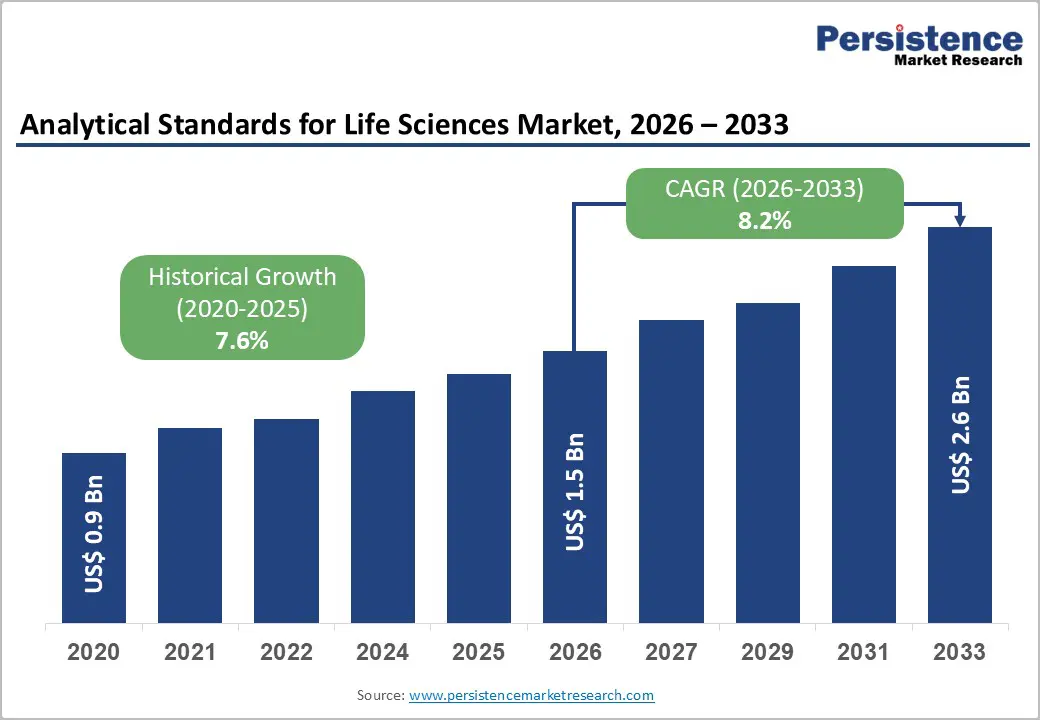
The global analytical standards for life sciences market size are likely to be valued at US$ 1.5 billion in 2026, and is projected to reach US$ 2.6 billion by 2033, growing at a CAGR of 8.2% during the forecast period 2026−2033.
Market expansion is driven by rising regulatory scrutiny and stringent quality assurance across pharmaceutical and biotechnology workflows. Increasing chronic disease burden and expanding biologics pipelines have heightened reliance on precise analytical validation, sustaining demand for high-purity standards. Greater focus on data reproducibility has accelerated adoption of certified reference materials in drug development and bioanalytical testing. Technological advancements in chromatography, spectroscopy, and mass spectrometry have improved sensitivity, increasing dependence on standardized calibration materials. Expanding healthcare infrastructure in emerging markets supports broader adoption. Regulatory authorities, including the U.S. Food and Drug Administration (FDA) and the European Medicines Agency, continue strengthening compliance requirements.
Key Industry Highlights
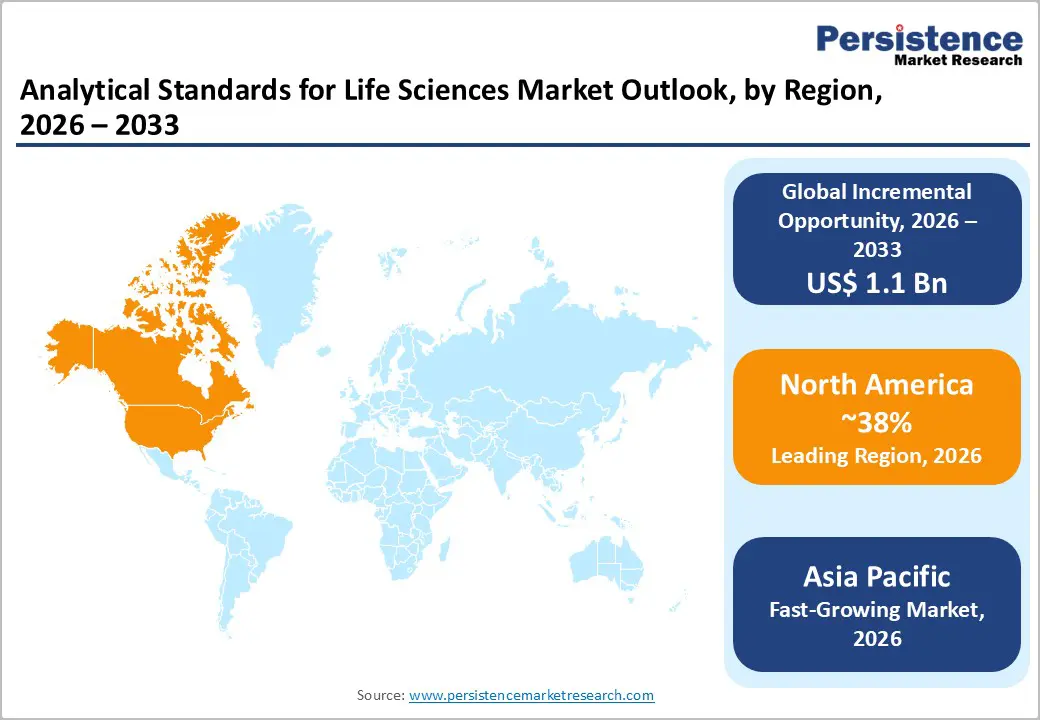
- Dominant Region: North America is expected to dominate by holding roughly 38% market share, due to advanced research infrastructure.
- Fastest-growing Regional Market: Asia Pacific is projected to be the fastest-growing market from 2026 to 2033, supported by expanding pharmaceutical manufacturing and healthcare investments.
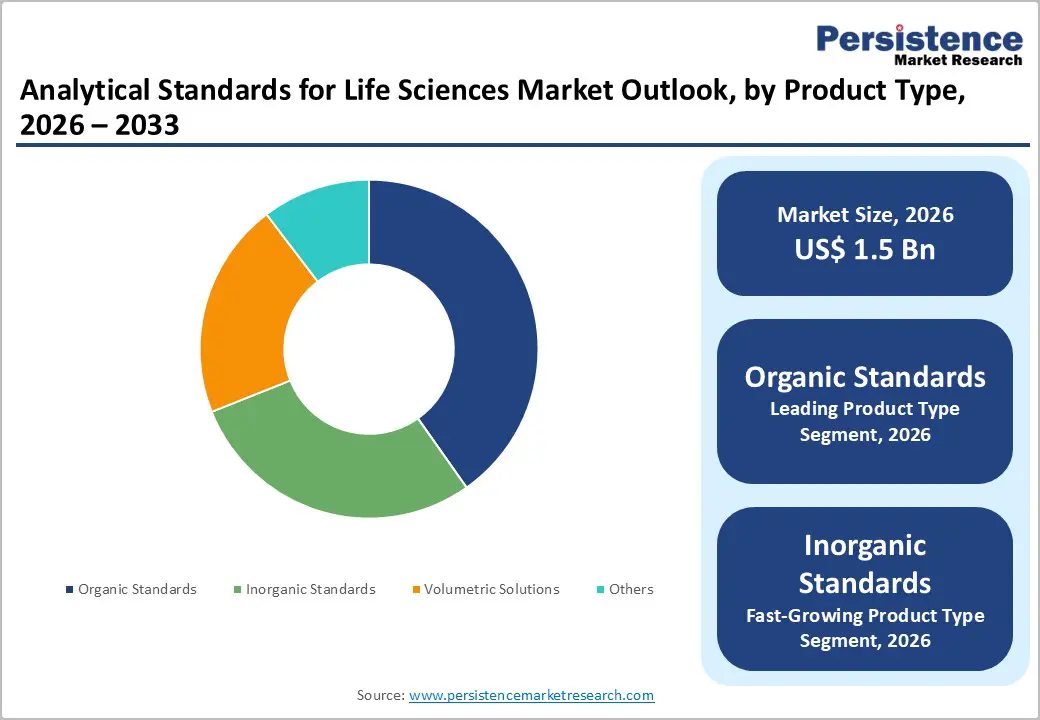
- Leading Product Type: Organic standards are expected to lead with an estimated 38% market share in 2026, due to extensive utilization in drug development.
- Fastest-growing Product Type: Inorganic standards are expected to witness the fastest growth, supported by increasing focus on elemental impurity analysis.
- Innovation Trends: Growth is driven by digital laboratory integration, automation, advanced analytical instrumentation, and expansion of biologics and personalized medicine, increasing demand for high-purity and customized analytical standards.
| Key Insights | Details |
|---|---|
|
Analytical Standards for Life Sciences Market Size (2026E) |
US$ 1.5 Bn |
|
Market Value Forecast (2033F) |
US$ 2.6 Bn |
|
Projected Growth (CAGR 2026 to 2033) |
8.2% |
|
Historical Market Growth (CAGR 2020 to 2025) |
7.6% |
DRO Analysis
Strict Regulations to Drive Standards Demand
Regulatory frameworks enforce strict validation standards across analytical workflows, driving consistent use of certified reference materials. Agencies such as the U.S. FDA require defined accuracy and precision thresholds, with bioanalytical methods expected to remain within ±15% variance in 2025 validation criteria. These expectations create direct dependence on traceable calibration standards to ensure reproducibility. Laboratories rely on standardized materials to meet submission requirements, maintain audit readiness, and generate comparable datasets across studies. Any deviation in measurement quality increases risk of regulatory rejection, delaying approvals and increasing compliance costs.
Compliance requirements extend across impurity profiling, stability testing, and batch release validation, reinforcing the need for high-purity standards. Regulatory guidance mandates identification and control of degradation products and contaminants during development and manufacturing. Analytical standards support accurate detection of low-level impurities and ensure consistency across global testing environments. Standardized reference materials enable alignment with harmonized guidelines and reduce variability in multi-site operations. Strong regulatory oversight increases focus on data integrity, forcing laboratories to adopt validated methods supported by certified standards to maintain quality benchmarks and regulatory acceptance.
Advanced Technologies to Raise Standards Demand
Advanced analytical platforms such as chromatography and mass spectrometry operate with high sensitivity and low detection limits. These systems generate complex datasets that require precise calibration for accuracy and reproducibility. Small deviations in measurement create significant variation in results, especially in impurity profiling and biomolecule analysis. Standardized reference materials ensure consistency across instruments and laboratories. Regulatory authorities emphasize validated analytical procedures for submission data. In 2025, the U.S. FDA issued guidance requiring validated and verified analytical testing methods for regulatory submissions, reinforcing the need for reliable calibration standards.
Integration of automated and digital laboratory systems increases throughput and data generation rates. High-throughput screening and real-time analytics demand stable and traceable standards for continuous calibration. Advanced technologies detect ultra-trace impurities and structural variations, increasing reliance on high-purity reference materials. Instrument interoperability across global laboratories requires harmonized standards to maintain data integrity. Quality control frameworks depend on reproducible analytical outputs to meet compliance thresholds. As analytical precision increases, tolerance for variability declines, driving consistent use of certified standards in validation workflows, stability testing, and bioanalytical measurements across pharmaceutical and biotechnology operations.
Limited Availability of Specialized Standards
Specialized analytical standards remain difficult to access due to complex synthesis and purification requirements. Many life science compounds involve unstable, highly reactive, or low-yield molecules, which restrict large-scale production. Strict certification protocols demand extensive validation, traceability, and documentation, increasing development timelines. Manufacturers face challenges in maintaining consistent purity levels across batches. Limited suppliers dominate niche categories, reducing competition and supply flexibility. Custom standard development often requires advanced technical expertise and infrastructure, which narrows production capacity. High dependence on skilled personnel and controlled environments further constrains availability in rapidly evolving research areas.
Supply chain constraints intensify the issue across global markets. Transportation and storage conditions require strict temperature control and contamination prevention, raising logistical complexity. Regulatory compliance across regions varies, creating delays in approvals and distribution. Research demand for novel biomarkers and biologics outpaces production capabilities, leading to supply gaps. Small and mid-sized laboratories face procurement delays due to limited distribution networks. High production costs restrict inventory expansion, affecting timely availability. Market fragmentation and limited standard harmonization across regions further complicate access for end users in pharmaceutical and biotechnology workflows.
Complex Storage and Handling Challenges
Strict environmental control requirements create significant operational constraints across laboratories. Analytical standards often require low-temperature storage, controlled humidity, and protection from light exposure. Minor deviations can degrade purity and compromise stability. Laboratories must invest in specialized storage systems such as ultra-low freezers and monitored environments. This increases capital expenditure and maintenance burden. Frequent calibration and validation of storage conditions demand skilled personnel. Handling procedures require precision to avoid contamination or loss. These factors reduce workflow efficiency and increase operational risk, particularly in high-throughput testing environments where consistency remains critical for regulatory compliance.
Supply chain complexity further intensifies storage and handling limitations. Transportation of sensitive materials requires cold chain logistics and real-time monitoring systems. Any disruption during transit can impact material integrity and usability. Limited shelf life increases pressure on inventory management and procurement cycles. Laboratories face challenges in maintaining adequate stock without overordering. Disposal of expired or compromised standards adds to operational costs. Variability in storage capabilities across regions affects uniform adoption. Smaller facilities encounter higher constraints due to limited infrastructure, restricting scalability and consistent implementation of analytical standards.
Increasing Clinical Trials to Stoke Demand
Rising clinical trial activity strengthens demand for analytical standards through increased sample testing, validation, and regulatory documentation requirements. Each trial phase requires precise calibration to ensure accuracy, reproducibility, and data integrity across laboratories. Standardized reference materials support biomarker analysis, impurity profiling, and pharmacokinetic assessments under strict protocols. Growth in trial volume expands testing frequency and complexity, particularly for biologics and advanced therapies. According to the U.S. FDA, 46 new drugs received approval in 2025, reflecting sustained clinical development activity and associated analytical workload.
Clinical research environments demand consistent analytical performance across multi-site trials, increasing reliance on validated standards for cross-laboratory comparability. Regulatory frameworks enforce strict quality benchmarks for data submission, requiring traceable and certified materials. Complex study designs, including adaptive and precision-based trials, elevate sensitivity requirements for analytical instruments. This shift drives adoption of high-purity standards for method validation and stability testing. Expansion of decentralized and global trials increases variability in testing environments, reinforcing the need for harmonized calibration tools to ensure uniform data quality and regulatory acceptance across regions.
Innovation in Complex Standards
Rising molecular complexity across biologics, cell therapies, and gene-based products increases demand for highly specific reference materials. Standard compounds no longer match structural diversity seen in advanced pipelines. Complex impurities, degradation pathways, and multi-variant profiles require tailored analytical benchmarks. Laboratories prioritize precision in quantification and identity verification. Regulatory alignment reinforces this shift. In 2025, the U.S. FDA continued expanding structured data standards for submissions, strengthening expectations for standardized and reproducible datasets across clinical and analytical workflows. This environment supports development of complex standards designed for high-sensitivity platforms.
Advanced instrumentation increases analytical resolution and detection capability, creating demand for equally sophisticated calibration materials. Mass spectrometry and multi-dimensional chromatography generate high-volume datasets requiring validated reference points. Simple standards fail to support these systems. Customized standards improve traceability, batch consistency, and cross-laboratory comparability. Digital integration across laboratory systems reinforces reliance on precise calibration inputs. Compliance frameworks emphasize data integrity, reproducibility, and audit readiness. Complex standards align with these requirements and support consistent validation processes. This shift creates strong commercial potential for specialized standard providers focused on innovation and differentiation in high-complexity analytical environments.
Category-wise Analysis
Product Type Insights
Organic Standards are anticipated to secure around 38% of the analytical standards for life sciences market share in 2026, reflecting strong demand across pharmaceutical and biopharmaceutical applications. Organic standards support drug development, impurity profiling, and bioanalytical testing with high precision. These materials enable accurate identification and quantification of active compounds and degradation products. Regulatory focus on reproducibility and traceability strengthens adoption in analytical workflows. Pharmaceutical companies use these standards to improve consistency in chromatography and spectroscopy. Strong supplier networks and expanding compound libraries support accessibility and wider market penetration.
Inorganic standards are projected to witness the highest growth rate during 2026–2033, driven by rising demand for elemental analysis and environmental monitoring in life sciences. Growth is supported by increasing need for trace metal detection in pharmaceuticals, biologics, and diagnostics. These standards ensure compliance with regulations on elemental impurities. Adoption of techniques such as inductively coupled plasma mass spectrometry and atomic absorption spectroscopy increases reliance on accurate calibration materials. Expanding focus on safety profiling and improved availability of multi-element standards further supports market growth.
End-User Insights
Pharmaceutical Companies are likely to be the leading segment with a projected 40% of the analytical standards for life sciences market share in 2026 due to extensive utilization in drug development and quality control processes. Pharmaceutical companies rely on analytical standards for method validation, regulatory compliance, and product consistency. Continuous use across discovery, development, and manufacturing sustains demand. Internal quality protocols and regulatory oversight drive adoption in batch testing, stability studies, and impurity profiling. Increasing laboratory automation and digital integration improve efficiency and data accuracy. Strong dependence on standardized calibration materials supports reproducible results and consistent quality across pharmaceutical workflows.
Contract research organizations (CRO) are projected to register the highest growth during 2026–2033, driven by increasing outsourcing of research and development activities. Rising demand for cost efficiency and operational flexibility supports adoption of CRO services. These organizations conduct analytical testing, clinical research, and method development, requiring consistent use of analytical standards for accuracy and compliance. Scalability and technology-driven operations, including digital platforms and automated laboratory systems, improve efficiency and enable high-throughput workflows, strengthening demand for standardized materials.
Regional Insights
North America Analytical Standards for Life Sciences Market Trends and Insights
North America is expected to lead with an estimated 38% of the analytical standards for life sciences market share, supported by a highly structured regulatory environment and advanced laboratory ecosystems across United States and Canada. Strong enforcement of validation protocols and impurity profiling standards drives consistent demand for certified reference materials. High concentration of biopharmaceutical innovation pipelines increases utilization across analytical workflows. Investment intensity in research infrastructure supports adoption of high-purity standards. Established supply networks ensure rapid availability of complex compounds. Integration of advanced analytical platforms strengthens calibration requirements, reinforcing dependence on standardized materials across development and quality control functions.
Sustained dominance is reinforced by high expenditure on drug development and strict compliance expectations across manufacturing stages in United States and Canada. Analytical standards play a critical role in ensuring batch consistency and data integrity under regulated conditions. Extensive use of chromatography and mass spectrometry platforms increases demand for precise calibration materials. Strong collaboration between industry and regulatory bodies supports alignment with evolving validation frameworks. High adoption of digital laboratory systems improves traceability and reproducibility. Skilled workforce availability enhances efficient handling of complex analytical processes, supporting continuous demand for specialized and certified standards across life sciences operations.
Europe Analytical Standards for Life Sciences Market Trends and Insights
Europe maintains a significant position in the analytical standards ecosystem, supported by a well-established regulatory framework and advanced laboratory infrastructure across Germany, France, and United Kingdom. Harmonized compliance guidelines for impurity profiling, stability testing, and method validation drive consistent demand for certified reference materials. High concentration of pharmaceutical manufacturing and research institutions supports integration of analytical standards into development workflows. Strong focus on chemical safety and environmental testing expands application scope. Emphasis on data traceability and reproducibility strengthens adoption across regulated laboratory environments and quality control operations.
Advanced biopharmaceutical pipelines and biosimilar development programs expand utilization across Switzerland, Netherlands, and Sweden. High investment in precision medicine and complex molecule research drives demand for specialized reference materials. Established contract research networks support analytical testing and validation services, increasing consumption of calibration standards. Integration of digital laboratory systems improves operational efficiency and data integrity. Strong collaboration between academic institutions and industry supports innovation in analytical methodologies.
Asia Pacific Analytical Standards for Life Sciences Market Trends and Insights
Asia Pacific is forecasted to be the fastest-growing market for analytical standards for life sciences between 2026 and 2033, stimulated by rapid expansion of pharmaceutical manufacturing and contract research capabilities. Strong production scaling across China and India increases demand for validated analytical workflows and certified reference materials. Growth in biologics development and generic drug pipelines strengthens requirement for impurity profiling and stability testing. Regulatory alignment with international quality standards drives consistent adoption of high-purity materials. Investment in laboratory infrastructure and analytical instrumentation supports increased utilization of calibration standards across development and quality control environments.
Acceleration in advanced analytical capabilities supports further expansion across Japan and South Korea. Strong focus on precision medicine and biosimilar development increases need for trace element analysis and reproducible testing frameworks. Expansion of clinical research activities drives demand for standardized materials in bioanalytical validation. Government-backed innovation programs strengthen laboratory modernization and technical expertise. Increased integration of automated systems improves throughput and data accuracy. Growing participation in global supply chains reinforces compliance-driven procurement of analytical standards across life sciences operations.
Competitive Landscape
The global analytical standards ecosystem demonstrates moderate consolidation, where leading companies such as Merck KGaA, Thermo Fisher Scientific, and LGC Limited hold significant revenue share. Strong positioning is supported by broad product portfolios and certified reference material capabilities. Global distribution networks enable consistent supply across regulated markets. Competitive differentiation is driven by purity levels, traceability standards, and regulatory compliance support.
Companies such as Waters Corporation and Agilent Technologies strengthen market presence through integration of analytical instruments and calibration standards. High technical expertise requirements create barriers for new entrants. Regulatory validation processes increase complexity in product development. Capital-intensive production infrastructure limits scalability for smaller players. Niche providers focus on specialized compounds, supporting innovation and targeted applications within analytical workflows.
Key Industry Developments
- In March 2026, Agilent Technologies introduced advanced chromatography and mass spectrometry innovations at major scientific events, enhancing analytical performance, workflow efficiency, and data quality, thereby strengthening the role of high-precision analytical standards in pharmaceutical and biopharmaceutical testing.
- In November 2025, Amsbio launched advanced adeno-associated virus (AAV) reference standards to improve accuracy, consistency, and quality control in gene therapy research and production. These standards enable precise calibration of assays and better assessment of full-to-empty capsid ratios, supporting reliable data generation and regulatory compliance across laboratories.
- In June 2025, Thermo Fisher Scientific introduced two advanced mass spectrometers, Orbitrap Astral Zoom and Orbitrap Excedion Pro, at ASMS, enhancing analytical precision and throughput in life sciences workflows and strengthening demand for high-quality analytical standards in biopharmaceutical research and bioanalytical validation.
Companies Covered in Analytical Standards for Life Sciences Market
- Merck KGaA
- Thermo Fisher Scientific
- LGC Limited
- Waters Corporation
- Agilent Technologies
- PerkinElmer
- Restek Corporation
- AccuStandard
- SPEX CertiPrep
- Chiron AS
- Toronto Research Chemicals
- Cayman Chemical Company
- Dr. Ehrenstorfer GmbH
- Mallinckrodt Pharmaceuticals
- United States Pharmacopeia
Frequently Asked Questions
The global analytical standards for life sciences market are projected to reach US$ 1.5 billion in 2026.
Stringent regulatory compliance, expanding biopharmaceutical research, and increasing demand for accurate analytical validation are driving the market.
The market is poised to witness a CAGR of 8.2% from 2026 to 2033.
Growth in biologics and biosimilars, expansion in emerging markets, and rising outsourcing of analytical testing are creating key market opportunities.
Some of the key market players include Merck KGaA, Thermo Fisher Scientific, LGC Limited, Waters Corporation, and Agilent Technologies.


