




- Specialty & Fine Chemicals
- Amine Oxide Market
Amine Oxide Market Size, Share, and Growth Forecast 2026 - 2033
Amine Oxide Market by Product Type (Lauryl Dimethylamine Oxide, Cocamidopropylamine Oxide, Other Amine Oxides), by Functionality (Surfactants, Foaming Agents, Cleaning Agents, Emulsifiers & Conditioning Agents, Thickeners), Industry (Home Care Industry, Personal Care & Cosmetics, Industrial & Institutional Sector, Oil & Gas Industry, Agriculture Industry), and Regional Analysis, 2026 - 2033

Amine Oxide Market Size and Trend Analysis
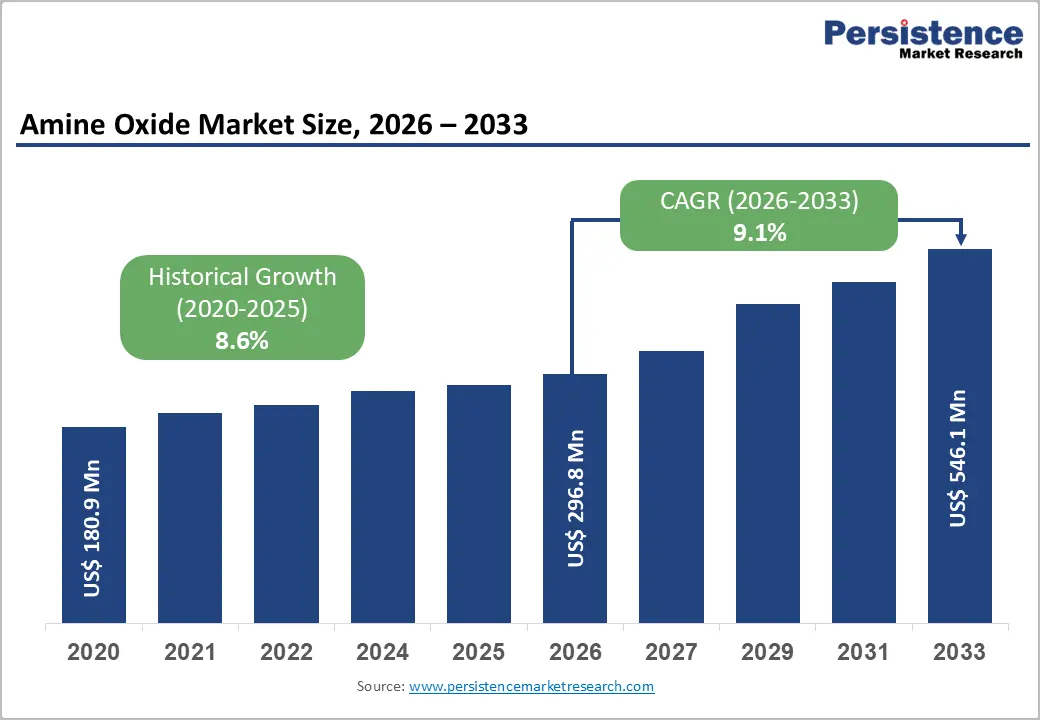
The global amine oxide market size is expected to be valued at US$ 296.8 million in 2026 and projected to reach US$ 546.1 million by 2033, growing at a CAGR of 9.1% between 2026 and 2033. The market has expanded steadily from US$ 180.9 million in 2020 to US$ 296.8 million in 2026, reflecting strong historical momentum.
Growth is driven by rising demand for mild, biodegradable surfactants across personal care, home care, and industrial cleaning applications. Consumers increasingly prefer low-irritant, pH-stable formulations, while regulatory bodies such as the U.S. Environmental Protection Agency and the European Chemicals Agency are accelerating the shift toward safer, eco-friendly surfactants, such as amine oxides.
Key Market Highlights
- Leading Region: Asia Pacific dominates the amine oxide market with 39% share in 2026, driven by strong demand across China, India, and ASEAN.
- Fastest-Growing Region: North America is the fastest-growing region, supported by the rising adoption of eco-friendly surfactants and advanced regulatory frameworks.
- Leading Product Type: Lauryl Dimethylamine Oxide leads with 45% share, owing to its superior foaming, mildness, and cost efficiency.
- Leading Functionality: Surfactants dominate with 40% share, reflecting the core role of amine oxides in cleaning and personal care formulations.
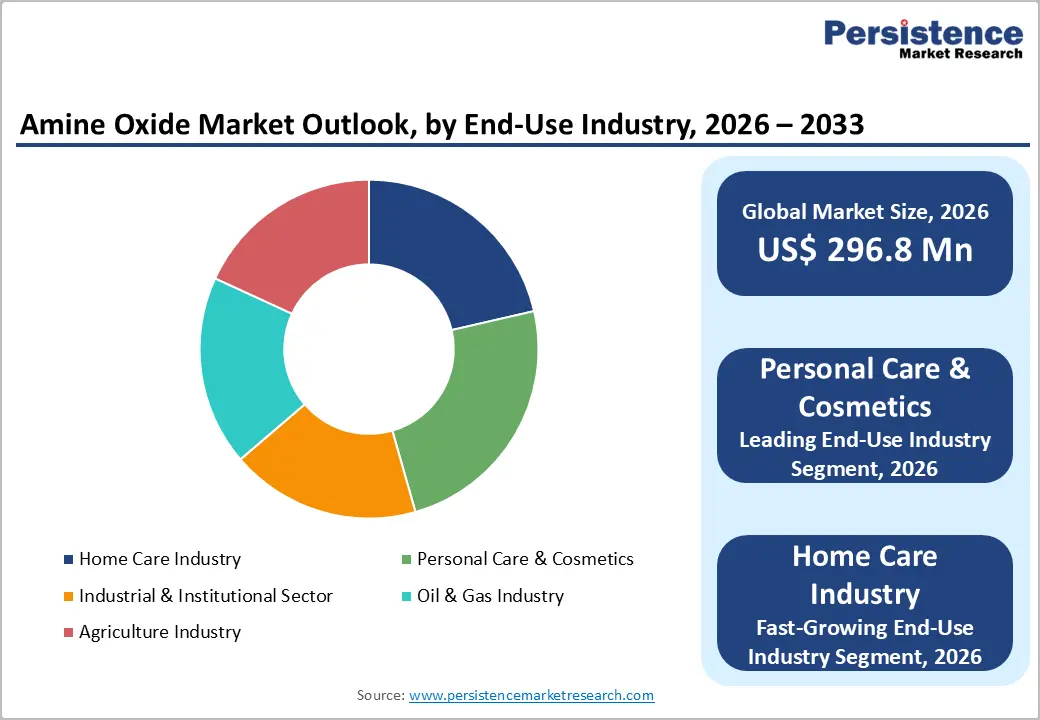
- Leading Industry: Personal Care & Cosmetics holds 38% share, driven by demand for mild and skin-friendly ingredients.
- Key Opportunity: Growing shift toward bio-based amine oxides aligned with sustainability regulations and eco-label initiatives.
Market Dynamics
Drivers - Rising Demand for Mild and Sustainable Surfactants
The personal and home care industries strongly drive the amine oxide market due to their need for high-foaming, mild, and conditioning ingredients in both leave-on and rinse-off formulations. Growing disposable incomes and rising hygiene awareness, particularly in emerging economies, have supported steady expansion in personal care consumption, with the sector growing by around 5-6% in 2025. This trend is accelerating the shift toward milder surfactants, such as amine oxides.
Regulatory pressure is further strengthening adoption. Authorities such as the European Union and the U.S. Food and Drug Administration emphasize low irritation, eco-labeling, and biodegradability. Amine oxides align with EPA Safer Choice and EU Ecolabel standards due to their low toxicity and high biodegradability. Leading companies such as Unilever, Procter & Gamble, and L’Oréal are increasingly incorporating these ingredients into formulations to meet green chemistry and performance requirements.
Expanding Industrial Applications Across Cleaning, Oil, and Agriculture
Amine oxides are gaining importance beyond consumer products, particularly in industrial cleaning, oil & gas, and agricultural formulations. In oil recovery processes, they function as foaming agents, emulsifiers, and corrosion inhibitors, improving efficiency in enhanced oil recovery systems. The growing reliance on such techniques, as highlighted by global energy agencies, continues to drive demand for high-performance surfactants in this sector.
In agriculture, amine oxides act as adjuvants that enhance the effectiveness of herbicides and pesticides by improving wetting and penetration. Increasing global demand for crop protection chemicals is reinforcing their usage. Additionally, in industrial and institutional cleaning, their ability to perform across wide pH ranges and hard water conditions makes them ideal for detergents and sanitizers, especially amid rising demand for low-VOC and adaptable formulations.
Restraints - Raw Material Price Volatility Impacting Production Economics
The amine oxide market faces pressure from fluctuations in key raw materials, including fatty amines and fatty alcohols derived from palm oil, coconut oil, and tallow. These feedstocks are highly sensitive to climatic disruptions, trade policies, and geopolitical factors in major producing regions like Southeast Asia and South America. Recent weather-related disruptions and El Niño effects have caused notable price swings, increasing manufacturing costs.
Industry sources indicate that fat- and oil-based inputs can experience annual price variations of 15-25% during volatile periods. Such fluctuations strain profit margins, particularly for smaller manufacturers lacking backward integration. Additionally, stricter environmental regulations on deforestation and land use may limit palm oil expansion, tightening supply flexibility and creating long-term uncertainty in raw material availability.
Regulatory Compliance Burdens Limiting Market Entry Expansion
While environmental regulations promote the adoption of safer surfactants, they also create significant entry barriers for smaller manufacturers. In the European Union, compliance with REACH regulations requires extensive testing, documentation, and registration of chemical substances, including amine oxides. The associated costs can reach €100,000-150,000 per substance, making regulatory compliance resource-intensive for new entrants.
Similarly, in the United States, frameworks under the Toxic Substances Control Act and programs like EPA Safer Choice impose strict risk assessment and data requirements. These regulatory complexities limit expansion opportunities for smaller players and favor large, integrated companies. Additionally, evolving policies on packaging waste and chemical safety further increase reformulation costs, impacting the overall economics of amine oxide-based products.
Opportunities - Rising Adoption of Bio-Based and Sustainable Surfactants
A key opportunity in the amine oxide market is the shift toward bio-based formulations derived from renewable feedstocks such as coconut oil, palm kernel oil, and other non-food oils. Regulatory initiatives such as the European Green Deal and national bioeconomy programs are encouraging a reduced reliance on fossil-based chemicals. This aligns well with amine oxides, which can be produced via sustainable pathways and meet increasing demand for eco-friendly ingredients.
Major companies are launching plant-based amine oxide portfolios positioned as biodegradable and low-toxicity solutions compatible with organic standards. The biosurfactant segment is growing at around 10-12% CAGR, driven by regulatory and consumer push. Companies like BASF and Evonik are expanding renewable surfactant offerings, targeting eco-label certifications and capturing demand from green personal care and home care markets.
Expanding Hygiene and Home Care Demand in Emerging Markets
Rapid urbanization and rising disposable incomes across Asia Pacific, Latin America, and Africa are creating strong growth opportunities for amine oxides. Increasing awareness of hygiene is driving demand for liquid detergents, hand washes, shampoos, and surface cleaners. Urban population growth in countries such as India, China, and Indonesia is expected to significantly boost the consumption of cleaning and personal care products over the next decade.
Industry data shows that liquid detergent and personal care product volumes are growing at low- to mid-single-digit rates, favoring mild surfactants such as amine oxides. Investments in regional manufacturing are improving supply efficiency and reducing costs. Countries like India and China are emerging as key production hubs, supporting long-term demand across consumer and industrial cleaning applications.
Category-wise Analysis
Product Type Insights
Lauryl dimethylamine oxide leads the product type segment, accounting for approximately 45% of the global amine oxide market in 2025. Its dominance is attributed to an optimal balance of foaming efficiency, mildness, and compatibility with other surfactants used in shampoos, body washes, and hand soaps. Derived from lauric-rich feedstocks such as coconut oil, it is cost-effective and widely available, making it highly suitable for large-scale applications across personal and home care formulations.
Cocamidopropylamine Oxide is emerging as the fastest-growing segment due to increasing demand for enhanced conditioning and viscosity-building properties in premium formulations. It is gaining traction in sulfate-free and sensitive-skin products, where improved texture and skin feel are critical. Its compatibility with modern formulation trends and rising demand for high-performance mild surfactants are driving its rapid adoption across evolving personal care applications.
Functionality Insights
Surfactants dominate the functionality segment, representing around 40% of the amine oxide market in 2025. This is driven by their amphoteric nature, which allows them to perform effectively across a range of pH conditions and blend seamlessly with anionic and cationic surfactants. Their role in improving foam stability, wetting, and cleaning efficiency in detergents and personal care products makes them indispensable in both household and industrial formulations.
Emulsifiers & conditioning agents are the fast-growing functionality segment, supported by rising demand for multifunctional ingredients in advanced formulations. These applications are expanding in premium cosmetics and specialized industrial products where texture, stability, and conditioning performance are key. Increasing focus on product differentiation and enhanced user experience is accelerating their adoption across high-value applications.
Industry Insights
Personal care & cosmetics is the leading end-user segment, capturing approximately 38% of the amine oxide market in 2025. Growth is driven by strong demand for shampoos, body washes, facial cleansers, and baby care products that emphasize mildness and safety. Regulatory validation and consumer preference for low-irritation, biodegradable ingredients further support the widespread use of amine oxides in this segment, reinforcing its dominant position globally.
The home care industry is a fast-growing segment, fueled by rising hygiene awareness and increasing consumption of liquid detergents, dishwashing liquids, and surface cleaners. The shift toward mild yet effective cleaning agents and the expansion of urban households are driving adoption. Continuous product innovation and demand for eco-friendly cleaning solutions are further accelerating growth in this segment.
Regional Insights
North America Amine Oxide Market Trends and Insights
North America holds a significant share of the global amine oxide market, accounting for approximately 30% in 2026, led by the United States. The region benefits from strong demand across personal care, home care, and oil & gas sectors, supported by advanced regulatory frameworks from agencies such as the EPA and FDA. Increasing preference for biodegradable, low-toxicity surfactants and continuous innovation in concentrated detergent formulations are reinforcing market growth.
- U.S. Amine Oxide Market
The U.S. amine oxide market is valued at approximately US$ 120 million in 2026, making it the dominant contributor in North America. Growth is driven by strong consumption of personal and home care products, along with industrial applications. The market is projected to grow at a CAGR of ~9.5% through 2033, supported by regulatory emphasis on safer surfactants and rising hygiene awareness. Continuous innovation in detergents and personal care formulations further strengthens demand.
Europe Amine Oxide Market Trends and Insights
Europe represents a mature yet steadily growing amine oxide market, supported by stringent regulatory frameworks and sustainability-driven policies. The region is projected to grow at a CAGR of approximately 8.5-9.0% from 2026 to 2033, driven by initiatives such as REACH and the EU Green Deal. These frameworks promote the adoption of biodegradable and low-toxicity surfactants, increasing the use of amine oxides across personal care and home care products.
- Germany Amine Oxide Market
Germany accounts for roughly 25% of the European market, valued at about US$ 45 million in 2026. It is a key production and consumption hub, driven by strong industrial cleaning and personal care sectors. Growth is supported by sustainability regulations and advanced chemical manufacturing infrastructure.
- U.K. Amine Oxide Market
The U.K. market is estimated at US$ 30 million in 2026, driven by rising demand for private-label detergents and personal care products. Increasing preference for natural and mild ingredients is boosting adoption, supported by expanding retail and e-commerce channels.
- France Amine Oxide Market
France is valued at approximately US$ 28 million in 2026, with strong demand for cosmetics and dermatological products. The presence of premium beauty brands and stringent regulatory requirements supports the use of mild, biodegradable surfactants such as amine oxides.
Asia Pacific Amine Oxide Market Trends and Insights
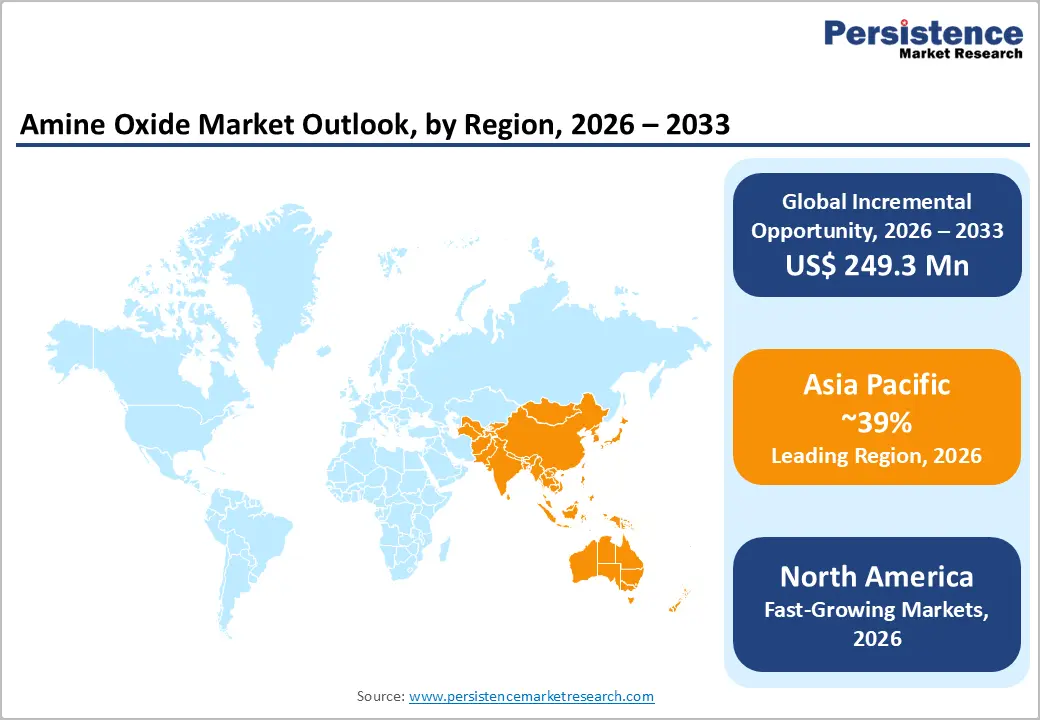
Asia Pacific is the fastest-growing region, accounting for approximately 39% of the global market in 2026. Growth is driven by rapid urbanization, increasing disposable incomes, and expanding manufacturing capabilities in countries such as China, India, and Japan. The region has become a major hub for surfactant production, supported by strong investments and localization of supply chains. Rising demand for hygiene products, coupled with increasing awareness of mild and eco-friendly formulations, is accelerating adoption across personal and home care sectors.
- China Amine Oxide Market
China is valued at approximately US$ 80 million in 2026, making it the largest market in the region. Growth is driven by strong demand for detergents and personal care products, supported by large-scale manufacturing and government focus on sustainable chemicals.
- India Amine Oxide Market
India’s amine oxide market is estimated at US$ 35 million in 2026, driven by strong growth from urbanization, rising hygiene awareness, and expanding FMCG demand. Increasing domestic production and favorable cost structures are supporting market expansion.
- Japan Amine Oxide Market
Japan is valued at around US$ 25 million in 2026, characterized by demand for high-quality, low-irritation personal care products. The market benefits from advanced formulations and strict quality standards, supporting steady adoption of amine oxides.
Competitive Landscape
The global amine oxide market is moderately consolidated, with a few large multinational chemical producers holding significant control over production, technology, and supply chains. High entry barriers, including capital intensity, regulatory compliance, and access to raw materials, favor established players. Companies with integrated operations or long-term feedstock sourcing agreements are better positioned to manage cost volatility and maintain consistent supply across global markets.
Competition is shaped by strategies such as capacity expansion, product innovation, and sustainability-driven differentiation. Firms are increasingly focusing on eco-friendly formulations and customized solutions for niche applications. Additionally, emerging trends such as contract manufacturing, value-added surfactant services, and recycling initiatives are reshaping the competitive landscape, particularly in industrial and institutional cleaning segments.
Key Developments:
- In March 2025, BASF SE introduced a new range of plant-derived amine oxides at its European sites, positioning them as renewable-carbon surfactants for use in eco-label detergents and natural cosmetics. The product line aligns with the EU Green Deal and EU Ecolabel requirements, supporting customers’ sustainability targets.
- In July 2024, Evonik Industries AG announced a 20% capacity increase at its U.S. surfactant facility, focusing on personal-care amine oxides used in shampoos and body washes. The expansion was driven by rising demand for mild surfactant systems in North America and aims to shorten lead times for regional customers.
- In November 2023, Stepan Company launched a low-VOC amine oxide portfolio for industrial and institutional cleaning products, targeting U.S. and EU regulations on volatile organic compounds. The new grades are designed to maintain high foaming and cleaning performance while meeting EPA Safer Choice and similar standards.
Amine Oxide Market Report - Key Insights & Details
| Key Insights | Details |
|---|---|
| Historical Market Value (2020) | US$ 180.9 Mn |
| Current Market Value (2026) | US$ 296.8 Mn |
| Projected Market Value (2033) | US$ 546.1 Mn |
| CAGR (2026 - 2033) | 9.1% |
| Leading Region | Asia Pacific, 39% share |
| Dominant Industry | Personal Care & Cosmetics, 38% share |
| Top-ranking Product | Lauryl Dimethylamine Oxide, 45% |
| Incremental Opportunity | US$ 249.3 Mn |
Companies Covered in Amine Oxide Market
- Clariant AG
- Stepan Company
- Huntsman Corporation
- Evonik Industries AG
- The Lubrizol Corporation
- Solvay SA
- Kao Corporation
- BASF SE
- Croda International Plc
- Akzo Nobel N.V.
- Lonza Group Ltd.
- Oxiteno S.A.
- The Chemours Company
- Eastman Chemical Company
- Arkema S.A.
Frequently Asked Questions
The global Amine Oxide Market is projected to reach US$ 296.8 million in 2026, driven by rising demand across personal care, home care, and industrial applications.
The key driver is increasing demand for mild, biodegradable surfactants, with Personal Care & Cosmetics accounting for ~38% share, supported by regulatory and consumer preferences.
Asia Pacific leads with ~39% share in 2026, driven by strong growth in China, India, and ASEAN across hygiene and cleaning applications.
A key opportunity lies in the shift toward bio-based and sustainable amine oxide formulations that meet EU Green Deal, eco-label, and green-chemistry requirements.
Key market players include BASF SE, Evonik Industries AG, Stepan Company, Clariant AG, Akzo Nobel N.V., Lonza Group, and Croda International Plc.


