




- Specialty & Fine Chemicals
- Aromatic Ketone Polymers Market
Aromatic Ketone Polymers Market Size, Share, and Growth Forecast 2026 - 2033
Aromatic Ketone Polymers Market by Polymer Type (Polyacrylic Ketone, Polystyrene Ketone, Polyethylene Ketone, Polyurethane Ketone), by Form (Solid, Liquid, Powdered, Film, Others), by Processing Technology, by Application, Industry, and Regional Analysis, 2026 - 2033

Aromatic Ketone Polymers Market Size and Trend Analysis
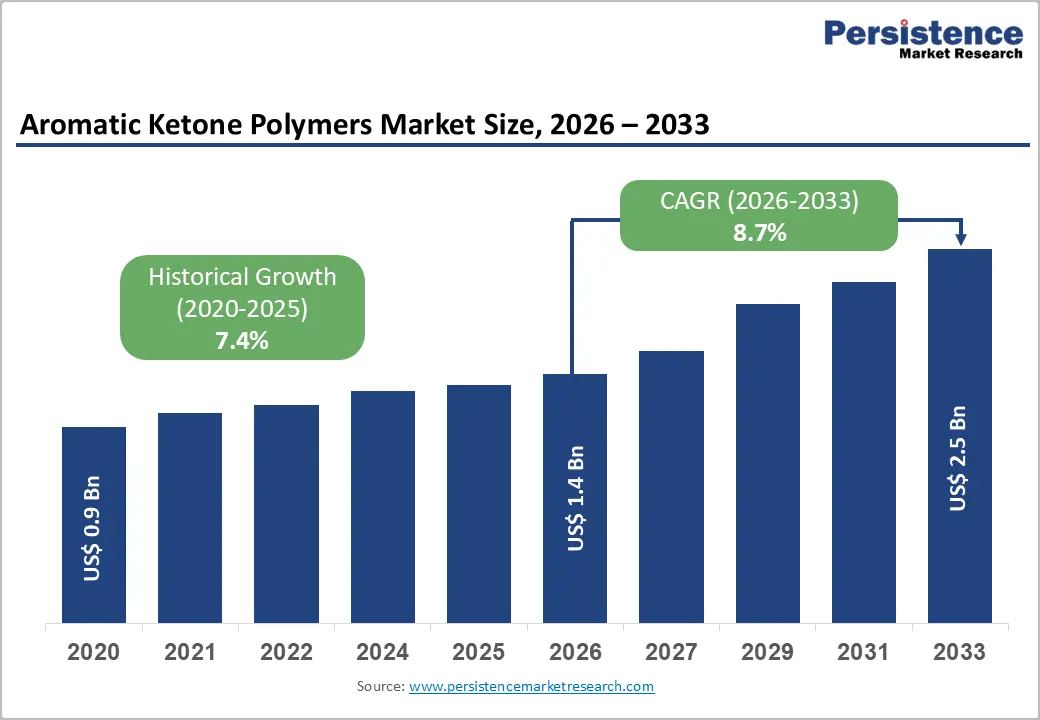
The global Aromatic Ketone Polymers Market size is expected to be valued at US$ 1.4 billion in 2026 and projected to reach US$ 2.5 billion by 2033, growing at a CAGR of 8.7% between 2026 and 2033. Growth is driven by rising demand for high-performance materials in automotive and aerospace sectors, where lightweight components enhance fuel efficiency.
Advancements in processing technologies, particularly additive manufacturing, enable complex and high-precision designs, accelerating adoption. According to International Energy Agency data, global automotive production reached 92 million units in 2024, increasing demand for durable polymers. Additionally, sustainability regulations such as EU REACH standards support market expansion.
Key Industry Highlights:
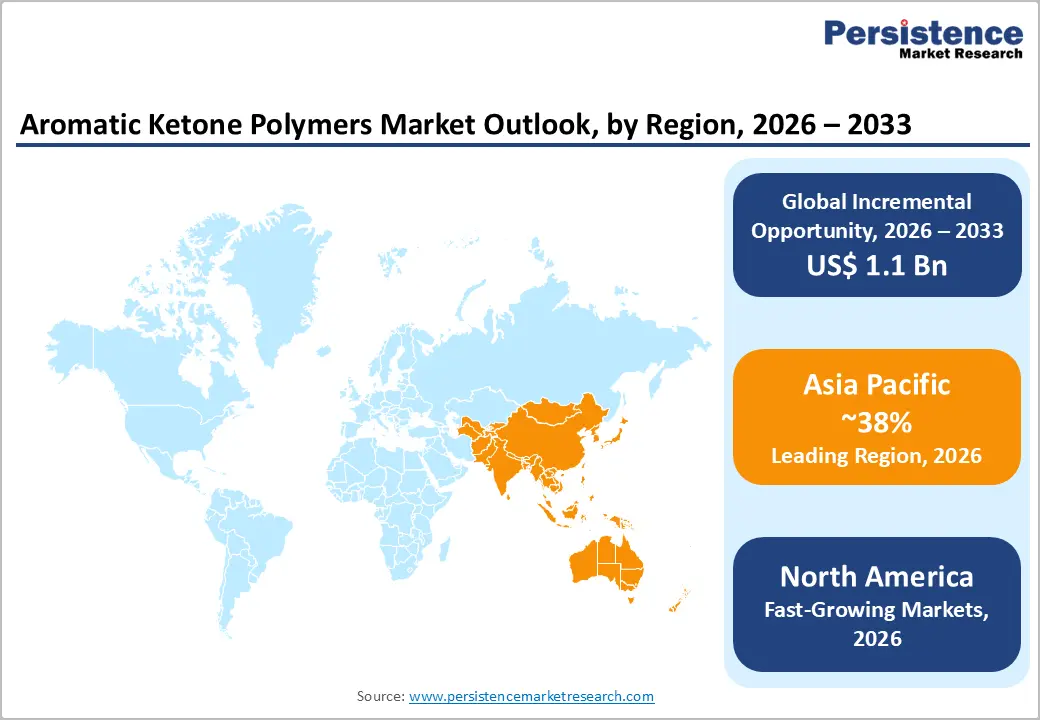
- Leading Region: Asia Pacific leads the aromatic ketone polymers market with a 38% share in 2025, driven by strong manufacturing capabilities and rapid EV expansion.
- Fastest Growing Region: North America emerges as the fastest-growing region, driven by strong aerospace investments, medical innovation, and advanced manufacturing ecosystems.
- Leading Processing: Injection molding dominates with a 48% share in 2025, supported by its efficiency in high-volume and precision component production.
- Fastest Growing Category: Healthcare is the fastest-growing end-user segment, fueled by increasing demand for biocompatible and sterilizable high-performance materials.
- Key Market Opportunity: Sustainable coatings and adhesives offer significant opportunities, driven by stringent environmental regulations and growing demand for low-VOC, eco-friendly materials.
Market Dynamics
Drivers
Rising Automotive and Aerospace Demand Driving Market Expansion
The automotive sector’s shift toward lightweight materials is a major driver of the aromatic ketone polymers market. These polymers offer superior mechanical strength and thermal stability, making them ideal for under-the-hood and structural applications. According to the Society of Automotive Engineers (SAE), reducing vehicle weight by 10% can improve fuel efficiency by 6–8%, encouraging manufacturers to adopt advanced high-performance polymers.
In aerospace, increasing regulatory approvals for high-performance polymers in aircraft interiors are accelerating adoption. Major aircraft programs continue to incorporate these materials to improve durability and reduce weight. Additionally, global electric vehicle sales reached 14 million units in 2024, as per the IEA, boosting demand for heat-resistant insulating materials and reinforcing long-term growth potential across transportation sectors.
Additive Manufacturing Advancements Enhancing Polymer Adoption
Advancements in additive manufacturing technologies are significantly expanding the use of aromatic ketone polymers across industries. These polymers enable precise, customized component production with minimal material waste, supporting efficient manufacturing processes. Standards established by ASTM International further validate their suitability for both prototyping and full-scale production, strengthening their role in high-performance industrial applications.
The Wohlers Report 2025 highlights that the additive manufacturing market is growing at a 23% CAGR, with engineering polymers accounting for nearly 40% of total material usage. Technologies such as laser sintering enable complex geometries while reducing lead times by up to 50%, enhancing design flexibility and accelerating adoption across medical, electronics, and advanced engineering sectors.
Restraints
High Production Costs and Raw Material Price Volatility
Elevated production costs significantly restrain the adoption of aromatic ketone polymers across industries. The use of specialized monomers, such as diphenyl ether, introduces price volatility, with ICIS reporting 20–25% volatility in 2024 due to ongoing supply chain disruptions. Additionally, energy-intensive polymerization processes increase overall manufacturing costs by nearly 30% compared to conventional commodity plastics.
Limited large-scale production further restricts cost efficiency, as manufacturers struggle to achieve economies of scale. According to the American Chemistry Council, these polymers can cost 2–3 times as much as standard alternatives. This pricing gap limits adoption in cost-sensitive sectors such as construction and consumer goods, slowing broader market penetration despite performance advantages.
Stringent Regulatory Compliance and Approval Delays
Strict regulatory frameworks pose a significant challenge to the aromatic ketone polymers market. Agencies such as the Environmental Protection Agency (EPA) and EU REACH mandate extensive testing for toxicity, emissions, and environmental impact. Compliance costs can reach approximately $500,000 per new polymer grade, as reported by Chemical & Engineering News, increasing barriers for manufacturers.
Lengthy approval timelines, often ranging between 18 and 24 months, further delay product commercialization and discourage innovation. Additionally, OSHA safety standards for handling aromatic compounds add operational complexity. These regulatory and compliance burdens are particularly challenging in developing regions with limited infrastructure, restricting scalability and slowing overall market growth.
Opportunities
Expanding Healthcare Applications Driving Advanced Polymer Adoption
Rising healthcare demands are creating strong opportunities for aromatic ketone polymers in medical devices. These materials offer excellent biocompatibility and resistance to sterilization, making them suitable for implants, surgical instruments, and diagnostic tools. FDA approvals for implant-grade materials have increased by around 15% annually, supporting broader adoption. Additionally, compliance with ISO 10993 standards reduces inflammation risks and improves patient safety in critical medical applications.
The global medical device market is projected to grow at a 5.2% CAGR through 2030, driven by an aging population, with the WHO estimating that 2 billion people will be over 60 by 2050. This demographic shift significantly boosts demand for advanced materials in prosthetics, diagnostics, and sterile packaging, enabling manufacturers to capitalize on high-value, performance-driven healthcare applications.
Sustainable Coatings and Adhesives Creating New Growth Avenues
Sustainability initiatives are opening new opportunities for aromatic ketone polymers in coatings and adhesives. Policies such as the European Green Deal, which targets a 55% reduction in emissions by 2030, are driving demand for low-VOC and environmentally friendly formulations. UL certifications indicate these polymers can reduce solvent usage by up to 40%, supporting circular economy goals and regulatory compliance.
Rapid construction growth in Asia-Pacific further strengthens demand, with China approving approximately 1.2 million green building projects in 2024. Innovations in water-based coating technologies improve adhesion performance by nearly 20%, expanding applications across textiles, electronics assembly, and eco-friendly industrial processes, allowing manufacturers to tap into sustainability-driven market expansion.
Category-wise Analysis
Polymer Type Insights
Polyether ketone dominates the polymer type segment, accounting for approximately 45% of the market share in 2025. Its exceptional thermal stability up to 260°C and strong chemical resistance make it highly suitable for demanding environments. ASTM D4000 standards highlight its superior tensile strength of around 100 MPa, while increasing aerospace demand and certifications further reinforce its widespread adoption across automotive and medical applications.
Polyurethane ketone is emerging as the fastest-growing segment due to its enhanced processability and compatibility with advanced manufacturing techniques. Its growing use in additive manufacturing and aerospace components supports design flexibility and weight reduction. Increasing adoption in high-performance applications, particularly where customization and complex geometries are required, is accelerating its market penetration across multiple industries.
Form Insights
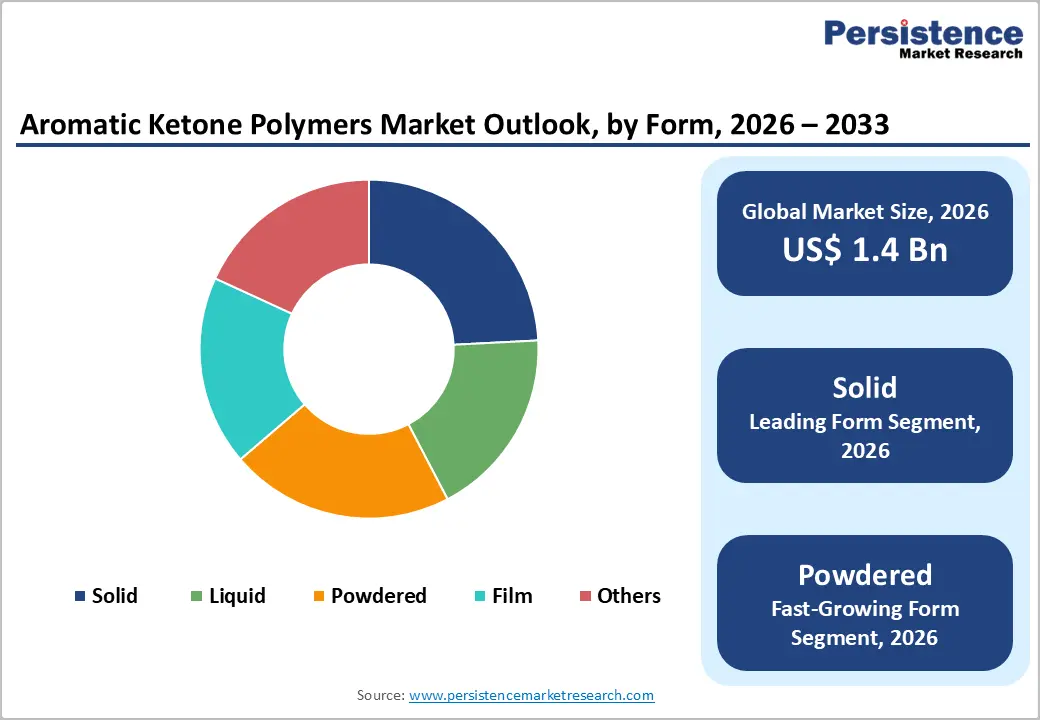
Solid form leads the market with a 52% share in 2025, primarily due to its ease of handling and consistent processing characteristics. ISO 1133 melt flow standards confirm improved uniformity, reducing defects during injection molding processes. Industry data indicates that a majority of engineering polymers are supplied in solid form, making them highly suitable for automated, high-volume production across automotive and electronics sectors.
Powder form is witnessing the fastest growth, driven by increasing demand in additive manufacturing and coatings applications. Its suitability for processes such as laser sintering enables the production of complex and lightweight components. The growing use in advanced manufacturing environments, along with rising demand for precision-based applications, is driving the rapid expansion of powder-based aromatic ketone polymers.
Processing Technology Insights
Injection molding holds the leading position with a 48% market share in 2025, supported by its efficiency in producing high-volume, complex components. Industry standards highlight cycle times under 30 seconds, significantly reducing production costs. Its widespread adoption across automotive and aerospace industries ensures consistent quality and scalability, making it the preferred processing method for aromatic ketone polymers.
Additive manufacturing is the fastest-growing processing technology due to its ability to create intricate designs with minimal material waste. The increasing demand for customized components and rapid prototyping is driving adoption. Its application across aerospace, medical, and electronics sectors enables improved design flexibility, reduced lead times, and enhanced performance, positioning it as a key growth driver.
Application Insights
Plastics and composites account for the largest share at 40% in 2025, driven by their superior strength-to-weight ratio and durability. Industry testing standards validate high modulus performance, making them ideal for structural applications. Growing demand in the aerospace and automotive sectors further supports their dominance, particularly in applications requiring lightweight yet high-strength materials.
Medical devices represent the fastest-growing application segment, supported by increasing demand for biocompatible and sterilizable materials. Aromatic ketone polymers are increasingly used in implants, surgical instruments, and diagnostic equipment. Their ability to meet strict healthcare standards, combined with rising investments in medical technology, is accelerating their adoption in advanced healthcare applications.
Industry Insights
The automotive sector leads the market with a 35% share in 2025, driven by increasing electrification and the need for lightweight, high-performance materials. Industry production data highlights strong vehicle output, with growing EV penetration further boosting demand. Aromatic ketone polymers are widely used in battery components and under-the-hood applications due to their ability to withstand high temperatures.
Healthcare is the fastest-growing end-user industry, fueled by rising demand for advanced medical materials and devices. The increasing focus on minimally invasive procedures and durable implants is driving adoption. Aromatic ketone polymers offer excellent biocompatibility and sterilization resistance, making them highly suitable for modern medical applications and supporting rapid growth in this segment.
Regional Insights
North America Aromatic Ketone Polymers Market Trends and Insights
North America holds a significant position in the aromatic ketone polymers market, accounting for approximately 30% share in 2025, driven largely by the United States. Strong R&D ecosystems and certifications from organizations like NSF International are accelerating adoption in medical devices, with over 500 polymer-based implants approved in 2024. Advanced aerospace initiatives and regulatory frameworks further strengthen regional demand.
Investments in aerospace and defense remain a key growth catalyst, particularly as programs such as NASA’s Artemis mission require high-temperature-resistant materials. Additionally, expanding advanced manufacturing hubs and rising use of high-performance polymers in healthcare and electronics continue to reinforce innovation-driven market expansion across the region.
Europe Aromatic Ketone Polymers Market Trends and Insights
Europe demonstrates steady growth supported by strong regulatory alignment and advanced material innovation, with a projected CAGR of around 8.5% during the forecast period. Germany leads through research initiatives from institutions such as the Fraunhofer Institute, while REACH compliance enhances adoption across automotive applications, accounting for a notable share of polymer usage.
Ongoing investments in aerospace and sustainable technologies are driving further adoption. The UK’s Aerospace Technology Institute's funding and the increasing use of advanced polymers in aircraft manufacturing highlight the region's strength. Additionally, countries like France and Spain are expanding renewable and industrial applications, supporting consistent demand for high-performance materials.
Asia Pacific Aromatic Ketone Polymers Market Trends and Insights
Asia Pacific leads the global market with approximately 38% share in 2025, driven by strong manufacturing capabilities and industrial expansion. China remains the dominant contributor through initiatives such as “Made in China 2025,” while regional growth is supported by increasing production of high-performance plastics and rising demand across automotive and electronics sectors.
The region is also the fastest-growing, fueled by rapid electrification and supportive government policies. Japan continues to advance material innovation in electronics, while India and ASEAN countries benefit from aggressive EV adoption targets, including India’s goal of 30% EV penetration by 2030, significantly boosting demand for advanced polymer materials.
Competitive Landscape
The aromatic ketone polymers market is moderately consolidated, characterized by a limited number of established players with strong technological capabilities. Competition is driven by continuous capacity expansions, particularly in Asia, to meet rising demand. Companies are investing heavily in research and development to introduce advanced and bio-based polymer variants, while maintaining strict quality standards supported by certifications such as ISO 9001.
Key competitive differentiation lies in the ability to offer customized formulations tailored to specific end-use requirements. Market participants are also increasingly focusing on sustainability collaborations and adopting digital technologies such as digital twins for process optimization, improving efficiency, reducing costs, and enhancing product performance across high-value applications.
Key Developments:
- In March 2025, Solvay launched a next-generation PEEK grade designed for electric vehicle batteries, delivering around 20% higher thermal conductivity and improved heat management, supporting safer and more efficient battery system performance.
- In July 2024, Victrex expanded its U.S. manufacturing facility capacity by approximately 50% to address rising demand from aerospace applications, strengthening supply capabilities and supporting increased adoption of high-performance polymers.
- In January 2025, Evonik Industries AG introduced a recyclable polyurethane ketone tailored for medical applications, enhancing sustainability while meeting strict biocompatibility and sterilization requirements for advanced healthcare devices and components.
Global Aromatic Ketone Polymers Market – Key Insights
| Key Insights | Details |
|---|---|
|
Historical Market Value (2020) |
US$ 0.9 Bn |
|
Current Market Value (2026) |
US$ 1.4 Bn |
|
Projected Market Value (2033) |
US$ 2.5 Bn |
|
CAGR (2026-2033) |
8.7% |
|
Leading Region |
Asia Pacific, 38% share |
|
Dominant Application |
Plastics & Composites, 40% share |
|
Top-ranking Product |
Polyether Ketone, 45% |
|
Incremental Opportunity |
US$ 1.1 Bn |
Companies Covered in Aromatic Ketone Polymers Market
- Victrex plc
- Syensqo
- Arkema S.A.
- Jilin Joinature Polymer Co., Ltd.
- Panjin Zhongrun High Performance Polymer Co., Ltd.
- Ensinger GmbH
- Toray Industries, Inc.
- Mitsubishi Chemical Corporation
- RTP Company
- DIC Corporation
- Gharda Chemicals Ltd.
- Drake Plastics Ltd. Co.
- Evonik Industries AG
- SABIC
- Shandong Kaisheng New Materials Co., Ltd.
Frequently Asked Questions
The global Aromatic Ketone Polymers Market is expected to reach US$ 1.4 billion in 2026, growing to US$ 2.5 billion by 2033 at 8.7% CAGR.
Key drivers include automotive lightweighting for fuel efficiency and advancements in 3D printing, supported by IEA EV sales data and ASTM standards.
Asia Pacific leads with 38% share in 2025, propelled by China's manufacturing and India's EV policies.
Expansion in healthcare devices offers potential, with FDA approvals rising 15% annually amid aging populations per WHO.
Leading companies include Solvay, Victrex, Evonik, and Arkema, focusing on R&D and expansions.


