




- Specialty & Fine Chemicals
- Proline Market
Proline Market Size, Share, and Growth Forecast, 2026 - 2033
Proline Market by Product Type (L-Proline, D-Proline), Application (Pharmaceuticals, Food & Beverages, Animal Feed, Cosmetics), and Regional Analysis for 2026 - 2033

Proline Market Size and Trends Analysis
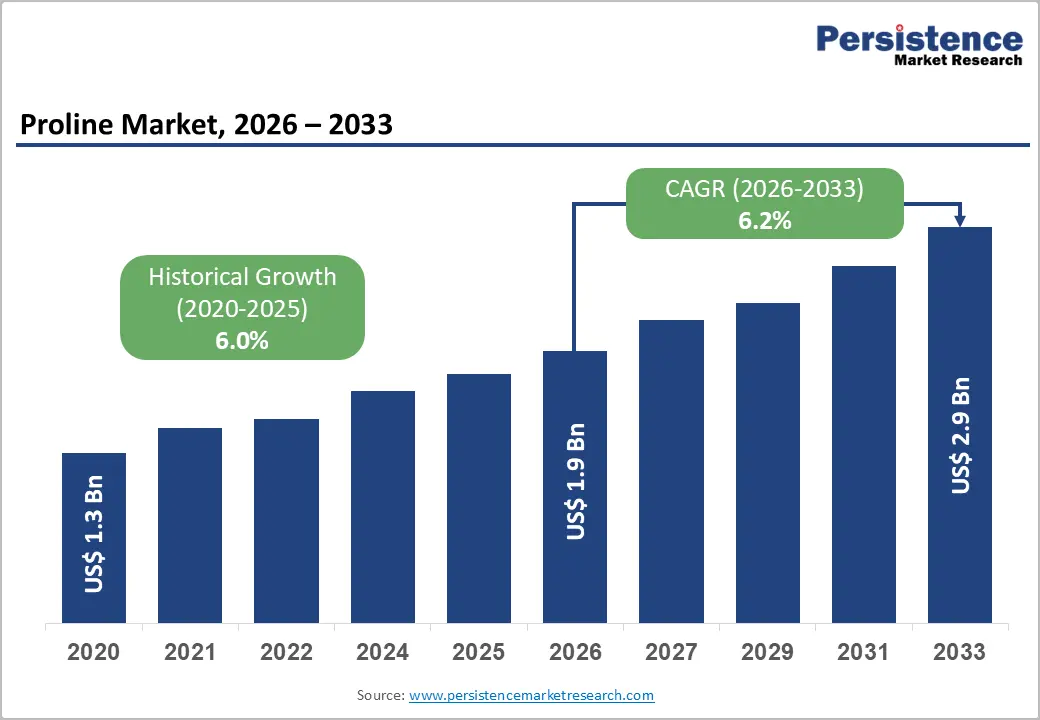
The global proline market size is likely to be valued at US$1.9 billion in 2026 and is expected to reach US$2.9 billion by 2033, growing at a CAGR of 6.2% during the forecast period from 2026 to 2033, driven by rising use in biopharmaceutical formulations, collagen synthesis, and functional nutrition products, with strong demand across health and wellness industries.
Proline (pyrrolidine-2-carboxylic acid) is a non-essential amino acid that serves as a critical building block in collagen synthesis, protein structure stabilization, and diverse biochemical pathways. Pharmaceutical applications remain the dominant consumption area, driven by expanding biologics and peptide research, while food and nutraceutical use is accelerating due to increasing consumer focus on collagen support, skin health, and preventive healthcare trends.
Key Industry Highlights:
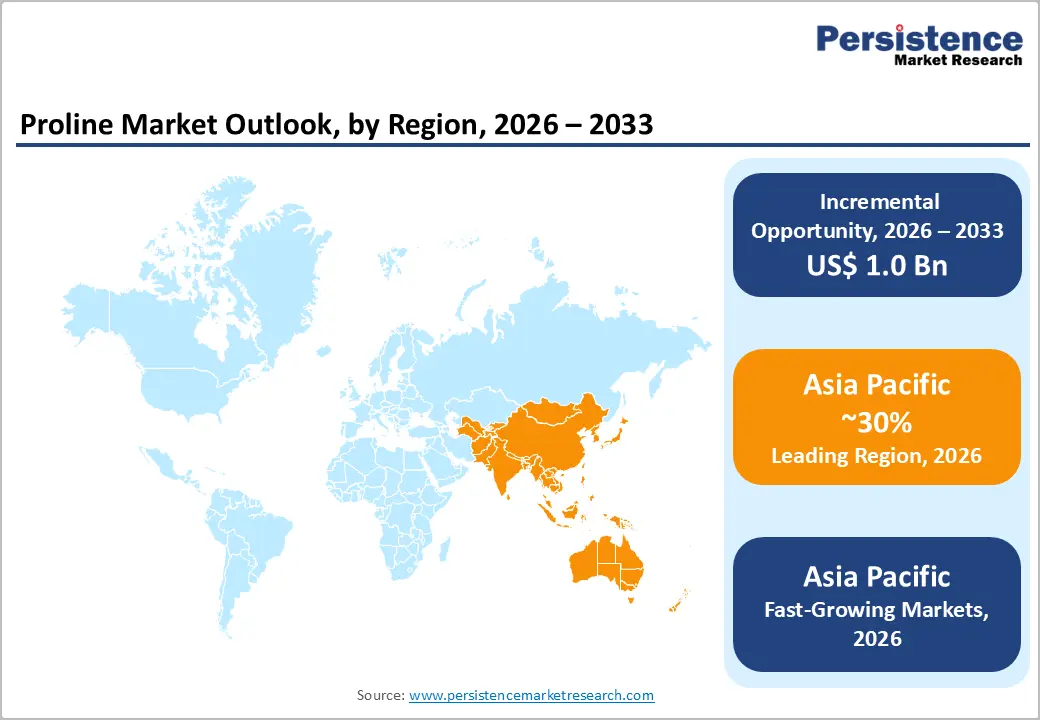
- Leading Region: Asia Pacific is anticipated to be the leading region, accounting for a market share of 30% in 2026, driven by strong pharmaceutical expansion, rising bio-based amino acid production, and increasing export activity.
- Fastest-growing Region: North America is likely to be the fastest-growing region, supported by pharmaceutical dominance, biotech R&D growth, rising supplement demand, and a strong FDA-regulated innovation ecosystem.
- Leading Product Type: L-Proline is projected to represent the leading product type in 2026, accounting for 80% of the revenue share, driven by its natural biological presence and widespread use in pharmaceuticals and food applications.
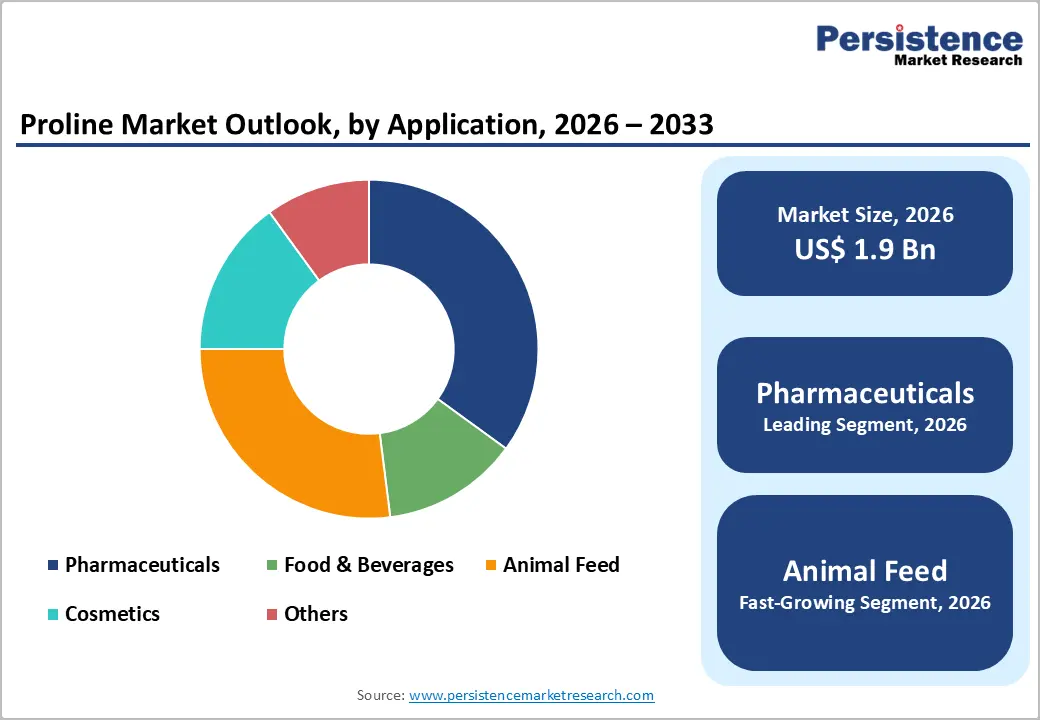
- Leading Application: Pharmaceuticals are anticipated to be the leading application, accounting for over 40% of the revenue share in 2026, supported by strong demand in therapeutic and collagen-based treatments.
- Key Opportunity: The key opportunity in the proline market lies in the shift toward biotech-driven, sustainable amino acid production integrated with growing demand across pharmaceuticals, nutraceuticals, and functional food applications.
DRO Analysis
Driver - Escalating Demand from the Pharmaceutical Sector
The increasing prevalence of chronic diseases, aging populations, and rising focus on regenerative medicine are expanding the usage of proline in drug formulations. Proline is a critical structural component in ACE inhibitors such as captopril and lisinopril, widely prescribed for hypertension and heart failure management. According to IQVIA (2025), global prescription drug sales surpassed US$1.6 trillion in 2024, with cardiovascular therapeutics accounting for a substantial portion of volume.
According to the National Institutes of Health (NIH) 2025, over 150 peptide-based drugs are currently in active clinical trials, with oncology, metabolic, and cardiovascular indications dominating the development landscape.
Growth in dermatological and anti-aging treatments is also contributing to sustained demand. Proline’s functional role in stabilizing protein structures makes it highly valuable in next-generation biologics and injectable therapies. Rising collaborations between biotech firms and pharmaceutical manufacturers are accelerating innovation, while expanding clinical research pipelines strengthen long-term consumption prospects across developed and emerging markets.
Restraint - Complex and Costly Biosynthesis Processes
Industrial production of proline often relies on fermentation or chemical synthesis methods that require controlled conditions, specialized enzymes, and high operational costs. These processes demand advanced biotechnological infrastructure, increasing capital expenditure for manufacturers. Purification of high-purity L-proline for pharmaceutical applications adds cost burdens. Variability in raw material sourcing and yield optimization challenges also affect production stability.
Maintaining consistent amino acid purity for pharmaceutical-grade applications requires stringent quality control measures, increasing compliance costs for manufacturers. Regulatory approvals for amino acid-based ingredients in different regions also create delays in commercialization and limit rapid market expansion. Dependence on specialized microbial strains and enzyme systems adds technical complexity to production cycles.
Opportunity - Biopharmaceutical and Peptide Drug Pipeline Expansion
The increasing development of advanced biologics and precision therapeutics relies heavily on amino acid building blocks. Proline plays a crucial role in stabilizing peptide structures and enhancing drug efficacy, making it highly relevant in next-generation therapies. Rising investment in monoclonal antibodies, recombinant proteins, and regenerative medicine is expanding their application scope.
Global demand for collagen-supporting ingredients has increased by over 20% in dietary supplement categories (FDA-aligned nutraceutical industry reports, 2025). Proline is widely incorporated in collagen peptides used in skin health and joint support formulations.
Proline is used in hydrolyzed collagen supplements for improving skin elasticity and reducing aging effects. Advancements in fermentation-based amino acid production are improving yield efficiency and reducing environmental impact, supporting sustainable sourcing trends. Rising consumer preference for clean-label, plant-based, and preventive health products is accelerating adoption across the food, cosmetic, and wellness industries.
Category-wise Analysis
Product Type Insights
L-Proline is expected to lead the proline market, accounting for approximately 80% of revenue in 2026, driven by its natural occurrence in proteins and extensive use across pharmaceuticals and food industries. Its biological chirality makes it highly suitable for collagen synthesis, tissue repair, and structural protein formation, which are essential in healthcare applications. For instance, L-Proline is widely used in collagen-based dietary supplements that support skin elasticity and joint health, especially in anti-aging formulations.
D-Proline is likely to represent the fastest-growing segment, supported by increasing adoption in advanced research applications, particularly in synthetic peptides and cosmetic formulations. Pharmaceutical researchers are increasingly exploring D-Proline for designing stable peptide chains in drug development. For example, D-Proline is used in synthetic peptide-based drug candidates that require improved shelf life and targeted biological activity in experimental therapeutics.
Application Insights
Pharmaceuticals are projected to lead the market, capturing around 40% of the revenue share in 2026, supported by their critical role in drug formulation, tissue repair therapies, and collagen-related medical applications. Proline is widely used in developing therapeutic solutions for skin disorders, cardiovascular treatments, and regenerative medicine due to its structural role in stabilizing proteins. A notable example includes proline, which is used in collagen-based wound healing treatments that accelerate tissue regeneration in post-surgical recovery therapies.
The animal feed is likely to be the fastest-growing application, driven by rising demand for high-quality livestock nutrition and improved animal health. Proline plays an important role in protein synthesis and immunity enhancement in animals, making it valuable in modern feed formulations. For instance, proline-enriched feed additives are increasingly used in poultry farming to improve growth performance and disease resistance in broiler chickens.
Regional Insights
North America Proline Market Trends
North America is likely to be the fastest-growing region in the proline market in 2026, growing at a CAGR of 6.5%, driven by strong pharmaceutical demand, advanced biotechnology infrastructure, and rising adoption of amino acid-based therapeutics. Pharmaceutical companies are integrating proline in biologics and skin health formulations due to its role in protein stabilization. Companies such as Evonik Industries AG are actively expanding their amino acid production capabilities in North America to support pharmaceutical-grade applications and bioprocessing innovation.
U.S. Proline Market Trends
The U.S. dominates the regional market, contributing approximately 70% share in 2026, driven by its biotech hubs such as Boston and California, strong FDA-approved peptide drug pipelines, and rising investment in regenerative medicine. Recent expansion of mRNA and peptide-based therapeutic research is increasing proline demand in advanced drug formulations.
Canada Proline Market Trends
Canada is expected to hold a smaller but growing regional market share of approximately 27% in 2026, supported by a growing nutraceutical industry, an increasing biotech startup ecosystem, and government-backed biomanufacturing incentives. Recent developments in fermentation-based amino acid production facilities are improving domestic supply chain resilience and export capacity.
Europe Proline Market Trends
Europe is likely to be a significant market for proline in 2026, growing at a CAGR of 5.8% due to strong pharmaceutical manufacturing, increasing demand for sustainable amino acid production, and advanced research in peptide therapeutics. Rising demand for collagen-based skincare and functional nutrition products is strengthening market growth. For example, BASF SE is investing in sustainable fermentation technologies to enhance amino acid production efficiency and reduce environmental impact across Europe.
U.K Proline Market Trends
The U.K. is expected to hold an estimated 25% of the regional share in 2026, supported by a strong clinical research ecosystem, rising peptide drug trials, and increasing biotech funding. Recent government-backed life sciences initiatives and growing focus on precision medicine are strengthening demand for amino acids in advanced therapeutic applications and nutraceutical innovations.
Germany Proline Market Trends
Germany is expected to dominate the regional market with approximately 35% of the regional market share in 2026, driven by a strong chemical and pharmaceutical manufacturing base, advanced fermentation technology adoption, and increasing investments in green biotech. Recent expansion of sustainable amino acid production facilities and R&D partnerships with universities is accelerating innovation in peptide and protein-based drug development.
Asia Pacific Proline Market Trends
The Asia Pacific region is anticipated to be the leading regional market, accounting for a market share of 30% in 2026, driven by rapid industrialization, expanding pharmaceutical manufacturing, and strong demand for amino acids in food and nutraceutical industries. Growing biotech capabilities and rising healthcare awareness are strengthening market growth. For example, Ajinomoto Co. Inc. is expanding its fermentation-based amino acid production capacity in Asia to meet rising pharmaceutical and food-grade demand.
China Proline Market Trends
China is expected to dominate the regional market with approximately 40% share in 2026, driven by the large-scale fermentation industry, strong export-oriented amino acid manufacturing, and rapid expansion of pharmaceutical and food additive production. Recent developments in biotech industrial parks, especially in Shanghai and Shandong, are increasing high-purity amino acid output and supply chain integration.
India Proline Market Trends
India is expected to hold approximately 20% regional market share, supported by a fast-growing pharmaceutical sector, increasing nutraceutical demand, and a strong API manufacturing base. Recent government initiatives, such as Make in India and biotech production-linked incentives, are encouraging the expansion of amino acid and fermentation-based industries, strengthening both domestic supply and export potential.
Competitive Landscape
The global proline market exhibits a moderately fragmented structure, driven by the presence of a few dominant multinational amino acid producers alongside several regional and niche manufacturers. The market is characterized by strong competition in fermentation-based production, product purity differentiation, and increasing focus on sustainable and high-efficiency manufacturing technologies.
With key leaders including Ajinomoto Co. Inc., Evonik Industries AG. Ltd., and BASF SE, the competitive environment is shaped by advanced R&D capabilities, distribution strength, and specialization in high-purity L-proline production. These players compete through continuous innovation in fermentation technology, strategic partnerships, and the development of application-specific amino acid solutions for the pharmaceutical and food industries.
Key Industry Developments:
- In January 2026, Evonik Industries AG focused on expanding amino acid production and improving fermentation efficiency, aligning with the rising demand for high-purity amino acids such as proline in pharmaceuticals and animal nutrition.
- In April 2026, Ajinomoto Co. Inc. developed plant-derived culture media technology for cultivated meat, significantly reducing costs in amino acid usage, including proline, and enhancing biotech applications in cell-based protein production.
- In March 2026, Ajinomoto Co. Inc. announced a new fermentation-based manufacturing process for amino acid-derived biosurfactants, directly impacting proline and related amino acid production by improving sustainability and reducing dependence on palm-based inputs.
Companies Covered in Proline Market
- Ajinomoto Co. Inc.
- Kyowa Hakko Bio Co., Ltd.
- Evonik Industries AG
- Sigma-Aldrich Corporation
- TCI Chemicals
- Wuxi Jinghai Amino Acid
- Shijiazhuang Haitian Amino Acid
- Tokyo Chemical Industry
- Merck KGaA
- Thermo Fisher Scientific
- BASF SE
- Universal Starch Chem Allied Ltd.
Frequently Asked Questions
The global proline market is projected to reach US$1.9 billion in 2026.
The proline market is driven by rising demand in pharmaceuticals, collagen-based nutraceuticals, and functional foods, supported by growing health awareness and biotech advancements.
The proline market is expected to grow at a CAGR of 6.2% from 2026 to 2033.
Key opportunities in the proline market lie in expanding biopharmaceutical and peptide drug development, growing demand for collagen-based nutraceuticals, and advancements in sustainable fermentation technologies.
Ajinomoto Co. Inc., Kyowa Hakko Bio Co. Ltd., Evonik Industries AG, Sigma-Aldrich Corporation, and TCI Chemicals are the leading players.


