




- Food Ingredients & Additives
- Algae Derived Products Market
Algae Derived Products Market Size, Share, and Growth Forecast, 2026 - 2033
Algae Derived Products Market By Product Type (Hydrocolloids, Algal Proteins, Others), Algae Source (Macroalgae/Seaweed, Microalgae, Others), Application, Cultivation and Regional Analysis for 2026 - 2033

Algae Derived Products Market Size and Trends Analysis
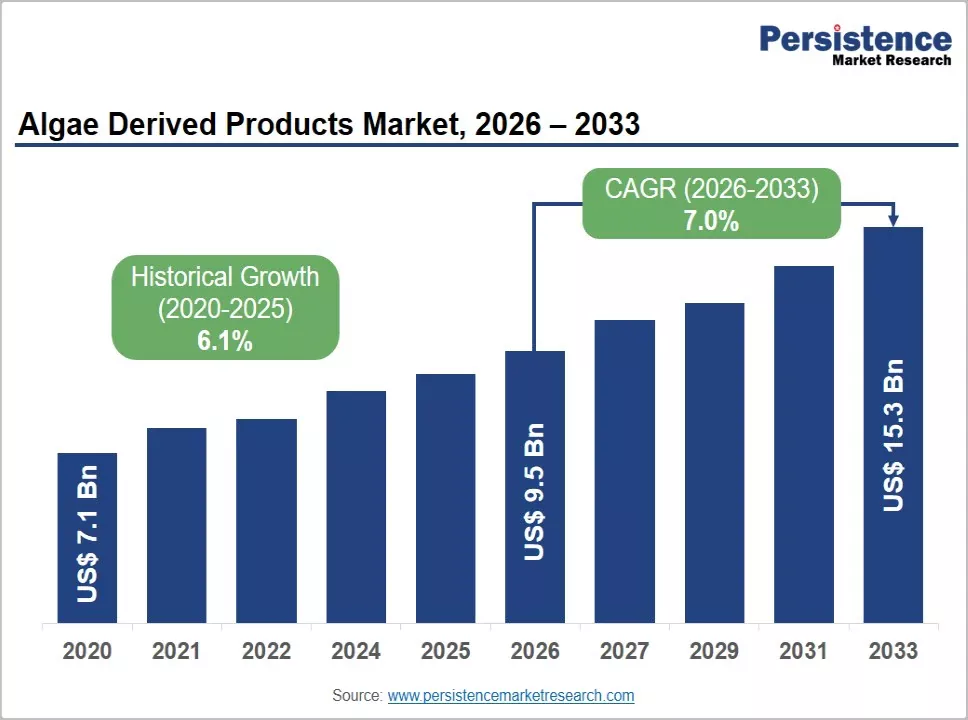
The global algae derived products market size is likely to be valued at US$9.5 billion in 2026 and is expected to reach US$15.3 billion by 2033, growing at a CAGR of 7.0% between 2026 and 2033.
The market is expanding as food manufacturers, nutraceutical companies, cosmetics producers, and agricultural businesses incorporate algae-derived ingredients into commercial products. Hydrocolloids and seaweed-based ingredients provide an established revenue base, while algal proteins, omega-3 oils, and bioactive extracts create opportunities for product diversification.
Growth will depend on the expansion of established food applications and the commercialization of higher-value nutritional ingredients, specialty pigments, agricultural inputs, and industrial materials. Manufacturers must address cultivation costs, processing efficiency, raw-material consistency, and regulatory requirements to maintain competitiveness.
Key Industry Highlights
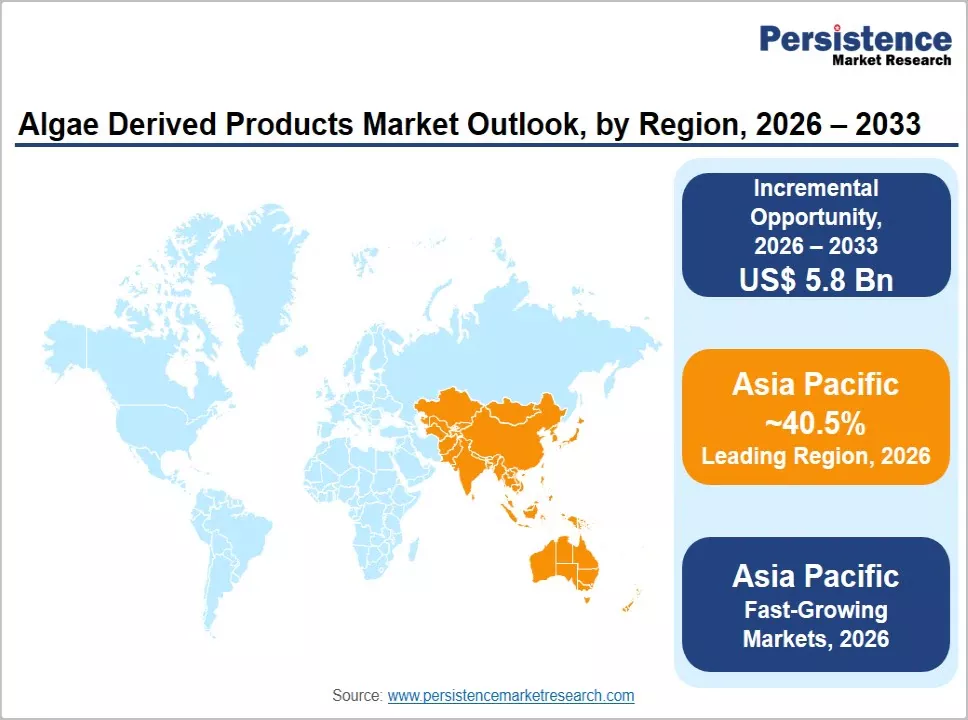
- Leading Region: Asia Pacific is the leading region, accounting for an anticipated 40.5% market share, supported by established seaweed cultivation, large-scale processing capabilities, and rising demand for algae-derived food.
- Fastest-Growing Region: Asia Pacific is also expected to be the fastest-growing region, driven by investments in seaweed farming, microalgae processing, and specialty ingredients.
- Dominant Product Type: Hydrocolloids are the leading product type, accounting for approximately 36.1% of the market share, widely used in food processing for thickening, gelling, stabilization, and texture modification, supporting recurring demand from food, pharmaceutical, and personal care manufacturers.
- Leading Algae Source: Macroalgae is the leading algae source, representing approximately 77.2% of the market share, used in hydrocolloids, food ingredients, and agricultural products support this position.
DRO Analysis
Drivers - Growing Demand for Functional and Plant-Derived Ingredients
Food and beverage manufacturers increasingly use algae-derived ingredients to improve texture, stability, color, and nutritional composition. Seaweed-derived agar, alginates, and carrageenan serve as gelling, thickening, and stabilizing agents, while microalgae provide proteins, pigments, and omega-3 fatty acids. The Food and Agriculture Organization of the United Nations reported global algae production of 37.8 million metric tons in 2022, demonstrating the scale of the underlying resource base. Demand from plant-based foods and functional nutrition manufacturers creates additional opportunities for ingredient suppliers. Commercial success, however, depends on consistent functionality, standardized composition, appropriate safety documentation, and competitive pricing for large-scale food production.
Expansion of Sustainable Nutrition and Industrial Applications
Algae-derived oils, proteins, pigments, and agricultural extracts are gaining relevance as businesses evaluate alternative sources of nutrients and industrial inputs. Microalgae cultivated through fermentation or controlled photobioreactor systems can produce specific compounds without relying exclusively on marine harvesting. Research supported by the U.S. Department of Energy examines algae cultivation, biomass productivity, resource utilization, and conversion into fuels and other products. These activities support the development of production methods that improve consistency and resource efficiency. Manufacturers can differentiate through strain selection, extraction performance, and application-specific formulations. Adoption will depend on measurable nutritional, functional, or environmental benefits, together with commercially viable production costs.
Restraint - High Cultivation, Processing, and Quality-Control Costs
Cultivation and downstream processing costs can restrict the adoption of algae-derived ingredients, particularly in price-sensitive applications. Harvesting, dewatering, drying, extraction, purification, and quality testing add costs before biomass reaches its final market. Closed cultivation systems offer greater control over growing conditions but require investment in equipment and operating infrastructure. Open ponds have lower infrastructure requirements but face greater exposure to environmental variability and biological contamination. These differences influence production yields, consistency, and overall economics. Higher-value omega-3 oils, pigments, and specialty extracts may support more extensive processing than bulk biomass products. Manufacturers must therefore match cultivation and processing technologies to the value and technical requirements of their target markets.
Opportunities - Commercialization of Algal Proteins and Specialty Nutritional Ingredients
Algal proteins offer opportunities in plant-based foods, sports nutrition, functional beverages, and specialized nutritional formulations. Spirulina and chlorella are established sources, while other microalgal species can provide differentiated protein, lipid, and micronutrient profiles. Commercial expansion will depend on improving flavor, color, solubility, digestibility, and protein concentration. Ingredient developers can strengthen their position by collaborating with food manufacturers, standardizing production processes, and validating performance in finished products. Integrated processing systems may also recover oils and pigments alongside protein fractions, potentially improving resource utilization. Investments that increase usable protein yield and reduce processing costs are more likely to support broader adoption than business models dependent exclusively on premium pricing.
Seaweed-Based Agricultural Inputs and Integrated Biorefineries
Seaweed extracts and related compounds have applications in agricultural biostimulants, specialty fertilizers, animal nutrition, and industrial materials. India's government has included seaweed among the categories of biostimulants regulated under the Fertilizer (Control) Order, 1985, while fisheries development programs support seaweed cultivation. These initiatives create opportunities to connect cultivation with processing and agricultural distribution. Integrated biorefineries provide another potential growth pathway by separating hydrocolloids, proteins, lipids, pigments, and residual biomass into different product streams. Such systems could distribute production costs across multiple revenue-generating applications. Investors should prioritize locations with suitable cultivation conditions, reliable processing infrastructure, established customer access, and demonstrable product performance.
Category-wise Analysis
Product Type Insights
Hydrocolloids are anticipated to account for approximately 36.1% of the market share. Seaweed-derived alginates, carrageenan, and agar are widely used as thickeners, gelling agents, and stabilizers in dairy products, plant-based alternatives, confectionery, sauces, and personal care formulations. For example, carrageenan helps stabilize chocolate milk, while agar is used in confectionery and laboratory media. Established industrial applications support recurring demand, with suppliers competing on product consistency, functionality, and reliable sourcing.
Algal proteins are projected to register a CAGR of approximately 8.5%. Spirulina and chlorella are gaining attention in plant-based foods, protein powders, sports nutrition, and functional beverages. Their commercial adoption depends on improving flavor, color, solubility, and protein concentration. For instance, spirulina powder is used in smoothies and nutrition blends, while chlorella is incorporated into dietary supplements. Better processing efficiency and partnerships with food manufacturers can support broader adoption and cost competitiveness.
Algae Source Insights
Macroalgae, commonly known as seaweed, are anticipated to account for approximately 77.2% of the market share. Their leading position reflects established cultivation networks and diverse commercial uses. Brown seaweed supplies alginates used in food and industrial formulations, while red seaweed provides carrageenan and agar for products such as dairy alternatives, desserts, and specialty applications. Green seaweeds are also used in food and agricultural products. This range of applications reinforces macroalgae’s commercial importance.
Microalgae are gaining traction as sources of proteins, lipids, pigments, and bioactive compounds. Spirulina and chlorella are used in nutritional products, while selected microalgae provide omega-3 oils and pigments such as astaxanthin. For example, microalgal DHA oils are incorporated into nutritional formulations, and astaxanthin is used in dietary supplements. Fermentation and closed photobioreactors can improve control over production conditions and product consistency. Growth will depend on species selection, processing efficiency, ingredient quality, and the economics of scaling production.
Regional Insights
North America Algae Derived Products Market Trends
North America is an important market for higher-value algae-derived ingredients, supported by food innovation, nutritional supplements, biotechnology, and specialized cultivation.
United States Algae Derived Products Market Trends
The United States benefits from established microalgae production and downstream ingredient development. In April 2025, DIC Corporation’s subsidiary Earthrise Nutritionals inaugurated a new harvest plant in California, following the facility’s start of operations in March. The investment of approximately ¥1.2 billion introduced AI-based algae monitoring, automated systems, and advanced water management. These capabilities support more consistent Spirulina production and strengthen the supply of ingredients used in nutrition products and natural blue coloring such as LINABLUE®.
Canada Algae Derived Products Market Trends
Canada contributes through seaweed cultivation, extraction, and specialty ingredients. Companies such as Acadian Seaplants supply seaweed-derived products for agricultural and industrial applications. North American demand for traceable ingredients and reliable quality creates opportunities for hydrocolloids, algal proteins, pigments, and omega-3 oils. However, commercial expansion depends on production costs, regulatory compliance, and the ability to secure long-term customer contracts.
Europe Algae Derived Products Market Trends
Europe combines established ingredient manufacturing with investment in fermentation, marine biotechnology, and sustainable food alternatives. Regulatory approval remains important, particularly for novel algae species and new food applications.
France Algae Derived Products Market Trends
In April 2026, Fermentalg launched its OMEGA ΩRIGINS range of microalgae-derived EPA and DHA oils. Its flagship formulation contains 40% EPA and 20% DHA, produced through a patented fermentation process without a separate concentration step. The launch targets supplements, functional foods and beverages, and pet nutrition. It illustrates how European producers are differentiating products through concentrated formulations and controlled production rather than competing only on biomass volume.
Germany Algae Derived Products Market Trends
Germany’s established food-processing and specialty-ingredient industries provide potential routes to market for algae-based ingredients. Suppliers can integrate these materials into food stabilization, nutrition, and personal care formulations through existing customer relationships. Across Europe, ingredient-specific regulatory requirements can increase launch costs, but clear authorization pathways help companies assess market access and permitted applications before investing in large-scale production.
Asia Pacific Algae Derived Products Market Trends
Asia Pacific leads the Algae Derived Products market, with an anticipated share of approximately 40.5%, supported by seaweed cultivation, processing capacity, traditional algae consumption, and rising demand for nutritional ingredients. China, Japan, India, Indonesia, and South Korea contribute through different combinations of cultivation, manufacturing, and consumption.
China Algae Derived Products Market Trends
China offers substantial growth opportunities for algae-derived nutrition ingredients. In July 2025, Corbion secured registrations from China’s General Administration of Customs for its AlgaPrime™ DHA and AlgaVia™ DHA brands, enabling commercialization in human and animal nutrition. Produced using controlled microalgae fermentation, these products offer alternatives to fish-derived omega-3 ingredients. The approvals improve market access for Corbion and illustrate how regulatory clearance can help international suppliers serve China’s expanding nutrition and feed industries.
India Algae Derived Products Market Trends
India is expanding its seaweed cultivation base through government-backed infrastructure and coastal development initiatives. According to the Ministry of Fisheries, seaweed production increased from 18,890 metric tons in 2015 to 74,083 metric tons in 2024. The government has identified 384 potential cultivation sites covering 24,707 hectares and supported projects involving cultivation infrastructure, seed banks, and a Multipurpose Seaweed Park in Tamil Nadu. These initiatives could strengthen supplies for carrageenan, agar, agricultural biostimulants, food, and personal care products. Commercial growth will depend on reliable seed supply, processing capacity, quality control, and stronger links between cultivators and ingredient buyers.
Overall, regional competition reflects different strengths: North America emphasizes specialized production and ingredient innovation, Europe focuses on differentiated products and regulatory readiness, while Asia Pacific benefits from established seaweed supply chains and expanding cultivation. Across all three regions, scalable production, consistent quality, and customer access will determine which opportunities translate into sustainable growth.
Competitive Landscape
The algae derived products market is fragmented across global ingredient manufacturers, hydrocolloid specialists, microalgae biotechnology companies, and regional seaweed processors. Larger ingredient groups benefit from established distribution networks, technical sales teams, and diversified product portfolios. Specialist producers compete through cultivation expertise, proprietary strains, extraction technologies, and application-specific formulations. Hydrocolloids provide an established competitive base, while microalgal oils, proteins, and pigments create opportunities for technology-led differentiation.
Leading participants prioritize product innovation, production efficiency, regulatory expansion, and geographic market development. Larger ingredient groups leverage distribution networks and application laboratories, while specialist producers focus on proprietary strains, concentrated compounds, and targeted formulations. Partnerships among cultivators, processors, researchers, and customers can accelerate commercialization. Emerging strategies emphasize integrated biomass utilization, controlled fermentation, traceability, and consistent quality to reduce supply-chain risk.
Key Industry Developments
- In April 2026, Corbion announced that it had secured a new U.S. patent for its AlgaPrime™ DHA LS algae-derived omega-3 technology, strengthening its intellectual property portfolio for aquaculture, animal nutrition, and pet food applications while reinforcing its fermentation-based innovation strategy.
- In April 2026, Fermentalg announced the launch of its OMEGA ΩRIGINS range, featuring microalgae-derived EPA and DHA oils with high-concentration formulations designed to expand its presence in dietary supplements, functional foods, and pet nutrition markets.
Companies Covered in Algae Derived Products Market
- Cargill, Incorporated
- Corbion N.V.
- DIC Corporation
- dsm-firmenich AG
- Cyanotech Corporation
- CP Kelco
- KIMICA Corporation
- Acadian Seaplants Limited
- Gelymar S.A.
- E.I.D.-Parry (India) Limited
- Fermentalg S.A.
- AstaReal Co., Ltd.
- Roquette Frères
- Euglena Co., Ltd.
- Allmicroalgae Natural Products S.A.
- BlueBioTech International GmbH
Frequently Asked Questions
The algae derived products market is expected to be valued at US$ 9.5 billion in 2026.
The market is projected to reach US$ 15.3 billion by 2033.
Key trends include growing demand for seaweed-derived hydrocolloids, expanding use of microalgal proteins and omega-3 oils, increased investment in fermentation-based production, and the development of seaweed-based agricultural biostimulants.
Hydrocolloids are the leading product type, accounting for approximately 36.1% of the market.
The market is forecast to grow at a CAGR of 7.0% between 2026 and 2033.
Major companies include Cargill, Incorporated, Corbion N.V., DIC Corporation, dsm-firmenich AG and Cyanotech Corporation,


