




- Beverages
- Alcohol Infusion Ingredients Market
Alcohol Infusion Ingredients Market Size, Share, and Growth Forecast, 2026 - 2033
Alcohol Infusion Ingredients Market by Ingredients Type (Yeast, Enzymes, Colorants, Flavors & Salts), Application (Whiskey, Rum, Vodka, Brandy, Tequila), and Regional Analysis for 2026 - 2033

Alcohol Infusion Ingredients Market Size and Trends Analysis
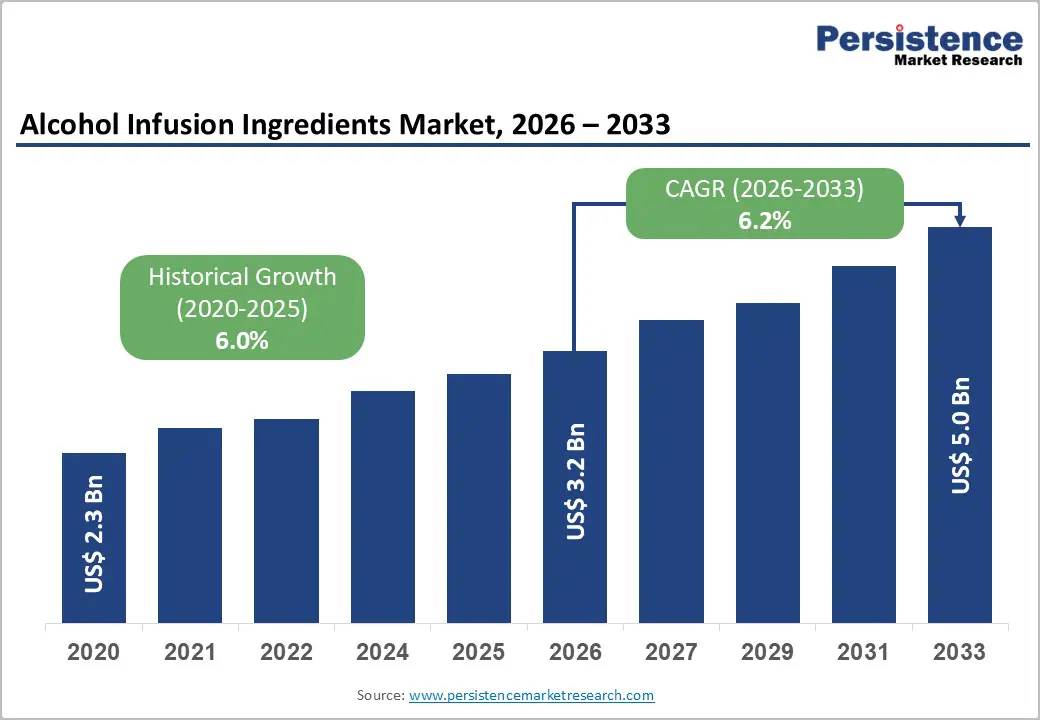
The global alcohol infusion ingredients market size is likely to be valued at US$3.2 billion in 2026 and is expected to reach US$5.0 billion by 2033, growing at a CAGR of 6.2% during the forecast period from 2026 to 2033, driven by evolving consumer preferences toward premium, flavored, and customized alcoholic beverages, particularly within the spirits segment.
This market comprises a range of functional and flavor-enhancing components such as yeast, enzymes, colorants, and flavors & salts, which are used not only in infusion processes but also across various stages of alcohol production to create distinctive taste, aroma, and visual profiles. Increasing demand for craft spirits and artisanal beverages has significantly accelerated the use of innovative infusion ingredients, as distillers seek to differentiate their offerings through unique botanical blends, exotic fruit infusions, and complex flavor layering. The rapid growth of ready-to-drink (RTD) cocktails and flavored alcoholic beverages has increased the adoption of these ingredients, as manufacturers focus on convenience-driven yet premium-quality products.
Key Industry Highlights:
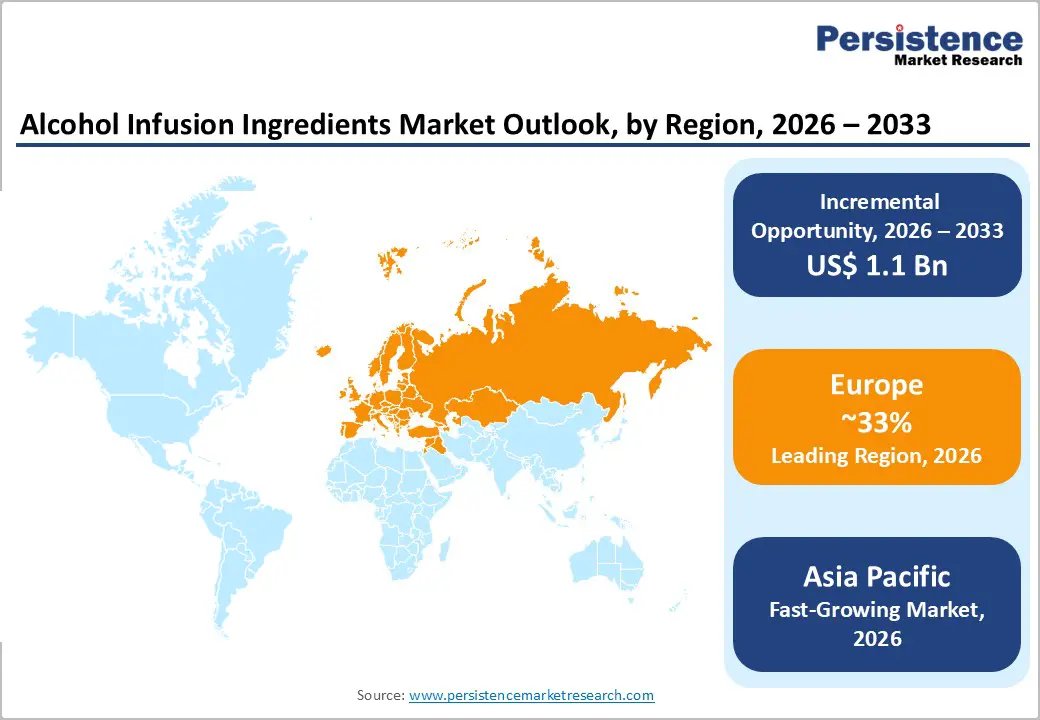
- Leading Region: Europe is anticipated to be the leading region, accounting for a market share of 33% in 2026, driven by strong demand for premium infused spirits and established distilling traditions.
- Fastest-growing Region: Asia Pacific is likely to be the fastest-growing region, supported by rapid urbanization, rising middle-class consumption, and growing demand for premium and flavored alcoholic beverages.
- Leading Ingredients Type: Flavors & salts are projected to represent the leading ingredients type in 2026, accounting for 40% of the revenue share, driven by their key role in enhancing taste and customization in infused spirits.
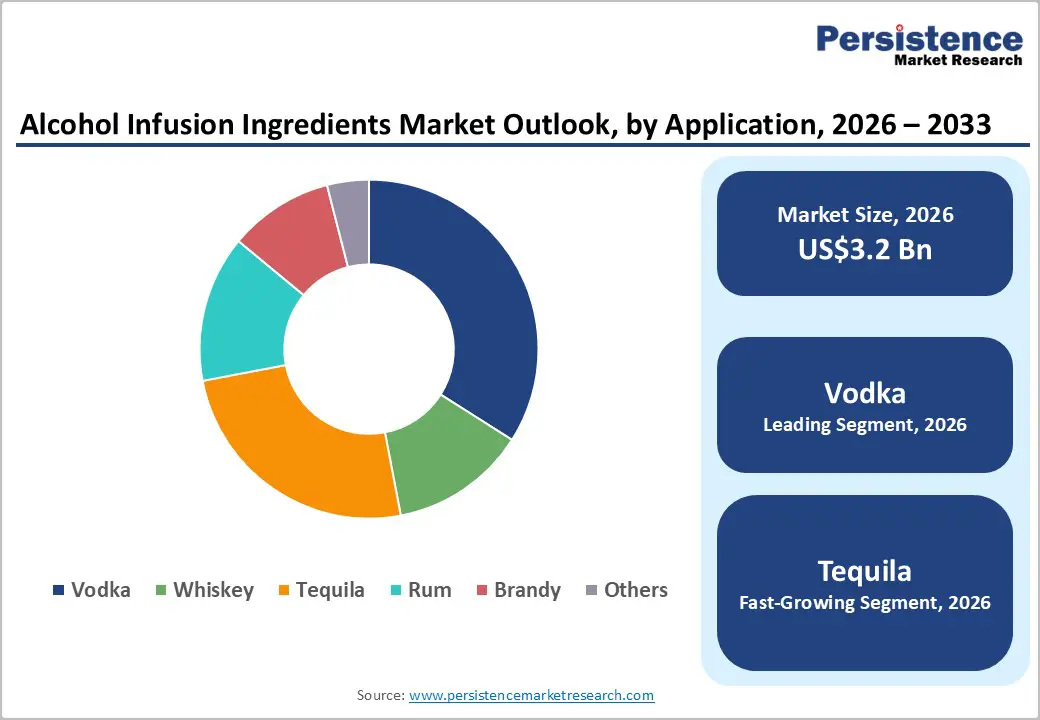
- Leading Application: Vodka is anticipated to be the leading application, accounting for over 35% of the revenue share in 2026, supported by its neutral base and high suitability for flavor infusions.
| Key Insights | Details |
|---|---|
|
Alcohol Infusion Ingredients Market Size (2026E) |
US$3.2 Bn |
|
Market Value Forecast (2033F) |
US$5.0 Bn |
|
Projected Growth (CAGR 2026 to 2033) |
6.2% |
|
Historical Market Growth (CAGR 2020 to 2025) |
6.0% |
DRO Analysis
Driver - Rising Demand for Premium and Flavored Spirits
The shift toward premiumization is significantly influencing the alcohol infusion ingredients landscape, as consumers increasingly seek high-quality, distinctive drinking experiences. This trend is especially evident in spirits such as whiskey, vodka, and tequila, where infusion ingredients such as natural flavors, botanicals, and specialty salts play a key role in differentiation. Consumers are moving away from standard products toward artisanal and craft offerings that emphasize authenticity, origin, and unique taste profiles.
The growing popularity of flavored alcoholic beverages and ready-to-drink cocktails is accelerating the use of infusion ingredients across production processes. Flavor experimentation, including exotic fruits, herbs, and spices, has become a central strategy for brands aiming to capture evolving consumer preferences. Clean-label trends push producers to adopt natural and minimally processed ingredients, aligning with health-conscious consumption patterns.
Expansion of Craft Distilling and Cocktail Culture
The rapid growth of craft distilleries worldwide is a major catalyst for the increased use of alcohol infusion ingredients, as smaller producers focus on creating unique and localized spirit offerings. Craft distillers prioritize experimentation with flavors, often incorporating regional fruits, herbs, and spices to develop signature products. This trend enhances demand for high-quality infusion ingredients that enable differentiation in a crowded marketplace. The emphasis on small-batch production and storytelling around ingredients also elevates consumer perception, making infusion components a critical part of brand identity and value creation within the premium spirits segment.
The rising influence of cocktail culture, driven by mixologists and social drinking trends, is increasing the adoption of infusion ingredients in both commercial and home settings. Bars and restaurants are increasingly using infused spirits to craft innovative cocktails, while consumers are replicating these experiences at home using DIY kits. This cultural shift promotes continuous demand for diverse and customizable ingredients, encouraging suppliers to innovate with new flavor profiles and formats. As cocktail consumption becomes more experiential, infusion ingredients remain central to delivering creativity, consistency, and enhanced sensory appeal across various consumption occasions.
Restraint - Regulatory Hurdles in Alcohol Production and Ingredient Approval
Stringent regulatory frameworks governing alcohol production and ingredient usage present a significant challenge for market participants. Approval processes for additives such as colorants, enzymes, and flavoring agents vary across regions, often requiring extensive testing and compliance with safety standards. These regulations can delay product launches and increase operational costs for manufacturers and ingredient suppliers. In regions with strict labeling and formulation guidelines, companies must invest additional resources to ensure transparency and adherence, which limits flexibility in innovation and slows the introduction of new infusion-based products into the market.
Evolving regulations around health, safety, and environmental impact complicate the landscape for alcohol infusion ingredients. Authorities increasingly emphasize the use of natural and safe ingredients, restricting certain synthetic compounds and enforcing tighter controls on sourcing and production methods. This creates additional pressure on manufacturers to reformulate products and maintain compliance across multiple jurisdictions. Smaller players, in particular, face barriers to entry due to high compliance costs and limited regulatory expertise.
Competitive Threats from Synthetic Alternatives and Substitution
The availability of low-cost synthetic flavoring agents and substitutes poses a notable restraint for the alcohol infusion ingredients market, particularly for natural and premium product segments. Synthetic alternatives often offer longer shelf life, cost efficiency, and consistent flavor profiles, making them attractive for large-scale production. This creates pricing pressure on suppliers of natural infusion ingredients, which typically involve higher sourcing and processing costs.
Substitution threats arise from the increasing popularity of low-alcohol and non-alcoholic beverages that use alternative flavoring systems. These products often rely on different ingredient compositions, reducing dependence on traditional alcohol infusion inputs. Consumer shifts toward health-conscious lifestyles accelerate this trend, impacting overall demand for infusion ingredients used in alcoholic beverages. To remain competitive, market players must continuously innovate and highlight the value of natural, authentic ingredients while addressing cost and scalability challenges associated with their production and supply chains.
Opportunity - Technological Convergence with Clean-Label and Sustainable Ingredients
Advancements in food and beverage technology are creating strong opportunities for the integration of clean-label and sustainable infusion ingredients in alcohol production. Innovations in extraction techniques, fermentation optimization, and flavor encapsulation are enabling manufacturers to develop high-quality, natural ingredients with improved stability and performance. These technologies support the growing demand for transparency and minimal processing, allowing producers to offer products that align with consumer expectations for authenticity and health-conscious consumption without compromising on taste or shelf life.
The convergence of sustainability and technology is encouraging the adoption of eco-friendly sourcing and production practices. Ingredient suppliers are increasingly investing in renewable raw materials, waste reduction methods, and energy-efficient processes to meet environmental standards and corporate responsibility goals. As consumers become more aware of sustainability issues, companies that leverage advanced technologies to deliver clean-label and environmentally responsible infusion ingredients are well-positioned to capture emerging growth opportunities.
Rising Demand for Sustainable and Organic Ingredient Sourcing
The increasing consumer preference for sustainably sourced and organic products is creating significant growth opportunities within the alcohol infusion ingredients market. Consumers are becoming more conscious of the environmental and ethical impact of their purchases, leading to higher demand for ingredients derived from organic farming and responsible supply chains. This shift is particularly relevant in premium spirits, where brand narratives around sustainability and natural sourcing enhance product appeal.
Regulatory support and industry initiatives promoting sustainable practices are encouraging wider adoption of eco-friendly ingredient sourcing. Certifications related to organic production and sustainability are gaining importance, influencing purchasing decisions across both commercial producers and end consumers. Companies that invest in traceability, ethical sourcing, and environmentally friendly processes can strengthen their market position and build long-term customer loyalty.
Category-wise Analysis
Ingredients Type Insights
Flavors & salts are expected to lead the alcohol infusion ingredients market, accounting for approximately 40% of revenue in 2026, driven by their critical role in shaping the sensory profile of alcoholic beverages. These ingredients enable producers to create distinctive taste, aroma, and visual appeal across a wide range of spirits, including whiskey, rum, and tequila. For example, a premium vodka brand introducing citrus and herb-infused variants relies heavily on natural flavor extracts and mineral salts to achieve a balanced and appealing profile.
Enzymes are likely to represent the fastest-growing segment, supported by their ability to enhance efficiency, consistency, and scalability in production processes. These biological catalysts play a vital role in fermentation and infusion by improving yield, optimizing raw material utilization, and ensuring uniform product quality. For example, a large-scale distillery producing flavored vodka utilizes advanced enzymes to enhance fermentation efficiency while maintaining consistent taste across batches.
Application Insights
Vodka is projected to lead the market, capturing around 35% of the revenue share, supported by its neutral base, which makes it highly adaptable for a wide variety of flavor infusions. This neutrality allows manufacturers to experiment extensively with fruits, herbs, spices, and other infusion ingredients without interference from inherent base flavors. For example, a globally recognized vodka brand launching berry-infused or vanilla-flavored variants depends on high-quality infusion ingredients to deliver consistent taste and visual appeal.
Tequila is likely to be the fastest-growing application, driven by rising interest in premium and flavored agave-based spirits. The segment is benefiting from shifting consumer preferences toward high-quality, artisanal beverages and the increasing popularity of tequila in cocktail culture. Infusion ingredients such as natural flavors, botanical extracts, and specialty enzymes are widely used to enhance tequila’s flavor complexity and create innovative variants that appeal to a broader audience. For example, a tequila producer introducing mango or chili-infused variants leverages specialized flavors and processing aids to achieve distinctive profiles.
Regional Insights
North America Alcohol Infusion Ingredients Market Trends
North America is likely to be a significant market for alcohol infusion ingredients, driven by strong demand for premium spirits, craft beverages, and flavored alcoholic products. The region benefits from a well-established distilling ecosystem, where craft distilleries and microbreweries actively experiment with infusion ingredients such as natural flavors, enzymes, and specialty yeast strains to create differentiated offerings. The growing popularity of ready-to-drink cocktails and mixology culture accelerates the use of infusion ingredients, particularly in the U.S.
A key trend shaping the regional landscape is the integration of advanced ingredient technologies and customized solutions tailored to premium beverage production. Major industry participants are focusing on research and development to enhance flavor stability, fermentation efficiency, and product consistency. For example, Sensient Technologies Corporation actively develops natural flavor systems and color solutions for alcoholic beverages, enabling manufacturers to create innovative infused spirits with consistent quality.
Europe Alcohol Infusion Ingredients Market Trends
Europe is anticipated to be the leading region, accounting for a market share of 33% in 2026, due to its deep-rooted heritage in brewing, winemaking, and distilling. The region’s strong emphasis on quality, authenticity, and regulatory compliance significantly influences ingredient selection, with high demand for natural yeast, botanical extracts, and specialty flavor compounds. Premiumization continues to be a dominant trend, as consumers increasingly prefer high-end, craft, and region-specific alcoholic beverages.
Sustainability and clean-label innovation are central to Europe’s market evolution, with manufacturers focusing on organic sourcing, traceability, and environmentally friendly production processes. Strict EU regulations ensure high safety and quality standards, encouraging suppliers to invest in standardized and reliable ingredient solutions. For example, Döhler GmbH is known for its natural flavor and botanical ingredient portfolio, supporting beverage producers in developing premium infused spirits aligned with clean-label trends.
Asia Pacific Alcohol Infusion Ingredients Market Trends
The Asia Pacific region is likely to be the fastest-growing region, driven by rapid urbanization, rising disposable incomes, and changing consumer lifestyles. Increasing acceptance of alcoholic beverages, particularly among younger populations, is fueling demand for premium and flavored spirits across countries such as China and India. The expansion of bars, pubs, and social drinking culture is supporting the adoption of infusion ingredients, especially in ready-to-drink formats and craft beverages.
Another significant trend is the region’s growing role as a manufacturing and supply hub for alcohol ingredients, supported by cost advantages and expanding production capabilities. Local and multinational companies are investing in capacity expansion and product innovation to cater to both domestic and international demand. For example, AngelYeast Co., Ltd. plays a crucial role in supplying fermentation ingredients used in alcoholic beverage production, enabling scalable and cost-efficient operations.
Competitive Landscape
The global alcohol infusion ingredients market exhibits a moderately fragmented structure, driven by the presence of numerous multinational ingredient manufacturers and specialized regional suppliers competing across flavor, enzyme, and fermentation technologies. The market is characterized by a mix of large-scale companies with extensive distribution networks and niche players focusing on botanical extracts, natural flavors, and craft-oriented solutions.
With key leaders, including Treatt Plc, AngelYeast Co., Ltd., Biospringer, Givaudan, Novozymes A/S, ADM, Sensient Technologies Corporation, Döhler GmbH, Ashland, and Kerry Group plc, the market demonstrates strong competitive intensity across both commodity and high-value ingredient segments. These players compete through continuous innovation in natural and clean-label ingredients, development of customized flavor solutions, and integration of advanced fermentation and enzyme technologies.
Key Industry Developments:
- In March 2026, The Spirits Business noted that RTDs are one of the few alcohol categories showing strong growth, fueled by experimentation and innovation in flavor infusion, encouraging manufacturers to adopt advanced ingredients, including botanical extracts and customized flavor systems.
- In October 2025, Beverage Daily highlighted continued growth in ready-to-drink (RTD) alcohol and canned cocktail launches, driven by strong consumer demand for premium, convenient beverages featuring authentic flavors, natural ingredients, and innovative combinations such as tequila-based and fruit-infused variants, reflecting evolving mixology trends and on-the-go consumption preferences.
Companies Covered in Alcohol Infusion Ingredients Market
- Treatt Plc
- AngelYeast Co., Ltd.
- Biospringer
- Givaudan
- Novozymes A/S
- Archer Daniels Midland Company (ADM)
- Sensient Technologies Corporation
- Döhler GmbH
- Ashland
- Kerry Group plc
Frequently Asked Questions
The global alcohol infusion ingredients market is projected to reach US$3.2 billion in 2026.
Rising demand for premium and flavored alcoholic beverages, along with the expansion of craft distilling and RTD cocktail trends, drives the alcohol infusion ingredients market.
The alcohol infusion ingredients market is expected to grow at a CAGR of 6.2% from 2026 to 2033.
Growing demand for clean-label, natural, and sustainable infusion ingredients, along with innovation in premium and RTD alcoholic beverages, presents key market opportunities.
Treatt Plc, AngelYeast Co., Ltd., Biospringer, Givaudan, Novozymes A/S, and ADM, Sensient Technologies Corporation are the leading players.


