




- Biotechnology
- Laser Capture Microdissection Market
Laser Capture Microdissection Market Size, Trends, Share, Growth, and Regional Forecast, 2026 to 2033
Laser Capture Microdissection Market by System (Instruments, Consumables, Software & Services), by Application (Research & Development, Diagnostics, Others), End-user (Contract Research Organizations, Pharmaceutical and Biotech Companies, Hospitals, Academic Institutes), and Regional Analysis, from 2026 to 2033

Laser Capture Microdissection Market Share and Trends Analysis
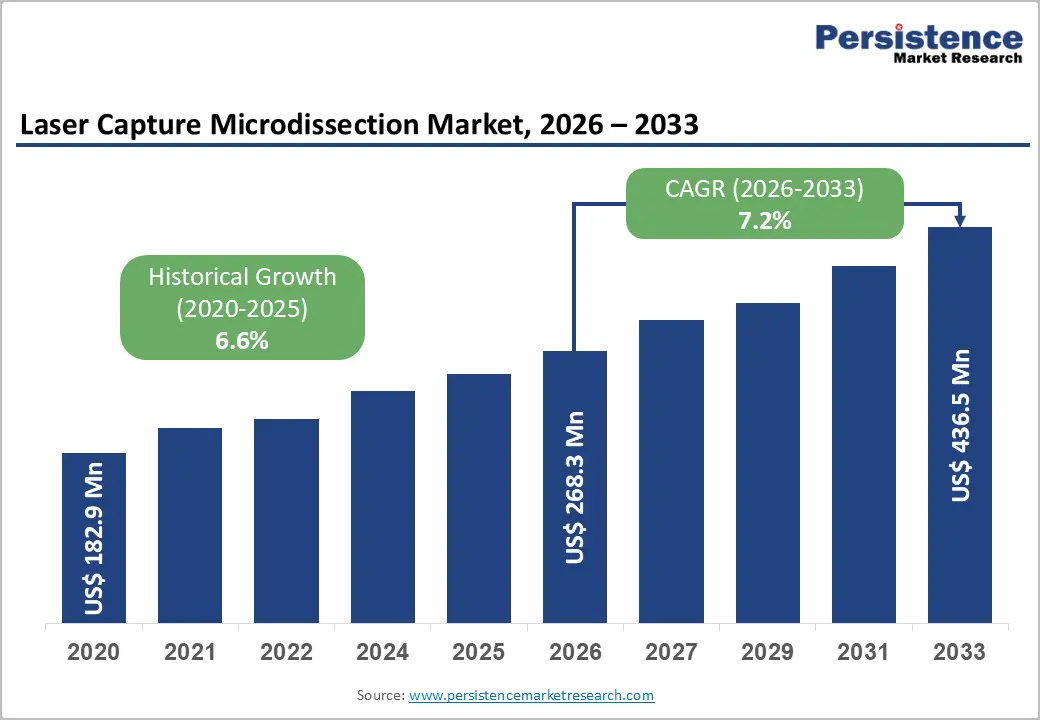
The global laser capture microdissection (LCM) market size is estimated to grow from US$ 268.3 million in 2026 to US$ 436.5 million by 2033, growing at a CAGR of 7.2% during the forecast period from 2026 to 2033.
New technologies have enabled scientists to obtain enhanced insights into processes taking place at subcellular levels. Laser capture microdissection (LCM) is observed as a key technique that can precisely collect homogenous cells, becoming an efficient method for capturing pure cell populations in molecular studies. The increasing influence of molecular analyses and cell biologics on the dynamics of life sciences & healthcare industry will promote the adoption of laser capture microdissection techniques, especially in cancer research studies.
Key Industry Highlights
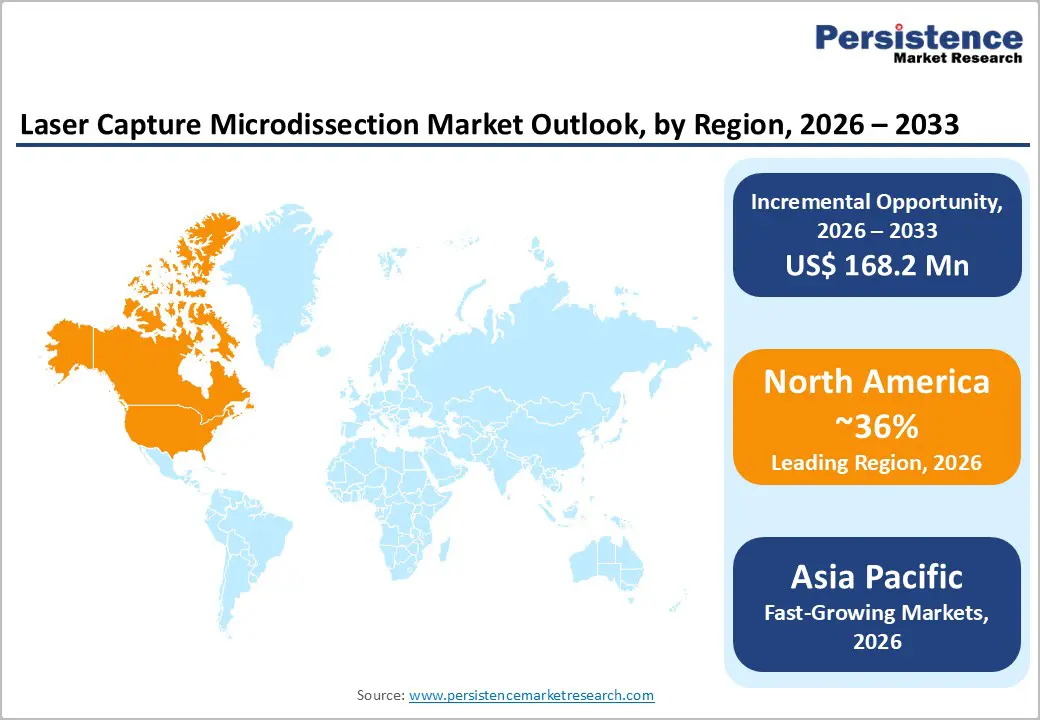
- Leading Region: North America remains the largest market, driven by advanced healthcare infrastructure, robust R&D investments, and a strong focus on cancer research, genomics, and personalized medicine.
- Fastest Growing Region: Asia Pacific is projected to achieve the fastest pace, supported by expanding research capabilities, increasing healthcare investments, and rising adoption of advanced diagnostic and analytical technologies.
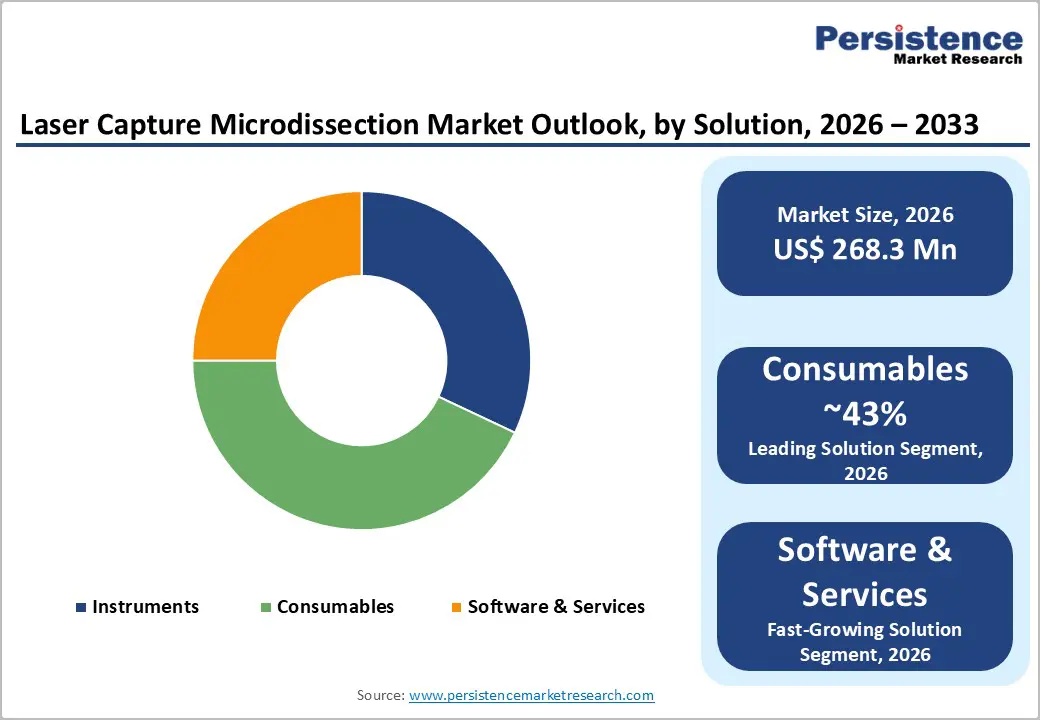
- Dominant Segment: Consumables dominate by system type, with around 43% share in 2025, due to their recurring use in every experiment and essential role in maintaining sample integrity.
- Fastest Growing Segment: Chlamydomonas protein expression is the fastest growing host type, driven by established genomes, optimized toolkits, and suitability for therapeutic protein and vaccine production.
| Key Insights | Details |
|---|---|
| Laser Capture Microdissection Market Size (2026E) | US$ 268.3 Mn |
| Market Value Forecast (2033F) | US$ 436.5 Mn |
| Projected Growth (CAGR 2026 to 2033) | 7.2% |
| Historical Market Growth (CAGR 2020 to 2025) | 6.6% |
Market Dynamics
Driver - Rising Incidence of Cancer and Demand for Precise Cell Isolation
The increasing global incidence of cancer is a major driver for the laser capture microdissection (LCM) market. Cancer’s heterogeneous nature means that tumors comprise multiple cell types, each with distinct genetic and molecular profiles, making accurate analysis critical for understanding disease progression. LCM enables researchers to isolate specific cells or microscopic regions from complex tissue samples with high precision, allowing detailed molecular and genetic studies. This capability is particularly valuable in oncology research, where understanding tumor heterogeneity can guide the development of targeted therapies and personalized treatment strategies. As cancer cases continue to rise worldwide, the demand for advanced technologies that provide accurate, cell-specific analysis, such as LCM, is expected to grow significantly over the forecast period.
Additionally, LCM’s application extends beyond oncology to molecular biology and forensic science, further supporting its adoption in specialized research areas. Its precision in isolating cells from heterogeneous samples allows researchers to perform downstream analyses, including DNA, RNA, and protein studies, with high reliability. Although alternative technologies like single-cell sequencing and microfluidics are emerging, LCM remains indispensable for certain applications due to its accuracy and ability to work with preserved tissue samples. This combination of increasing cancer prevalence and the need for precise cellular analysis continues to drive market growth.
Restraints - High Capital and Operating Costs of Advanced LCM Platforms
Advanced laser capture microdissection (LCM) systems, particularly dual-laser platforms with sophisticated optics, high-resolution imaging, and automation features, require substantial upfront investment. Hospitals, research institutions, and smaller laboratories must allocate significant capital to acquire these instruments. Beyond the initial purchase, ongoing operating costs, including proprietary caps, reagents, service contracts, and software upgrades, further increase the total cost of ownership. In regions with price-sensitive markets or resource-limited healthcare settings, these financial burdens can restrict adoption primarily to large academic centers and well-funded reference laboratories. Smaller laboratories and institutions may find it challenging to justify investment, despite the analytical advantages LCM offers in precise cell isolation and downstream molecular analysis. Consequently, the high capital and operational costs act as a major barrier, limiting market penetration and slowing the widespread adoption of LCM technologies across broader research and clinical applications globally.
Opportunity - Growing Use of LCM in Spatial Multi-Omics and Single-Cell Analysis
The increasing integration of laser capture microdissection (LCM) with spatial multi-omics and single-cell analysis presents a significant growth opportunity for vendors. LCM enables precise isolation of cells or microregions from complex tissue samples, which, when combined with RNA sequencing, proteomics, or metabolomics workflows, enhances the resolution of cell type-specific signatures and microenvironment interactions. Studies in breast and colorectal cancers have demonstrated that RNA FISH-guided LCM followed by downstream sequencing significantly improves understanding of tumor heterogeneity. Vendors that provide end-to-end solutions, including high-resolution imaging, accurate microdissection, and kits compatible with ultra-low input library preparation, can capture substantial value within the rapidly expanding single-cell and spatial omics ecosystem.
Additionally, strategic partnerships with sequencing and mass spectrometry companies, along with co-development of validated workflows for clinical research, position LCM platforms at the center of integrated precision medicine strategies. This alignment with high-growth genomics and proteomics markets can drive adoption and long-term revenue growth globally.
Category-wise Analysis
By System Insights
Within system types, consumables are expected to dominate the laser capture microdissection (LCM) market, accounting for approximately 43% share in 2025. This leadership is driven by their recurring use in every experiment and their essential role in ensuring sample integrity. Consumables include specialized caps, slides, reagents, and extraction kits designed to preserve DNA, RNA, and protein quality during microdissection and subsequent analyses. Proprietary products such as CapSure® caps used with Arcturus instruments, along with tailored extraction buffers, must be replaced for each microdissection run, generating consistent demand from both research and clinical laboratories. In contrast, instruments are typically one-time or infrequent capital purchases, while software upgrades and service contracts provide occasional revenue. Despite lower individual prices, the repeated consumption of consumables across laboratories contributes significantly to total vendor sales. Their essential role in maintaining workflow reliability makes consumables the largest and most stable revenue-generating segment within the LCM market.
By End-user Insights
Cancer research studies are observed to be the key applications of laser capture microdissection techniques, as they aid the studies on molecular progression of cancer cells and tissues. Academic institutes are actively adopting LCM systems and using these methods in identification of genetic differences between cancer tissues, preneoplastic tissues and normal tissues in the same patient.
Hospitals and pharmaceutical and biotech companies are also anticipated to emerge as key end-users of laser capture microdissection. The report further projects that North America will be a leading region in terms of end-use of laser capture microdissection across academic institutes, pharmaceutical & biotech companies, as well as hospitals. In the near future, companies and research institutes are likely to collaborate towards the application purview of laser capture microdissection, particularly in diagnostics.
Regional Insights
North America Laser Capture Microdissection Market Trends
North America has consistently dominated the global laser capture microdissection (LCM) market, holding a 35.97% share in 2025. This leadership is primarily driven by the region’s advanced healthcare infrastructure, significant investment in research and development (R&D), and the presence of key market players offering innovative LCM solutions. The strong emphasis on cancer research, genomics, and personalized medicine has further fueled demand for precise cellular analysis tools. The rising prevalence of cancer and other chronic diseases has increased the need for technologies capable of isolating specific cells from heterogeneous tissue samples, enhancing molecular analysis and therapeutic research.
The U.S., as the largest national market within North America, is expected to sustain steady growth over the forecast period. This is attributed to the widespread adoption of LCM in academic research, clinical diagnostics, and pharmaceutical development. Increasing collaborations between research institutions, biotechnology companies, and hospitals are supporting the integration of LCM with advanced workflows, including single-cell analysis and spatial multi-omics. The availability of trained personnel, ongoing technological advancements, and consistent funding for biomedical research continue to position North America as the most influential region in the global LCM market.
Asia Pacific Laser Capture Microdissection Market Trends
The Asia Pacific laser capture microdissection market is projected to grow at the fastest rate over the forecast period. Rapid expansion is driven by increasing investments in healthcare infrastructure, growing research capabilities, and rising demand for advanced diagnostic and analytical technologies. The proliferation of academic and research institutions across the region has further strengthened the adoption of LCM, supporting precise cellular analysis in oncology, genomics, and molecular biology studies.
China is a key contributor to market growth, with substantial investments in healthcare and biomedical research. The country’s focus on cancer research, genomics, and personalized medicine is driving demand for LCM technologies that enable high-precision cell isolation and downstream molecular analysis. Japan’s market growth is supported by leading research institutions, biotechnology companies, and government initiatives promoting scientific innovation and advanced research.
In India, expanding healthcare and research infrastructure, coupled with a focus on cancer studies, genomics, and personalized therapies, is increasing the adoption of LCM platforms. Overall, the Asia Pacific region’s strategic investments, scientific expertise, and growing research ecosystem are fueling rapid market growth, positioning it as the fastest-growing region globally.
Competitive Landscape
The laser capture microdissection (LCM) market is highly competitive, with key players pursuing inorganic growth strategies such as acquisitions to strengthen market presence. Other prominent companies in the market include Carl Zeiss Meditec AG, Thermo Fisher Scientific, Leica Microsystems, Molecular Machines & Industries GmbH, Standard BioTools Inc., CaresBio Laboratory, VitroVivo Biotech, and Gnome Diagnostics. These players are actively focusing on expanding product portfolios, developing advanced LCM technologies, and forming strategic partnerships to address evolving research and clinical needs. Companies have been profiled based on company overview, business strategies, financial performance, product offerings, and key business segments, highlighting their strategic positioning and contributions to market growth.
Key Industry Developments:
- In April 2025, Dr Lal PathLabs launched the Amyloid Typing test using Laser Capture Microdissection and Mass Spectrometry, enabling precise identification of various amyloid protein types.
- In November 2023, Laxco launched the Accuva Cellect Laser Capture Microdissection (LCM) system. The system is expected to provide highly precise cell isolation at the individual cell level, offering unmatched accuracy to enhance research analysis.
- In August 2023, Danaher Corporation acquired Abcam plc, which now operates as a standalone brand within Danaher’s Life Sciences segment, enhancing capabilities in disease mapping and drug discovery.
Companies Covered in Laser Capture Microdissection Market
- Thermo Fisher Scientific, Inc.
- Danaher Corporation
- Carl Zeiss AG
- Molecular Machines & Industries
- Theranostics Health Inc.
- Ocimum Biosolutions LLC
- 3DHISTECH Ltd.
- AvanSci Bio LLC
- Others
Frequently Asked Questions
The global laser capture microdissection market is projected to be valued at US$ 268.3 Mn in 2026.
Rising cancer prevalence, demand for precise cell analysis, growth in genomics research, and adoption of advanced diagnostic technologies.
The global market is poised to witness a CAGR of 7.2% between 2026 and 2033.
Integration with spatial multi-omics, single-cell analysis, regenerative medicine research, and collaborations for precision medicine and drug discovery applications.
Major players include Thermo Fisher Scientific, Inc., Danaher Corporation, Carl Zeiss AG, and Molecular Machines & Industries.


