




- Processed Food
- Food Retail Market
Food Retail Market Size, Trends, Share, Growth, and Regional Forecast, 2025 - 2032
Food Retail Market by Product Type (Fresh Food, Packaged / Processed Food, Organic & Health Foods), by Sales Channel (Supermarkets & Hypermarkets, Convenience Stores, Discount / Wholesale Stores, Specialty Stores), and Regional Analysis from 2025 - 2032

Food Retail Market Share and Trends Analysis
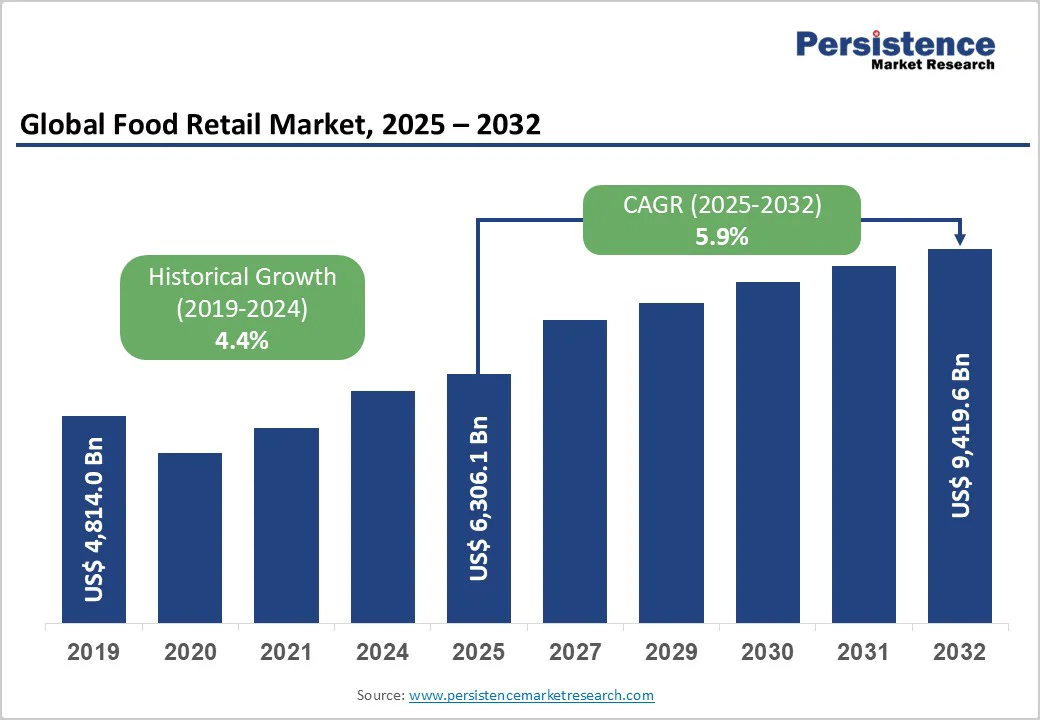
The global food retail market size is likely to value US$ 6,306.1 billion in 2025 and is projected to reach US$ 9,419.6 billion by 2032, growing at a CAGR of 5.9% during the forecast period from 2025 to 2032.
Key Industry Highlights:
- Leading Region: Asia Pacific, holding approx 39% share, driven by rising urbanization, disposable incomes, and adoption of digital and mobile-first grocery solutions.
- Fastest-Growing Region: North America, fueled by omnichannel retailing, AI-driven personalization, and growing demand for clean-label and health-focused products.
- Fastest-Growing Product Type Segment: Packaged / Processed Food, driven by convenience, extended shelf life, and innovations in flavors, fortified offerings, and ready-to-eat solutions.
- Market Drivers: Seamless blending of in-store, app, and quick-commerce platforms enhances convenience, frictionless engagement, and operational agility, reshaping grocery shopping experiences.
- Opportunities: Leveraging shopper analytics for real-time, behavior-based product recommendations, personalized promotions, and cross-selling to optimize revenue, reduce waste, and build loyalty.
- Key Developments: In October 2025, Walmart’s Open Call empowered over 100 U.S. entrepreneurs to feature products in stores and online. In August 2025, Reliance Retail announced a Rs. 40,000 crore investment in integrated food parks. In August 2025, Seven & i planned 2,300 new convenience stores across Japan and North America.
| Key Insights | Details |
|---|---|
|
Global Food Retail Market Size (2025E) |
US$ 6,306.1 Bn |
|
Market Value Forecast (2032F) |
US$ 9,419.6 Bn |
|
Projected Growth (CAGR 2025 to 2032) |
4.4% |
|
Historical Market Growth (CAGR 2019 to 2024) |
5.9% |
Market Dynamics
Driver - Seamless Blending of In-Store, App, and Quick-Commerce Platforms is Redefining Convenience
Convenience today is being perceived through the fusion of in-store experiences, mobile apps, and rapid delivery ecosystems. This omnichannel evolution allows shoppers to browse digitally, order instantly, and collect or receive goods seamlessly, reshaping the rhythm of grocery buying. Retailers are using integrated data systems to synchronize inventory, pricing, and promotions across every touchpoint, creating frictionless engagement. For instance, Walmart’s unified app connects online ordering with curbside pickup and real-time shelf updates, elevating customer satisfaction and operational agility. Around 85% of U.S. food retail sales come from omnichannel shoppers, reflecting how deeply hybrid journeys have become embedded in consumer behavior. This convergence is now a key growth driver, blending technology, logistics, and behavioral insight into a single retail continuum.
Restraints - Perishable Inventory Losses and Online Return Volumes Reduce Efficiency Gains
Operational efficiency in the global food retail market is increasingly constrained by perishable inventory losses and high volumes of online returns. Fresh produce, dairy, and ready-to-eat items have limited shelf life, making storage, transportation, and timely sales critical. Any delay or mismanagement leads to significant wastage, eroding profit margins, and straining supply chains. Simultaneously, the surge in e-commerce grocery orders has brought challenges with product returns due to damaged packaging, incorrect deliveries, or customer dissatisfaction, further impacting inventory planning and cost efficiency. These factors reduce the anticipated gains from digital integration and omni-channel strategies. Retailers must invest in advanced cold chain logistics, real-time tracking, and smarter return management systems to minimize spoilage and returns, but until these solutions are widespread, operational inefficiencies remain a persistent market restraint.
Opportunity - Leveraging Shopper Analytics to Curate Real-Time, Behavior-Based Product Recommendations
The evolution of digital retail platforms is creating a powerful opportunity for food retailers to leverage shopper analytics for real-time, behavior-based product recommendations. By analyzing purchase history, browsing patterns, and demographic data, retailers can anticipate consumer preferences and suggest relevant products at the moment of engagement. This personalization enhances the shopping experience, increases basket size, and drives repeat purchases. Advanced analytics also enable dynamic promotions, targeted discounts, and cross-selling of complementary items, optimizing revenue per customer.
Integration with mobile apps, in-store kiosks, and e-commerce platforms allows seamless delivery of these insights across channels. Retailers adopting such data-driven strategies can improve inventory management, reduce waste, and strengthen loyalty, positioning themselves to capitalize on shifting consumer expectations and the growing demand for convenience, personalization, and predictive retail solutions globally.
Category-wise Analysis
By Product Type, Packaged / Processed Food dominates the global food retail market
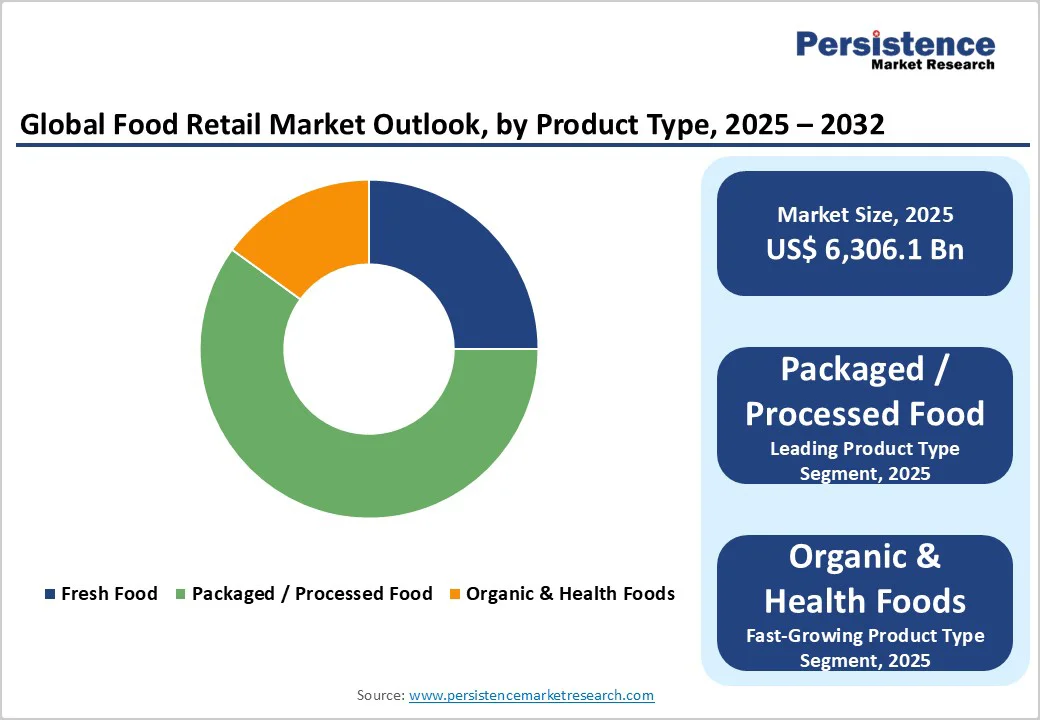
Packaged / Processed food holds approx 59% market share as of 2024, making it the dominant segment in the global food retail market. Its widespread availability, convenience, and extended shelf life make it highly appealing to urban consumers and busy households. Products such as ready-to-eat meals, canned goods, frozen foods, and snacks cater to the growing demand for quick, reliable, and consistent food options. Fresh food, including fruits, vegetables, dairy, and meat, continues to attract consumers seeking quality and nutritional value, while organic and health foods are gaining traction among health-conscious shoppers prioritizing natural, clean-label, and functional products. The dominance of packaged foods is reinforced by expanding retail networks, e-commerce platforms, and innovations in flavors, packaging, and fortified offerings, ensuring consistent growth across global markets.
By Sales Channel, Online Retail is Projected to Experience Significant Growth Throughout the Forecast Period
Online retail is projected to achieve a CAGR of 9.7% during the forecast period, driven by evolving consumer preferences for convenience, speed, and contactless shopping experiences. The rise of e-commerce platforms, mobile apps, and subscription-based grocery services enables consumers to access a wide variety of food products from the comfort of their homes.
Fresh produce, packaged foods, and specialty health products are increasingly ordered online, supported by innovations in cold chain logistics and same-day delivery services.
Digital promotions, personalized recommendations, and loyalty programs further enhance customer engagement. As urbanization and internet penetration expand globally, online retail is becoming a critical channel for reaching younger, tech-savvy shoppers, creating opportunities for retailers to optimize inventory, reduce wastage, and strengthen brand loyalty in the competitive food retail landscape.
Region-wise Insights
Asia Pacific Food Retail Market Trends
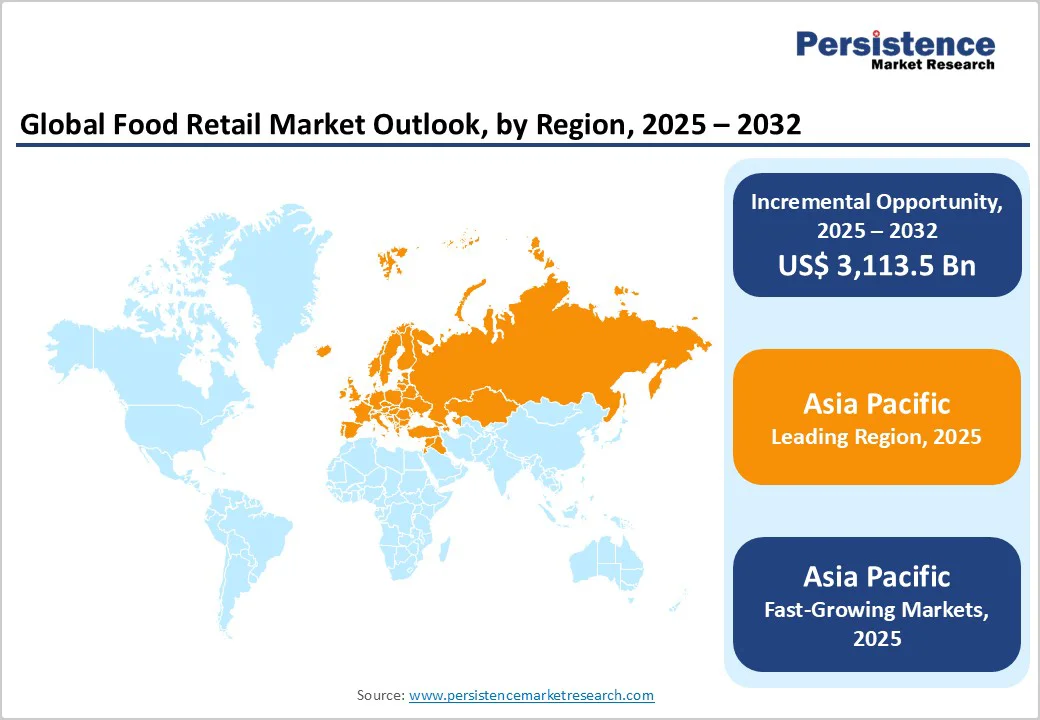
Asia Pacific holds approx 39% market share in the global food retail market, driven by rising urbanization, increasing disposable incomes, and evolving consumer preferences. In China, e-commerce grocery platforms and smart retail stores are expanding rapidly, integrating AI-driven recommendations and cashier-less checkouts. India is witnessing a surge in modern retail formats, with organized chains and digital grocery platforms gaining traction.
In August 2025, Reliance Retail announced plans to invest INR. 40,000 crore (US$ 4.67 billion) over three years to establish Asia’s largest integrated food parks, leveraging AI, robotics, and sustainable technologies to target INR 1,00,000 crore (US$ 11.67 billion) in annual FMCG revenue. Southeast Asian countries are embracing mobile-first grocery shopping, while Japan focuses on convenience, premium offerings, and clean-label products. Across the region, sustainability, technology integration, and personalized experiences are shaping food retail trends.
North America Food Retail Market Trends
North America’s food retail market continues to evolve, driven by changing consumer behaviors, technological adoption, and demand for convenience. In the U.S., omnichannel retailing is expanding rapidly, with grocery chains integrating mobile apps, curbside pickup, and same-day delivery to meet the needs of tech-savvy shoppers. Private-label products and clean-label offerings are gaining popularity, reflecting consumer interest in quality, transparency, and sustainability. Canada’s retail market is mature and largely consolidated, with five major retailers accounting for nearly 80% of the total grocery market. The remainder is served by over 6,500 independent stores and 25,000 small convenience outlets, creating a diverse landscape. Across both countries, trends such as plant-based foods, health-focused products, AI-driven personalization, and loyalty-based promotions are shaping the competitive and consumer-centric food retail environment.
Competitive Landscape
The global food retail market is moderately consolidated, with a mix of large multinational chains and regional players shaping competition. Leading companies are investing in omnichannel strategies, integrating online platforms with physical stores, and leveraging AI-driven inventory management to optimize stock levels and reduce waste. Startups are innovating with niche offerings, such as organic, plant-based, and clean-label products, catering to health-conscious consumers.
Marketing strategies increasingly focus on personalized promotions, loyalty programs, and influencer partnerships to engage digitally savvy shoppers. Advanced technologies, including robotics, IoT-enabled supply chains, and predictive analytics, are enhancing operational efficiency and customer experience. Retailers adopting these innovations can respond rapidly to demand fluctuations, streamline distribution, and maintain a competitive edge in a market driven by convenience, quality, and sustainability.
Key Industry Developments:
- In October 2025, Costco is expanding its footprint in North America with the planned opening of four new locations, reinforcing its commitment to growth for the 2025 fiscal year.
- In October 2025, Walmart’s Open Call empowered over 100 U.S. entrepreneurs to feature their products in stores and online, reinforcing the retailer’s $350 billion commitment to American-made goods. The initiative highlights innovative offerings and provides resources to help small businesses scale effectively.
- In August 2025, Seven & i announced plans to expand its footprint by opening approximately 1,000 convenience stores in Japan and 1,300 in North America by February 2031, driving long-term growth. The expansion reflects the company’s strategy to strengthen market presence and meet rising consumer demand across regions.
Companies Covered in Food Retail Market
- Walmart
- Amazon
- Costco Wholesale
- Carrefour S.A.
- The Schwarz Group
- Kroger
- Aldi
- Carrefour
- Tesco
- Seven & I Holdings
- Target
- Ahold Delhaize
- Reliance Retail
- Others
Frequently Asked Questions
The global food retail market is projected to be valued at US$ 6,306.1 Bn in 2025.
Seamless blending of in-store, app, and quick-commerce platforms is redefining convenience, driving the global food retail market.
The Global Food Retail market is poised to witness a CAGR of 5.9% between 2025 and 2032
Leveraging shopper analytics to curate real-time, behavior-based product recommendations is the key market opportunity.
Major players in the Global Food Retail market include Walmart, Amazon, Costco Wholesale, Carrefour S.A., The Schwarz Group, Kroger, and others.


