




- Electric Mobility
- Europe Quadricycle Market
Europe Quadricycle Market Size, Share, and Growth Forecast 2026 – 2033
Europe Quadricycle Market by Vehicle Category (Light Quadricycles (L6e), Heavy Quadricycles (L7e)), Propulsion Type (Internal Combustion Engine (ICE), Battery Electric Vehicle (BEV), Hybrid), Usage Type (Personal Mobility, Commercial Mobility, Last-Mile Delivery, Passenger Transportation, Fleet Mobility, Municipal Services, Miscellaneous), Regional Analysis, 2026-2033

Europe Quadricycle Market Size and Trend Analysis
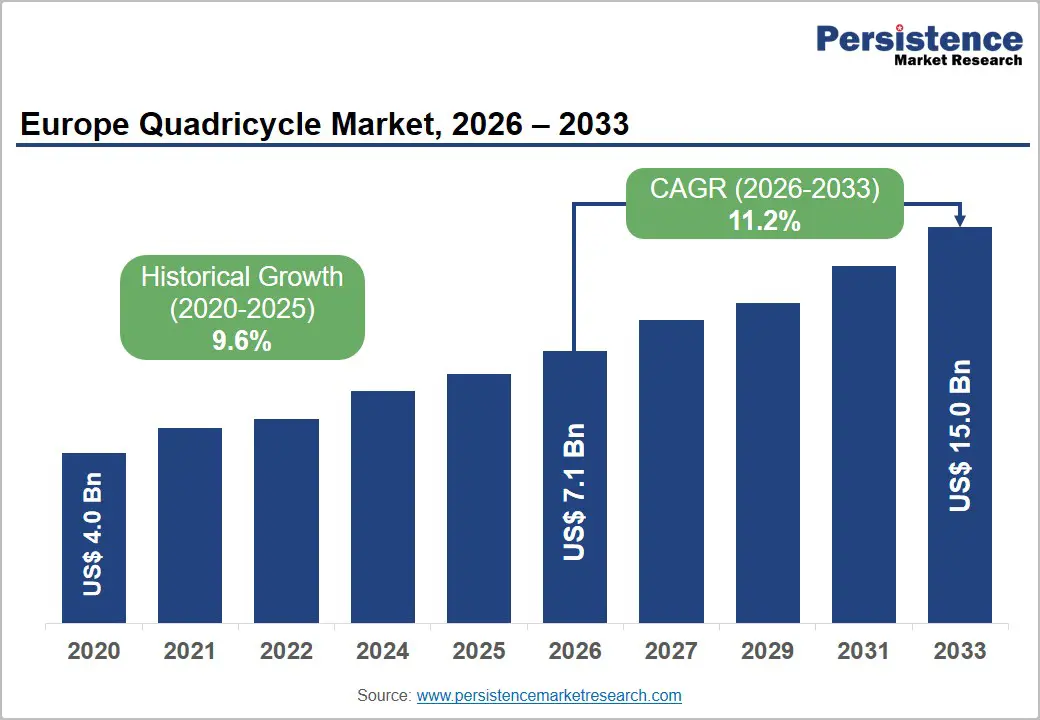
Europe Quadricycle market size is expected to be valued at US$7.1 billion in 2026 and projected to reach US$14.9 billion by 2033, growing at a CAGR of 11.2% between 2026 and 2033.
The market trajectory is shaped primarily by the convergence of urban decarbonization policies and consumer demand for compact, license-friendly vehicles.
Under Regulation (EU) 2019/631, vehicle manufacturers must reduce fleet-average CO2 emissions by 15% from 2026 onwards versus 2021 levels, with a 55% reduction mandated by 2030 and zero g/km from 2035, accelerating investment in electric quadricycle platforms. In parallel, cities including Paris, Milan, and London have widened low-emission zones, while licensing frameworks in France, Italy, and Spain permit teenagers aged 14 to drive L6e vehicles, broadening the addressable consumer base.
Broader electric-vehicle adoption trends across the European Union reinforce the outlook for the quadricycle market. According to the European Environment Agency, over 1.4 million new Battery Electric Vehicles were registered in the EU in 2024, accounting for 13.6% of new car registrations, while plug-in hybrid electric vehicles contributed an additional 7.3%. New electric car volumes rose from approximately 400,000 units in 2019 to 2.2 million in 2024, illustrating how rapidly the European consumer is transitioning to electrified mobility an underlying tailwind that benefits compact electric quadricycles such as the Microlino, Citroën Ami, and Mobilise Duo, positioned for urban use cases.
Key Industry Highlights:
- Leading Region: France leads the European quadricycle market with an estimated US$1.6 billion valuation in 2026, supported by a deep voiture sans permis culture, AM licensing from age 14, and strong domestic OEM presence, including Aixam and Ligier.
- Fast-Growing Region: Germany is among the fastest expanding national markets, propelled by Stellantis' Opel Rocks-e launches, the country's structured AM Führerschein framework, and rapid LEZ rollouts in Berlin, Munich, and Frankfurt during 2024-2026.
- Leading Propulsion Type Segment: Internal Combustion Engine (ICE) quadricycles command roughly 52% share in 2026, reflecting affordability, mature dealer networks, and continued demand in rural areas where electric vehicle charging access remains constrained.
- Fast-Growing Propulsion Type Segment: Battery Electric Vehicle (BEV) quadricycles are projected to expand at an 11% CAGR, supported by Regulation (EU) 2019/631 tightening, falling battery costs, and city-led LEZ access privileges.
- Key Opportunity: Electrification of last-mile urban logistics aligned with 15.2 billion annual European parcel volumes and AFIR charging mandates offers OEMs durable fleet contracts with operators such as La Poste, DPD, and municipal authorities.
DRO Analysis
Drivers - Urban Low-Emission Zones Reshape Compact Vehicle Demand
Quadricycle adoption is being structurally reinforced by Europe's expanding urban environmental regulations. As of 2024, more than 320 Low Emission Zones (LEZs) and Zero Emission Zones (ZEZs) were operational across European Union member states, with major hubs such as Paris, Madrid, Milan, and London progressively restricting older internal combustion vehicles from central districts.
Quadricycles, particularly L6e and L7e electric variants such as the Citroën Ami, Mobilize Duo, and Microlino qualify for unrestricted access under most LEZ schemes due to their sub-450 kg unladen mass and limited emission footprint. The European Environment Agency also reports that road transport contributes nearly 22% of EU greenhouse gas emissions, reinforcing policy support for lightweight urban mobility alternatives.
License-Free Mobility and Teen Driving Frameworks Widen Consumer Base
Regulatory frameworks across several European jurisdictions allow consumers aged 14 and above to operate L6e light quadricycles under an AM-category permit, with France and Italy remaining the largest demand pockets for this cohort.
According to data from the French Ministry of the Interior, registrations of voiture sans permis (license-free cars) surpassed 30,000 units in 2023, with adolescent drivers accounting for a meaningful share of new acquisitions. Italy's reform under Decreto Legislativo n. 121/2022 further widened access by recognising micro-mobility categories within urban transport corridors. Affordability is another lever; entry-level quadricycles typically retail between €7,500 and €12,000, well below the average price of a compact passenger car in Europe, making them an accessible first vehicle.
Market Restraints
Safety Performance Limitations Versus Conventional Passenger Cars
Quadricycles operate under reduced type-approval thresholds compared with M1 passenger cars, exempting them from many crash-test standards mandated under UNECE Regulation No. 94 and No. 95. Independent crash assessments published by Euro NCAP in 2014 and updated benchmarks in 2024 found that several light quadricycle models scored zero stars or recorded high injury risk in frontal and side impact evaluations.
Insurance premium loading on quadricycles has remained between 15% and 22% above equivalent compact cars in several markets, according to the Comité Européen des Assurances, dampening fleet conversion among risk-averse household buyers and limiting deeper penetration into the family vehicle segment.
Battery Cost Burden Constrains Electric Quadricycle Affordability
Although electric quadricycles deliver favourable operating economics, upfront pricing remains a deterrent. BloombergNEF lithium-ion battery pack pricing averaged US$ 115/kWh in 2024, and quadricycle manufacturers operating on far smaller production volumes than passenger car OEMs lack the scale to negotiate equivalent cell pricing.
BEV quadricycles such as the Mobilise Duo and Microlino are priced 25% to 40% above their ICE counterparts, while government purchase incentives have been progressively reduced in Germany and Italy during 2024 and 2025. The combination of higher sticker price and shrinking subsidies has slowed conversion among price-sensitive urban consumers, particularly in southern European markets.
Opportunities - Last-Mile Urban Logistics Electrification Unlocks Fleet Adoption
Parcel volumes across Europe reached 15.2 billion shipments in 2023, according to the International Post Corporation, with e-commerce penetration in markets including Germany, France, and the United Kingdom exceeding 80% for adult internet users. Operators such as La Poste, DPD, and DHL have piloted L7e electric vans, including the Goupil G4, Addax MT-15, and Renault Mobilise Bento for inner-city deliveries, citing parking flexibility, narrow-street manoeuvrability, and zero tailpipe emissions as primary operational advantages.
The Alternative Fuels Infrastructure Regulation (AFIR), entering force in 2024, requires public charging deployment along the TEN-T network every 60 km, further de-risking electric fleet operations. This convergence creates a structural opportunity for OEMs offering modular cargo configurations targeting commercial last-mile fleets.
Subscription and Shared Mobility Models Expand Recurring Revenue Streams
Vehicle subscription services for quadricycles are emerging as a distinct revenue channel as urban consumers shift away from outright ownership. Mobilise, the mobility brand of Renault Group, launched the Mobilise Duo with subscription pricing starting around €49 per month in select European markets, while operators such as Free2Move, Yoyo, and Ada have integrated quadricycles into car-sharing pools across Paris, Rome, and Madrid.
The European Cyclists' Federation and POLIS Network have documented strong municipal interest in shared micro-vehicle programs as part of Sustainable Urban Mobility Plans (SUMPs). Subscription, leasing, and pay-per-use formats also provide manufacturers with longer customer lifetime value and recurring service revenue, particularly relevant as the Mobility-as-a-Service ecosystem matures across European metropolitan corridors.
Category-wise Analysis
Vehicle Category Insights
Heavy Quadricycles (L7e) is likely to account for 58% Europe quadricycle market share in 2026, driven by their broader use across commercial, passenger transport, and municipal applications. L7e vehicles permit greater payload, higher motor power (up to 15 kW), and unladen mass up to 450 kg for goods vehicles under EU Regulation No. 168/2013, making them the preferred configuration for last-mile delivery fleets, municipal sanitation operations, and shared-mobility deployments.
Manufacturers such as Aixam, Ligier, Goupil Industrie, and Stellantis offer extensive L7e portfolios spanning combustion, battery-electric, and hybrid variants. Light L6e vehicles, while popular among adolescent drivers and short urban trips, are constrained by lower top speeds (45 km/h) and reduced cargo flexibility, limiting their share.
Propulsion Type Insights
Internal combustion engine (ICE) quadricycles continue to lead with a share of approximately 52% in 2026, supported by lower upfront pricing, established dealer networks, and entrenched preferences in rural and semi-urban regions where charging infrastructure remains sparse. Diesel and gasoline quadricycles produced by Aixam, Ligier, Chatenet, and Bellier Automobiles retail at meaningfully lower price points than equivalent BEV variants, supporting affordability for first-time buyers and small commercial operators.
Battery electric vehicle (BEV) quadricycles are projected to expand at a positive CAGR supported by the CO2 emission reduction trajectory under Regulation (EU) 2019/631, manufacturer launches such as the Mobilise Duo and Fiat Topolino, and tightening LEZ access for combustion vehicles.
Usage Type Insights
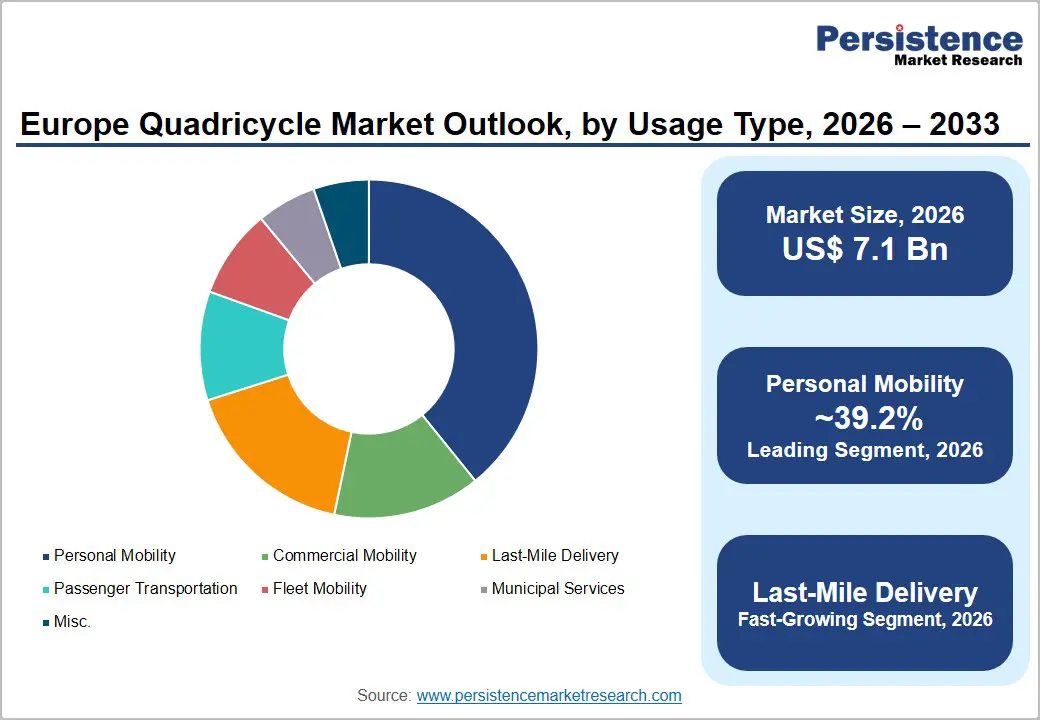
Personal mobility represents the leading usage segment with an estimated 39.2% share in 2026, reflecting widespread adoption among adolescent drivers, urban professionals, and elderly users seeking accessible last-mile transport. According to the French Ministry of the Interior, registrations of license-free vehicles exceeded 30,000 units in 2023, with similar momentum observed in Italy under the B1 license category for AM permit holders. Demand is reinforced by affordability, with average retail prices between €7,500 and €12,000 and the ability to park in compact urban spaces.
Commercial Mobility and Last-Mile Delivery segments are progressing through fleet pilots by La Poste, DPD, and municipal authorities, but volumes remain smaller than the personal-use category, which benefits from broad demographic appeal and dense distribution networks across the EU-27. Municipal Services use covering street cleaning, park maintenance, and inner-city patrolling has also emerged as a recurring fleet channel for L7e platforms supplied by Goupil Industrie and Addax Motors.
Regional Insights
Europe Quadricycle Market Trends and Insights
The Europe quadricycle market is anchored by France, Germany, and Italy, which together account for over 60% of regional demand in 2026. Market trends include accelerated electrification, expansion of teen-driver registrations, fleet adoption among postal and parcel operators, and tightening LEZ frameworks in cities such as Paris, Milan, and Madrid. Manufacturers are investing in BEV platforms, modular cargo bodies, and subscription-based commercial models tailored to municipal users.
Regional growth is also being supported by the Alternative Fuels Infrastructure Regulation (AFIR), which mandates expanded public charging coverage along the TEN-T network from 2024, easing one of the historical barriers to electric quadricycle adoption across both metropolitan and peri-urban corridors.
France Quadricycle Market Size
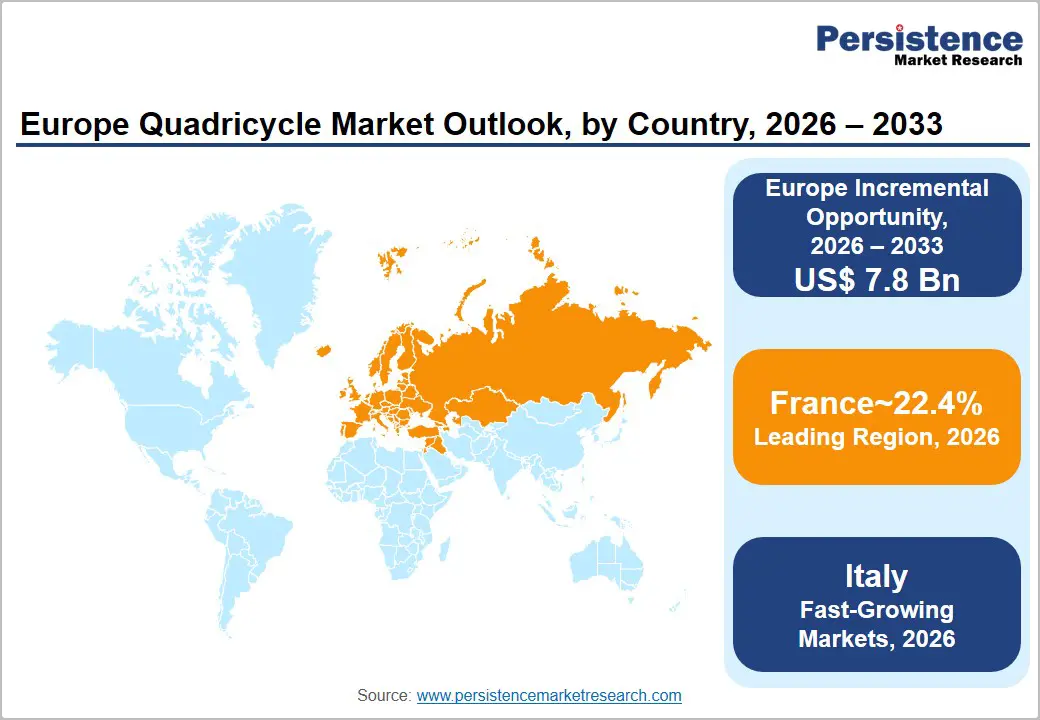
France leads the European quadricycle market with a value of approximately US$1.6 billion in 2026, capturing 22.4%of the regional share. The country's deep voiture sans permis culture, combined with AM license access for 14-year-olds, sustains strong personal-mobility demand. Domestic OEMs Aixam, Ligier, Chatenet, and Bellier Automobiles dominate distribution, while Mobilise Duo rollouts and La Poste's electric delivery fleet pilots in Paris reinforce volume. The Crit'Air environmental sticker scheme operating across Greater Paris, Lyon, and Grenoble has accelerated quadricycle preference for households restricted from operating older diesel vehicles in city centres.
Germany Quadricycle Market Size
Germany holds the second-largest position with a market value of approximately US$1.2 billion in 2026, accounting for nearly 17% of regional demand. Demand is reinforced by the AM Führerschein licensing pathway available from age 15, Stellantis' launch of the Opel Rocks-e Kargo for urban delivery, and Berlin and Munich's expanding low-emission zones. Microlino AG has also strengthened its presence through German dealer networks. The country's mature parcel ecosystem, anchored by DHL and Hermes, is driving early commercial L7e fleet trials, complemented by DEKRA-led safety certification programs supporting wider OEM market entry.
Italy Quadricycle Market Size
Italy is the third largest market at approximately US$1.0 billion in 2026, representing close to 14% of regional revenue. Italy's strong macchinette culture and reforms under Decreto Legislativo n. 121/2022 have widened teen access.
Domestic players such as Casalini, ESTRIMA S.p.A. (manufacturer of the Biro), and Tazzari EV maintain a strong urban presence in Milan, Rome, and Turin, alongside Stellantis' Fiat Topolino rollout. Milan's Area B and Area C restricted zones, covering over 70% of city traffic flow, have made compact L6e and L7e vehicles a practical alternative for resident households and short-haul commercial operators in the metropolitan area.
Competitive Landscape
Europe quadricycle market is moderately consolidated, with the top five OEMs Aixam, Ligier Group, Stellantis N.V., Microlino AG, and Renault Group (Mobilise) collectively accounting for over 65% of regional unit shipments. Competitive strategies emphasize electrification roadmaps, modular product platforms enabling rapid configuration changes for passenger versus cargo variants, and partnerships with municipalities, postal operators, and shared-mobility providers. Differentiation increasingly rests on battery range, charging speed, ADAS-light safety features, and subscription pricing.
Smaller specialists such as ESTRIMA, Casalini, Goupil Industrie, and XEV are pursuing niche positions in commercial cargo, premium urban design, and 3D-printed manufacturing economics. Strategic activity in 2024-2026 has centered on BEV portfolio expansion, dealer-network rationalisation, and the introduction of telematics-enabled fleet management services for municipal and last-mile logistics customers.
Key Developments:
- In February 2025, JATO Dynamics highlighted the expanded role of quadricycles in European urban transportation, with cities such as Milan, Paris, and London advancing low-emission zone enforcement and the Microlino, Mobilise Duo, and Fiat Topolino gaining traction.
- In August 2025, Microcars industry analysis emphasised adoption potential as several European markets continued allowing 14-year-old drivers under AM permit frameworks, reflecting OEM focus on affordability and youth mobility.
- June 2024, Stellantis N.V. launched the Fiat Topolino across Italy, France, Spain, and Germany at an entry price of around €9,890, marking a meaningful electric quadricycle expansion within the group's mainstream brand portfolio.
Companies Covered in Europe Quadricycle Market
- Renault S.A.
- Aixam-Mega S.A.S.
- Ligier Group
- Citroën S.A.
- Microlino AG
- Goupil Industrie SA
- Polaris Inc.
- Wink Motors
- Waev Inc.
- Cenntro Electric Group Ltd.
- Club Car LLC
- / Mahindra & Mahindra Ltd.
- Zhidou Electric Vehicle Co., Ltd.
- Italcar Industrial S.r.l.
Frequently Asked Questions
The European quadricycle market is valued at approximately US$7.1 billion in 2026 and projected to reach US$14.9 billion, expanding at a CAGR of 11.2% between 2026 and 2033.
Demand is propelled by expanding low-emission zones in cities such as Paris, Milan, and London, AM licensing for 14-year-old drivers across France and Italy, and tightening EU CO2 emission targets under Regulation (EU) 2019/631.
France leads the regional market with a 2026 valuation of around US$1.6 billion, representing about 22.4%of the regional share, supported by the country's voiture sans permis culture and a strong domestic OEM base.
Electrification of last-mile urban logistics is a significant opportunity, supported by 15.2 billion annual European parcel volumes and EV charging mandates under the Alternative Fuels Infrastructure Regulation (AFIR) effective from 2024.
Leading players include Aixam, Ligier Group, Stellantis N.V., Renault Group (Mobilize), Microlino AG, ESTRIMA S.p.A., Chatenet, and Goupil Industrie, among other regional and specialist manufacturers.


