Electric Cargo Bike Market Size, Share, and Growth Forecast, 2025 - 2032

Electric Cargo Bike Market By Propulsion Type (Pedal Assisted, Speed Pedelec, Throttle Assisted), Battery Type (Lead Acid Battery, Lithium-ion Battery), Application (Personal, Commercial), and Regional Analysis for 2025 - 2032

ID: PMRREP25447
Calendar

October 2025

150 Pages

Author : Likhit Meshram

Key Industry Highlights

  • Funding Round: Xunlu Innovation completed a new round of financing worth tens of millions of yuan in August 2025. The funds will be used for the mass production of e-cargo bikes and the research of the new generation of products.
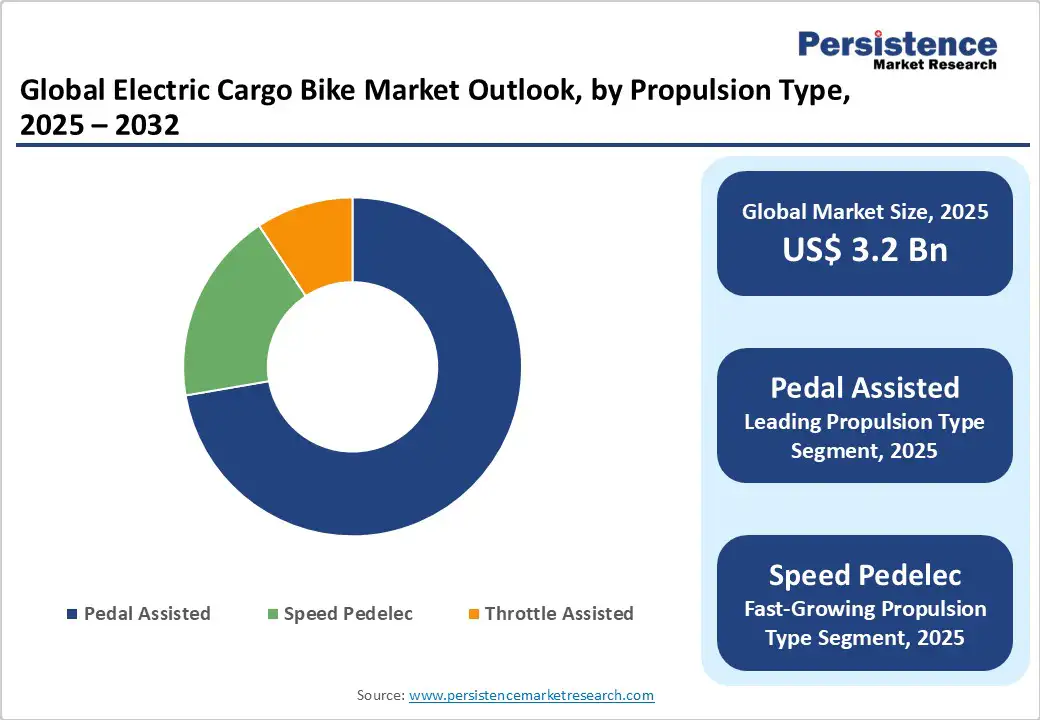
  • Leading Propulsion Type: Pedal-assisted bikes hold nearly 72.3% of the market share in 2025, as they provide a balance of rider effort and motor support.
  • Dominant Battery Type: Lithium-ion batteries, approximately 78.6% of the market share in 2025, because of their high energy density.
  • Key Application: Commercial recorded about 83.1% of the market share in 2025, due to the high efficiency of e-cargo bikes in last-mile logistics.
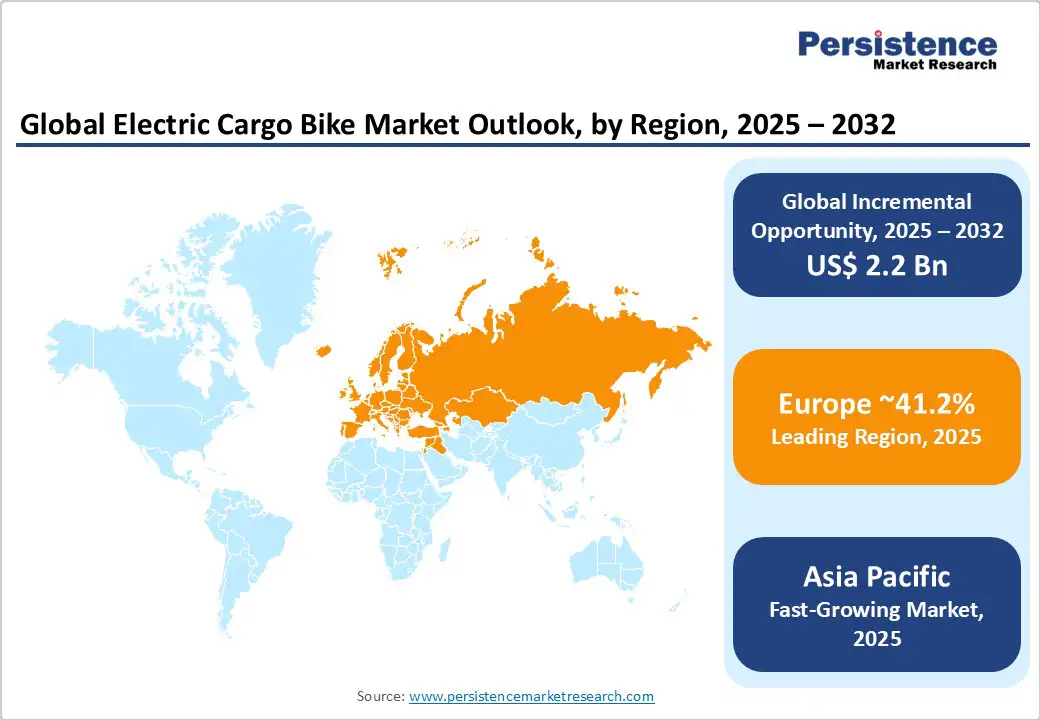
  • Leading Region: Europe, with about 41.2% of the market share in 2025, owing to government incentives and superior cycling culture.
  • Fastest-growing Region: Asia Pacific, backed by government EV incentives and the rising e-commerce.
Key Insights Details
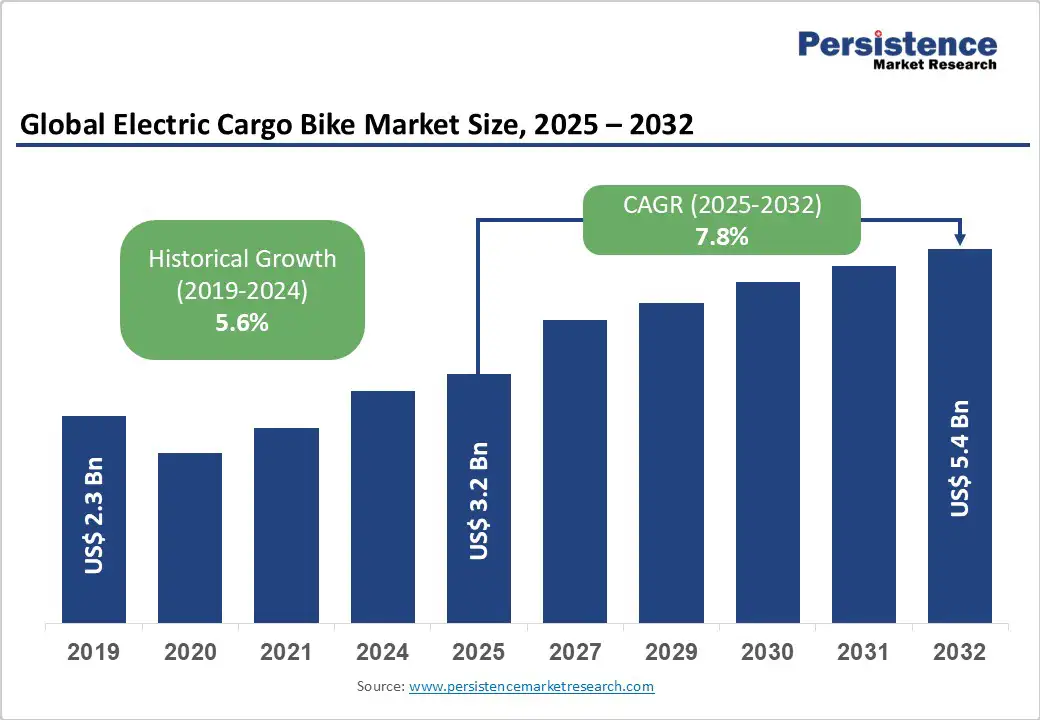
Electric Cargo Bike Market Size (2025E) US$3.2 Bn
Market Value Forecast (2032F) US$5.4 Bn
Projected Growth (CAGR 2025 to 2032) 7.8%
Historical Market Growth (CAGR 2019 to 2024) 5.6%

global-electric-cargo-bike-market-size-2025-2032

Market Factors - Growth, Barriers, and Opportunity Analysis

Growth Analysis - Adoption by E-commerce Companies for Green Deliveries

E-commerce growth is pushing businesses to seek fast, sustainable delivery solutions, and electric cargo bikes are filling this role. Amazon, DHL, and Alibaba have initiated pilot programs using e-cargo bikes for last-mile deliveries in dense urban centers, achieving quicker transit times while reducing emissions compared to traditional vans.

For example, DHL’s Cubicycle program in Germany integrates e-cargo bikes into city logistics, allowing delivery personnel to navigate congested streets more efficiently. This trend is fueled by consumer demand for eco-conscious shipping options and brand commitments to sustainability. Hence, the preference for green and quick delivery alternatives is becoming a leading driver for the adoption of e-cargo bikes worldwide.

Supportive Policies and Incentives from Governments and Cities

The growth of electric cargo bikes is being propelled by government initiatives and municipal regulations implemented to encourage sustainable urban mobility. Various countries across Europe and Asia Pacific have introduced subsidies, tax benefits, and grants specifically for electric two-wheelers and cargo bikes. For instance, Germany provides financial incentives for businesses integrating e-cargo bikes into urban delivery fleets, while Copenhagen and Amsterdam have implemented low-emission zones favoring electric vehicles.

These measures not only reduce upfront costs for buyers but also encourage widespread adoption among commercial operators and private users, creating a conducive environment for market expansion in line with climate action and congestion reduction strategies.

Barrier Analysis - Limitations due to Battery Range and Operational Conditions

One of the key challenges for electric cargo bikes is the limited range of their batteries, which can be further reduced under demanding conditions. Heavy loads, frequent stops in urban deliveries, steep inclines, and low temperatures all contribute to faster battery depletion, restricting the distance that can be covered on a single charge.

For instance, commercial fleet operators in cities across Europe have reported that e-cargo bikes carrying multiple parcels in winter require daily recharging, complicating logistics planning. This limitation affects their reliability for long routes or high-frequency deliveries, creating a need for additional charging infrastructure or backup vehicles.

Challenges from Specialized Maintenance Requirements

Electric cargo bikes demand specialized maintenance due to their motor systems, battery management, and electronic components, which can drastically increase servicing costs. Unlike traditional bicycles, repairs often require trained technicians and specific tools, making regular upkeep expensive and less accessible in certain regions.

For example, fleet operators in North America have shown that battery replacements and motor servicing can constitute a substantial portion of operating expenses, affecting cost efficiency. Improper maintenance can further reduce battery lifespan and compromise motor performance, impacting reliability for daily logistics operations.

Opportunity Analysis - Expansion of E-cargo Bikes in Last-mile Delivery

The explosive growth of e-commerce across global urban centers is transforming how goods are transported in cities, presenting new opportunities for electric cargo bikes. With increasing demand for quick, green, and cost-effective deliveries, e-cargo bikes are emerging as a practical alternative to traditional vans and trucks, especially for congested streets. Amazon and DHL in Europe have already piloted e-cargo bike programs in cities such as Berlin and Copenhagen, reporting improved delivery efficiency and low emissions.

This shift is further reinforced by urban policies limiting van access in central areas, creating a superior incentive for businesses to adopt e-cargo bikes. The convergence of consumer expectations for instant deliveries and city sustainability goals positions e-cargo bikes as a key solution in last-mile logistics.

Novel Manufacturing and Automation by Leading Producers

Leading electric cargo bike manufacturers are now investing in state-of-the-art production facilities that integrate novel automation, robotics, and stringent quality control processes. Riese & Müller and Urban Arrow are embracing these capabilities to expand production, improve reliability, and reduce manufacturing costs while maintaining high safety standards. This approach strengthens brand reputation and also enables market expansion in regions with rising demand.

Automated production further allows manufacturers to introduce unique features such as modular cargo compartments, improved battery systems, and improved connectivity. These developments create new business opportunities by appealing to both commercial fleet operators and private consumers seeking high-performance, dependable electric cargo bikes.

Category-wise Analysis

Propulsion Type Insights

The pedal-assisted segment will likely record a market share of nearly 72.3% in 2025, as it provides a balance between manual effort and electric assistance, making it practical for both commercial and personal use. Riders can rely on motor support for heavy loads or long distances, while still benefiting from physical exercise when desired. This type of propulsion is mainly suited for urban delivery scenarios where frequent stops, traffic congestion, and narrow streets demand precise control and flexibility.

Speed pedelec propulsion is gaining traction because it allows e-cargo bikes to reach high speeds, making them ideal for time-sensitive deliveries and long urban routes. Unlike standard pedal-assisted bikes, speed pedelecs can maintain fast transit without overexerting the rider, enabling businesses to improve efficiency in last-mile logistics. Urban Arrow in the Netherlands, for example, is developing speed pedelec models customized for courier services.

Battery Type Insights

Lithium-ion batteries are anticipated to account for approximately 78.6% of the market share in 2025, owing to their high energy density, lightweight design, and longer lifespan compared to other battery types. They allow e-cargo bikes to carry heavy loads over long distances without frequent recharging, making them ideal for commercial deliveries and urban commuting. Also, lithium-ion technology supports quick charging and smooth integration with smart battery management systems, thereby pushing demand.

Lead-acid batteries continue to see decent demand, primarily due to their low upfront cost and superiority in simple applications. They are often used in entry-level or budget-friendly cargo bikes in emerging markets where affordability is a priority. For instance, several e-bike manufacturers in India and Southeast Asia provide lead-acid-powered cargo bikes for local deliveries and small businesses, as these batteries are durable for short, low-speed routes.

Application Insights

The commercial segment is poised to hold a market share of around 83.1% in 2025 as businesses increasingly rely on efficient and eco-friendly solutions for last-mile delivery. E-cargo bikes are mainly advantageous in congested urban areas, where vans and trucks face traffic delays and parking restrictions. The ability to carry significant payloads while navigating narrow streets gives businesses a competitive edge, reinforcing commercial use as the dominant segment in the market.

Personal applications of electric cargo bikes are witnessing considerable growth due to changing lifestyles, environmental awareness, and urban mobility trends. Families use e-cargo bikes to transport children, groceries, and personal goods, replacing short car trips and promoting sustainable commuting. Rising health consciousness and the desire for green alternatives also contribute to the steady uptake.
global-electric-cargo-bike-market-outlook-by-propulsion-type-2025-2032

Regional Insights

Europe Electric Cargo Bike Market Trends

In 2025, Europe is expected to account for approximately 41.2% of the market share, as electric cargo bikes have become integral to urban mobility in the region. It is attributed to environmental policies, e-commerce growth, and a shift toward sustainable transportation.

Germany dominates the market, supported by extensive cycling infrastructure, government incentives, and a strong culture of sustainability. Berlin and Hamburg have already integrated e-cargo bikes into public transportation systems and urban logistics.

The Netherlands continues to see steady growth in terms of adoption, with a well-established cycling culture and supportive urban planning. Key cities have been at the forefront of implementing smart mobility solutions, with e-cargo bikes playing a prominent role in urban logistics.

Denmark also exhibits high adoption rates, with Copenhagen being recognized as one of the most bike-friendly cities globally. The city's infrastructure supports the widespread use of e-cargo bikes for both personal and commercial purposes.

Asia Pacific Electric Cargo Bike Market Trends

Electric cargo bikes are gaining popularity in Asia Pacific owing to urbanization, environmental policies, and the rise of e-commerce. China leads the market with leading manufacturers such as Yadea Group and Yamaha Motor spearheading development and export growth. In India, the government is actively promoting electric mobility through initiatives such as the PM e-Drive scheme, which has been extended until March 2028.

The program delivers substantial incentives for electric vehicle purchases, including electric cargo bikes, to encourage adoption and reduce emissions. Indonesia has introduced additional incentives to promote the sale of electric vehicles, including electric cargo bikes.

These measures include the removal of the luxury tax on EVs for the 2024 fiscal year and a suspension of import tax until the end of 2025, aiming to increase domestic demand and attract investment in the automotive sector.

North America Electric Cargo Bike Market Trends

Electric cargo bikes are rapidly gaining momentum in North America, driven by urbanization, environmental policies, and the rise of e-commerce. In the U.S., cities, including Boston, have launched initiatives such as the country's first cargo e-bike share program, delivering a unique transportation alternative to reduce commuter stress and promote environmental benefits.

In addition, companies such as Lectric are providing affordable models, including the XPedition 2, which boasts a 120-mile range and 28 mph top speed, making it a versatile car-replacement option.

Government incentives are further accelerating adoption. For instance, Ava Community Energy in Alameda County, California, launched a US$10 Million e-bike rebate program, providing rebates ranging from US$400 to US$1,500 to residents to encourage the use of e-bikes for short trips. Several programs across Canada and the U.S. are also providing subsidies to reduce the upfront cost of electric cargo bikes.
global-electric-cargo-bike-market-outlook-by-region-2025-2032

Competitive Landscape

The global electric cargo bike market consists of key players such as Rad Power Bikes, Riese & Müller, Urban Arrow, Tern Bicycles, and DOUZE Factory. They are expanding their product lines, investing in research and development, and improving their global presence to maintain a competitive edge. For instance, Lectric's XPedition 2.0 model is praised for its value, design, and performance, making it a notable option in the market.

Key Industry Developments

  • In June 2025, Honda debuted a new business unit named Fastport that will use four-wheel cargo cycles to serve the last mile delivery market in North America and Europe. The company has developed a modular, electric quadricycle that it will use for deliveries.
  • In March 2025, Taiwan-based Tern launched its latest cargo electric bike with notable upgrades over its predecessor in Europe and North America. The GSD electric cargo bike can accommodate an adult rider along with up to two children or cargo.

Companies Covered in Electric Cargo Bike Market

  • Accell Group
  • CUBE Bikes
  • Bakfiets.nl
  • Aima Technology Group Co. Ltd.
  • Giant Manufacturing Co. Ltd.
  • DOUZE Factory SAS
  • Jiangsu Xinri E-Vehicle Co. Ltd.
  • Pedego Electric Bikes
  • Jinhua Jobo Technology Co.
  • Rad Power Bikes
  • Pon Holding B.V.
  • RYTLE GmbH
  • Riese & Müller
  • Smart Urban Mobility B.V.
  • Xtracycle Inc.
  • The Cargo Bike Company
  • Tern Bicycles
  • Yadea Group Holdings Ltd.
  • XYZ CARGO
  • YUBA BICYCLES LLC
Frequently Asked Questions

The electric cargo bike market is projected to reach US$3.2 Billion in 2025.

Rising e-commerce demand and government incentives are the key market drivers.

The electric cargo bike market is poised to witness a CAGR of 7.8% from 2025 to 2032.

Integration of smart batteries and expanding last-mile logistics in congested cities are the key market opportunities.

Accell Group, CUBE Bikes, and Bakfiets.nl are a few key market players.

Electric Cargo Bike Market Report Scope
Report Attribute Details
Historical Data/Actuals 2019 - 2024
Forecast Period 2025 - 2032
Market Analysis Value: US$ Bn
Geographical Coverage
  • North America
  • Europe
  • East Asia
  • South Asia & Oceania
  • Latin America
  • Middle East & Africa
Segmental Coverage
  • Propulsion Type
  • Battery Type
  • Application
  • Region
Competitive Analysis
  • Accell Group
  • CUBE Bikes
  • Bakfiets.nl
  • Aima Technology Group Co. Ltd.
  • Giant Manufacturing Co. Ltd.
  • DOUZE Factory SAS
  • Jiangsu Xinri E-Vehicle Co. Ltd.
  • Pedego Electric Bikes
  • Jinhua Jobo Technology Co.
  • Rad Power Bikes
  • Pon Holding B.V.
  • RYTLE GmbH
  • Riese & Müller
  • Smart Urban Mobility B.V.
  • Xtracycle Inc.
  • The Cargo Bike Company
  • Tern Bicycles
  • Yadea Group Holdings Ltd.
  • XYZ CARGO
  • YUBA BICYCLES LLC
Report Highlights
  • Market Forecast and Trends
  • Competitive Intelligence and Share Analysis
  • Growth Factors and Challenges
  • Strategic Growth Initiatives
  • Pricing Analysis
  • Future Opportunities and Revenue Pockets
  • Market Analysis Tools
Market Segmentation

By Propulsion Type

  • Pedal Assisted
  • Speed Pedelec
  • Throttle Assisted

By Battery Type

  • Lead Acid Battery
  • Lithium-ion Battery
  • Others

By Application

  • Personal
  • Commercial

By Region

  • North America
  • Europe
  • East Asia
  • South Asia & Oceania
  • Latin America
  • Middle East & Africa

Related Reports

  1. Executive Summary
    1. Global Electric Cargo Bike Market Snapshot, 2025 and 2032
    2. Market Opportunity Assessment, 2025 - 2032, US$ Bn
    3. Key Market Trends
    4. Future Market Projections
    5. Premium Market Insights
    6. Industry Developments
    7. PMR Analysis and Recommendations
  2. Market Overview
    1. Market Scope and Definition
    2. Market Dynamics
      1. Drivers
      2. Restraints
      3. Opportunity
      4. Challenges
      5. Key Trends
    3. COVID-19 Impact Analysis
    4. Forecast Factors - Relevance and Impact
  3. Value Chain Analysis
    1. Supply Chain Analysis
    2. List of Key Market Players
  4. Value Added Insights
    1. PESTLE Analysis
    2. Porter’s Five Force Analysis
  5. Price Trend Analysis, 2019 - 2032
    1. Pricing Analysis, By Propulsion Type
    2. Key Factors Impacting Prices, By Battery Type
  6. Global Electric Cargo Bike Market Outlook
    1. Key Highlights
      1. Market Size (US$ Bn) and Y-o-Y Growth
      2. Absolute $ Opportunity
    2. Market Size (US$ Bn) Analysis and Forecast
      1. Historical Market Size (US$ Bn) Analysis, 2019-2024
      2. Market Size (US$ Bn) Analysis and Forecast, 2025-2032
    3. Global Electric Cargo Bike Market Outlook: Propulsion Type
      1. Historical Market Size (US$ Bn) Analysis, By Propulsion Type, 2019-2024
      2. Market Size (US$ Bn) Analysis and Forecast, By Propulsion Type, 2025-2032
        1. Pedal Assisted
        2. Speed Pedelec
        3. Throttle Assisted
      3. Market Attractiveness Analysis: Propulsion Type
    4. Global Electric Cargo Bike Market Outlook: Battery Type
      1. Historical Market Size (US$ Bn) Analysis, By Battery Type, 2019-2024
      2. Market Size (US$ Bn) Analysis and Forecast, By Battery Type, 2025-2032
        1. Lead Acid Battery
        2. Lithium-ion Battery
        3. Others
      3. Market Attractiveness Analysis: Battery Type
    5. Global Electric Cargo Bike Market Outlook: Application
      1. Historical Market Size (US$ Bn) Analysis, By Application, 2019-2024
      2. Market Size (US$ Bn) Analysis and Forecast, By Application, 2025-2032
        1. Personal
        2. Commercial
      3. Market Attractiveness Analysis: Application
  7. Global Electric Cargo Bike Market Outlook: Region
    1. Historical Market Size (US$ Bn) Analysis, By Region, 2019-2024
    2. Market Size (US$ Bn) Analysis and Forecast, By Region, 2025-2032
      1. North America
      2. Europe
      3. East Asia
      4. South Asia and Oceania
      5. Latin America
      6. Middle East & Africa
    3. Market Attractiveness Analysis: Region
  8. North America Electric Cargo Bike Market Outlook
    1. Historical Market Size (US$ Bn) Analysis, By Market, 2019-2024
      1. By Country
      2. By Propulsion Type
      3. By Battery Type
      4. By Application
    2. Market Size (US$ Bn) Analysis and Forecast, By Country, 2025-2032
      1. U.S.
      2. Canada
    3. Market Size (US$ Bn) Analysis and Forecast, By Propulsion Type, 2025-2032
      1. Pedal Assisted
      2. Speed Pedelec
      3. Throttle Assisted
    4. Market Size (US$ Bn) Analysis and Forecast, By Battery Type, 2025-2032
      1. Lead Acid Battery
      2. Lithium-ion Battery
      3. Others
    5. Market Size (US$ Bn) Analysis and Forecast, By Application, 2025-2032
      1. Personal
      2. Commercial
    6. Market Attractiveness Analysis
  9. Europe Electric Cargo Bike Market Outlook
    1. Historical Market Size (US$ Bn) Analysis, By Market, 2019-2024
      1. By Country
      2. By Propulsion Type
      3. By Battery Type
      4. By Application
    2. Market Size (US$ Bn) Analysis and Forecast, By Country, 2025-2032
      1. Germany
      2. France
      3. U.K.
      4. Italy
      5. Spain
      6. Russia
      7. Türkiye
      8. Rest of Europe
    3. Market Size (US$ Bn) Analysis and Forecast, By Propulsion Type, 2025-2032
      1. Pedal Assisted
      2. Speed Pedelec
      3. Throttle Assisted
    4. Market Size (US$ Bn) Analysis and Forecast, By Battery Type, 2025-2032
      1. Lead Acid Battery
      2. Lithium-ion Battery
      3. Others
    5. Market Size (US$ Bn) Analysis and Forecast, By Application, 2025-2032
      1. Personal
      2. Commercial
    6. Market Attractiveness Analysis
  10. East Asia Electric Cargo Bike Market Outlook
    1. Historical Market Size (US$ Bn) Analysis, By Market, 2019-2024
      1. By Country
      2. By Propulsion Type
      3. By Battery Type
      4. By Application
    2. Market Size (US$ Bn) Analysis and Forecast, By Country, 2025-2032
      1. China
      2. Japan
      3. South Korea
    3. Market Size (US$ Bn) Analysis and Forecast, By Propulsion Type, 2025-2032
      1. Pedal Assisted
      2. Speed Pedelec
      3. Throttle Assisted
    4. Market Size (US$ Bn) Analysis and Forecast, By Battery Type, 2025-2032
      1. Lead Acid Battery
      2. Lithium-ion Battery
      3. Others
    5. Market Size (US$ Bn) Analysis and Forecast, By Application, 2025-2032
      1. Personal
      2. Commercial
    6. Market Attractiveness Analysis
  11. South Asia & Oceania Electric Cargo Bike Market Outlook
    1. Historical Market Size (US$ Bn) Analysis, By Market, 2019-2024
      1. By Country
      2. By Propulsion Type
      3. By Battery Type
      4. By Application
    2. Market Size (US$ Bn) Analysis and Forecast, By Country, 2025-2032
      1. India
      2. Southeast Asia
      3. ANZ
      4. Rest of South Asia & Oceania
    3. Market Size (US$ Bn) Analysis and Forecast, By Propulsion Type, 2025-2032
      1. Pedal Assisted
      2. Speed Pedelec
      3. Throttle Assisted
    4. Market Size (US$ Bn) Analysis and Forecast, By Battery Type, 2025-2032
      1. Lead Acid Battery
      2. Lithium-ion Battery
      3. Others
    5. Market Size (US$ Bn) Analysis and Forecast, By Application, 2025-2032
      1. Personal
      2. Commercial
    6. Market Attractiveness Analysis
  12. Latin America Electric Cargo Bike Market Outlook
    1. Historical Market Size (US$ Bn) Analysis, By Market, 2019-2024
      1. By Country
      2. By Propulsion Type
      3. By Battery Type
      4. By Application
    2. Market Size (US$ Bn) Analysis and Forecast, By Country, 2025-2032
      1. Brazil
      2. Mexico
      3. Rest of Latin America
    3. Market Size (US$ Bn) Analysis and Forecast, By Propulsion Type, 2025-2032
      1. Pedal Assisted
      2. Speed Pedelec
      3. Throttle Assisted
    4. Market Size (US$ Bn) Analysis and Forecast, By Battery Type, 2025-2032
      1. Lead Acid Battery
      2. Lithium-ion Battery
      3. Others
    5. Market Size (US$ Bn) Analysis and Forecast, By Application, 2025-2032
      1. Personal
      2. Commercial
    6. Market Attractiveness Analysis
  13. Middle East & Africa Electric Cargo Bike Market Outlook
    1. Historical Market Size (US$ Bn) Analysis, By Market, 2019-2024
      1. By Country
      2. By Propulsion Type
      3. By Battery Type
      4. By Application
    2. Market Size (US$ Bn) Analysis and Forecast, By Country, 2025-2032
      1. GCC Countries
      2. Egypt
      3. South Africa
      4. Northern Africa
      5. Rest of Middle East & Africa
    3. Market Size (US$ Bn) Analysis and Forecast, By Propulsion Type, 2025-2032
      1. Pedal Assisted
      2. Speed Pedelec
      3. Throttle Assisted
    4. Market Size (US$ Bn) Analysis and Forecast, By Battery Type, 2025-2032
      1. Lead Acid Battery
      2. Lithium-ion Battery
      3. Others
    5. Market Size (US$ Bn) Analysis and Forecast, By Application, 2025-2032
      1. Personal
      2. Commercial
    6. Market Attractiveness Analysis
  14. Competition Landscape
    1. Market Share Analysis, 2025
    2. Market Structure
      1. Competition Intensity Mapping By Market
      2. Competition Dashboard
    3. Company Profiles (Details - Overview, Financials, Strategy, Recent Developments)
      1. Accell Group
        1. Overview
        2. Segments and Propulsion Type
        3. Key Financials
        4. Market Developments
        5. Market Strategy
      2. CUBE Bikes
      3. Bakfiets.nl
      4. Aima Technology Group Co. Ltd.
      5. Giant Manufacturing Co. Ltd.
      6. DOUZE Factory SAS
      7. Jiangsu Xinri E-Vehicle Co. Ltd.
      8. Pedego Electric Bikes
      9. Jinhua Jobo Technology Co.
      10. Rad Power Bikes
      11. Pon Holding B.V.
      12. RYTLE GmbH
      13. Riese & Müller
      14. Smart Urban Mobility B.V.
      15. Xtracycle Inc.
      16. The Cargo Bike Company
      17. Tern Bicycles
      18. Yadea Group Holdings Ltd.
      19. XYZ CARGO
      20. YUBA BICYCLES LLC
      21. Others
  15. Appendix
    1. Research Methodology
    2. Research Assumptions
    3. Acronyms and Abbreviations

Research Methodology Framework for Market Research Excellence

At Persistence Market Research, we implement a comprehensive, validated, and multi-dimensional approachto market analysis that delivers actionable insights across complex market landscapes. Our methodology combines the analytical rigor of leading consulting firms with innovative research techniques, ensuring robust market assessments that guide strategic decision-making with confidence.

Core Research Philosophy

Our methodology is built on four foundational pillars:

Research Philosophy Image

At Persistence Market Research, our methodology is designed to transcend conventional market studies by combining analytical rigor, multi-source validation, and future-focused insights.

We integrate advanced research frameworks, robust data collection strategies, cutting-edge analytics, and innovative technologies to deliver a 360-degree view of complex markets.

We integrate advanced research frameworks, robust data collection strategies, cutting-edge analytics, and innovative technologies to deliver a 360-degree view of complex markets.

Each stage spanning from strategic scoping and hypothesis-building to competitive intelligence, quality validation, and actionable recommendations is engineered to provide clients with unmatched clarity, precision, and confidence in decision-making.

By embedding innovation and technology at the core, our approach ensures that insights are not only comprehensive but also predictive, empowering businesses to seize opportunities, mitigate risks, and achieve sustainable growth

Research Philosophy Image

Capturing Key Information and Events

During this phase, key research objectives focus on essential information and data points for assessing the market, including:

Research Philosophy Image

TAM-SAM-SOM Framework Implementation

We employ both top-down and bottom-up approaches to ensure accurate market sizing.

Top-Down Market SizingBottom-Up Market Sizing
Universe Definition: Total global/regional market identificationUnit Economics: Average transaction values, purchase frequencies, customer lifecycle
Segmentation Filters: Geographic, demographic, and behavioral constraintsCustomer Segmentation: Detailed buyer persona development and sizing
Market Share Analysis: Competitive landscape assessment and share allocationPenetration Analysis: Market penetration rates by segment and geography
Growth Rate Application: Historical trends and forward-looking growth assumptionsScaling Methodology: Extrapolation techniques with confidence intervals

Validation & Cross-Verification

  • Triangulation: Comparing top-down and bottom-up results for consistency
  • Sensitivity Analysis: Testing key assumptions and parameter variations
  • Peer Benchmarking: Comparison with analogous markets and industry benchmarks
  • Expert Review: External validation through industry specialist consultation

Research Philosophy Image

Forecasting & Projection Modeling

Our proprietary forecasting models incorporate multiple variables and scenarios.

Forecasting Components

  • Historical Trend Analysis: 10-year historical growth patterns and cyclical variations
  • Driver-Based Modeling: Economic indicators, demographic shifts, technology adoption
  • Scenario Planning: Base case, optimistic, and conservative projections
  • Monte Carlo Simulations: Probability-weighted outcomes and risk assessments

Model Validation

  • Back-Testing: Historical accuracy assessment over 3–5-year periods
  • Cross-Validation: Multiple modeling approaches for result comparison
  • External Benchmarking: Comparison with established market forecasts
  • Continuous Calibration: Quarterly model updates based on new data

Comprehensive Data Collection Strategy

Our secondary research phase establishes a robust knowledge base utilizing diverse, credible sources.

Secondary Data Sourcess

  • Industry Publications & Reports
  • Government & Regulatory Data
  • Financial Intelligence (filings & reports)
  • Academic Research & Digital Intelligence

Quality Assurance Protocol

  • Source credibility assessment and publication date validation
  • Data consistency checks across multiple sources
  • Bias identification and neutralization techniques
  • Information gap tracking for primary research prioritization

Research Philosophy Image

Primary Research Excellence

Our primary research methodology employs best-in-class techniques to capture unique market insights.

Quantitative Research Methods

  • Large-Scale Surveys: Statistically representative samples with 95% confidence intervals
  • Survey Methodology: Multi-channel deployment (online, telephone, in-person)
  • Question Architecture and Response Optimization

Qualitative Research Methods

  • Executive Interviews
  • Focus Groups
  • Expert Consultations

Quality Assurance & Validation Framework

Multi-Stage Validation Process

  • Source Verification and Consistency Testing
  • Outlier Detection and Bias Assessment
  • Peer Review Process and External Validation
  • Sensitivity Analysis and Confidence Intervals

Research Philosophy Image

Methodology Validation & Credibility

Our research methodology has been extensively validated through:

  • Academic Partnerships: Collaborations with top-tier business schools and research institutions
  • Client Success Stories: Documented case studies demonstrating research impact and ROI
  • Continuous Benchmarking: Performance comparison with leading global research firms

This comprehensive methodology framework positions Persistence Market Research at the forefront of market intelligence, combining the analytical sophistication of top-tier consulting firms with innovative research techniques. Our approach ensures that every market assessment delivers precise, actionable, and strategically valuable insights that drive business success in competitive market environments.

Ready to unlock your market potential? Contact our research experts to discuss how our validated methodology can transform your strategic decision-making with data-driven market intelligence.

Copyright © 2026 Persistence Market Research. All Rights Reserved

Connect With Us -