




- Energy Storage Solutions
- Zn-air Battery Market
Zn-air Battery Market Size, Share, and Growth Forecast, 2026 - 2033
Zn-air Battery Market by Product Type (Non-rechargeable, Rechargeable, Other), Application (Consumer Electronics, Electric Vehicles (EV), Others), Voltage Type, and Regional Analysis for 2026 - 2033

Zn-air Battery Market Size and Trends Analysis
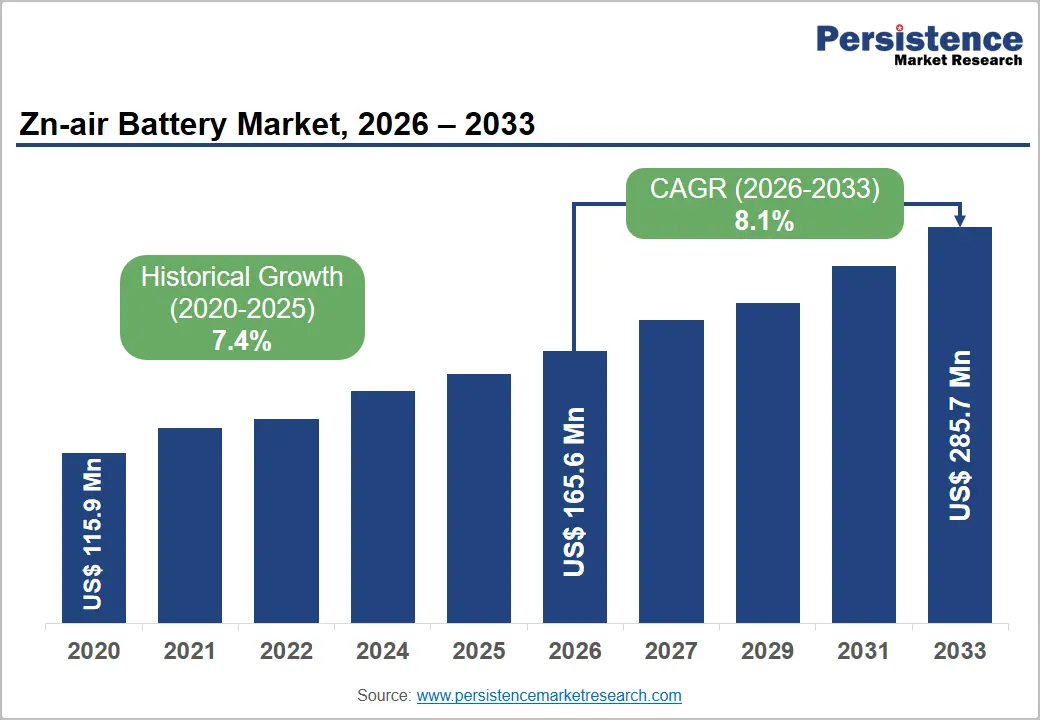
The global zn-air battery market size is likely to be valued at US$165.6 million in 2026 and is expected to reach US$285.7 million by 2033, growing at a CAGR of 8.1% between 2026 and 2033, driven by increasing demand for compact power sources in hearing aids and consumer electronics, alongside the rising adoption of long-duration energy storage systems for renewable energy integration and grid stability.
The chemistry’s reliance on abundant zinc resources, favorable safety profile, and lower raw-material dependence compared to lithium-based batteries supports its commercial attractiveness. Expanding investments in rechargeable zinc-air technologies and supportive energy-transition policies are expected to further strengthen market development throughout the forecast period.
Key Industry Highlights:
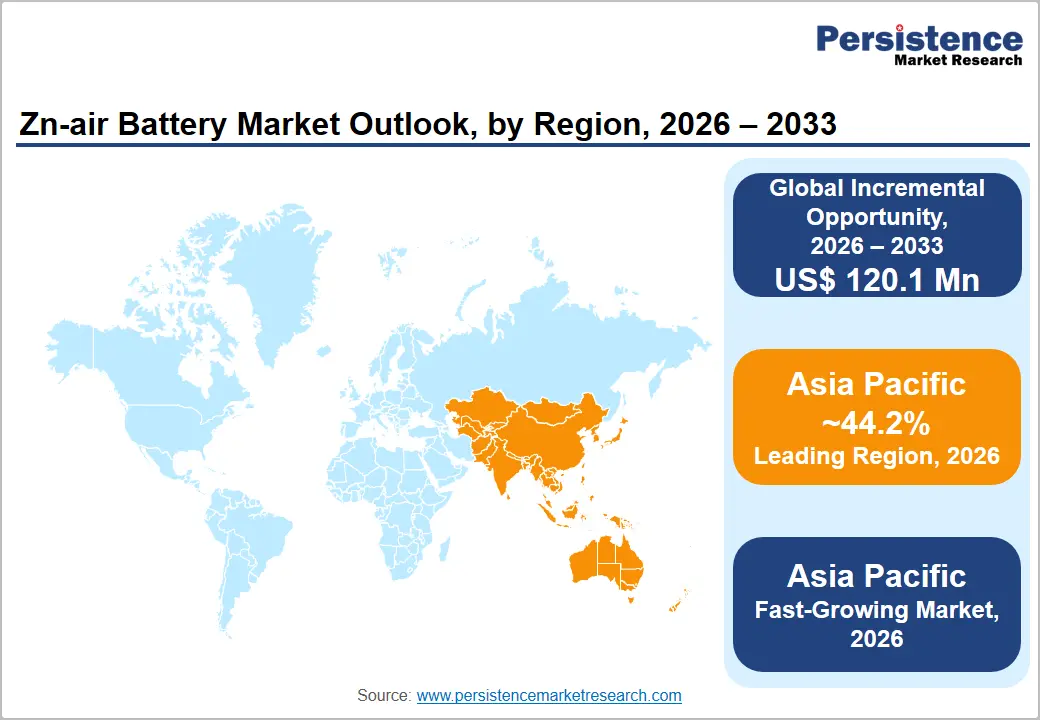
- Leading Region: Asia Pacific is projected to account for 44.2% of market share in 2026, driven by strong electronics manufacturing capabilities, expanding battery production infrastructure, and increasing investments in renewable energy storage projects.
- Fastest-growing Region: Asia Pacific is projected to register the highest growth rate through 2033, supported by rising energy storage demand, government-backed clean energy initiatives, and expanding battery manufacturing activities across China, India, Japan, and Southeast Asia.
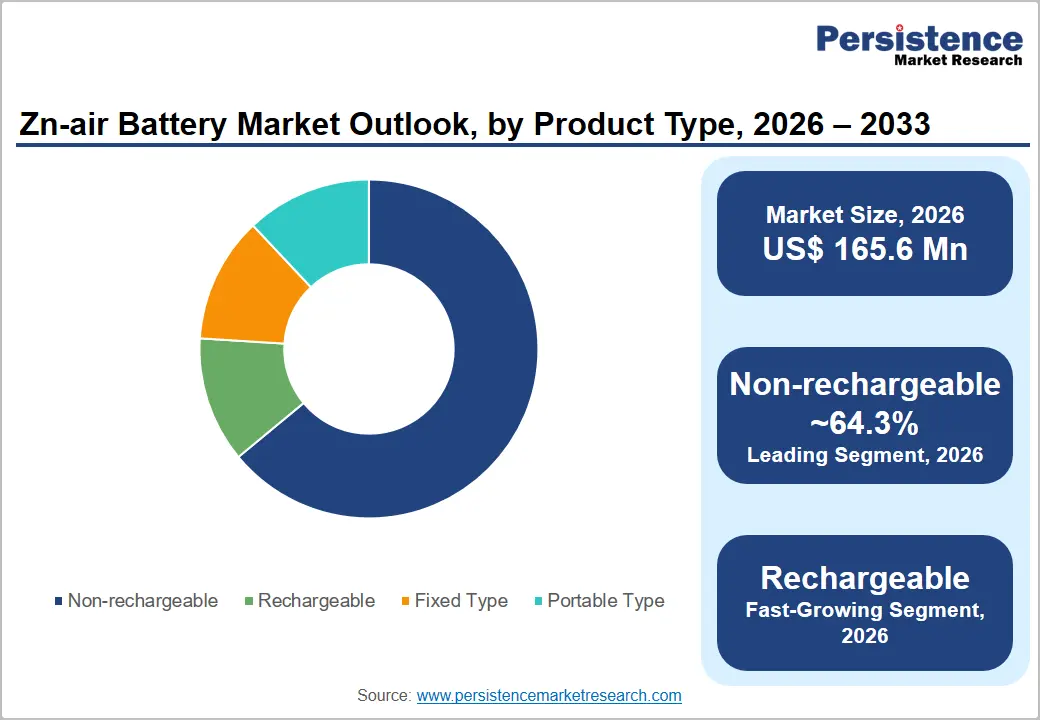
- Dominant Product Type: Non-rechargeable (primary) batteries are anticipated to account for 64.3% market share in 2026, supported by extensive use in hearing aids, portable medical devices, and compact consumer electronics.
- Leading Application: Consumer electronics is estimated to account for 51.7% market share in 2026, driven by strong demand for hearing aids, wearable devices, sensors, and other portable electronic applications requiring compact, high-energy-density batteries.
DRO Analysis
Driver - Rising Demand for Hearing Aids and Portable Electronic Devices
One of the most significant drivers of the Zn-air battery market is the increasing global demand for hearing aids and miniature electronic devices. Zinc-air batteries have long been the preferred power source for hearing aids owing to their high energy density, lightweight structure, and reliable performance. The growing elderly population worldwide is contributing to higher incidences of hearing impairment, increasing the need for hearing assistance devices. Since hearing aids require compact batteries capable of delivering consistent energy over extended periods, zinc-air technology remains a preferred solution.
The consumer electronics sector also supports market expansion. Wearable devices, sensors, remote monitoring equipment, and portable electronics continue to require efficient power solutions that offer long operational life and minimal maintenance. These characteristics strengthen demand for primary zinc-air batteries and support recurring replacement sales, creating a stable revenue stream for manufacturers.
Growing Adoption of Long-Duration Energy Storage Systems
The global transition toward renewable energy is creating strong opportunities for advanced battery technologies. As solar and wind installations expand, grid operators increasingly require energy storage systems capable of delivering electricity for extended durations. Rechargeable zinc-air batteries are emerging as a promising solution due to their potential for high energy density, enhanced safety, and lower dependence on critical minerals.
Utility companies, industrial facilities, and microgrid operators are evaluating zinc-air technologies for stationary storage applications. Compared with conventional lithium-ion systems, zinc-air batteries offer advantages in material availability and long-duration storage capability. Ongoing research focused on improving rechargeability, cycle life, and system efficiency is accelerating commercialization efforts. These developments are creating a second major growth avenue for the industry beyond traditional consumer applications.
Restraint - Commercialization and Performance Challenges
Despite favorable long-term prospects, commercialization challenges continue to restrain broader adoption of zinc-air batteries. Rechargeable zinc-air systems require significant technological improvements in air electrodes, electrolyte management, and cycle durability before achieving widespread deployment. Manufacturers must also invest heavily in pilot projects, product testing, and manufacturing infrastructure.
The market faces competition from established battery chemistries, particularly lithium-ion technologies, which benefit from mature supply chains and extensive manufacturing capacity. Long qualification cycles for utility-scale projects and industrial applications can further delay revenue generation. While zinc-air batteries offer promising economic and environmental benefits, overcoming technical limitations and achieving large-scale production remain critical requirements for market expansion.
Opportunities - Circular Economy Policies and Sustainable Battery Development
Increasing emphasis on sustainable energy storage technologies presents a substantial opportunity for zinc-air battery manufacturers. Governments and regulatory agencies worldwide are implementing policies designed to improve battery recycling, material traceability, and environmental performance. Zinc-air batteries benefit from the use of abundant and relatively accessible raw materials, reducing dependence on supply-constrained metals.
Organizations seeking to improve sustainability performance are increasingly evaluating battery technologies with lower environmental footprints. Zinc-air batteries align well with these objectives due to their potential recyclability and reduced reliance on critical minerals. Companies that develop robust recycling programs and sustainable manufacturing practices are likely to gain competitive advantages as environmental regulations become more stringent.
Expansion of Manufacturing Capacity and Strategic Partnerships
The commercialization landscape is improving as manufacturers invest in pilot facilities, demonstration projects, and strategic collaborations. Research institutions, battery developers, and industrial partners are actively working to advance rechargeable zinc-air technologies. These partnerships accelerate innovation, facilitate technology validation, and improve market confidence.
Emerging manufacturing hubs across Asia Pacific and North America are expected to support production scaling and supply chain development. Collaborative initiatives between industry participants and academic institutions are also helping address technical challenges related to performance and durability. As manufacturing capabilities mature, zinc-air batteries are expected to become increasingly competitive across stationary storage and transportation applications.
Category-wise Analysis
Product Type Insights
The non-rechargeable (primary) segment is anticipated to account for approximately 64.3% of market share in 2026, maintaining its position as the largest product category. Its dominance is driven by extensive use in hearing aids, portable medical equipment, and compact consumer electronics. Major brands such as Rayovac, Duracell, Panasonic, and Maxell continue to offer zinc-air batteries specifically designed for hearing-aid applications, supporting steady replacement demand.
The segment benefits from high energy density, leak-resistant performance, and low maintenance requirements. Growing adoption of hearing assistance devices among aging populations and the continued need for reliable miniature power sources are expected to sustain demand throughout the forecast period.
The rechargeable (secondary) segment is projected be the fastest-growing product category. Growth is supported by increasing deployment of long-duration energy storage systems, renewable energy projects, and commercial backup power applications.
Companies such as e-Zinc, ABOUND Energy, and Enzinc are actively developing rechargeable zinc-air technologies for utility-scale storage and microgrid applications. The ability to utilize abundant zinc materials while delivering extended energy storage duration positions rechargeable zinc-air batteries as a promising alternative for future energy infrastructure.
Application Insights
The consumer electronics segment is anticipated to hold approximately 51.7% of the market share in 2026, making it the leading application category. Hearing aids remain the largest commercial application, while zinc-air batteries are also used in wearable devices, wireless sensors, portable electronics, and communication equipment.
For example, Panasonic, Rayovac, and Duracell supply zinc-air batteries widely used in hearing aids due to their compact size and long operating life. Strong replacement demand and expanding healthcare device adoption continue to support the segment's market leadership.
The electric vehicles and grid energy storage segment is expected to witness the fastest growth during the forecast period, driven by rising investments in renewable energy integration and advanced battery technologies. Zinc-air batteries offer advantages such as high theoretical energy density, lower material costs, and improved sustainability compared to some conventional battery chemistries.
For instance, companies including e-Zinc and ABOUND Energy are developing zinc-based storage solutions for renewable energy projects and grid resilience applications. As utilities and industrial operators seek long-duration storage alternatives, these applications are expected to become major growth contributors for the Zn-air battery market.
Regional Insights
North America Zn-air Battery Market Trends
North America remains one of the most influential regions in the Zn-air Battery Market, supported by a strong innovation ecosystem, advanced research infrastructure, and growing investments in energy storage technologies. The region benefits from increasing renewable energy deployment, supportive government initiatives, and rising demand for long-duration energy storage solutions. Growing adoption of hearing aids and portable medical devices also contributes to steady demand for primary zinc-air batteries.
U.S. Zn-air Battery Market Trends
The U.S. dominates the North America Zn-air battery market due to extensive battery research programs, energy transition initiatives, and increasing investments in renewable energy infrastructure. Utility companies and technology developers are actively evaluating rechargeable zinc-air batteries for grid-scale energy storage, microgrids, and backup power systems. The country also hosts several companies focused on advanced zinc battery technologies, supporting commercialization and product development. Strong demand from healthcare applications, particularly hearing aids and portable medical equipment, further strengthens market growth.
Canada Zn-air Battery Market Trends
Canada is emerging as an important market for zinc-air battery innovation, supported by government-backed clean energy programs and investments in energy storage technologies. The country is home to several zinc-based battery developers working on long-duration storage solutions. Growing renewable energy installations and increasing interest in grid resilience are expected to create additional opportunities for rechargeable zinc-air batteries over the coming years.
Europe Zn-air Battery Market Trends
Europe represents a key market for zinc-air batteries, driven by stringent environmental regulations, ambitious carbon reduction targets, and growing demand for sustainable energy storage solutions. The region's emphasis on battery recycling, material traceability, and circular economy initiatives creates favorable conditions for zinc-air battery adoption. Increasing renewable energy deployment and investments in advanced battery manufacturing continue to support market expansion.
Germany Zn-air Battery Market Trends
Germany is the leading Zn-air battery market in Europe due to its strong manufacturing base, advanced engineering capabilities, and significant investments in energy transition programs. The country is witnessing growing demand for energy storage systems that support renewable energy integration and grid stability. Germany's established battery ecosystem also supports innovation in both primary and rechargeable zinc-air technologies.
U.K. Zn-air Battery Market Trends
The U.K. continues to strengthen its position through investments in battery research, clean energy projects, and grid modernization initiatives. Growing deployment of renewable energy resources is increasing the need for long-duration storage technologies, creating opportunities for zinc-air battery developers. The country's focus on decarbonization and energy security is expected to support future market growth.
France Zn-air Battery Market Trends
France is experiencing increasing demand for energy storage systems as renewable energy capacity expands across the country. Government support for sustainable technologies and investments in clean energy infrastructure are creating favorable conditions for advanced battery adoption. Zinc-air batteries are gaining attention for their potential role in supporting long-duration energy storage requirements.
Asia Pacific Zn-air Battery Market Trends
Asia Pacific is the largest regional market, accounting for approximately 44.2% of the market share in 2026, and is projected to remain the fastest-growing region through 2033. The region benefits from extensive electronics manufacturing capabilities, strong battery production infrastructure, abundant raw material availability, and increasing investments in renewable energy storage technologies. Growing demand for consumer electronics, hearing aids, and grid-scale storage systems continues to strengthen market expansion.
China Zn-air Battery Market Trends
China is the dominant contributor to the Asia Pacific market due to its massive electronics manufacturing ecosystem and rapidly expanding renewable energy sector. The country continues to invest heavily in advanced battery technologies to support energy transition goals and industrial development. Strong production capabilities and large-scale battery supply chains position China as a critical market for both primary and rechargeable zinc-air batteries.
Japan Zn-air Battery Market Trends
Japan plays a significant role in the Zn-air battery market through its expertise in specialty battery manufacturing and technological innovation. The country is home to leading battery manufacturers supplying zinc-air batteries for hearing aids and consumer electronics. Continued investment in advanced battery research is expected to support the development of next-generation rechargeable zinc-air technologies.
India Zn-air Battery Market Trends
India is emerging as one of the most promising growth markets in the region. Increasing renewable energy investments, government initiatives promoting domestic battery manufacturing, and growing research activities related to zinc-based energy storage are creating new opportunities. Rising demand for affordable energy storage solutions and expanding healthcare infrastructure are expected to drive zinc-air battery adoption.
Competitive Landscape
The global zn-air battery market remains moderately fragmented, with competition occurring across both primary battery and long-duration energy storage segments. Established battery manufacturers dominate consumer and healthcare applications through extensive distribution networks and strong brand recognition. Emerging technology companies are focusing on rechargeable zinc-air systems designed for stationary storage and industrial applications.
Leading participants are prioritizing product innovation, manufacturing expansion, strategic partnerships, and commercialization of rechargeable zinc-air technologies. Key competitive differentiators include energy density improvements, enhanced cycle life, lower production costs, and stronger sustainability credentials. Companies are also increasingly adopting collaborative development models to accelerate market entry and technology validation.
Key Industry Developments:
- In January 2026, ABOUND Energy announced a strategic refinement of its intellectual property portfolio and received a purchase order for its AeroTex™ carbon-based gas diffusion layer, aimed at accelerating the commercialization of its third-generation Zaeras™ zinc-air long-duration energy storage platform.
- In January 2026, ABOUND Energy announced a strategic commercialization initiative focused on advancing its Zaeras™ zinc-air battery platform through targeted investments in engineering development and manufacturing preparedness.
Companies Covered in Zn-air Battery Market
- Panasonic Energy Co., Ltd.
- Energizer Holdings, Inc.
- Rayovac (Spectrum Brands Holdings, Inc.)
- VARTA AG
- GP Batteries International Limited
- Renata SA
- Maxell, Ltd.
- Duracell Inc.
- Camelion Batterien GmbH
- ABOUND Energy Inc.
- e-Zinc Inc.
- Enzinc, Inc.
- Zinc8 Energy Solutions Inc.
- NantEnergy, Inc.
- Phinergy Ltd.
- ZAF Energy Systems, Inc.
Frequently Asked Questions
The global zn-air battery market is estimated to be valued at US$165.6 million in 2026.
The zn-air battery market is expected to reach US$285.7 million by 2033.
Key trends include growing adoption of rechargeable zinc-air batteries for long-duration energy storage and rising demand for hearing aids and portable medical devices.
The non-rechargeable (primary) battery segment leads the market and is anticipated to account for approximately 64.3% of market share in 2026, driven by widespread use in hearing aids, portable medical devices, and compact consumer electronics.
The global zn-air battery market is projected to grow at a CAGR of 8.1% between 2026 and 2033.
Major companies include Panasonic Energy Co., Ltd., Energizer Holdings, Inc., VARTA AG, and GP Batteries International Limited.


