




- Bulk Chemicals
- Well Stimulation Materials Market
Well Stimulation Materials Market Size, Share, and Growth Forecast 2026 - 2033
Well Stimulation Materials Market by Technology (Hydraulic Fracturing, Acidization), Material Type (Proppants, Base Fluid Materials, Fluid Additives), and Regional Analysis, 2026 - 2033

Well Stimulation Materials Market Size and Trend Analysis
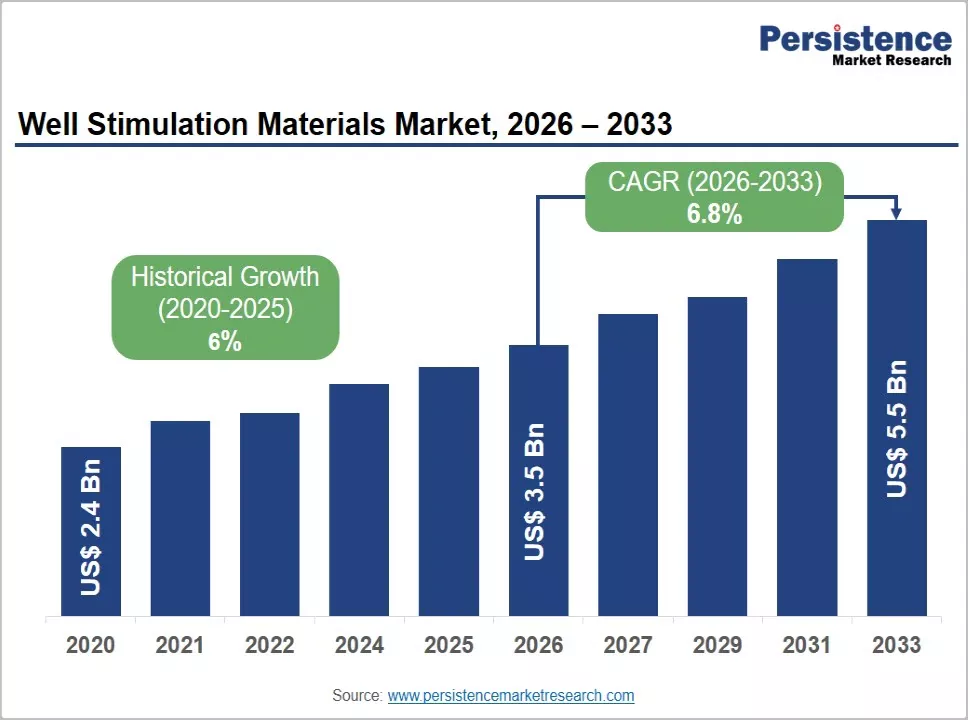
The global well stimulation materials market size is likely to be valued at US$ 3.50 billion in 2026 and is projected to reach US$ 5.55 billion by 2033, growing at a CAGR of 6.8% during the forecast period between 2026 and 2033. This trajectory reflects sustained capital commitment to tight oil and shale gas formations, mainly across North American basins where operators continue extending lateral lengths and increasing proppant loading per stage.
The U.S. Energy Information Administration (EIA) projects domestic crude production to remain above 13 million barrels per day through the late 2020s, underpinning durable operator spending on hydraulic fracturing fluids, proppants, and fluid additives. For procurement strategists and energy-sector investors, the market's compounding growth presents a structurally attractive opportunity rather than a cyclical trade.
Key Industry Highlights
- Dominant Region: North America is projected to dominate the regional market, driven by established proppant logistics networks, and operator completion intensity that consistently exceeds global averages. This leadership position is unlikely to erode materially through 2033.
- Fastest-growing Region: Asia Pacific is fastest growing, propelled by CNPC and ONGC unconventional programs backed by national energy security mandates. Investors seeking geographic diversification within the well stimulation materials space should weight this region accordingly.
- Dominant Technology: Hydraulic fracturing's 76% technology share reflects how thoroughly unconventional resource development has restructured operator completion economics. The adoption of Simul-Frac and zipper-frac techniques is extending per-pad material volumes, reinforcing fracturing's dominant position rather than plateauing it.
- Fastest-growing Material Type: Fluid additives the fastest-growing material type are attracting disproportionate R&D capital from suppliers including Ecolab and Dow, as operators seek formulations that simultaneously optimize fracture network complexity, minimize formation damage, and satisfy tightening environmental discharge standards across U.S. and international jurisdictions.
- Key Market Update: The Jafurah Basin unconventional program by Saudi Aramco represents the most consequential single-operator demand catalyst outside North America through 2033. Suppliers with high-temperature, high-salinity fluid additive capability and established MENA logistics infrastructure are positioned to capture a material share of this multi-billion-dollar completion program.
DRO Analysis
Driver - National Energy Security Policies Driving Upstream Capital Reinvestment
Energy security imperatives across major consuming nations are compelling governments to incentivize domestic upstream activity. The U.S. Inflation Reduction Act (IRA) of 2022 embedded production tax credits and manufacturing incentives that have directly supported oilfield services spending, including materials procurement.
Similarly, India's Ministry of Petroleum and Natural Gas launched its Hydrocarbon Exploration and Licensing Policy (HELP) to attract investment into domestic unconventional blocks, creating incremental demand for well stimulation materials in basins such as the Cambay and Krishna-Godavari. Regulatory support of this nature provides multi-year revenue visibility for materials suppliers and positions the well stimulation materials sector for sustained volume growth through the forecast horizon.
Restraint - Environmental Regulation and Water Usage Scrutiny Constraining Operations
Hydraulic fracturing's intensive water requirements typically two to ten million gallons per completion attract sustained regulatory scrutiny, particularly in water-stressed geographies. The U.S. Environmental Protection Agency (EPA) has tightened effluent discharge standards under the Safe Drinking Water Act, raising compliance costs for operators and indirectly pressuring stimulation material usage patterns. In the European Union, several member states maintain effective moratoriums on high-volume hydraulic fracturing, materially limiting the addressable market for fracturing fluids and proppants across a region that otherwise represents significant resource potential.
Opportunity - Green Chemistry and Low-Carbon Fracturing Fluids Opening a Premium Segment
The well stimulation materials sector is experiencing the early formation of a differentiated, sustainability-oriented product tier. Operators under ESG (Environmental, Social, and Governance) disclosure pressure particularly those listed on major exchanges are actively seeking biodegradable friction reducers, low-toxicity biocides, and waterless fracturing fluid systems.
Halliburton commercially launched its CleanFleet low-emission fracturing fleet in 2023, signaling operator appetite for paired equipment-and-materials sustainability solutions. Suppliers capable of formulating and certifying green chemistry alternatives stand to command premium pricing and preferred-vendor status among investment-grade operators seeking to reduce Scope 3 emissions intensity from their completion programs.
Category-wise Analysis
Technology Insights
Why Does Hydraulic Fracturing Dominate the Market?
Hydraulic fracturing is projected to lead the technology segment command about 76% of well stimulation materials market share in 2026, propelled by unconventional reservoir economics are inseparable from high-intensity fracture stimulation. Shale operators in formations such as the Wolfcamp and Haynesville deploy 40 to 60 fracturing stages per lateral, each requiring precisely engineered proppant-fluid blends to generate and prop open productive fracture networks.
The capital commitment embedded in multi-year unconventional drilling programs creates structural lock-in of hydraulic fracturing as the dominant completion technology. Its acceleration is further fueled by the adoption of Simul-Frac simultaneous fracturing techniques pioneered at scale by Pioneer Natural Resources which double fracturing throughput on pad wells and proportionally increase per-pad material consumption.
Acidization is likely to be the fastest-growing technology sub-segment, gaining momentum in carbonate reservoir development across the Middle East and Latin America. Operators targeting tight limestone formations use matrix acidization and acid fracturing to dissolve rock and create conductive channels, requiring specialized hydrochloric acid formulations and acid-corrosion inhibitors.
Material Type Insights
What Is Driving Proppant Demand in the Global Market?
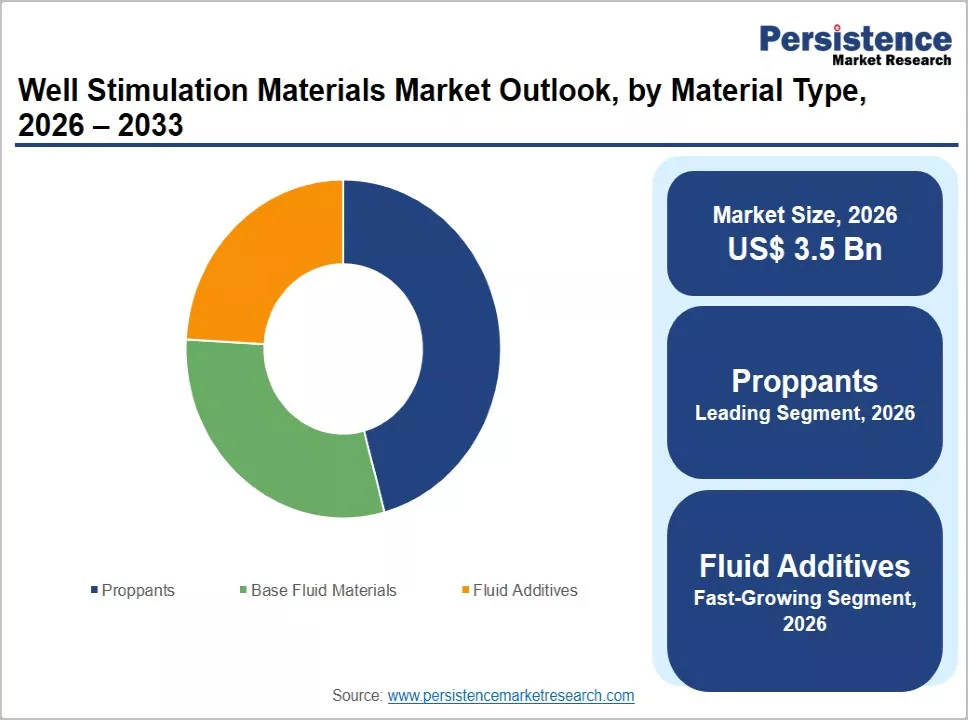
Proppants are expected to dominate the material type account about 49% of market share in 2026, driven by their irreplaceable mechanical role in fracture conductivity. Independent oil producers operating in the Midland Basin specify high-mesh silica sand or resin-coated proppants to sustain fracture permeability under reservoir closure stress, directly determining well productivity and ultimate recovery. The proppant selection process governed by American Petroleum Institute (API) crush resistance and turbidity standards underpins consistent demand from technically rigorous operator procurement teams.
Proppant's dominance is structurally durable because no alternative material replicates its combination of compressive strength, cost efficiency, and established supply logistics.
Fluid additives are likely to be the fastest-growing material type, driven by operators' increasing emphasis on completion optimization and regulatory compliance. Ecolab's oilfield chemistry division expanded its friction reducer and scale inhibitor portfolio in 2023-2024, responding to operator demand for additives that maintain fracture fluid efficiency while meeting EPA wastewater management requirements. Next-generation additives including nanoparticle-based fluid loss control agents are opening new performance tiers that command higher margins across the well stimulation materials space.
Regional Insights
North America Well Stimulation Materials Market Trends and Insights
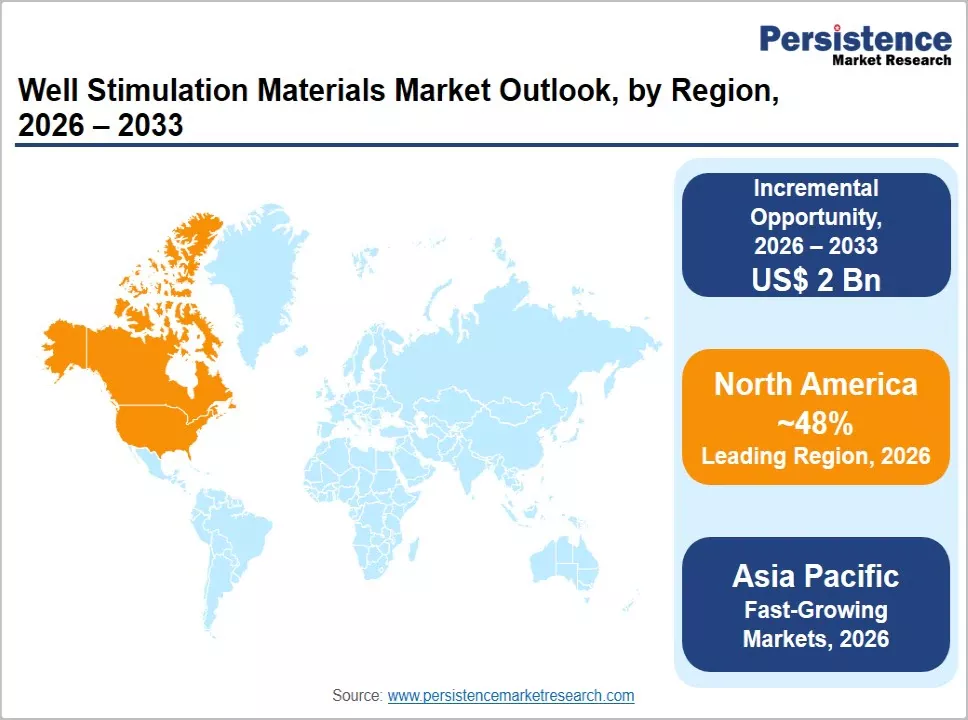
North America is estimated to dominate the regional market capture nearly 48% of well stimulation materials market share in 2026. The region's dominance reflects decades of unconventional resource development infrastructure, including an extensive network of proppant mines, blending facilities, and oilfield chemical distribution terminals. The U.S. Department of Energy's continued funding of completion technology research under its Office of Fossil Energy and Carbon Management reinforces the operational ecosystem sustaining North American stimulation activity. Regional demand will grow as operators extend development into lower-productivity tier-two acreage, requiring higher stimulation intensity per well.
U.S. Well Stimulation Materials Market Size
The U.S. is expected to hold around 88% of the North America regional market in 2026. Demand is anchored by prolific basin activity across the Permian, Appalachian, and DJ Basin plays, where completion designs continue to intensify. The U.S. Bureau of Land Management's ongoing permitting decisions for federal acreage will serve as a key forward indicator of operator spending and stimulation material offtake through 2033.
Canada Well Stimulation Materials Market Size
Canada is anticipated to capture nearly 12% of the North America regional market in 2026. Canadian unconventional activity centers on the Montney and Duvernay formations in British Columbia and Alberta, where liquids-rich natural gas production supports sustained fracturing programs. Expansion of LNG Canada's Phase 2 export capacity will incentivize upstream drilling and stimulation spending, providing a clear demand catalyst for well stimulation materials suppliers through the late 2020s.
Europe Well Stimulation Materials Market Trends and Insights
Europe is projected to account around 10% of well stimulation materials market in 2026. Demand here is primarily conventional focused on matrix acidization and workover stimulation in mature North Sea fields rather than large-scale hydraulic fracturing, which remains politically constrained across much of the continent. The European Commission's REPowerEU plan, while prioritizing renewables, simultaneously accelerated domestic gas field development to reduce dependence on Russian imports, providing a measured but real stimulus for well intervention and acidization activity.
Field redevelopment in the Norwegian Continental Shelf and the Southern North Sea will remain the primary demand anchor through 2033
Germany Well Stimulation Materials Market Size
Germany is expected to command around19% of the Europe regional market in 2026. Germany's stimulation materials demand is largely tied to underground gas storage maintenance and workover activity in legacy fields in Lower Saxony, rather than new drilling. The country's accelerated gas infrastructure expansion following the 2022 energy crisis provides a marginal but meaningful forward signal for continued stimulation services activity.
U.S. Well Stimulation Materials Market Size
The U.K. is projected to hold around 14% of the Europe regional market in 2026. Mature North Sea production fields generate consistent demand for matrix acidization and scale-inhibitor treatments to sustain ageing reservoir output. The North Sea Transition Authority (NSTA) continues to issue late-life field extension licenses, which typically require well intervention and stimulation to maintain commercial flow rates, sustaining near-term materials demand.
Which Region Will Drive the Fastest Well Stimulation Materials Growth Through 2033?
Asia Pacific is likely to be the fastest-growing during the forecast period between 2026 to 2033. National energy security mandates in China and India are driving government-backed unconventional exploration programs that require large-scale stimulation campaigns in frontier tight gas and coalbed methane formations. China National Petroleum Corporation (CNPC) has identified the Sichuan Basin's shale gas reserves as a strategic production priority, investing in multi-pad hydraulic fracturing programs that will generate compounding demand for proppants and fracturing fluid systems through 2033.
China Well Stimulation Materials Market Size
China is estimated to command around 32% of the Asia Pacific regional market in 2026. Domestic shale gas production targets set under China's 14th Five-Year Plan are compelling operators to accelerate completion activity in the Sichuan and Tarim basins. As domestic proppant manufacturing capacity expands led by state-affiliated ceramics producers China will increasingly satisfy stimulation material demand through local supply chains, though imported specialty additives will retain a role in technically complex completions.
India Well Stimulation Materials Market Size
India is anticipated to hold about 12% of the Asia Pacific regional market in 2026. Oil and Natural Gas Corporation (ONGC) is advancing tight gas development in the Vindhyan and Cambay basins under India's strategic gas production expansion mandate. Policy support through the Hydrocarbon Exploration and Licensing Policy is attracting international oilfield service providers to the Indian market, creating competitive supply conditions that will progressively lower stimulation material costs and incentivize wider adoption through 2033.
Competitive Landscape
The global well stimulation materials market operates as a moderately concentrated market, where large diversified chemical and industrial gas companies compete alongside specialist oilfield chemistry providers. BASF SE, Dow, DuPont, and Akzo Nobel N.V. bring formulation depth and global supply chain scale, enabling them to serve integrated operator procurement programs across multiple basins simultaneously.
CARBO Ceramics Inc. occupies a differentiated position in engineered ceramic proppants, competing on crush resistance and conductivity performance rather than price. Ecolab, Ashland, and Chevron Phillips Chemical Company anchor the fluid additives segment. Competitive advantage ultimately rests on three factors: technical formulation capability for reservoir-specific conditions, logistics reliability in remote completion environments, and the ability to deliver material qualification data aligned with API performance standards that operator completion engineers require before approving new materials.
Key Industry Developments
- January 2025: BASF SE announced an expansion of its oilfield chemistry production capacity at its Freeport, Texas facility, adding dedicated lines for friction reducers and scale inhibitors targeting Permian Basin completions, increasing annual output by an estimated 15%.
- March 2024: Ecolab completed the acquisition of a specialty oilfield biocide and corrosion-inhibitor business from a mid-size chemical manufacturer, strengthening its fluid additive portfolio and extending its geographic reach into Latin American unconventional markets.
- November 2024: Linde commissioned a new high-purity nitrogen supply infrastructure at a Midland Basin hub, enabling waterless and low-water fracturing operations a development that positions the company to serve operators under water-use regulatory pressure in West Texas.
Companies Covered in Well Stimulation Materials Market
- Akzo Nobel N.V.
- Ashland
- BASF SE
- CARBO Ceramics Inc.
- Chevron Phillips Chemical Company
- Dow
- DuPont
- Ecolab
- Linde
- Others
Frequently Asked Questions
The global well stimulation materials market is valued at US$ 3.50 billion in 2026 and is forecast to reach US$ 5.55 billion by 2033, advancing at a CAGR of 6.8%.
Rising per-well proppant and fluid additive consumption as operators extend horizontal laterals in unconventional reservoirs and government-backed upstream investment policies.
Proppants hold the largest material-type share at 49% of the global market, because they perform an irreplaceable mechanical function propping open hydraulic fractures to sustain reservoir permeability and long-term hydrocarbon flow.
North America dominates with around 48% of global share, anchored by the world's most active unconventional resource development programs and an integrated supply infrastructure encompassing silica sand mines.
A key opportunity is the green chemistry shift where biodegradable friction reducers and low-toxicity biocides command premium pricing from ESG-compliant operators.
Leading companies in the market include BASF SE, Dow, Ecolab, CARBO Ceramics Inc., Akzo Nobel N.V., DuPont, Ashland, Chevron Phillips Chemical Company, and Linde.


