




- Bulk Chemicals
- Tire Pyrolysis Oil Market
Tire Pyrolysis Oil Market Size, Share, and Growth Forecast, 2026 - 2033
Tire Pyrolysis Oil Market by Source Type (Passenger Vehicle Tires, Commercial Vehicle Tires, Off-road Vehicle Tires, Industrial Rubber Waste), Production Process (Slow Pyrolysis, Fast Pyrolysis, Flash Pyrolysis), and Regional Analysis, for 2026 - 2033

Tire Pyrolysis Oil Market Size and Trend Analysis
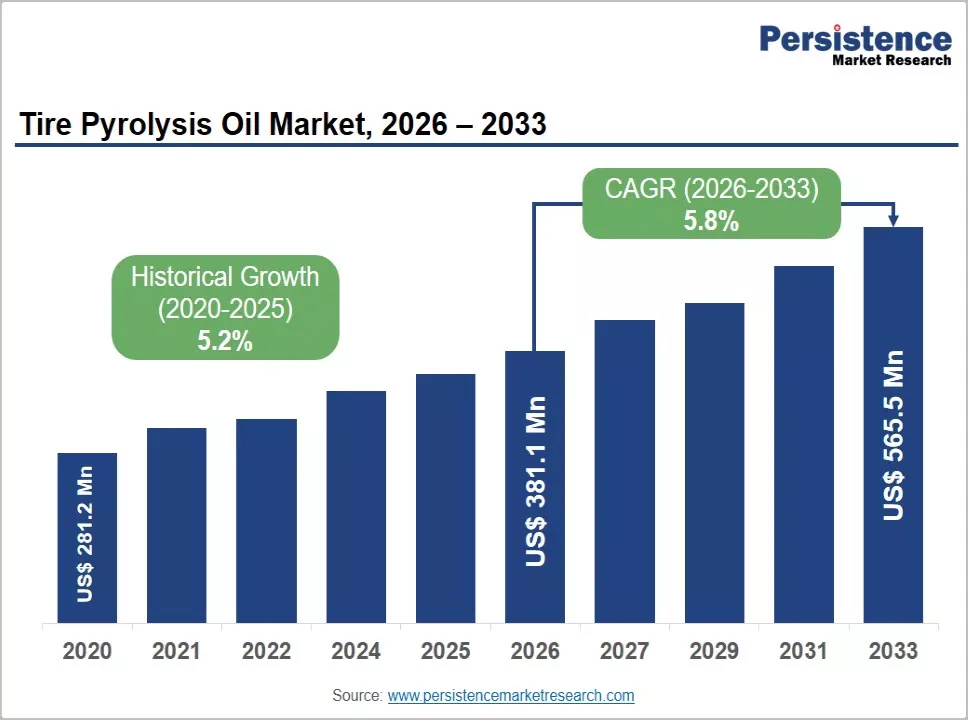
The global tire pyrolysis oil market is likely to be valued at US$ 381.1 million in 2026 and is expected to reach US$ 565.5 million by 2033, growing at a CAGR of 5.8% during the forecast period from 2026 to 2033.
Governments across Europe and Asia are tightening end-of-life tire (ELT) disposal mandates while simultaneously classifying tire-derived pyrolysis oil as a recoverable fuel and chemical feedstock, a dual designation that is structurally reshaping investment in thermal depolymerization infrastructure. The European Union's End-of-Life Vehicles Regulation, revised under the broader circular economy legislative package, is compelling tire manufacturers and waste processors to demonstrate measurable feedstock recovery rates.
Key Industry Highlights:
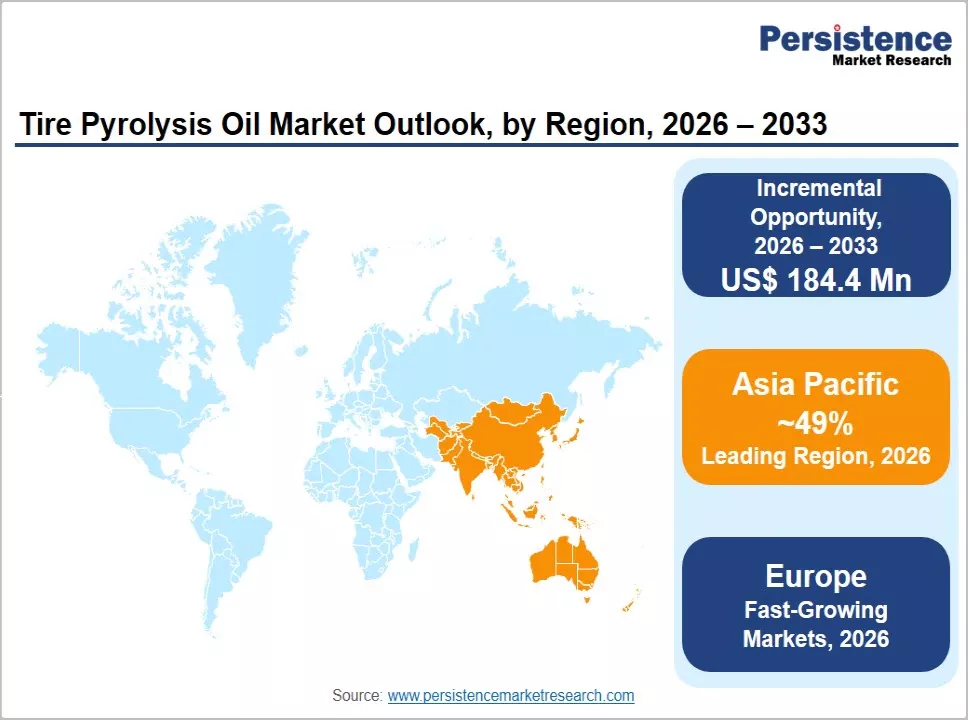
- Leading Region: Asia Pacific is anticipated to be the leading region in the tire pyrolysis oil market, supported by a market value of US$ 186.74 million in 2026, driven by the world's largest end-of-life tire volumes and government-sanctioned pyrolysis frameworks in China and India.
- Fastest-growing Region: Europe is likely to witness significant growth in the tire pyrolysis oil market at a CAGR of 6.5%, supported by a market value of US$ 95.28 million in 2026, driven by the European Commission's Circular Economy Action Plan.
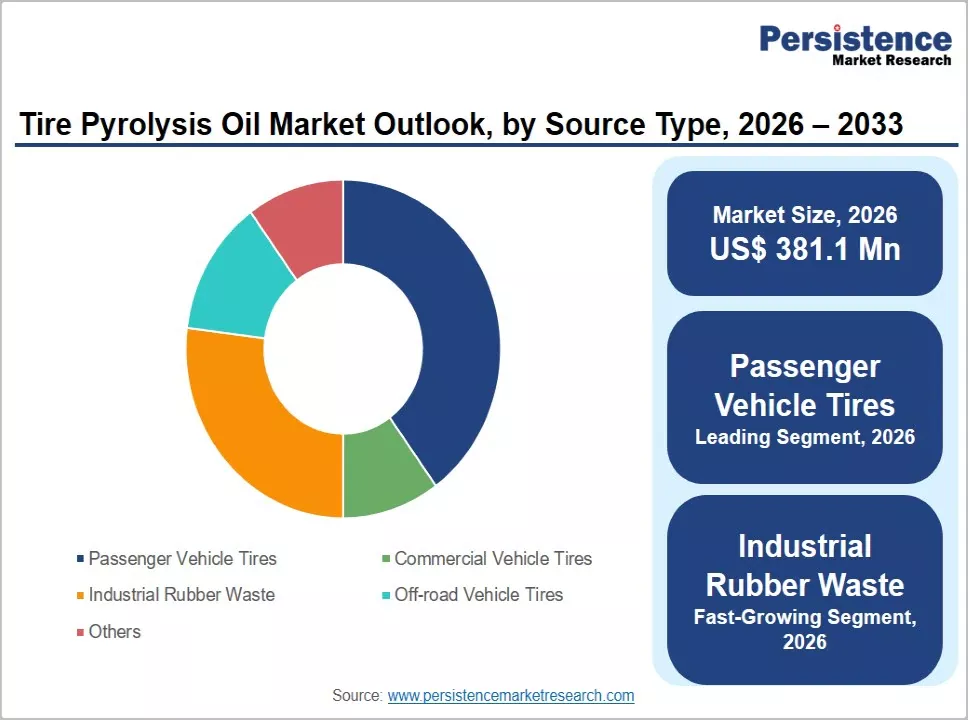
- Leading Source Type: Passenger vehicle tires are projected to represent the leading source type segment in 2026, accounting for 47% of the market share, supported by mature retail collection networks and predictable oil yields.
- Fastest-growing Production Process: Fast pyrolysis is anticipated to be the fastest-growing production process, supported by shorter residence times that enable higher throughput per reactor unit.
- Key Opportunity: Repositioning tire pyrolysis oil as a chemical industry feedstock, with aromatic fractions supplied to petrochemical refiners, creates opportunities for operators with hydrotreatment and fractionation capability.
DRO Analysis
Driver - Surging End-of-Life Tire Volumes and Regulatory Mandates for Thermal Recovery
Approximately 1.5 billion tires reach end-of-life globally each year, according to data published by the World Business Council for Sustainable Development (WBCSD). Conventional disposal routes (landfill and open stockpiling) face intensifying regulatory closure.
India's Ministry of Environment, Forest and Climate Change codified pyrolysis as a designated ELT processing route under its Hazardous and Other Wastes Management Rules, creating a compliant commercial pathway for tire-derived fuel oil (TDFO) producers. This regulatory formalization is converting informal sector activity into licensed, scalable operations, directly expanding addressable capacity in the tire pyrolysis oil sector.
Restraint - Inconsistent Feedstock Quality and Contaminant Management Challenges
Tire pyrolysis oil contains elevated concentrations of sulfur, typically 0.8-1.5% by weight, along with polycyclic aromatic hydrocarbons (PAHs) and char particulates that complicate direct use in sensitive combustion systems. The International Maritime Organization (IMO) sulfur cap of 0.5% m/m under MARPOL Annex VI effectively excludes unrefined pyrolysis oil from the marine fuel market without additional hydrotreatment. Upgrading infrastructure requirements add capital expenditure of US$ 2-5 million per processing unit, creating a meaningful barrier for smaller independent operators.
Opportunity - Circular Economy Integration with Chemical Feedstock Refining
Beyond fuel applications, tire pyrolysis oil contains aromatics (toluene, xylene, limonene) that are commercially extractable as chemical intermediates. Pyrum Innovations AG, listed on the Frankfurt Stock Exchange, has piloted a refining process to fractionate pyrolysis oil into distinct chemical streams, targeting petrochemical buyers rather than fuel blenders.
This positions tire pyrolysis oil as a secondary raw material within circular polymer supply chains, dramatically expanding the buyer universe beyond industrial fuel purchasing desks. As virgin naphtha prices remain sensitive to crude oil volatility, chemical producers are actively evaluating pyrolysis-derived aromatics as a cost-stable alternative feedstock.
Category-wise Analysis
Source Type Insights
Why Do Passenger Vehicle Tires Dominate Tire Pyrolysis Oil Feedstock Supply?
Passenger vehicle tires hold 47% of the tire pyrolysis oil market in 2026, equivalent to US$ 179.12 million, because they represent the most abundant, geographically dispersed, and logistically accessible category of ELT feedstock globally.
Passenger tires are collected at scale through established retail take-back networks, Michelin's Tyromer program and municipal collection schemes operated by European tire retailers under European Tire and Rubber Manufacturers' Association (ETRMA) producer responsibility frameworks. Their relatively homogeneous rubber compound formulation also yields predictable oil output rates of approximately 40-45% by weight, which industrial pyrolysis plant operators prefer when calibrating throughput models.
Industrial Rubber Waste is the fastest-growing feedstock segment, accelerating as conveyor belts, gaskets, and production scrap from manufacturing facilities enter formal ELT processing streams. Scandinavian Enviro Systems has expanded its feedstock intake protocols to include non-tire rubber vulcanizates, targeting automotive parts manufacturers in Germany and Sweden whose sustainability reporting obligations under the EU Corporate Sustainability Reporting Directive (CSRD) incentivize documented rubber waste diversion.
Production Process Analysis
Which Pyrolysis Process Technology Leads Commercial-Scale Tire Oil Production?
Slow pyrolysis commands 62% of the tire pyrolysis oil market in 2026, equivalent to US$ 236.28 million, because its extended thermal residence time (typically 30-60 minutes at 450-550°C) consistently maximizes oil yield per ton of tire feedstock under commercial operating conditions.
Cement producers and industrial fuel blenders purchasing tire-derived fuel oil in bulk contract volumes specifically preference slow pyrolysis output for its higher average calorific value and lower char carry-over compared with faster thermal processing routes. Operators including Klean Industries have standardized on continuous slow pyrolysis reactor configurations for large-scale merchant plants, reducing per-unit capital cost through modular scale-up.
Fast pyrolysis is the fastest-growing production process, gaining traction because its shorter residence times enable higher throughput per reactor unit. Contec S.A., the Polish waste processing group, has commissioned fast pyrolysis units targeting fuel oil output for industrial district heating networks in Central Europe, a use case that benefits from faster cycle economics and lower specific energy consumption per liter of output.
Regional Insights
North America Tire Pyrolysis Oil Market Trends
North America accounts for 16% of the tire pyrolysis oil market in 2026, representing US$ 60.98 million. The region's growth is tempered by established cement kiln co-processing infrastructure that competes with pyrolysis for ELT feedstock. The U.S. Environmental Protection Agency (EPA) Solid Waste provisions governing tire-derived fuel combustion create compliance layers that modestly favor incumbent co-processing operators. Renewed interest from industrial fuel buyers in the Gulf Coast refining corridor, however, signals forward momentum.
U.S. Tire Pyrolysis Oil Market Trends
The U.S. tire pyrolysis oil market represents 88% of the North America regional market in 2026, equivalent to US$ 53.66 million. Industrial furnace and cement kiln operators in Texas and Louisiana drive the majority of domestic demand for tire-derived fuel oil, substituting conventional residual fuel oil as input cost management. Expanding EPA guidance on pyrolysis oil blending specifications through 2025-2026 is expected to widen the buyer base.
Canada Tire Pyrolysis Oil Market Trends
The Canada tire pyrolysis oil market represents 12% of the North America regional market in 2026, equivalent to US$ 7.32 million. Provincial extended producer responsibility (EPR) legislation (particularly Ontario's Tire Stewardship program) channels a significant volume of ELTs toward domestic processing, creating a stable feedstock supply base. As Canadian industrial operators face carbon pricing obligations under the federal Output-Based Pricing System, tire pyrolysis oil's lower lifecycle carbon intensity relative to virgin fuel oil should attract incremental procurement interest through 2033.
Europe Tire Pyrolysis Oil Market Trends
Europe accounts for 25% of the tire pyrolysis oil market in 2026, representing US$ 95.28 million, and is the fastest-growing regional market at an estimated CAGR of 6.5% through 2033. The European Commission's Circular Economy Action Plan and waste classification revisions under the EU Waste Framework Directive are actively incentivizing pyrolysis oil recovery as a circular feedstock. Industrial cluster demand in Germany, the Netherlands, and Poland is converting ELT stockpiles into contracted processing volumes.
Germany Tire Pyrolysis Oil Market Trends
The Germany tire pyrolysis oil market represents 33% of the Europe regional market in 2026, equivalent to US$ 31.44 million. Germany's dense industrial base (particularly cement producers such as HeidelbergMaterials and chemical refiners) sustains consistent demand for tire-derived fuel oil as a co-processing input. Stricter German Federal Immission Control Act (BImSchG) emission standards are driving investment in upgraded pyrolysis oil hydrotreatment capability, positioning Germany as a technology-development hub for the European sector through the forecast period.
U.K. Tire Pyrolysis Oil Market Trends
The U.K. tire pyrolysis oil market represents 18% of the Europe regional market in 2026, equivalent to US$ 17.15 million. Wastefront AS, the Norwegian waste tire processor, selected Sunderland, UK as the site for its first commercial-scale tire pyrolysis plant (a facility targeting approximately 100,000 tons of ELT annual capacity) anchoring the U.K.'s emergence as a scale production center. Post-Brexit regulatory divergence from EU waste classification frameworks introduces some uncertainty, but domestic industrial fuel demand provides near-term offtake stability.
Asia Pacific Tire Pyrolysis Oil Market Trends
What Is Driving Asia Pacific's Dominance of the Global Tire Pyrolysis Oil Market?
Asia Pacific accounts for 49% of the tire pyrolysis oil market in 2026, representing US$ 186.74 million, and leads all regions by a substantial margin. The region generates the world's largest volume of end-of-life tires, underpinned by vehicle fleet sizes expanding rapidly across China, India, and Southeast Asia. Industrial energy intensity, combined with governments' formal designation of pyrolysis as a sanctioned waste processing route, sustains both feedstock supply and offtake demand within the same regional geography, a structural advantage no other region replicates at comparable scale.
China Tire Pyrolysis Oil Market Trends
The China tire pyrolysis oil market represents 35% of the Asia Pacific regional market in 2026, equivalent to US$ 65.36 million. China's National Development and Reform Commission (NDRC) has classified pyrolysis oil as a resource recovery product under its circular economy policy framework, enabling VAT incentives for qualified producers. Domestic industrial fuel demand from steel mills, ceramic kilns, and chemicals processors provides deep, recurring offtake, positioning China as the single most consequential national market in the tire pyrolysis oil landscape through 2033.
India Tire Pyrolysis Oil Market Trends
The India tire pyrolysis oil market represents 19% of the Asia Pacific regional market in 2026, equivalent to US$ 35.48 million. India's formalization of the pyrolysis sector (following notification of the Plastic Waste Management and Hazardous Waste Rules) has catalyzed licensing of commercial-scale pyrolysis units across Maharashtra, Gujarat, and Tamil Nadu. As India's vehicle fleet surpasses 300 million registered units, per data from the Ministry of Road Transport and Highways, the ELT feedstock pipeline will deepen materially, supporting sustained growth in domestic pyrolysis oil output through the forecast period.
Competitive Landscape
The tire pyrolysis oil industry remains moderately fragmented, with no single operator holding dominant share. Competition pivots on three variables: reactor technology proprietary to each operator, consistency of feedstock supply agreements, and the ability to access premium offtake contracts with industrial fuel buyers or chemical refiners. Pyrum Innovations AG, Scandinavian Enviro Systems, Klean Industries, and Wastefront AS lead the technology-differentiated tier.
Ecolomondo Corporation and Green Fuel Nordic Oy occupy strong regional niches in North America and Northern Europe respectively. Bridgestone Corporation represents a strategically distinct entrant, a tire manufacturer integrating backward into pyrolysis to manage its own ELT liabilities while capturing feedstock economics.
Key Industry Developments:
- In November 2026, Scandinavian Enviro Systems AB signed a conditional service agreement for a proposed tire pyrolysis plant project in North America, following a letter of intent for technology licensing announced in March 2026.
Companies Covered in Tire Pyrolysis Oil Market
- Bolder Industries
- Bridgestone Corporation
- Circtec
- Contec S.A.
- Ecolomondo Corporation
- Green Fuel Nordic Oy
- Klean Industries
- Pyrum Innovations AG
- Scandinavian Enviro Systems
- Wastefront AS
Frequently Asked Questions
The global tire pyrolysis oil market is valued at US$ 381.10 million in 2026 and is projected to reach US$ 565.51 million by 2033, expanding at a CAGR of 5.8%.
The Basel Convention's tightening restrictions on cross-border waste tire exports are compelling domestic processing investment across Asia and Europe.
Passenger vehicle tires represent the dominant feedstock segment, holding 47% of share. Their dominance reflects the unmatched scale of municipal and retail ELT collection networks globally.
Asia Pacific dominates the market with a 49% share in 2026, sustained by the world's largest end-of-life tire generation volumes and government-designated pyrolysis processing frameworks in China and India.
The highest-value opportunity lies in repositioning tire pyrolysis oil as a chemical industry feedstock rather than a commodity fuel.
Leading companies in the tire pyrolysis oil market include Pyrum Innovations AG, Scandinavian Enviro Systems, Wastefront AS, Klean Industries, Bolder Industries, and Bridgestone Corporation.


