




- Media & Entertainment
- Web to Print Software Market
Web to Print Software Market Size, Share, and Growth Forecast, 2026 - 2033
Web to Print Software Market by Offering (Software / Platform, Services), Deployment (Cloud-Based / SaaS, On-Premises), Industry (Commercial Printing, Corporate / Enterprise Printing, Retail, Education, Healthcare, Government & Public Sector, Others), and Regional Analysis for 2026 - 2033

Web to Print Software Market Size and Trends
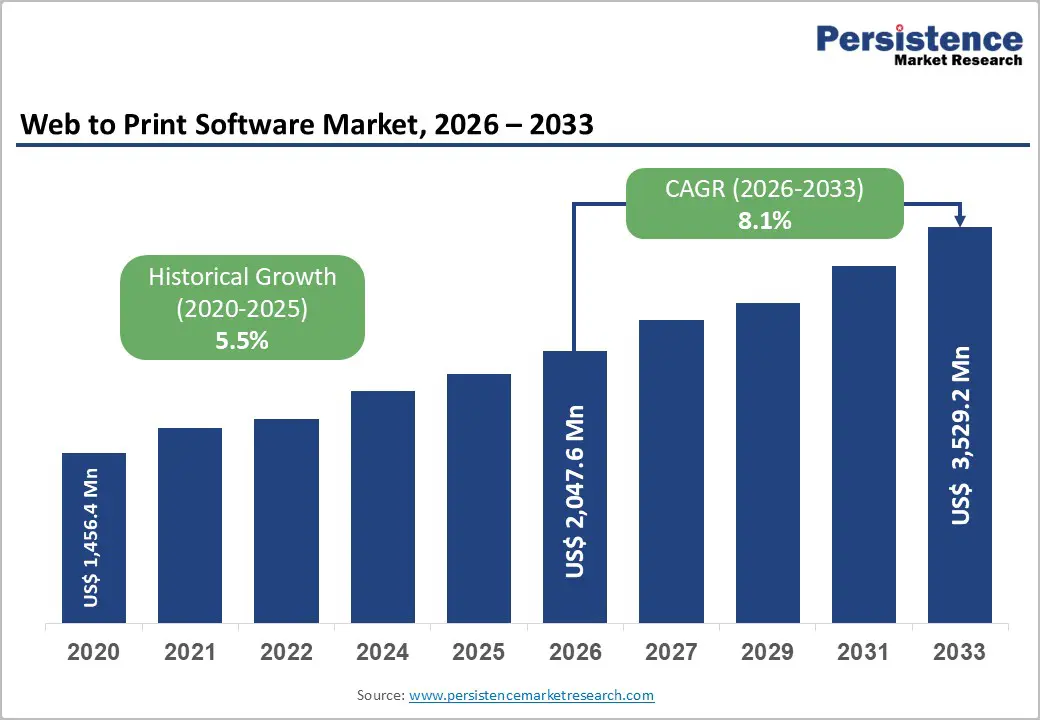
The global Web to Print Software Market size is projected to rise from US$ 2,047.6 Mn in 2026 to US$ 3,529.2 Mn by 2033. It is anticipated to witness a CAGR of 8.1% during the forecast period from 2026 to 2033, driven by the accelerating digital transformation across the global print industry, rising demand for personalized and on-demand print products.
As e-commerce ecosystems expand globally, businesses increasingly rely on automated web-to-print solutions to reduce manual intervention, cut operational costs, and deliver faster turnaround times. The integration of artificial intelligence (AI)-powered design tools, API-driven automation, and mobile-first ordering interfaces is further amplifying adoption.
Key Industry Highlights:
- Leading Offering: Software / Platform dominates with over 72% market share in 2026, valued at more than US$ 1,474.2 Mn, driven by the rising need for end-to-end workflow automation, real-time customization, and centralized print management. Services are the fastest-growing, supported by increasing demand for integration, consulting, and ongoing system optimization.
- Leading Deployment: On-Premises holds over 45% share in 2026, valued at more than US$ 921.4 Mn, due to strong demand for data security, regulatory compliance, and deeper customization capabilities. Cloud-Based / SaaS is the fastest-growing, driven by scalability, lower upfront costs, remote accessibility, and growing adoption of subscription-based digital storefronts.
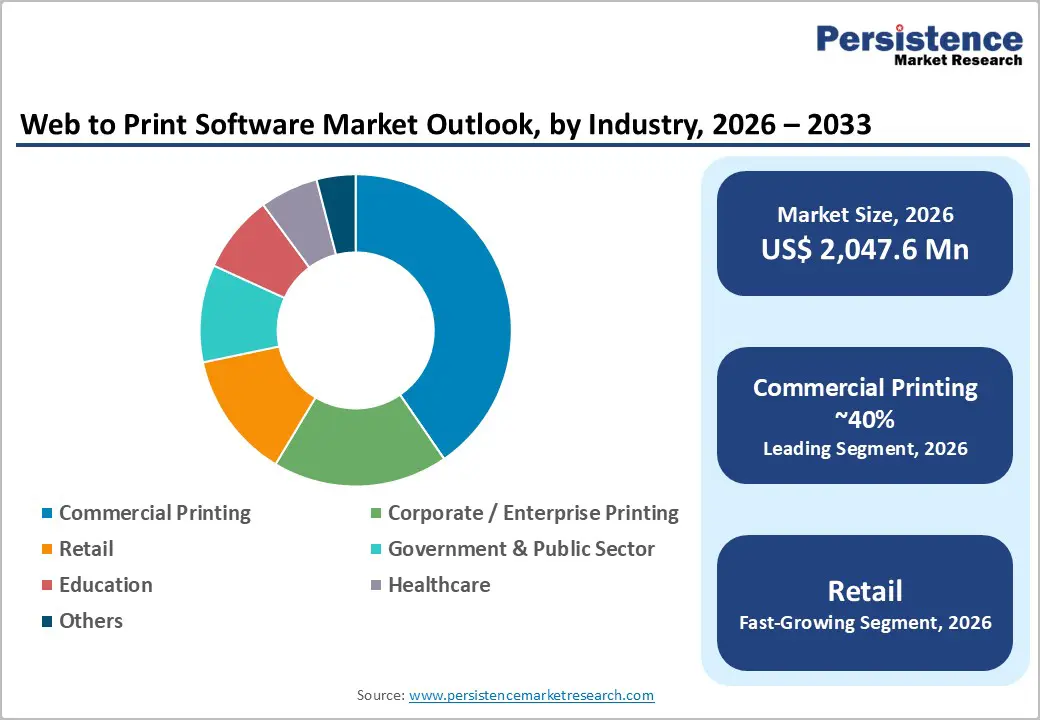
- Leading Industry: Commercial Printing commands the largest share at over 40% in 2026, valued at more than US$ 819 Mn, owing to high reliance on automated workflows, bulk order processing, and demand for consistent, high-quality output. Retail is the fastest-growing, expanding at a CAGR of 11.6%, fueled by personalized merchandise, print-on-demand models, and e-commerce-driven customization trends.
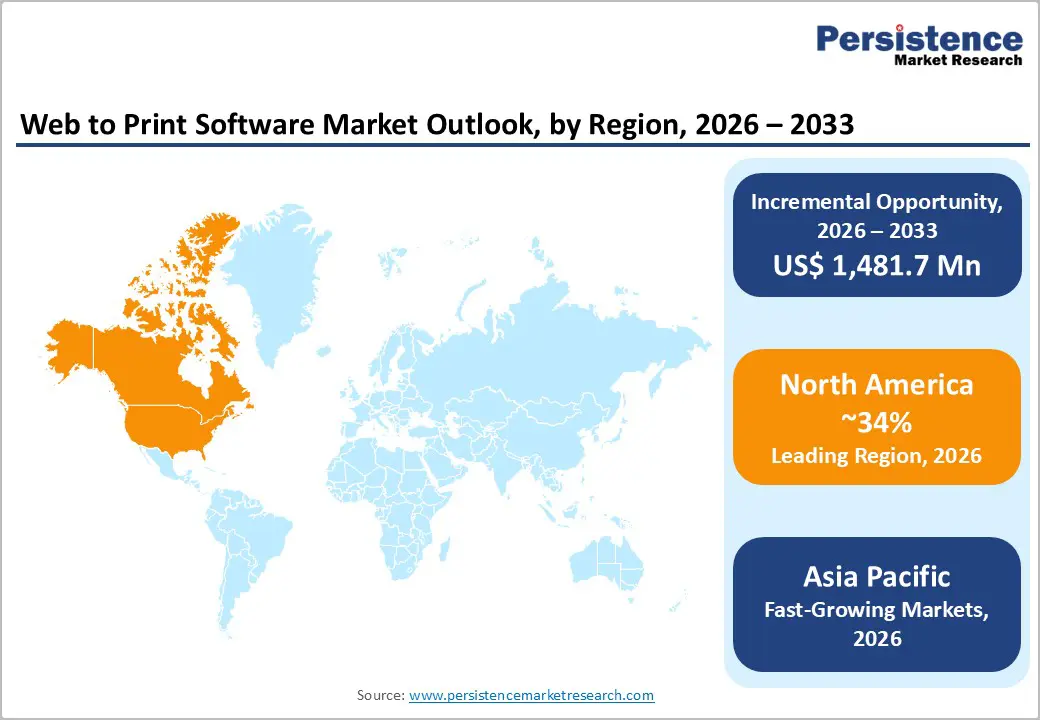
- Leading Region: North America leads with over 34% share in 2026, valued at US$ 696.2 Mn, supported by mature SaaS adoption, strong e-commerce penetration, and advanced print automation technologies. Asia Pacific is the fastest-growing region with a CAGR of 12.8%, driven by rapid digitalization, expanding SME adoption, and strong growth in print-on-demand ecosystems across China and India.
| Key Insights | Details |
|---|---|
|
Web to Print Software Market Size (2026E) |
US$ 2,047.6 Mn |
|
Market Value Forecast (2033F) |
US$ 3,529.2 Mn |
|
Projected Growth (CAGR 2026 to 2033) |
8.1% |
|
Historical Market Growth (CAGR 2020 to 2025) |
5.5% |
Market Dynamics
Driver
Rising Demand for Personalized and On-Demand Print Solutions
The proliferation of personalized marketing and on-demand print products is emerging as one of the most compelling growth drivers. According to a 2025 State of Print Production Report by Gelato AS, over 80% of print professionals identified AI and automation as essential for workflow improvement. Average print runs have declined from over 3,000 units to fewer than 30 units in the last decade, underscoring the shift toward short-run, highly customized output. This transformation compels print service providers to adopt web-to-print platforms offering browser-based design tools, automated proofing, and real-time order management. Industries such as retail, healthcare, and education are increasingly deploying branded print portals to serve internal teams and external clients, driving steady subscription-based revenue for platform vendors.
Accelerating Digital Transformation and E-Commerce Integration
Cross-border e-commerce is growing rapidly annually, generating robust demand for multilingual and multi-currency web-to-print portals. According to a study, approximately 55% of commercial printers now leverage web-to-print portals for workflow optimization, while near 50% of packaging printers utilize customizable templates for short-run orders. Adobe's strategic integration of Zazzle checkout tools within Adobe Express in late 2024 exemplifies how major technology platforms are embedding print commerce capabilities directly into creative workflows. This integration accelerates order volumes and expands the addressable market, while also increasing brand consistency for multi-location enterprises through centralized asset management portals.
Restraint
Integration Complexity with Legacy Systems
A persistent barrier to broader web-to-print software adoption is the complexity associated with integrating modern platforms into existing legacy printing systems and enterprise IT infrastructure. Studies indicate that over 30% of small print shops report significant challenges in synchronizing older hardware and software with new digital storefronts. The need for API compatibility, data migration, staff retraining, and ongoing technical support substantially increases the total cost of implementation. For smaller print service providers with constrained IT budgets, these integration hurdles often delay or deter adoption entirely.
High Initial Implementation and Licensing Costs
Despite long-term efficiency gains, the upfront investment associated with deploying enterprise-grade web-to-print software remains a notable barrier, particularly for emerging markets and independent print operators. Software licensing fees, customization costs, hardware compatibility upgrades, and staff onboarding collectively represent a substantial capital outlay. Data security obligations, especially as businesses handle branded artwork, customer photographs, and payment credentials across multiple jurisdictions, add compliance costs that further strain budgets. The European Union's evolving data protection regulations and supply chain transparency mandates, including the EU Deforestation Regulation, enforceable for large firms from December 2025, require print suppliers to invest additionally in audit-ready documentation and compliance infrastructure.
Opportunity
Integration with Marketing Automation and Omnichannel Campaigns
Businesses are adopting omnichannel strategies, where print materials such as brochures, catalogs, and direct mail are integrated with digital campaigns. According to Data & Marketing Association, response rates for direct mail campaigns can reach 4.9%, significantly higher than many digital channels. Web-to-print platforms enable seamless integration with marketing automation tools, allowing enterprises to create personalized, data-driven print campaigns. This capability enhances customer engagement and brand consistency across channels. As companies continue investing in omnichannel marketing, demand for advanced web-to-print solutions with cross-media integration features is expected to grow substantially.
Advancements in AI and Design Automation Technologies
AI-powered tools automate design creation, optimize layouts, and provide real-time recommendations, significantly reducing design time and costs. According to a study, AI adoption across industries has increased to over 50%, indicating strong momentum for intelligent automation solutions. In web-to-print applications, AI enables personalized design templates, predictive analytics, and enhanced user experiences. These advancements are particularly beneficial for high-volume printing and customization-intensive industries. As AI technologies continue to evolve, they are expected to become a key differentiator for web-to-print software providers, driving future market expansion.
Category-wise Analysis
Offering Analysis
Software / Platform dominates the market, capturing more than 72% market share in 2026 with a value exceeding US$ 1,474.2 Mn, due to the growing need for end-to-end digital print workflow management and real-time customization capabilities. Businesses increasingly require centralized platforms that integrate design tools, order processing, inventory tracking, and customer management into a single interface. The demand is particularly strong among enterprises seeking to reduce manual errors and improve turnaround times. The scalability of software platforms enables organizations to handle high-volume print orders efficiently.
Services are expected to grow significantly due to the increasing complexity of implementing and optimizing web-to-print ecosystems across diverse business environments. Companies require consulting, integration, and training services to ensure seamless deployment and alignment with existing IT infrastructure. As customization needs grow, ongoing support and maintenance services become critical for system performance and upgrades. Small and medium enterprises, in particular, rely on service providers for technical expertise and cost-effective deployment.
Deployment Analysis
On-Premises holds over 45% market share in 2026, with a value exceeding US$ 921.4 Mn, due to strong demand from organizations prioritizing data security, regulatory compliance, and control over internal operations. Large enterprises and commercial printers often prefer on-premises solutions to safeguard sensitive customer and design data. These deployments allow for deeper customization and integration with legacy systems, which is crucial for complex printing environments. Industries with strict data governance policies favor on-premises setups to minimize external risks. Reliability and independence from internet connectivity further support adoption in critical operations.
Cloud-Based / SaaS is expected to grow rapidly due to increasing demand for flexible, scalable, and cost-efficient deployment models. Businesses are shifting toward subscription-based platforms that eliminate high upfront infrastructure costs and enable quick implementation. Cloud solutions support remote access, collaboration, and real-time updates, making them ideal for distributed teams and global operations. The growing adoption of digital storefronts and online print ordering systems further accelerates cloud usage.
Industry Analysis
Commercial Printing commands the largest market share at over 40% in 2026, with a value exceeding US$ 819 Mn, due to the sector’s high dependency on automated workflows and bulk order processing capabilities. It requires efficient systems to manage large-scale, repeatable print jobs while maintaining quality and consistency. Web-to-print solutions enable them to offer customizable products, streamline order intake, and reduce operational costs. The increasing demand for marketing materials, packaging, and promotional products further fuels adoption. The need to shorten turnaround times and improve customer experience strengthens the reliance on digital print platforms.
Retail is expected to grow at a CAGR of 11.6% due to the rapid expansion of personalized and on-demand product offerings in e-commerce. Retailers are leveraging web-to-print platforms to provide customized merchandise such as apparel, packaging, and promotional items. The shift toward direct-to-consumer models and online storefronts increases the need for seamless design-to-delivery workflows. Retail brands also benefit from reduced inventory risks through print-on-demand capabilities. Growing consumer preference for unique, personalized products continues to drive adoption within the retail sector.
Regional Insights
North America Web to Print Software Market Trends
North America holds over 34% share in 2026, reaching US$ 696.2 Mn value. The region benefits from a highly mature print ecosystem, strong SaaS adoption, and deep penetration of e-commerce platforms, particularly in the United States, which drives the majority of demand. A significant proportion of SMEs are increasingly adopting web-to-print platforms to streamline order management and enhance customer engagement. The region also attracts a major share of global investments in print automation and SaaS innovation, supported by leading technology providers. Continuous advancements in AI-driven design tools, mobile-first interfaces, and subscription-based pricing models are further strengthening market growth.
Asia Pacific Web to Print Software Market Trends
Asia Pacific is expected to grow at a significant rate with a CAGR of 12.8%, driven by rapid digitalization and expanding print-on-demand ecosystems. China and India are the primary growth engines, supported by large SME bases, increasing internet penetration, and booming e-commerce activity. Governments across the region, particularly in India, are promoting digital economy initiatives, accelerating the adoption of SaaS-based print solutions. The region has also witnessed a notable rise in venture capital investments in cloud-based platforms and localized print solutions. Countries such as Japan, Singapore, and Vietnam are gaining traction due to their focus on high-quality printing and technology integration.
Europe Web to Print Software Market Trends
Europe is expected to hold more than 27% share by 2026. The region is characterized by a strong emphasis on print quality, brand consistency, and enterprise-grade solutions, driving steady adoption of cloud-based web-to-print platforms. Regulatory frameworks such as the General Data Protection Regulation are encouraging companies to adopt secure, compliant, and auditable software systems. Leading players are reporting solid growth in digital printing solutions, reflecting increasing demand for automation and workflow digitization. Spain and Nordic countries are emerging as growth markets due to rising digital transformation across the commercial printing and corporate sectors.
Competitive Landscape
The Web to Print Software market exhibits a moderately consolidated competitive structure, with leading players controlling significant market share, while a broad base of specialized vendors caters to niche verticals and regional markets. Key competitive differentiators include API robustness, AI integration, template library breadth, and multi-language support. Vendors are increasingly adopting subscription-based SaaS models, pursuing strategic partnerships with hardware manufacturers, and investing in R&D for AI-driven automation, mobile storefronts, and sustainability-aligned workflows.
Key Industry Developments
- In May 2025, GelatoConnect introduced 149 new features in Q1 2025, enhancing tools for print producers to improve efficiency, automation, and operational control across procurement, workflow, and logistics. The updates, developed in collaboration with customers, have delivered measurable gains in productivity, cost savings, and capacity, while enabling seamless web-to-print integrations, AI-driven product management, and real-time production tracking for Print Service Providers.
- In February 2025, XMPie launched StoreFlow Cloud, a scalable SaaS-based web-to-print solution designed to enable faster store deployment, lower upfront costs, and subscription-based pricing for businesses of all sizes. The platform offers multiple tiers along with private cloud options, and includes features such as product customization, print automation, shipping integration, and uCreate for Adobe InDesign to enhance creative workflows.
Companies Covered in Web to Print Software Market
- Electronics For Imaging, Inc.
- Agfa-Gevaert NV
- XMPie, Inc. (a Xerox Company)
- Vpress Ltd.
- Aleyant Systems, LLC
- Avanti Computer Systems Limited
- Radixweb India Limited
- INFIGO Software Limited
- Gelato AS
- Design’N’Buy
- PrintSites, Inc.
- Rocketprint Software Ltd.
- OnPrintShop
- Others
Frequently Asked Questions
The global market is projected to be valued at US$ 2,047.6 Mn in 2026.
The growing need for automated, scalable, and cost-efficient print procurement and customization solutions enables businesses to streamline workflows and reduce manual intervention are key driver of the market.
The market is expected to witness a CAGR of 8.1% from 2026 to 2033.
The expansion of AI-powered Web to Print & the rapid growth of on-demand printing are creating strong growth opportunities.
Electronics For Imaging, Inc., Agfa-Gevaert NV, XMPie, Inc., Vpress Ltd., Aleyant Systems, LLC, Avanti Computer Systems Limited, Radixweb India Limited, INFIGO Software Limited are among the leading key players.


