




- Semiconductor Materials & Components
- Wearable Computing Devices Market
Wearable Computing Devices Market Size, Share, and Growth Forecast 2026 - 2033
Wearable Computing Devices Market by Product Type (Smartwatches, Head-Mounted Displays), Operating System (watchOS, Android/Wear OS), Connectivity Technology (Bluetooth, Cellular), End User (Fitness and Wellness, Medical and Healthcare), and Regional Analysis, 2026 - 2033

Wearable Computing Devices Market Size and Trend Analysis
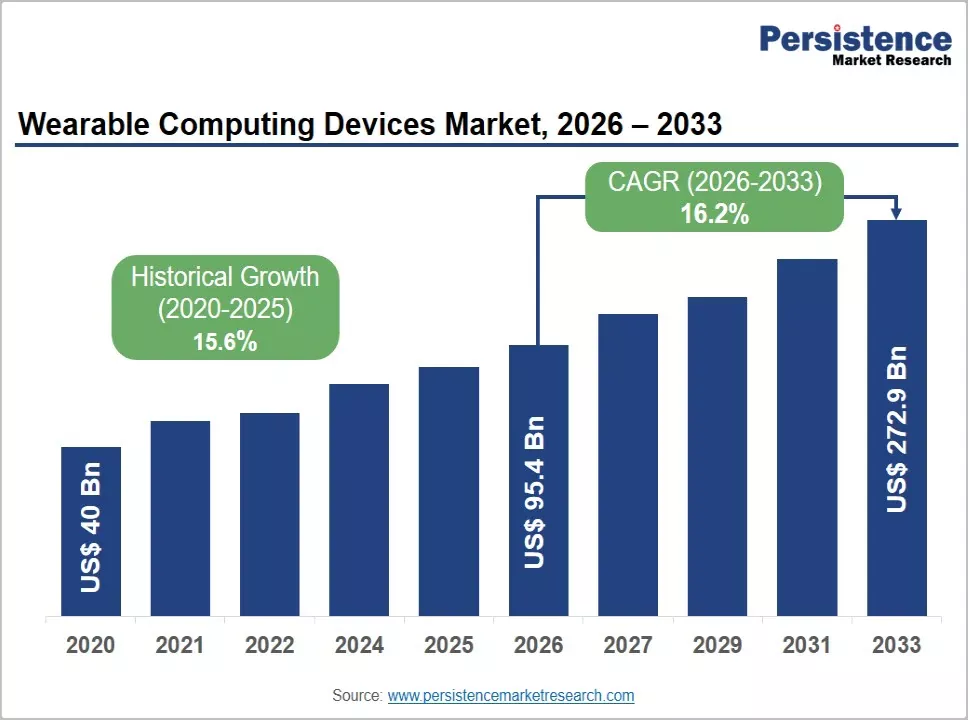
The global wearable computing devices market size is likely to be valued at US$ 95.4 billion in 2026 and is projected to reach US$ 272.9 billion by 2033, growing at a CAGR of 16.2% during the forecast period between 2026 and 2033.
Wearable computing is moving from a gadget category to a health, productivity, and artificial intelligence (AI) interface. The market, valued at US$ 40 billion in 2020, has compounded at 15.6% through 2026 as smartwatches, hearables, and fitness trackers matured into daily-use devices, and the next phase is being defined by on-device AI, continuous biosensing, and face-worn computing.
Platform owners are bundling health insights, voice assistants, and subscription services into hardware, which raises lifetime value per device and lengthens replacement cycles only modestly. The forecast period will therefore reward vendors that combine sensor accuracy, regulatory clearance, and a sticky software ecosystem. Procurement strategists should read this as an ecosystem-led, volume-and-services growth story, with the highest upside concentrated in smart glasses, medical-grade monitoring, and industrial exoskeleton deployments.
Key Industry Highlights
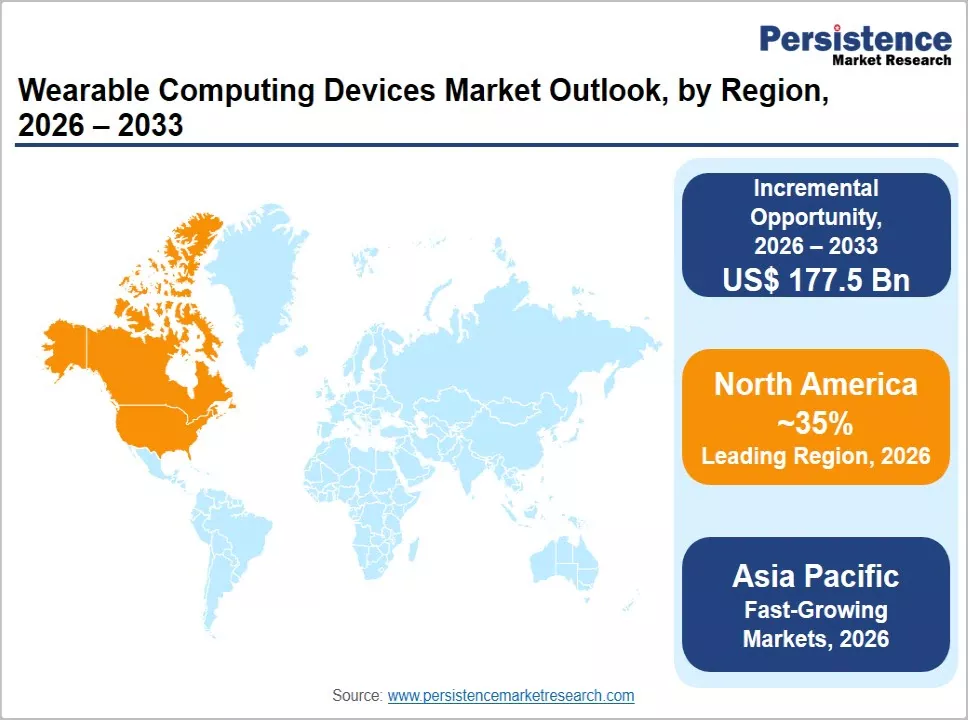
- Dominant Region: North America holds 35% of the wearable computing devices market in 2026, supported by high smartwatch penetration, large installed bases of Apple and Google ecosystems, and early regulatory clearances for medical-grade features such as irregular rhythm and hypertension notifications. Employer wellness programs and insurer-linked incentive schemes add a recurring demand layer.
- Fastest-growing Region: Asia Pacific is projected to expand at an estimated 18.9% CAGR through 2033, led by China, India, and South Korea. Domestic brands competing on price and battery life, rising disposable incomes, and aggressive 5G rollouts are widening the addressable base well beyond early adopters.
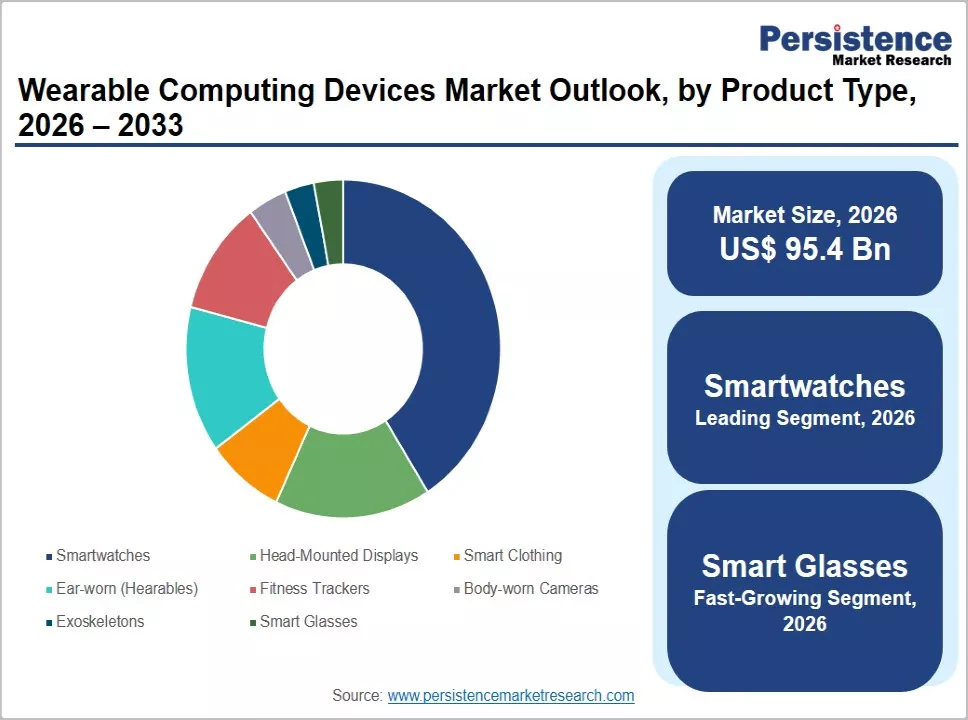
- Leading Product Type: Smartwatches account for roughly 41% of 2026 revenue, anchored by Apple Watch and Samsung Galaxy Watch franchises that now function as health-monitoring platforms. Vendors are differentiating through blood-pressure screening, sleep apnoea alerts, and AI coaching rather than raw display or processor upgrades.
- Fastest-growing Type and Emerging Opportunity: Smart glasses are the fastest-growing product type as AI assistants, cameras, and compact displays converge in eyewear that people will actually wear all day. Samsung, Google, and Meta are now competing with fashion-led partnerships, while exoskeletons and smart clothing build a second growth leg in rehabilitation, logistics, and occupational safety.
DRO Analysis
Driver - Convergence of AI, Continuous Biosensing, and Preventive Healthcare
Wearables are shifting from activity counting to clinical-grade, continuous monitoring. Regulators have cleared features such as hypertension notifications on the Apple Watch and hearing-health functions in hearables, which converts consumer devices into early-detection tools and lets payers and employers justify subsidies.
On-device neural processors are also enabling private, low-latency AI coaching, and Samsung’s move to Qualcomm’s Snapdragon Wear Elite platform for its 2026 Galaxy Watch lineup shows how silicon is being re-architected for always-on intelligence. Suppliers that pair accurate sensors with validated algorithms, such as Apple Inc., Samsung Electronics Co. Ltd., and Garmin Ltd., hold a defensible position as health data becomes the key purchase criterion.
Restraint - Data Privacy, Regulatory Complexity, and Battery Constraints
Wearables collect intimate biometric, location, and, increasingly, audio and visual data, which exposes vendors to overlapping rules such as the EU General Data Protection Regulation, the U.S. Health Insurance Portability and Accountability Act where devices touch clinical workflows, and fragmented medical-device approval pathways.
Always-on cameras on smart glasses have already triggered public backlash, forcing manufacturers to add privacy indicators and on-device processing. Battery life remains a physical ceiling for display-rich and camera-equipped devices, which limits how much AI can run locally and slows adoption among users who dislike daily charging.
Opportunity - Smart Glasses, Medical-grade Wearables, and Industrial Exoskeletons
Face-worn AI is the most visible whitespace. Samsung unveiled its first Intelligent Eyewear in July 2026, developed with Google and designed with Gentle Monster and Warby Parker, while Meta’s Ray-Ban Display glasses have reportedly been supply-constrained, which signals pent-up demand.
Beyond consumer devices, hospital-at-home programs are creating demand for prescribed biosensors, and logistics and manufacturers are piloting exoskeletons from Ekso Bionics Holdings Inc. and Cyberdyne Inc. to cut musculoskeletal injuries. Vendors that secure clinical validation and enterprise channels will open revenue pools that are less exposed to consumer upgrade cycles.
Category-wise Analysis
Why Do Smartwatches Command a Majority of the Global Wearable Computing Devices Market?
Smartwatches are projected to lead the segment, account nearly 41% of market share in 2026. They combine the widest sensor suite on the wrist, an established app ecosystem, and cellular connectivity that lets the watch replace the phone during exercise. Apple Watch Series 11 and the Samsung Galaxy Watch9 and Watch Ultra2, the latter launched at Galaxy Unpacked in London on July 22, 2026, illustrate how annual refreshes now center on health analytics, battery endurance, and AI features rather than form factor. Health claims that carry regulatory clearance give these devices pricing power that fitness bands cannot match.
Smart glasses are likely to be the fastest-growing product type, propelled by lightweight designs that put cameras, microphones, and voice assistants in familiar frames. Samsung has positioned its Intelligent Eyewear around Gemini-based assistance with privacy safeguards, following Samsung’s October 2025 launch of the US$ 1,799 Galaxy XR headset with Google and Qualcomm. Hearables are also gaining relevance as earbuds add heart-rate sensing, live translation, and hearing-aid functions, blurring the line between audio and health devices.
Operating System Insights
WatchOS is estimated dominate the operating system segment hold nearly 29% market share in 2026. Advanced health and fitness monitoring features, including heart rate tracking, sleep analysis, blood oxygen monitoring, and activity tracking, strengthened consumer preference. Continuous software improvements, seamless connectivity, a well-established application ecosystem, and strong brand recognition further supported watchOS adoption across health-conscious consumers and technology-oriented users.
Android / Wear OS is likely to be the fastest growing during the forecast period, driven by increasing adoption of smartwatches from Samsung, Google, and other Android-based manufacturers. Growing compatibility with a wide range of Android smartphones strengthens consumer accessibility across different price categories. Continuous improvements in operating system functionality, expanding application ecosystems, and integration of advanced health and fitness tracking features further support adoption.
Technology Insights
Bluetooth is projected to lead the technology segment account around 62% market share in 2026, driven by widespread smartphone connectivity, low power consumption, and cost-effective wireless communication. Its compatibility with smartphones enables seamless data synchronization, notification delivery, and wireless communication. Low power consumption supports longer battery life, making Bluetooth suitable for continuous smartwatch connectivity. Furthermore, its cost-effective implementation, reliable short-range communication, and availability across multiple device categories strengthen its adoption.
Cellular (LTE, 5G) is likely to be the fastest growing during the forecast period, driven by increasing consumer demand for smartwatches with independent connectivity and advanced communication capabilities. Cellular-enabled devices allow users to make calls, send messages, access the internet, and receive notifications without relying on smartphones. Growing adoption of eSIM technology, improvements in 5G network coverage, and increasing demand for connected wearable devices are strengthening segment growth.
End User Insights
What Is Driving Fitness and Wellness Dominance Across the Wearable Computing Devices Industry?
Fitness and wellness is expected to lead the segment, hold about 38% of market share in 2026, supported by mass-market adoption of trackers, rings, and watches for step, sleep, and recovery monitoring. Garmin Ltd. and Huami Corp. (Amazfit) compete on multi-week battery life and training analytics, while Fitbit under Google is rebuilding its software around an AI health coach. The category also benefits from subscription layers, including premium coaching and advanced metrics, which turn a one-time hardware sale into recurring revenue.
Medical and healthcare is likely to be the fastest-growing end user, driven by remote patient monitoring, chronic disease management, and regulatory clearances for features once limited to clinics. Withings has brought clinical-grade measurement into consumer form factors, including its U-Scan urine-analysis device, while Medtronic PLC and OMRON Healthcare Inc. extend connected monitoring into diabetes and cardiovascular care. Hospitals and insurers are increasingly willing to reimburse or subsidise validated wearables that reduce readmissions, which supports durable double-digit growth.
Regional Insights
North America Wearable Computing Devices Market Trends and Insights
North America is expected to account for around 35% of the wearable computing devices market share in 2026. The region benefits from premium-priced device mixes, deep penetration of platform ecosystems, and favorable regulatory pathways for software-based medical functions. The U.S. Food and Drug Administration’s (FDA) clearance of consumer-grade notifications has set a template that other regions are now following, and enterprise adoption in logistics, field service, and defense is adding steady volume.
U.S. Wearable Computing Devices Market Size
The U.S. is estimated to hold around 88% of the North America regional market in 2026. Demand is anchored by the Apple, Google, and Garmin ecosystems, strong employer wellness programs, and extensive law-enforcement use of body-worn cameras. Reimbursement experiments for remote patient monitoring will keep medical-grade wearables expanding through 2033.
Canada Wearable Computing Devices Market Size
Canada is expected to account for over 12% of the North America regional market in 2026. Provincial digital-health initiatives and virtual-care programs are encouraging the use of connected monitors, while industrial and mining employers are adopting wearable safety devices for lone-worker and fatigue monitoring in remote sites.
Europe Wearable Computing Devices Market Trends and Insights
Europe is anticipated to command around 13% of the wearable computing devices market in 2026. Demand is shaped by an ageing population, strong privacy expectations, and the Medical Device Regulation, which raises the bar for health claims but rewards vendors with validated clinical evidence. Fashion-led eyewear and premium hearables are finding receptive buyers, and exoskeleton rehabilitation programs in public hospitals are expanding steadily.
Germany Wearable Computing Devices Market Size
Germany is projected to account for around 24% of the Europe regional market in 2026. Statutory health insurers can reimburse approved digital health applications, which supports demand for connected monitors, while the country’s automotive and machinery base is a leading adopter of industrial wearables and exoskeletons for ergonomics.
U.K. Wearable Computing Devices Market Size
The U.K. is estimated to account for nearly 20% of the Europe regional market in 2026. National Health Service virtual-ward programs use wearable sensors to monitor patients at home, and consumer demand for smartwatches and smart rings remains robust. Retail partnerships between technology brands and optical chains are accelerating smart glasses visibility.
Which Region Will Drive the Fastest Wearable Computing Devices Growth Through 2033?
Asia Pacific is forecast to be the fastest-growing region, capturing around 31% of market share in 2026 and expanding at an estimated 18.9% CAGR through 2033. Domestic manufacturing depth, competitive pricing, and a mobile-first consumer base are speeding adoption. Xiaomi Corp., Huawei Technologies Co. Ltd., and Huami Corp. (Amazfit) have pushed capable devices into entry price tiers, while HarmonyOS and local health ecosystems are creating alternatives to Western platforms.
China Wearable Computing Devices Market Size
China is projected to hold 44% of the Asia Pacific regional market in 2026. Huawei and Xiaomi lead local volumes with HarmonyOS-based watches and bands that integrate with their phone and home ecosystems, and domestic AI glasses start-ups are launching rapidly. Government support for the silver economy and digital healthcare provides an additional policy tailwind.
India Wearable Computing Devices Market Size
India is expected to account for around 14% of the Asia Pacific regional market in 2026. Homegrown brands compete aggressively on price and battery life, driving mass adoption of smartwatches and true wireless earbuds, while the government’s electronics manufacturing incentives are pulling assembly into the country. Rising lifestyle disease awareness is shifting demand from fashion towards health-tracking features.
Competitive Landscape
The global wearable computing devices market is moderately consolidated at the top, with a handful of platform owners controlling smartwatch and hearable value, while the long tail across fitness trackers, smart clothing, body-worn cameras, and exoskeletons remains fragmented. Apple Inc., Samsung Electronics Co. Ltd., Xiaomi Corp., Huawei Technologies Co. Ltd., and Garmin Ltd. dominate by shipment value and ecosystem reach.
Fitbit LLC (Google), Huami Corp. (Amazfit), Sony Corporation, and Bose Corporation hold strong positions in fitness, wellness, and audio. Microsoft Corporation anchors enterprise head-mounted displays, and specialists including Withings, Medtronic PLC, OMRON Healthcare Inc., Ekso Bionics Holdings Inc., and Cyberdyne Inc. compete in clinical and rehabilitation niches. Winning requires integrated hardware, silicon, software, and health services, as well as the regulatory expertise to convert sensor data into clinically accepted insights.
Key Industry Developments
- In November 2026, WIRobotics partnered with Ottobock to expand the distribution of its WIM S wearable mobility robot across North America. WIRobotics USA Inc., the U.S. subsidiary of WIRobotics, signed a distribution and sales agreement with Otto Bock HealthCare LP on October 15, 2026. Under the agreement, WIRobotics USA supplied WIM S, while Ottobock took responsibility for distribution across the U.S. and Canada. The companies launched the partnership in the U.S., where consumers gained access to WIM S through Ottobock direct-to-consumer platform and WIRobotics USA online store. They also introduced product demonstrations at selected orthotic and prosthetic clinics.
- In February 2026, Wearable Devices Ltd. launched ai6 Labs, an integrated neural artificial intelligence (AI) ecosystem designed to bridge human intent with digital interactions. The initiative combined foundational neural research, product commercialization, and accelerated AI experimentation to advance touchless human-machine interaction. The ecosystem operated through three interconnected pillars: a foundation layer, revenue and ecosystem growth, and an AI accelerator. The foundation layer leveraged the company Large MUAP Model (LMM) to decode human intent through non-invasive electromyography (EMG) technology and translate biological signals into machine-readable data for AI applications.
Companies Covered in Wearable Computing Devices Market
- Apple Inc.
- Samsung Electronics Co. Ltd.
- Xiaomi Corp.
- Huawei Technologies Co. Ltd.
- Garmin Ltd.
- Fitbit LLC (Google)
- Sony Corporation
- Microsoft Corporation
- Bose Corporation
- Huami Corp. (Amazfit)
- Withings
- Medtronic PLC
- AIQ Smart Clothing Inc.
- Sensoria Inc.
- GoPro Inc.
- Transcend Information Inc.
- Ekso Bionics Holdings Inc.
- Cyberdyne Inc.
- OMRON Healthcare Inc.
Frequently Asked Questions
The global wearable computing devices market is valued at US$ 95.4 billion in 2026.
The convergence of on-device AI and continuous biosensing, regulatory clearance of clinical-grade features on consumer devices, and the shift of health insurers and employers towards preventive monitoring, supported by the arrival of AI-enabled smart glasses and falling hardware costs in emerging economies.
Smartwatches hold around 41% of the market. Their advantage derives from the widest on-wrist sensor suite, mature app ecosystems, cellular independence from the phone, and cleared health features that justify premium pricing and annual upgrades.
North America lead with a 35% share in 2026, driven by high-income consumers, deep penetration of the Apple and Google ecosystems, supportive regulatory pathways for software-based medical features, and employer and insurer-backed wellness programs.
The largest opportunities lie in AI-enabled smart glasses, medical-grade remote monitoring wearables that qualify for reimbursement, and industrial and rehabilitation exoskeletons, as vendors build recurring revenue through health subscriptions and enterprise services.
Leading companies include Apple Inc., Samsung Electronics Co. Ltd., Xiaomi Corp., Huawei Technologies Co. Ltd., and Garmin Ltd. The market is moderately consolidated at the top, with intense competition in fitness, hearables, and emerging smart glasses.


