




- Power Generation, Transmission, & Distribution
- Waste Heat to Power Market
Waste Heat to Power Market Size, Share, and Growth Forecast 2026 - 2033
Waste Heat to Power Market by Waste Heat Source (Industrial Waste Heat, Power Generation Waste Heat, Gas Turbine Waste Heat, Internal Combustion Engine Waste Heat, Waste-to-Energy Waste Heat, Others), Technology (Steam Rankine Cycle, Organic Rankine Cycle, Kalina Cycle, Thermoelectric Generation, Stirling Engine, Others), Capacity (Up to 1 MW, 1-5 MW, 5-10 MW, Above 10 MW), End-use Industry (Cement, Iron & Steel, Petroleum Refining, Chemical & Petrochemical, Oil & Gas, Pulp & Paper, Food & Beverage, Waste-to-Energy, Other Industries), Installation Type (Greenfield, Retrofit), and Regional Analysis for 2026 - 2033

Waste Heat to Power Market Size and Trends Analysis
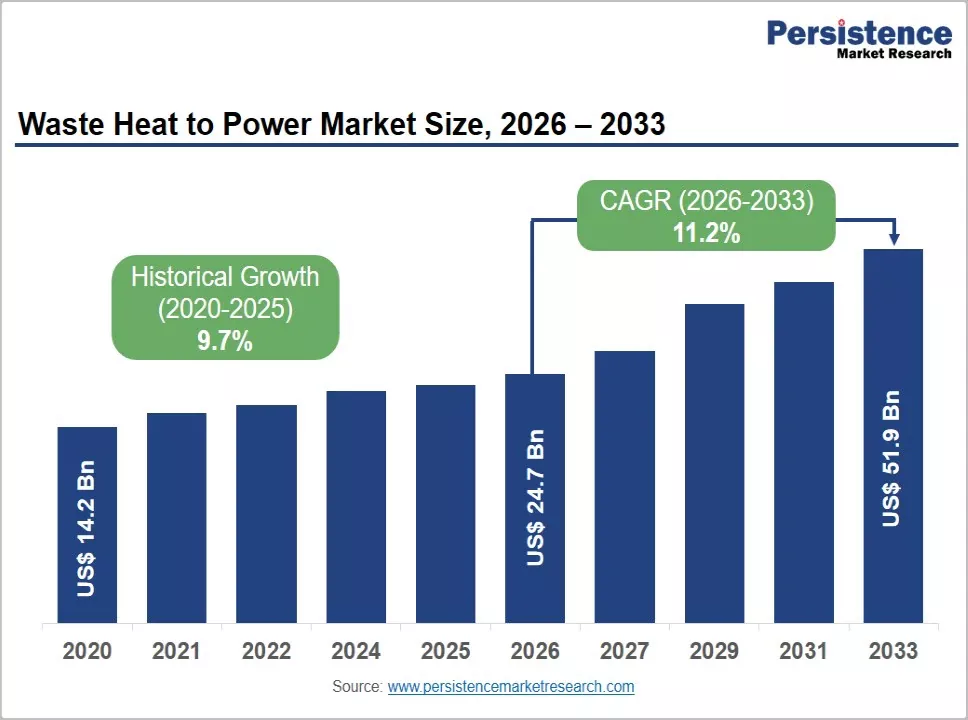
The global waste heat to power market is expected to be valued at US$ 24.7 billion in 2026 and is projected to reach US$ 51.9 billion by 2033, growing at a CAGR of 11.2% between 2026 and 2033.
Rising industrial energy costs continue pushing manufacturers toward waste heat recovery adoption. Facility operators increasingly view waste heat recovery as a cost-effective decarbonization strategy. Growing regulatory pressure to reduce industrial emissions further sustains waste heat to power investment.
Industrial facilities generate substantial thermal energy that traditionally escapes unused into the atmosphere. Capturing this waste energy for onsite power generation reduces operating costs and emissions simultaneously. The International Energy Agency has documented significant untapped waste heat recovery potential across heavy industry globally. Facility operators pursuing waste heat recovery increasingly view the technology as a competitive advantage rather than solely a compliance measure.
Growing corporate sustainability commitments further reinforce waste heat to power adoption across manufacturing sectors. Manufacturers publicly committing to emissions reduction targets increasingly prioritize onsite waste heat recovery investment. Rising investor scrutiny of industrial energy efficiency practices continues pushing facility operators toward measurable efficiency gains. Suppliers offering verifiable emissions reduction data are positioned to capture stronger customer trust than those without transparent reporting.
Key Industry Highlights
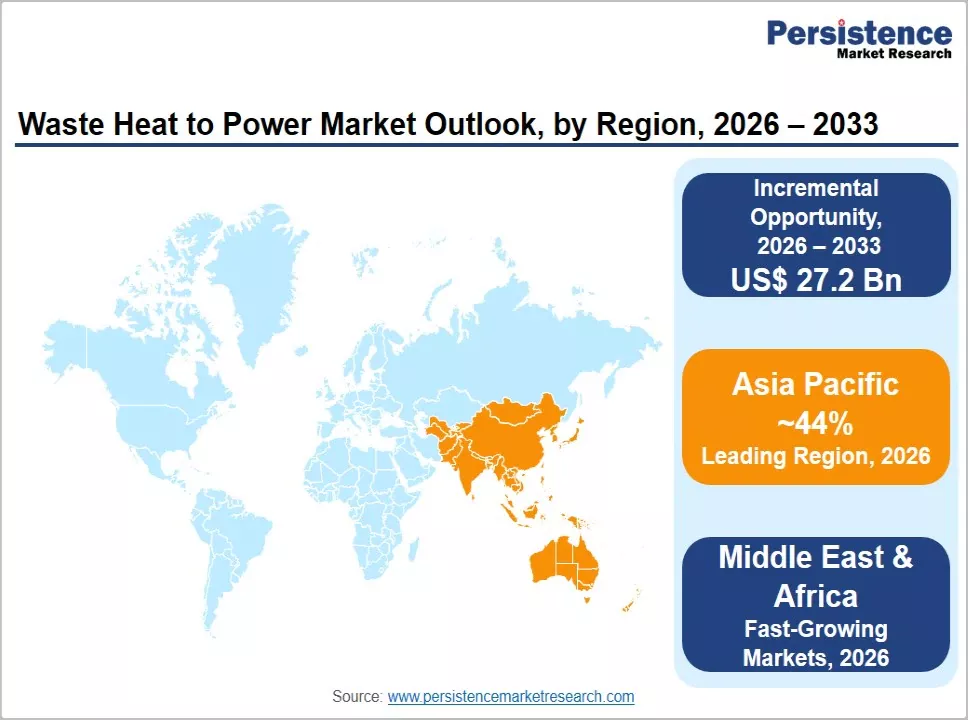
- Leading Region: Asia Pacific is likely to lead the global market with around 44% share in 2026, supported by extensive industrial manufacturing capacity and rising energy efficiency mandates.
- Fastest-growing Region: Middle East & Africa represents the fastest-growing market, driven by expanding industrial diversification and increasing waste heat recovery mandates.
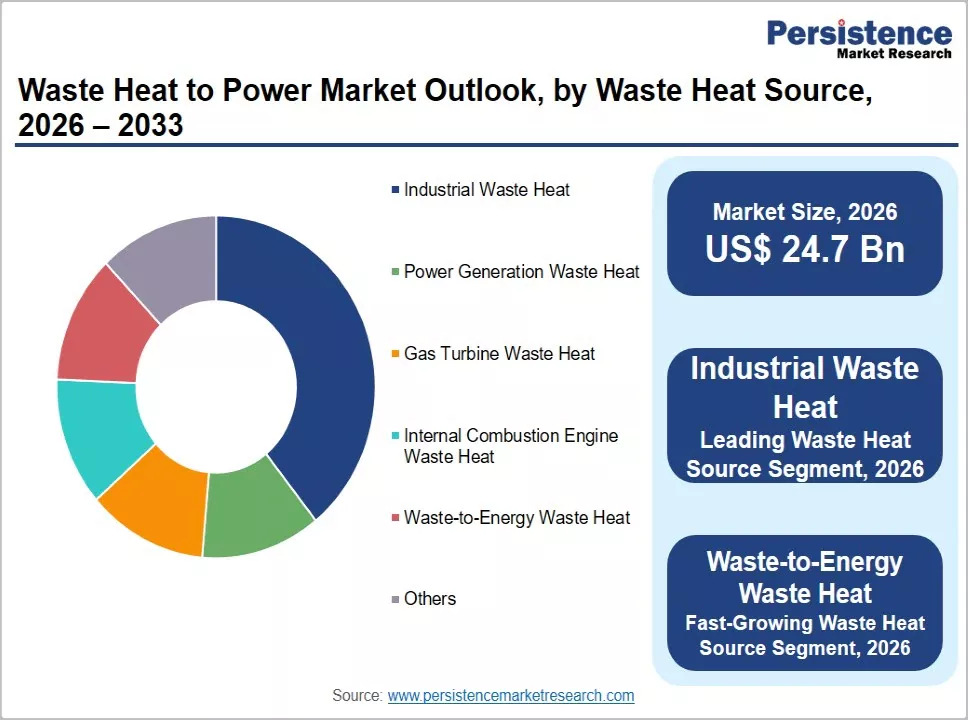
- Leading Segment: Industrial waste heat is the leading waste heat source, holding around 38% share in 2026, supported by the extensive installed base of manufacturing facilities generating recoverable thermal energy.
- Fastest-growing Segment: Waste-to-energy waste heat is the fastest-growing waste heat source, driven by rising deployment of municipal waste-to-energy facilities and increasing demand for power generation from combustion waste heat.
- Key Market Opportunity: Growing demand for organic Rankine cycle systems in mid-size industrial facilities offers suppliers opportunities to expand modular retrofit solutions for low-temperature waste heat recovery.
Market Dynamics
Drivers - Rising Industrial Energy Costs Supporting Waste Heat Recovery Adoption
Manufacturers facing rising electricity prices increasingly seek onsite power generation alternatives. The International Energy Agency has documented continued growth in global industrial electricity prices in recent years. Growing energy cost pressures continue reinforcing manufacturer interest in waste heat recovery investment. Suppliers with proven waste heat recovery technology are positioned to capture higher order volumes as energy costs continue climbing.
Industrial electricity prices have risen substantially across several major manufacturing regions in recent years. Facilities securing onsite power generation capacity typically achieve stronger cost predictability than those fully dependent on grid electricity.
Expanding Emissions Regulation Driving Industrial Efficiency Investment
Regulators increasingly require industrial facilities to reduce carbon emissions and improve energy efficiency. The United States Environmental Protection Agency has set progressively stricter industrial emissions standards requiring efficiency improvements. Growing regulatory pressure signals a shift toward greater energy recovery investment across heavy industry.
Suppliers developing certified waste heat recovery systems are positioned to capture a major share as regulation tightens further. Several national governments have introduced mandatory energy audits requiring facilities to identify waste heat recovery opportunities. Suppliers offering compliance-ready documentation typically gain faster approval from facility operators navigating regulatory requirements.
Restraints - High Upfront Capital Costs Limiting Small Facility Adoption
Waste heat recovery systems require substantial upfront capital investment relative to expected facility energy savings. Smaller industrial facilities frequently lack the balance sheet strength needed to fund system installation without external financing. Limited access to affordable project financing further slows smaller facilities' ability to adopt waste heat recovery technology. Companies unable to secure adequate capital face delayed adoption, weakening their competitive position against larger, better-funded facilities.
Payback periods for waste heat recovery systems typically span several years depending on facility-specific energy savings. Smaller facilities increasingly explore energy performance contracting arrangements to spread costs over the system's operating life.
Inconsistent Waste Heat Quality Complicating System Design
Industrial waste heat streams vary substantially in temperature, volume, and consistency across different processes. Suppliers need to customize system designs to match each facility's specific waste heat characteristics. The International Energy Agency has documented significant variability in industrial waste heat quality across different manufacturing sectors. Suppliers without flexible, modular system designs face longer engineering timelines that delay project completion and revenue recognition.
Facilities operating multiple process lines often generate waste heat streams at inconsistent temperatures throughout the day. Suppliers offering adaptable, multi-temperature system designs typically secure contracts faster than rigid, single-configuration providers.
Opportunities - Growing Demand for Organic Rankine Cycle Retrofits in Mid-Size Facilities
Mid-size industrial facilities increasingly seek cost-effective waste heat recovery without extensive process modification. Suppliers offering modular organic Rankine cycle systems can secure long-term retrofit contracts ahead of competitors. Growing facility interest in low-temperature waste heat recovery signals accelerating demand for organic Rankine cycle technology. Companies that validate reliable low-temperature conversion performance are positioned to win multi-facility supply agreements.
Firms building dedicated retrofit engineering teams typically secure larger allocation shares than new-build-focused suppliers. Turboden and Exergy International continue expanding modular organic Rankine cycle product lines targeting mid-size industrial retrofits. Suppliers finalizing standardized retrofit packages over the coming years are positioned to capture broader facility adoption than fully customized alternatives.
Expanding Waste-to-Energy Facility Integration Opportunities
Municipal waste-to-energy facilities increasingly seek to maximize power output from combustion waste heat streams. Suppliers offering integrated waste heat recovery systems can capture high-value facility contracts. Growing global waste-to-energy facility construction continues expanding the addressable waste heat power market. Companies that validate reliable high-temperature conversion performance are positioned to secure long-term municipal partnerships.
Firms investing early in waste-to-energy engineering typically gain preferred-vendor status across relevant facility projects. Waste-to-energy facilities generate consistently high-temperature combustion heat that is well suited for efficient power conversion. Suppliers demonstrating validated waste-to-energy integration performance are increasingly securing extended multi-facility service agreements.
Category-wise Analysis
Waste Heat Source Insights
Industrial waste heat represents the leading segment, holding around 38% share of the waste heat to power market in 2026, supported by the large installed base of energy-intensive manufacturing facilities. Its leading position is further reinforced due to substantial recoverable heat generation across cement, steel, and chemical production and established waste heat recovery infrastructure.
Waste-to-energy waste heat represents the fastest-growing segment, driven by rising deployment of municipal waste-to-energy facilities across multiple regions. Growth is further supported by increasing efforts to maximize electricity generation from waste combustion and improve energy recovery efficiency.
Technology Insights
Organic Rankine cycle represents the leading technology segment, accounting for around 46% of the market share in 2026, supported by its ability to convert low- and medium-temperature waste heat into electricity. Its widespread adoption is further reinforced owing to established technology maturity, extensive supplier expertise, and suitability across diverse industrial heat sources.
Thermoelectric generation represents the fastest-growing technology, driven by rising demand for compact, solid-state waste heat conversion solutions. Adoption is further supported by minimal maintenance requirements, flexible installation, and suitability for smaller and distributed waste heat recovery applications.
Capacity Insights
The 1–5 MW segment is likely to lead the market with around 34% share in 2026, supported by the balance between meaningful electricity generation and manageable capital requirements offered to mid-size industrial facilities. Demand within this capacity range is further reinforced due to growing investment in energy efficiency across mid-size manufacturing operations.
End-use Industry Insights
Cement leads the end-use industry category with around 24% share in 2026, supported by substantial waste heat generation from high-temperature clinker production. The segment's leading position is further reinforced due to established waste heat recovery adoption among major cement producers and the significant potential for onsite power generation.
Installation Type Insights
Retrofit is expected to be the leading installation type segment, holding around 63% share of the market in 2026, supported by the large installed base of existing industrial facilities. Demand for retrofit systems is further driven by the ability to integrate waste heat recovery into operating facilities without replacing core production equipment, alongside established retrofit engineering capabilities among leading suppliers.
Regional Analysis
North America Waste Heat to Power Market Trends and Insights
North America is projected to hold around 18% share of the waste heat to power market in 2026, supported by strong industrial energy efficiency incentives and a large manufacturing base. Growing natural gas price volatility is reshaping facility operators' interest in onsite power generation due to increasing pressure to improve energy cost management. The region is heading toward steady retrofit-driven demand growth, driven by expanding energy efficiency investment across industrial facilities through 2033. Canada's expanding industrial efficiency programs further support regional adoption across diverse manufacturing sectors.
U.S. Waste Heat to Power Market Size
The U.S. accounts for around 81% of North American waste heat to power market revenue, supported by its extensive industrial manufacturing base and strong energy efficiency incentives. Ormat Technologies and Calnetix Technologies maintain extensive domestic project deployment, supporting broader adoption across industrial facilities. The U.S. is positioned to maintain regional demand leadership as industrial energy efficiency investment expands through 2033, driven by growing focus on energy cost reduction and onsite power generation. The U.S. Department of Energy continues supporting industrial waste heat recovery through dedicated energy efficiency funding programs nationwide.
Europe Waste Heat to Power Market Trends and Insights
Europe is expected to hold roughly 24% share of the waste heat to power market in 2026, driven by stringent emissions regulations and industrial efficiency directives. Growing energy security concerns are reinforcing demand for onsite waste heat power generation due to greater emphasis on energy efficiency and reduced dependence on external energy supplies. Europe is heading toward accelerated efficiency-driven demand growth, driven by facility-level decarbonization investment through 2033. The European Commission's Industrial Emissions Directive continues influencing industrial investment priorities related to emissions reduction and energy efficiency across member states.
Germany Waste Heat to Power Market Size
Germany accounts for around 29% share of European market revenue, supported by its strong industrial manufacturing base and rigorous energy efficiency standards. Siemens Energy and GEA Group maintain extensive domestic engineering capabilities, supporting waste heat recovery deployment across industrial applications. Germany is positioned for steady growth through 2033, driven by continued industrial efficiency investment and increasing focus on energy recovery. Germany's federal energy efficiency strategy continues prioritizing industrial waste heat recovery across manufacturing regions.
U.K. Waste Heat to Power Market Size
The U.K. is anticipated to hold a significant share of the European waste heat to power market in 2026, fueled by growing industrial efficiency investment and rising energy cost pressures. Government support for industrial decarbonization incentives further reinforces investment in energy recovery technologies. Market growth is expected to continue through 2033, driven by increasing adoption of industrial waste heat recovery systems. The Department for Energy Security and Net Zero continues supporting industrial decarbonization through dedicated efficiency grant programs.
France Waste Heat to Power Market Size
France is projected to hold a considerable share of the European waste heat to power market in 2026, supported by a strong domestic industrial base and growing investment in energy efficiency. Government investment in industrial decarbonization incentive programs further supports waste heat recovery deployment across manufacturing sectors. France is positioned for continued growth through 2033, driven by increasing adoption of waste heat recovery and industrial efficiency technologies. France's national low-carbon strategy continues supporting industrial energy efficiency investment across manufacturing sectors.
Asia Pacific Waste Heat to Power Market Trends and Insights
Asia Pacific is expected to maintain leadership in the global waste heat to power market, holding around 44% share in 2026. The region’s leadership is supported by extensive industrial manufacturing capacity and rising energy efficiency mandates. Mitsubishi Heavy Industries and IHI Corporation maintain extensive manufacturing capabilities, supporting the region's large industrial equipment base. Rising government energy efficiency mandates continue reinforcing regional demand, driven by increasing focus on reducing industrial energy consumption and emissions.
Market expansion across Asia Pacific is increasingly supported by partnerships with established regional industrial equipment manufacturers, reflecting the region's high concentration of industrial production. China's Ministry of Industry and Information Technology continues supporting industrial energy efficiency upgrades through dedicated national programs.
India Waste Heat to Power Market Size
India accounts for around 12% of the Asia Pacific waste heat to power market revenue, supported by expanding cement and steel manufacturing capacity and rising energy efficiency mandates. Government energy conservation initiatives continue increasing investment interest in waste heat recovery across industrial facilities. India's market is positioned for continued expansion through 2033, driven by increasing industrial capacity and growing demand for energy-efficient power generation. The Bureau of Energy Efficiency continues reporting participation in industrial energy conservation programs across the country.
Japan Waste Heat to Power Market Size
Japan is anticipated to hold a notable share of the Asia Pacific market in 2026, supported by its mature industrial manufacturing base and established focus on energy efficiency. IHI Corporation and Mitsubishi Heavy Industries maintain extensive research and development activities in advanced waste heat recovery technologies, supporting technology adoption across industrial applications. Japan is positioned for steady, efficiency-driven demand growth through 2033, driven by continued investment in industrial energy optimization. Japan's Ministry of Economy, Trade and Industry continues to report industrial energy efficiency investment across domestic manufacturing facilities.
Competitive Landscape
The global waste heat to power market is highly competitive. Established suppliers compete through proprietary organic Rankine cycle technology and long-term facility service agreements. Moderate fragmentation persists across smaller regional suppliers while large-scale industrial contracts increasingly consolidate around a smaller set of proven global engineering firms. The dominant strategic theme is turnkey project delivery, as suppliers increasingly bundle equipment supply with engineering, installation, and maintenance services.
New entrants without proprietary technology face high barriers to winning large industrial supply contracts. Ormat Technologies and Turboden continue leveraging deep engineering expertise to secure preferential project allocation ahead of smaller competitors. Emerging business model shifts toward energy performance contracting are further reshaping how suppliers structure long-term facility agreements.
Key Industry Developments
- September 2026, Alfa Laval launched its next-generation Hukka-5 exhaust gas steam boiler for cruise vessels and passenger ferries, featuring an inverted downward natural circulation design to enhance waste heat recovery and reduce emissions.
- June 2026, Kanin Energy announced plans to develop a 7-megawatt waste-heat-to-power facility at the Phillips 66 Mewbourn natural gas processing complex in Colorado to convert industrial waste heat into reliable onsite electricity.
- March 2026, Turboden was selected by Tallgrass as a waste-heat-to-power provider to deliver new baseload capacity across gas compressor stations in Ohio and Indiana using its Organic Rankine Cycle technology.
Companies Covered in Waste Heat to Power Market
- Ormat Technologies, Inc.
- Turboden S.p.A.
- Mitsubishi Heavy Industries, Ltd.
- Siemens Energy AG
- General Electric
- Alfa Laval AB
- Atlas Copco AB
- Exergy International S.r.l.
- Dürr Group
- IHI Corporation
- Baker Hughes Company
- GEA Group AG
- Thermax Limited
- Kaishan Group
- Calnetix Technologies LLC
- ENOGIA SAS
- Access Energy Corporation
Frequently Asked Questions
The global market size is estimated at US$ 24.7 billion in 2026.
Rising industrial energy costs continue pushing manufacturers toward waste heat recovery adoption.
Asia Pacific is likely to lead the global market with about 44% share in 2026.
Growing demand for organic Rankine cycle systems in mid-size facilities offers suppliers a durable retrofit opportunity.
Key players in the market include Ormat Technologies, Turboden, and Mitsubishi Heavy Industries.


