




- Electrical Equipment & Services
- Vortex Flowmeter Market
Vortex Flowmeter Market Size, Share, and Growth Forecast 2026 - 2033
Vortex Flowmeter Market by Product Type (Inline, Massflow, Insertion Vortex Flowmeter), Application (Liquids, Gases, Steam, Corrosive Fluids and Slurries), End-user (Oil and Gas, Power, Chemical and Petrochemical), and Regional Analysis, 2026 - 2033

Vortex Flowmeter Market Size and Trends Analysis
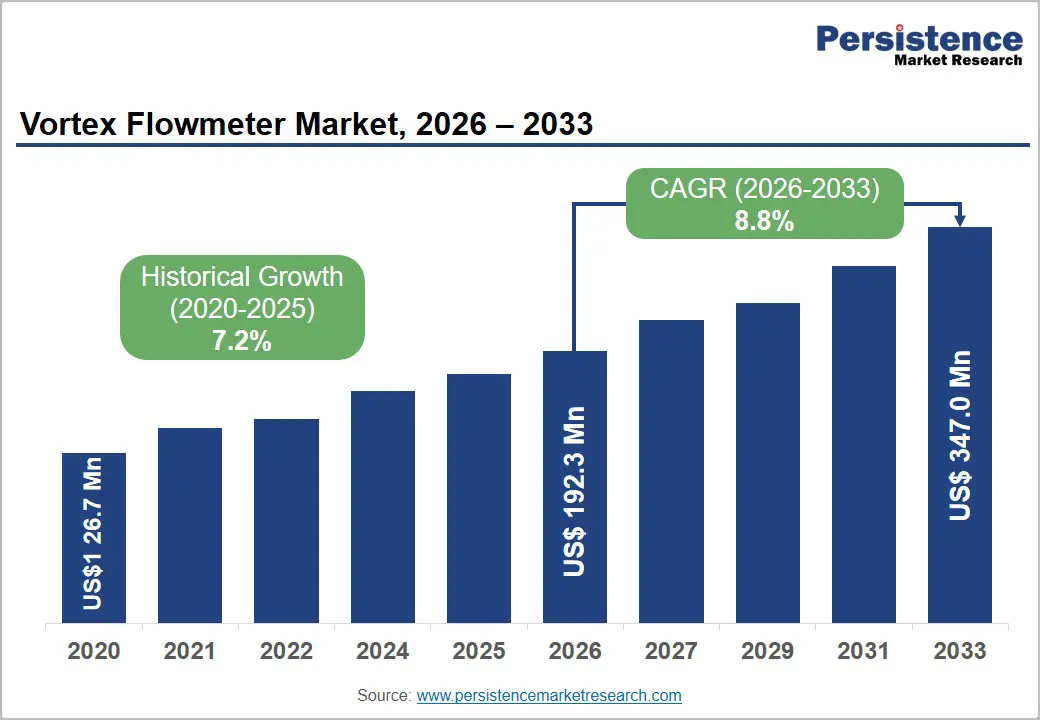
The global vortex flowmeter market size is likely to be valued at US$192.3 million in 2026 and is estimated to reach US$347.0 million by 2033, growing at a CAGR of 8.8% during the forecast period from 2026 to 2033, driven by rising demand for accurate steam and gas flow measurement across energy-intensive industries. Increasing focus on energy efficiency and emission reduction is further pushing industries to adopt advanced flow measurement solutions.
Key Industry Highlights:
- Leading Product Type: Massflow vortex flowmeters, approximately 39.6% share in 2026, as these provide direct and accurate steam and gas mass measurement.
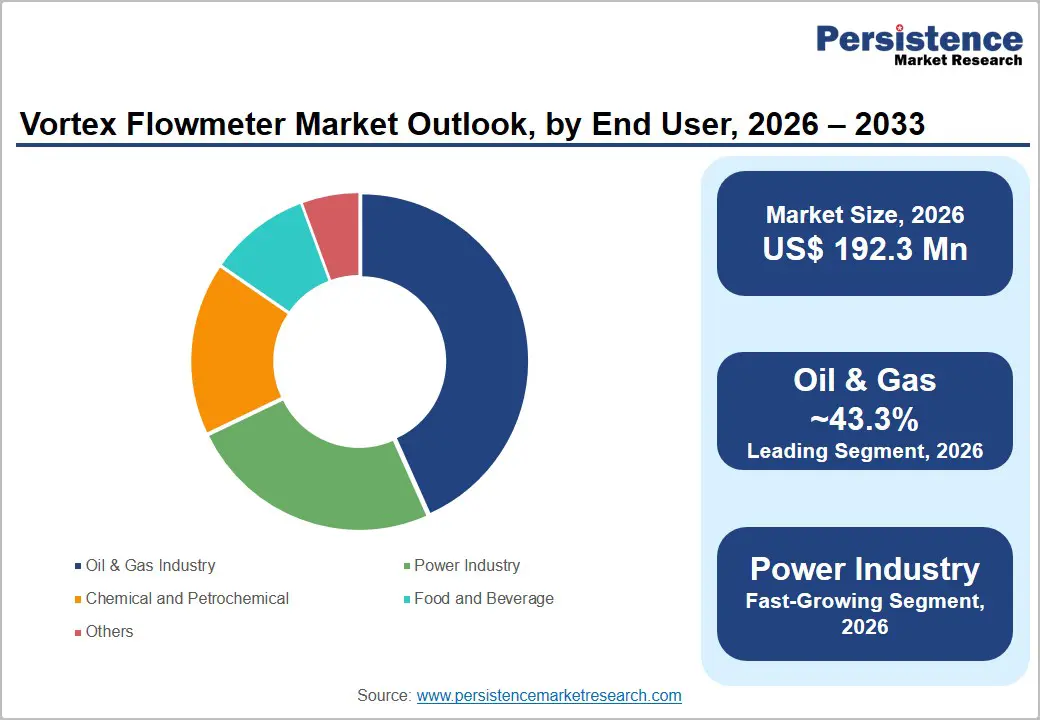
- Dominant End-user: The oil & gas segment with about 43.3% share in 2026, as it requires continuous and reliable flow measurement across high-temperature processing environments.
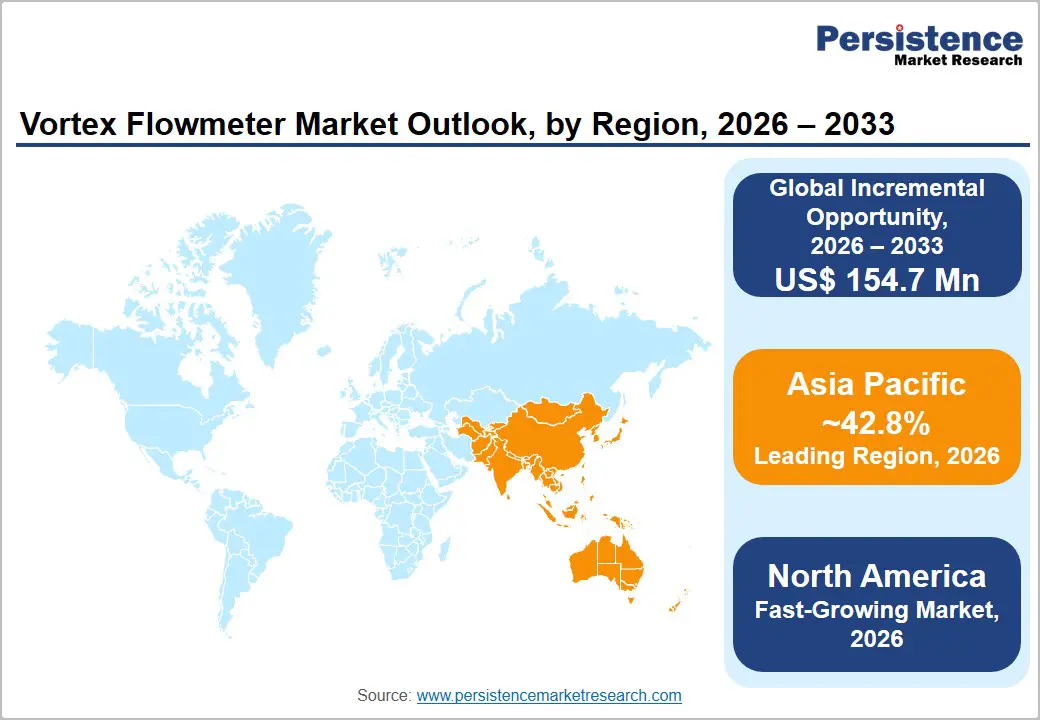
- Leading Region: Asia Pacific, with about a 42.8% share in 2026, fueled by its high concentration of energy-intensive industries.
- Fast-growing Region: North America, augmented by modernization of aging industrial systems and rising adoption of energy-efficient flow measurement technologies.
- Recent Study: In June 2025, researchers published a study in the journal Flow Measurement and Instrumentation introducing a vortex uniform velocity tube integrated sensor for steam flow measurement. The research demonstrated less than 1% relative error and approximately 0.7% repeatability under high-temperature and high-pressure conditions. It pointed to ongoing innovation aimed at improving vortex-based steam measurement accuracy and reducing monitoring costs.
DRO Analysis
Driver - Increasing Demand for Energy and Steam Management
Steam is one of the most widely used energy carriers in industrial facilities, and one of the hardest to meter accurately. Multivariable vortex flowmeters address this by combining flow velocity, temperature, and pressure sensors into a single device. This allows the built-in flow computer to calculate mass flow rate and energy output in British Thermal Units (BTUs), kilowatt-hours (kWh), or gigajoules (GJ) in real time, without the requirement for separate instruments.
Endress+Hauser's Prowirl family of vortex flowmeters, for example, provides simultaneous measurement of volume flow, temperature, and pressure. It enables precise compensation of gas-corrected volume, steam mass, energy, delta heat, and even steam dryness fraction. As industrial plants face increasing pressure to reduce energy waste and document consumption for compliance, multivariable vortex meters have become the primary metering tool for steam distribution and boiler efficiency management.
Need for Improved Durability to Propel Adoption
Vortex flowmeters have no rotating or reciprocating components. This is a structural advantage that makes them inherently well-suited for high-temperature and high-pressure applications where mechanical wear is a failure risk. Standard vortex meters are rated for process temperatures up to 400°C and pressures up to 100 bar. In June 2025, for instance, KROHNE launched a new high-temperature vortex flowmeter specifically designed for steam and hot oil service, extending usable operating conditions further for process industries.
This durability profile makes vortex meters the preferred flow measurement technology in power generation. There, they are used in gas turbines for flow validation, performance monitoring, and heat rate calculation. In November 2024, Yokogawa Electric announced a strategic partnership with McCrometer to co-develop high-accuracy vortex flowmeter technologies for Liquefied Natural Gas (LNG) and petrochemical applications. This shows the sustained demand from high-severity process sectors.
Restraint - High-Viscosity Fluids to Prevent Vortex Formation and Signal Generation
Vortex flowmeters rely on a physical phenomenon called the Kármán vortex street, a repeating pattern of alternating vortices that forms when fluid flows past a bluff body inside the pipe. This phenomenon only occurs reliably under turbulent flow conditions, characterized by a Reynolds number (Re) above 10,000 to 30,000, depending on meter design. As fluid viscosity rises, the Reynolds number falls for any given flow rate. Below the threshold, vortex formation becomes weak, unstable, or stops entirely, further causing the meter to read zero even when flow is present. This is a hard physical limit.
Vortex meters are generally not recommended for fluids above 30 millipascal-seconds (mPa·s) or approximately 30 centipoise (cP). This excludes high-viscosity fluids such as heavy oils, asphalt, polymer melts, and slurries. These are common in petrochemical refining, bitumen processing, and adhesives manufacturing. For these fluids, alternative technologies such as Coriolis or positive displacement meters are used instead, thereby limiting vortex meter adoption across an entire category of industrial processes.
Opportunity - Advanced Signal Filtering to Make Vortex Meters Reliable
Pipeline vibration has historically been one of the most significant reliability issues for vortex flowmeters. As the sensor detects pressure fluctuations caused by vortex shedding, mechanical vibration from nearby pumps, motors, or pipe structures can generate false signals at similar frequencies, thereby causing erroneous flow readings. Digital Signal Processing (DSP) has substantially reduced this problem. Rosemount's mass balance sensor design incorporates an adaptive digital signal filter that separates pipeline vibration interference from genuine vortex flow signals.
Yokogawa's digital vortex flowmeter uses multiple digital band-pass filters with adjustable amplitude attenuation, performing spectral analysis to identify and isolate the dominant vortex frequency component. It is a method published in ScienceDirect in August 2025. A U.S. Patent (No. 10,876,869) filed by a team of researchers specifically addresses Kalman filter-based methods for rejecting transient impact vibration interference in vortex sensors. Together, these developments are making vortex meters feasible in process environments where vibration previously ruled them out.
Embedded Diagnostics to Shift Vortex Meter Maintenance from Reactive to Predictive
Modern vortex flowmeters are now designed to monitor their own condition continuously, detecting anomalies in sensor signals, electronics health, and process variables in real time. Endress+Hauser's Heartbeat Technology, integrated across its Prowirl vortex flowmeter range, includes diagnostics, verification, and monitoring functions that generate standardized event messages compliant with the NAMUR NE 107 diagnostic framework. The Proline Prowirl F 200 can detect entrained air, pipeline vibration caused by pump cavitation, sensor coating, corrosion, and inhomogeneous media.
It can also detect up to 125 diagnosable conditions in a single device. These diagnostics feed into the Industrial Internet of Things (IIoT) network. Endress+Hauser's Netilion cloud platform collects field device data and presents diagnostics with cause-and-remedy guidance, enabling condition-based maintenance scheduling. As plants seek to reduce unplanned downtime and extend calibration intervals, embedded diagnostics in vortex meters are becoming a key selection criterion alongside measurement accuracy.
Category-wise Analysis
Product Type Insights
Massflow vortex flowmeters are predicted to lead with a share of approximately 39.6% in 2026, as industries now focus on energy efficiency and accurate billing rather than simple volumetric measurement. Steam, compressed air, and industrial gases are often purchased, sold, and monitored based on mass flow or energy consumption. Modern vortex meters can combine flow, temperature, and pressure measurements in a single device to calculate mass flow. This eliminates the requirement for separate transmitters and reduces installation complexity.
According to Endress+Hauser, multivariable vortex meters can provide compensated mass flow measurement, which is important for process optimization and energy balancing.
Inline vortex flowmeters are estimated to be the fastest-growing over the forecast period, as they provide a good balance between accuracy, durability, and installation simplicity. Several industries are replacing aging differential pressure flowmeters with inline vortex meters as they are easier to install and provide a wider measurement range. The technology is also extremely versatile. A single inline vortex meter can measure liquids, gases, and steam. This flexibility allows manufacturers to standardize instrumentation across multiple production lines.
End-user Insights
The oil & gas industry is anticipated to dominate with a share of nearly 43.3% in 2026, as it relies heavily on continuous flow measurement throughout the entire value chain, from upstream production to downstream refining and petrochemicals. Flow measurement is essential for monitoring crude oil, natural gas, steam injection systems, compressed gases, hydrocarbons, and utility services. Vortex flowmeters are specifically useful as they can handle high temperatures, high pressures, and harsh process conditions commonly found in oil & gas facilities.
The power industry segment is expected to remain in the second position in 2026, as steam measurement is becoming more important as utilities focus on efficiency improvement and emissions reduction. Steam flow is a key performance indicator in thermal power plants. Even small measurement errors can affect fuel efficiency and plant economics. Vortex flowmeters provide reliable steam measurement over a wide operating range, making them suitable for both conventional and modern power generation facilities.
Regional Insights
Asia Pacific Vortex Flowmeter Market Trends
Asia Pacific is anticipated to lead in 2026 with a share of nearly 42.8%, as it has the highest concentration of process industries that use steam, gases, and liquids at a large scale. China, India, Japan, and South Korea have large chemical, petrochemical, food processing, and power sectors. These industries rely heavily on steam monitoring, where vortex flowmeters are widely used. According to the International Energy Agency (IEA), Asia Pacific accounts for the largest share of global industrial energy consumption, with China and India leading industrial steam usage. This further increases demand for reliable flow measurement systems.
China Vortex Flowmeter Market Trends
China will likely lead in Asia Pacific in 2026 with a share of around 38.8%, owing to its large-scale industrial modernization and strict energy-efficiency targets. The country’s government has mandated energy intensity reduction targets under its national policies. Industries are required to monitor steam and energy usage more accurately. Vortex flowmeters are widely adopted in such cases as they support mass flow and energy measurement.
India Vortex Flowmeter Market Trends
In 2026, India is projected to account for a share of approximately 27.4%, owing to steady policy-driven industrial expansion and energy efficiency programs. The Bureau of Energy Efficiency (BEE) under the Government of India runs the Perform, Achieve, and Trade (PAT) scheme. This scheme compels energy-intensive industries to measure and reduce energy consumption. Accurate steam and fluid measurement is essential here, increasing demand for vortex flowmeters.
North America Vortex Flowmeter Market Trends
North America is predicted to be the fastest-growing market in 2026 with a share of approximately 29.1%, spurred by the retrofit and modernization of aging industrial infrastructure. Several facilities in the U.S. and Canada still use obsolete flow measurement systems such as orifice plates. These systems are being replaced with vortex flowmeters that deliver better accuracy and lower maintenance.
U.S. Vortex Flowmeter Market Trends
A share of nearly 66.3% is expected to be held by the U.S. in 2026, supported by industrial digitalization and energy optimization initiatives. The Department of Energy (DOE) promotes Advanced Manufacturing programs that focus on improving energy efficiency in industrial plants. These programs encourage the use of smart sensors and flow measurement devices. Another key trend is the growth of LNG exports and petrochemical investments. The U.S. Energy Information Administration (EIA) reported that the country remains one of the top LNG exporters globally. LNG terminals and gas processing plants require precise flow monitoring, where vortex flowmeters are widely used.
Europe Vortex Flowmeter Market Trends
Europe will likely see decent growth over the forecast period, with a share of nearly 17.3% in 2026, spurred by rising focus on energy efficiency and sustainability policies. The European Union’s Energy Efficiency Directive requires industries to monitor and reduce energy consumption. Accurate steam and fluid measurement is essential to achieve these targets. Another driver is the transition toward clean energy systems. District heating, combined heat and power (CHP), and renewable integration are extending across Europe. These systems rely heavily on steam and heat flow measurement, supporting the use of vortex flowmeters.
Germany Vortex Flowmeter Market Trends
Germany will likely register a substantial share of approximately 35.4% in 2026, propelled by its well-established industrial and engineering base. The country has a large number of chemical, automotive, and manufacturing facilities. These industries require precise flow measurement for process control and energy management. Germany is also a leader in Industry 4.0 adoption. The government actively promotes smart manufacturing and digitalization. This includes the use of intelligent flowmeters with communication capabilities and diagnostics.
U.K. Vortex Flowmeter Market Trends
A share of around 23.1% is predicted to be held by the U.K. in 2026, owing to a focus on decarbonization and energy transition. The government’s Net Zero Strategy emphasizes reducing emissions across industrial sectors. This requires better monitoring of energy usage, including steam and gas flows. There is also growth in district heating and energy-from-waste projects. These applications rely on accurate flow measurement systems. Vortex flowmeters are commonly used due to their reliability in steam applications.
Competitive Landscape
The global vortex flowmeter market is moderately consolidated with a small group of multinational instrumentation companies controlling a significant share of industry revenues. Companies such as Emerson Electric, Yokogawa Electric Corporation, Siemens AG, ABB Ltd., Endress+Hauser, and KROHNE Group dominate the competitive landscape. They are doing so through extensive product portfolios, global service networks, and long-standing relationships with customers in oil & gas, chemicals, power generation, water treatment, and food processing industries.
Competition is increasingly centered on digitalization and smart diagnostics rather than basic flow measurement accuracy. Manufacturers are integrating vortex flowmeters with Industrial IoT platforms, predictive maintenance software, Ethernet-APL communication protocols, and advanced signal-processing technologies. Large vendors are also bundling vortex flowmeters with Distributed Control Systems (DCS), asset management platforms, and plant analytics software. This strategy increases customer retention and creates switching costs.
Key Industry Developments:
- In July 2025, Yokogawa India announced the first delivery of its advanced AXG flowmeters through Adept Fluidyne in Pune, strengthening the firm’s local flow measurement manufacturing and distribution capabilities in India. The development followed Yokogawa's acquisition of Adept Fluidyne and supports the company's broad strategy to extend intelligent flow measurement solutions across industrial sectors, including applications where vortex flowmeters are widely deployed.
- In January 2025, Yokogawa Electric Corporation highlighted its OpreX Vortex Flowmeter VY Series in trade coverage, drawing attention to the series' Spectral Signal Processing (SSP) technology, which accurately identifies and eliminates pipe vibration noise to capture a stable vortex signal. Available in sizes up to 16 inches, the VY Series delivers what is reported to be the shortest face-to-face length in its class.
- In June 2024, ABB announced the launch of its FSV400 VortexMaster flowmeter with Ethernet-APL (Advanced Physical Layer) connectivity, marking the first time Ethernet communications had been integrated into an ABB vortex flowmeter. The new connectivity enables high-speed transmission of process and diagnostic data directly from the field.
Companies Covered in Vortex Flowmeter Market
- ABB Ltd.
- Azbil Corp.
- Badger Meter Inc.
- Beijing Gallop Technology Co. Ltd.
- Dover Corp.
- Emerson Electric Co.
- Endress Hauser Group Services AG
- General Electric Co.
- Honeywell International Inc.
- ifm electronic gmbh
- KROHNE Messtechnik GmbH
- Parker Hannifin Corp.
- RS Hydro Ltd.
- Schneider Electric SE
- Siemens AG
- Sierra Instruments Inc.
- TLV Co. Ltd.
- Yokogawa Electric Corp.
- Others
Frequently Asked Questions
The global vortex flowmeter market is projected to be valued at US$192.3 million in 2026.
The vortex flowmeter market is expected to reach US$347.0 million by 2033.
Key market trends include the integration of digital diagnostics and rising demand for energy-efficient measurement solutions.
Massflow vortex flowmeters are expected to be the leading product type with a share of nearly 39.6% in 2026, owing to their ability to integrate temperature and pressure compensation in a single device.
The market is expected to grow at a CAGR of 8.8% from 2026 to 2033.
ABB Ltd., Azbil Corp., and Badger Meter Inc. are a few key market players.


