




- Specialty & Fine Chemicals
- Vitamin A-Acetate Market
Vitamin A-Acetate Market Size, Share, and Growth Forecast 2026 - 2033
Vitamin A-Acetate Market by Product Form (Liquid Formulations, Powder Formulations), Source (Synthetic Derived, Naturally Derived), Application (Cosmetics and Personal Care, Food and Beverages), End-user (Manufacturers, Retailers), and Regional Analysis, 2026 - 2033

Vitamin A-Acetate Market Size and Trend Analysis
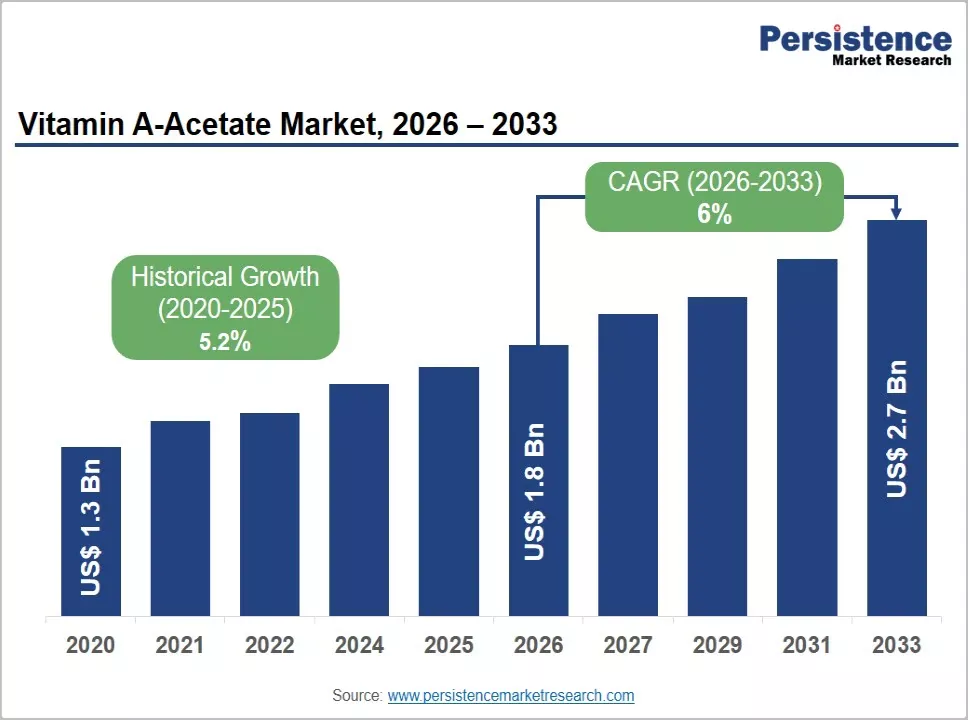
The global vitamin A-acetate market size is likely to be valued at US$ 1.80 billion in 2026 and is projected to reach US$ 2.71 billion by 2033, growing at a CAGR of 6% during the forecast period between 2026 and 2033.
Retinyl acetate the stabilized ester form of retinol used across food fortification, animal nutrition, and topical skincare sits at the intersection of three converging demand systems: mandatory micronutrient programs, preventive nutrition science, and the global clean-label cosmetics reformulation wave.
This trajectory reflects sustained procurement by food and beverage manufacturers responding to World Health Organization (WHO) mandates on vitamin A supplementation in populations at clinical deficiency risk, particularly across sub-Saharan Africa and South and Southeast Asia. The US$ 0.91 billion incremental opportunity between 2026 and 2033 is structurally underpinned not speculative which makes this landscape relevant to both procurement strategists and institutional investors evaluating specialty nutrition assets.
Key Industry Highlights
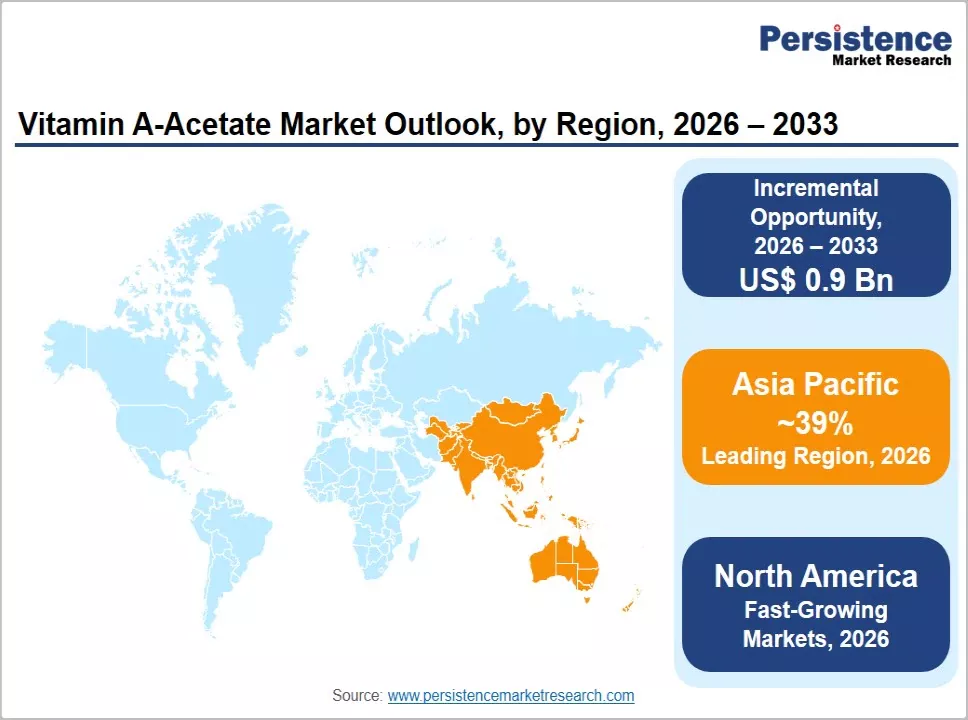
- Dominant Region: Asia Pacific leads the vitamin A-acetate market with 39% share and the fastest regional growth rate at an estimated 7.4% CAGR, driven by China's dual role as the world's largest synthetic retinyl acetate producer and a rapidly growing domestic consumer of fortified foods and animal nutrition premixes.
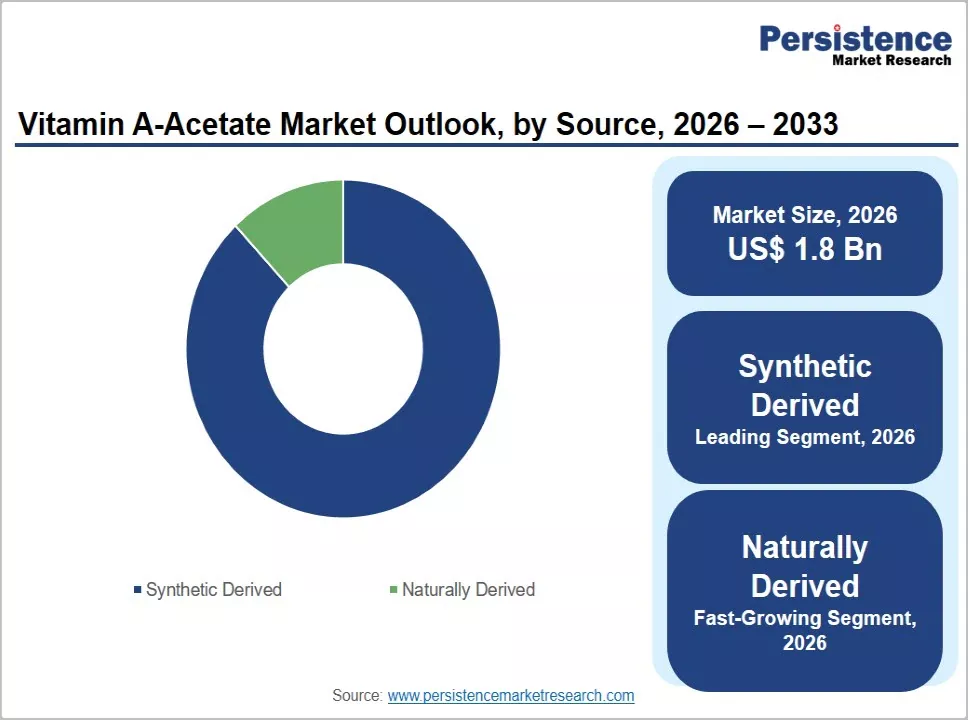
- Leading Product Type: Synthetic derived vitamin A-acetate's 88% market share in 2026. Due to regulatory reference standards for retinyl acetate in fortification, pharmaceuticals, and animal feed are written around synthetic purity benchmarks established by bodies including the USP and Ph.Eur., displacement by alternative sources requires parallel regulatory re-registration a multi-year process that structurally protects incumbents.
- Fastest-growing Type: Naturally derived retinyl acetate is the standout emerging segment, gaining disproportionate commercial traction in premium infant nutrition and clean-label dietary supplements. The segment's growth is catalyzed by consumer-facing brands responding to natural-sourcing preferences, creating a bifurcated pricing architecture where naturally derived grades command a meaningful premium over synthetic equivalents rewarding suppliers with certified, traceable marine- or plant-derived retinoid supply chains.
- Key Market Opportunity: For ingredient distributors and specialty chemical investors, the fastest near-term strategic opportunity lies at the intersection of cosmetic-grade retinyl acetate supply and the EU's evolving retinoid regulatory framework. As EFSA continues refining upper intake level guidance and the European Commission implements further cosmetic ingredient restrictions, formulators face recurring reformulation cycles each representing a fresh procurement decision that favors technically agile, regulatory-fluent suppliers over pure commodity volume players.
DRO Analysis
Driver- WHO-Driven Micronutrient Fortification Mandates Sustaining Baseline Demand
Mandatory food fortification programs remain the most durable demand anchor in the vitamin A-acetate industry. The WHO and UNICEF jointly estimate that vitamin A deficiency affects approximately 190 million preschool-age children globally, primarily across Africa and South Asia, sustaining government procurement pipelines for retinyl acetate-fortified staple foods including flour, edible oils, and rice.
The Global Alliance for Improved Nutrition (GAIN) has expanded fortification agreements with national governments across 14 countries since 2022, directly increasing bulk vitamin A-acetate procurement volumes. Manufacturers supplying these programs require consistent, pharmaceutical-grade retinyl acetate at defined potency specifications, reinforcing long-term supply contracts with a small number of vertically integrated producers.
Restraint- Volatile Synthetic Precursor Pricing Creating Margin Pressure Across the Supply Chain
The synthesis of retinyl acetate depends on beta-ionone and other isoprenoid intermediates derived from petrochemical and terpene chemistry. Feedstock price volatility particularly following the 2022 energy shock in Europe compressed margins for mid-tier producers lacking backward integration into precursor manufacturing. BASF SE, one of the sector's largest producers, flagged elevated raw material costs as a headwind to its nutrition segment profitability in its 2022 annual report. Smaller toll manufacturers and regional distributors absorbed margin pressure they could not pass through to price-sensitive institutional buyers, creating a consolidation incentive across the mid-market.
Opportunity- Premiumization of Retinol-Based Skincare Opening a High-Margin Cosmetic Channel
The global prestige skincare market's sustained focus on evidence-based anti-ageing actives has elevated retinyl acetate valued for its superior dermal stability relative to pure retinol as a preferred ingredient in serums, overnight creams, and encapsulated delivery systems. L'Oréal S.A. and Estée Lauder Companies have both expanded retinoid-based product lines since 2023, with retinyl acetate featured in formulations targeting consumers seeking clinically validated skin renewal benefits without the irritation profile of prescription-grade tretinoin. This creates a differentiated, high-margin demand channel for cosmetic-grade retinyl acetate that is less price-sensitive than feed or fortification procurement, rewarding suppliers capable of meeting purity and encapsulation specifications.
Category-wise Analysis
Why Do Liquid Formulations Command the Majority of Vitamin A-Acetate Market Revenue?
Liquid formulations is projected to account around 58% of market share in 2026, driven by solution-phase retinyl acetate integrates into emulsion manufacturing processes used by both food processors and cosmetic manufacturers. Edible oil fortification a primary delivery vehicle in WHO-endorsed nutrition programs requires a liquid vitamin A-acetate concentrate that disperses homogeneously without additional blending steps. Cosmetic formulators at companies such as Shiseido and Beiersdorf similarly rely on oil-soluble liquid retinyl acetate for incorporation into emollient-rich serum and cream bases, eliminating the reconstitution step that powder forms require.
Liquid formulations are likely to be the fastest-growing product form, driven by the rapid expansion of ready-to-drink fortified beverages and functional dairy categories. Nestlé S.A.'s NAN and MILO product lines reformulated with enhanced micronutrient profiles across Southeast Asia between 2023 and 2024 exemplify the growing deployment of liquid retinyl acetate in high-volume beverage fortification, compounding demand from both volume growth and reformulation cycles.
Source Insights
Synthetic derived vitamin A-acetate is estimated to hold nearly 88% of the market share in 2026, fueled by the overwhelming cost and scalability advantages of chemical synthesis via the Roche-BASF isoprenoid route. Synthetic retinyl acetate delivers consistent retinol equivalency at defined International Units (IU) per gram, enabling precise dosing in regulated fortification and pharmaceutical applications. Feed compounders, flour millers, and pharmaceutical-grade supplement manufacturers all specify synthetic retinyl acetate because pharmacopoeia monographs including those of the U.S. Pharmacopeia (USP) are written around synthetic reference standards, creating a de facto procurement default.
Naturally derived vitamin A-acetate is likely to be the fastest-growing source segment, catalyzed by the premium supplement and infant nutrition categories' demand for non-GMO, animal-sourced retinoid provenance. Carlson Laboratories and other premium U.S. supplement brands have shifted formulations toward fish-liver-oil-derived retinyl acetate since 2023, responding to consumer labelling preferences verified through National Institutes of Health (NIH) Office of Dietary Supplements consumer surveys showing heightened interest in natural-source micronutrients.
What Is Driving the Food and Beverages Segment's Dominance in the Vitamin A-Acetate Market?
Food and beverages are estimated to account nearly 72% of market share in 2026, propelled by mandatory fortification requirements that create non-discretionary procurement volumes at industrial scale. National fortification programs including India's FSSAI-mandated vitamin A addition to edible oils and the U.S. FDA-regulated enrichment of milk and margarine generate recurring bulk orders from large food manufacturers. Infant formula producers such as Abbott Nutrition and Mead Johnson (now part of Reckitt Benckiser) specify retinyl acetate at pharmaceutical-grade purity to meet infant dietary reference intake standards, sustaining a high-value sub-segment within the broader food application.
Cosmetics and personal care is likely to be the fastest-growing application, propelled by the widespread reformulation of over-the-counter retinoid skincare products following EU Regulation 2022/1176, which restricted retinol concentrations in leave-on face products and prompted formulators to substitute or supplement with retinyl acetate at compliant concentrations. This regulatory pivot has opened significant new formulation volume for cosmetic-grade retinyl acetate suppliers with European distribution capabilities.
End-user Insights
Manufacturers are anticipated to command around 86% of market in 2026, stimulated by retinyl acetate is an upstream industrial input, not a finished consumer product purchased in bulk by food processors, feed compounders, pharmaceutical manufacturers, and cosmetic formulators integrating it into value-added downstream products. Zhejiang Medicine Co., Ltd. and NHU Co., Ltd. both supply multi-ton vitamin A-acetate lots directly to manufacturing customers under long-term supply agreements, with pricing indexed to agreed purity grades and IU specifications. This manufacturer-to-manufacturer procurement structure concentrates purchasing power and volume in a small number of technically sophisticated buyers.
Retailers represent the fastest-growing end-user segment, driven by the expansion of private-label vitamin supplement ranges at pharmacy and health retail chains. CVS Health and Boots (Walgreens Boots Alliance) have expanded own-brand vitamin A supplement SKUs since 2024, sourcing retinyl acetate directly from ingredient distributors to improve category margins, compressing the traditional manufacturer intermediary layer.
Regional Insights
North America Vitamin A-Acetate Market Trends and Insights
North America is forecast to account about 25% of vitamin A-acetate market in 2026. The region's mature food fortification infrastructure governed by FDA mandatory enrichment standards for dairy and grain products sustains stable industrial procurement volumes. Incremental growth is coming from the premium dietary supplement channel and from cosmetic retinoid reformulation activity, both of which favor higher-purity, higher-margin retinyl acetate grades.
U.S. Vitamin A-Acetate Market Size
The U.S. is estimated to command nearly 85% of the North America regional market in 2026. Demand is anchored by FDA-regulated enrichment of fluid milk and cereal grain products, with growth momentum building in the dietary supplement sector as Council for Responsible Nutrition (CRN) data shows continued expansion of multivitamin and immune-support supplement consumption post-pandemic.
Canada Vitamin A-Acetate Market Size
Canada is expected to hold around 15% of the North America regional market in 2026. Health Canada's mandatory vitamin A fortification requirement for margarine and skim milk powder sustain baseline industrial demand, with forward momentum linked to growing natural health product registrations under the Natural Health Products Regulations, which are expanding retail-channel retinyl acetate volumes.
Europe Vitamin A-Acetate Market Trends and Insights
Europe is projected to account around 13% of Vitamin A-Acetate market in 2026. The region's vitamin A-acetate landscape is defined by EFSA oversight, reformulation pressure in cosmetics following EU Regulation 2022/1176, and a premiumization trend in the functional food and clinical nutrition segments. German and French manufacturers are leading reformulation investment, sustaining demand for pharmaceutical- and cosmetic-grade retinyl acetate.
Germany Vitamin A-Acetate Market Size
Germany is estimated to account nearly 23% of the Europe regional market in 2026. Germany's large pharmaceutical and clinical nutrition manufacturing base including companies such as Fresenius Kabi drives demand for USP- and Ph.Eur.-compliant retinyl acetate, with growth supported by expanding parenteral nutrition product portfolios across the country's hospital procurement networks.
U.K. Vitamin A-Acetate Market Size
The U.K. is anticipated to command around 16% of the Europe regional market in 2026. Post-Brexit alignment of the UK Food Standards Agency (FSA) with pre-existing EU fortification and supplement regulations has maintained regulatory continuity for retinyl acetate suppliers, while the UK's growing clean-beauty retail sector led by chains such as Holland & Barrett is expanding demand for naturally derived and clean-label vitamin A formats.
Which Region Will Drive the Fastest Vitamin A-Acetate Growth Through 2033?
Asia Pacific is forecast to dominate and capture around 39% of market share during the forecast period between 2026 to 2026. China's domestic production capacity anchored by NHU Co., Ltd. and Zhejiang Medicine Co., Ltd. is expanding to meet both export demand and a rapidly growing domestic functional food and animal nutrition market. India's FSSAI-driven fortification mandates and Southeast Asia's expanding aquaculture sector are compounding regional growth momentum through the forecast period.
China Vitamin A-Acetate Market Size
China is estimated to capture nearly 42% of the Asia Pacific regional market in 2026. China dominates regional supply and demand simultaneously domestic producers supply the majority of global synthetic retinyl acetate, while expanding middle-class consumption of fortified foods and premium skincare products drives internal demand growth. Forward investment in fermentation-based retinoid synthesis by NHU signals a potential shift in the cost structure of the global vitamin A-acetate industry through the 2030s.
India Vitamin A-Acetate Market Size
India is expected to hold around 18% of the Asia Pacific regional market in 2026. The Food Safety and Standards Authority of India (FSSAI)'s mandatory oil fortification program sustains large-volume procurement by edible oil refiners, with Adani Wilmar among the processors complying with prescribed retinyl acetate addition standards. India's expanding pharmaceutical export sector is adding a secondary demand layer as generic vitamin supplement manufacturers scale production capacity.
Competitive Landscape
The global vitamin A-acetate market is moderately concentrated at the upstream synthesis level and fragmented downstream. DSM-Firmenich, BASF SE, NHU Co., Ltd., and Zhejiang Medicine Co., Ltd. control the majority of global synthetic retinyl acetate capacity, competing primarily on feedstock integration, production scale, and pharmacopoeial compliance credentials.
Mid-tier players including Adisseo, Xiamen Kingdomway Group, and RIKEN VITAMIN CO., LTD compete on application-specific grades, regional distribution proximity, and technical service capabilities. Winning in this market requires the ability to certify across multiple pharmacopoeial standards simultaneously (USP, Ph.Eur., JP), as multinational customers demand a single supply source for multi-jurisdictional compliance.
Key Industry Developments
- In September 2026, Hexagon Nutrition Limited launched VIT A+, a stable vitamin A palmitate formulation developed by Particles for Humanity, at the Micronutrient Forum Global Conference in Accra, Ghana. The new formulation targeted large-scale food fortification across Africa by addressing vitamin A degradation during storage, distribution, and cooking, particularly under hot and humid conditions. The technology used an encapsulation material to protect vitamin A and improve its retention in fortified food products, including bouillon cubes, wheat flour, and sugar.
Companies Covered in Vitamin A-Acetate Market
- DSM
- BASF
- NHU
- Zhejiang Medicine Co., Ltd.
- Adisseo
- Xiamen Kingdomway Group
- RIKEN VITAMIN CO., LTD
- Divi’s Laboratories Ltd.
- PHARMASYNTH FORMULATIONS LIMITED
- Informa Markets B.V.
- Arshine Lifescience Co., Limited
- Hebei Zhentian Food Additives Co., Ltd.
- Rochem International Inc.
- Hangzhou Think Chemical Co., Ltd.
Frequently Asked Questions
The global Vitamin A-Acetate market is valued at US$ 1.80 billion in 2026.
Growth in the vitamin A-acetate industry is driven by government-mandated food fortification programs including national schemes aligned with WHO micronutrient guidelines and by the accelerating incorporation of retinyl acetate into animal feed premixes as global livestock production intensifies.
The food and beverages application segment holds the largest share at 72% of the market, driven by non-discretionary industrial procurement under regulatory fortification mandates in major markets.
Asia Pacific dominates the market with 39% share, supported by China's integrated synthetic retinyl acetate production capacity and India's mandatory edible oil fortification regime administered by the Food Safety and Standards Authority of India (FSSAI).
The highest-value near-term opportunity is the cosmetic-grade retinyl acetate segment, opened by EU Regulation 2022/1176's restrictions on retinol in leave-on cosmetic products, which has created durable new demand for retinyl acetate as a compliant active substitute.
Some of leading players include DSM-Firmenich, BASF SE, NHU Co., Ltd., and Zhejiang Medicine Co., Ltd., which collectively control the majority of global synthetic retinyl acetate manufacturing capacity.


