




- Marine
- Vessel Traffic Management System Market
Vessel Traffic Management System Market Size, Share, and Growth Forecast 2026–2033
Vessel Traffic Management System Market by Component (Hardware, Software, Services), by Deployment (On-premises, Cloud-based, Hybrid), System Type (Vessel Traffic Services (VTS), Vessel Traffic Management Information Systems (VTMIS), Port Management Information Systems (PMIS), Coastal Surveillance Systems, Others), End-user and Regional Analysis, 2026–2033

Global Vessel Traffic Management System Market Size and Trend Analysis
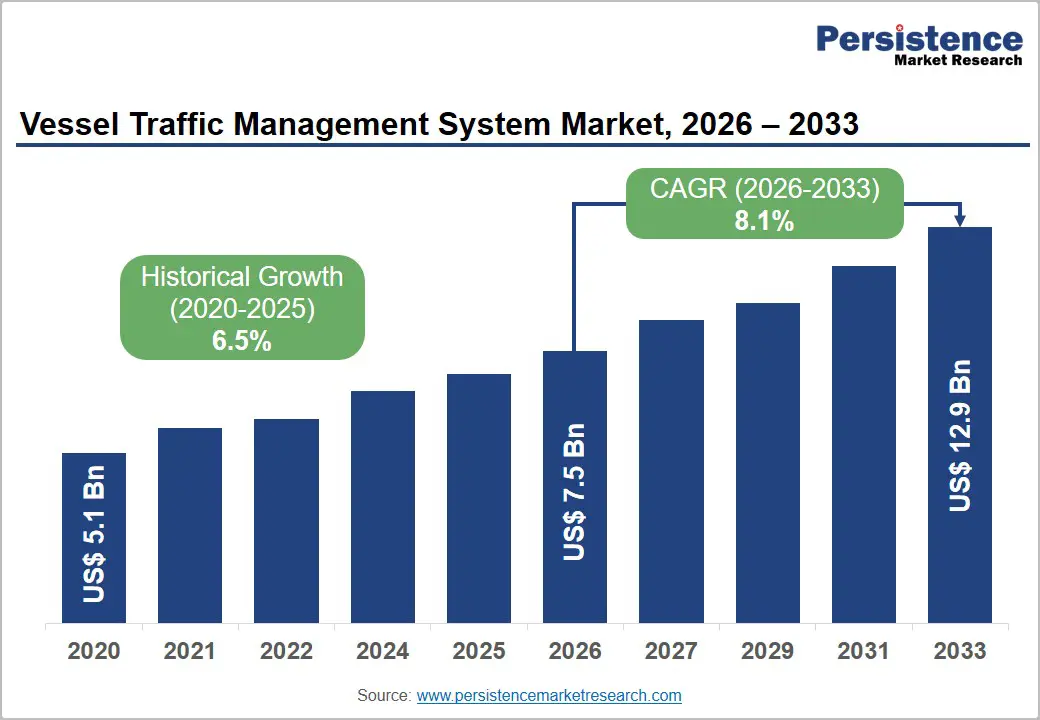
The global vessel traffic management system market is expected to be valued at US$ 7.5 billion in 2026 and is projected to reach US$ 12.9 billion, growing at a CAGR of 8.1% between 2026 and 2033, due to the International Maritime Organization (IMO)’s SOLAS Chapter V mandate requiring AIS carriage for vessels above 300 gross tonnes, which is compelling continuous upgrades in port monitoring and surveillance infrastructure across 150+ member states.
Rising global seaborne trade volumes, due to expanding containerized trade flows and globalization of supply chains, are further increasing vessel density in key maritime corridors. This is driving sustained investment in traffic coordination, collision avoidance, and navigation safety systems.
Key Industry Highlights:
- Leading Component: Hardware dominates the Vessel Traffic Management System (VTMS) market with over 48% share in 2026, valued at ~US$ 3.60 Billion, driven by large-scale deployment of radar arrays, AIS transponders, CCTV towers, and coastal surveillance infrastructure required for foundational maritime monitoring.
- Leading Deployment: On-premises deployment holds over 55% share in 2026, due to strict security requirements, mission-critical port operations, and the need for uninterrupted control of sensitive maritime data.
- Leading System Type: Vessel Traffic Services (VTS) accounts for over 40% share in 2026, valued at ~US$ 3.0 billion, as it forms the core operational layer for real-time vessel tracking and navigation safety.
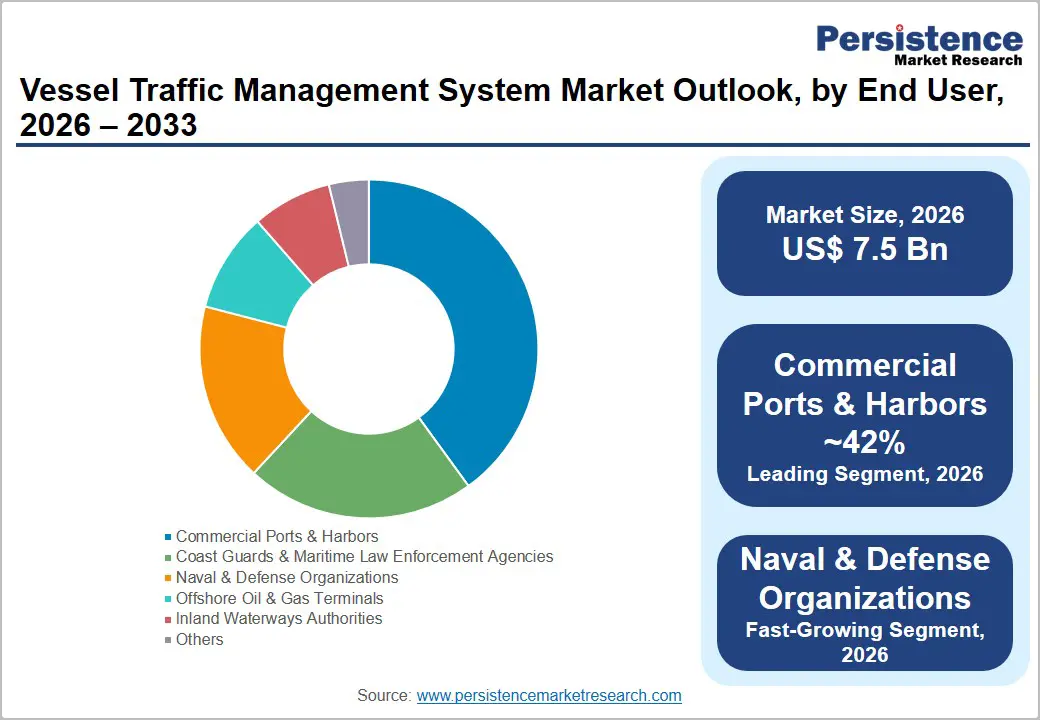
- Leading End-user: Commercial ports & harbors are likely to dominate with ~42% share in 2026, valued at ~US$ 3.15 Billion, driven by the need to reduce vessel turnaround time, optimize berth allocation, and enhance port efficiency.
- Fastest Growing End-user: Naval & Defense organizations are the fastest-growing segment, supported by increasing maritime domain awareness and coastal security investments.
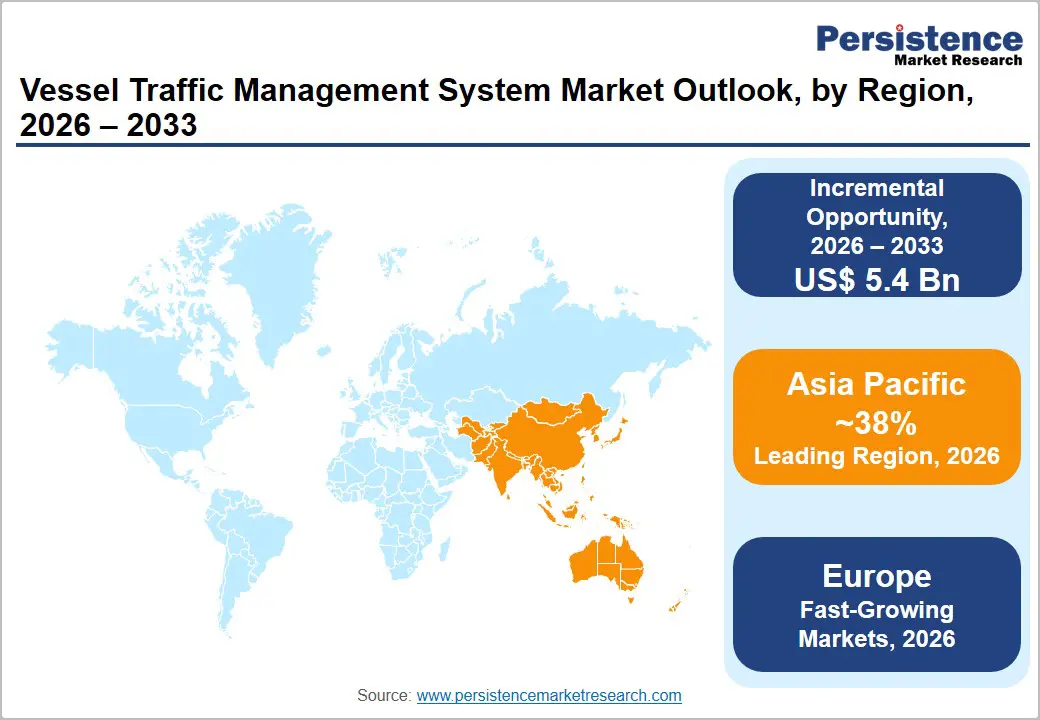
- Leading Region: Asia Pacific leads with over 38% share in 2026, valued at ~US$ 2.85 Billion, driven by large-scale port expansion, container throughput dominance, and government-led maritime modernization programs across China, India, and ASEAN. It is also the fastest-growing region with a CAGR of ~13.4%, supported by deepwater port development and digital navigation initiatives.
Market Dynamics
Drivers - Mandatory Digitalisation of Port Infrastructure Under IMO's e-Navigation Strategy
Global maritime transport accounts for over 80% of world trade by volume, making ports critical nodes in the international logistics system. The IMO’s e-Navigation framework and SOLAS regulations have accelerated baseline digital adoption across global fleets. Port authorities that delay VTMS upgrades increasingly face revenue risk, as digitally advanced ports achieve 15–25% improvements in vessel turnaround time and berth efficiency, enhancing attractiveness for shipping lines.
The IMO’s e-Navigation Strategy Implementation Plan encourages member states to progressively integrate digital data services into maritime traffic management workflows. Vendors such as Kongsberg Maritime have expanded next-generation VTMS platforms integrating AIS, radar, and multi-sensor fusion capabilities. These operational efficiency gains and compliance expectations are expected to accelerate replacement cycles, particularly in mid-tier ports across Southeast Asia and West Africa.
Escalating Maritime Security Threats Driving Dual-Use Surveillance Investment
Rising geopolitical tensions across key maritime chokepoints, including the Red Sea, South China Sea, and the Strait of Hormuz, are accelerating demand for integrated maritime surveillance systems that combine commercial vessel traffic management with defense-grade coastal monitoring capabilities. The Strait of Hormuz alone handles around one-fifth of global oil trade flows, making it one of the most strategically sensitive shipping corridors in the world.
Governments are increasingly deploying systems integrating long-range radar, AIS, and electro-optical sensors to improve real-time situational awareness and threat detection. The European Union’s maritime security initiatives, alongside NATO-aligned modernization programs and similar investments in Asia and the Middle East, continue to reinforce this trend. Procurement cycles in dual-use surveillance systems are compressing in some segments toward 3–5 year upgrade horizons, particularly in high-risk maritime zones where continuous monitoring is essential.
Restraints - High Capital Expenditure and Extended Procurement Lead Times at Emerging-Economy Ports
The upfront capital expenditure required to deploy a full-stack Vessel Traffic Management System (VTMS) including radar towers, AIS and sensor networks, control room infrastructure, and software licensing typically ranges from US$ 15 million to US$ 80 million per port, depending on system scale, traffic density, and integration complexity. This creates a significant financial barrier for smaller port authorities in developing economies operating under constrained fiscal budgets.
Multilateral financing processes such as World Bank–supported port modernization projects in regions like Sub-Saharan Africa and South Asia often involve 18–24-month approval and disbursement cycles, delaying procurement timelines. Even approved projects frequently experience extended conversion periods, favoring well-capitalized incumbents with established relationships with development finance institutions.
Cybersecurity Compliance Complexity Suppressing Retrofit Demand
Legacy VTMS installations face increasing cost pressures as IMO cybersecurity guidelines (MSC-FAL.1/Circ.3 and subsequent revisions) became effectively enforceable through integration into ISM Code audits from January 2021 onward. Operators are now required to either retrofit certified cybersecurity frameworks onto existing systems or undertake full system replacement.
Cybersecurity-compliant retrofits increase total modernization costs by approximately 20–35%, significantly affecting project economics. This compresses margins for both operators and system integrators in upgrade contracts. Incumbents with pre-certified, cyber-compliant VTMS architectures hold a structural advantage, while new entrants face higher certification and compliance costs before competing for large-scale government tenders.
Opportunities - AI-Powered Predictive Traffic Optimisation as a Premium Software Layer
Vendors and system integrators are increasingly embedding machine-learning capabilities to enhance decision-making using AIS data streams and real-time port conditions, enabling improved operational efficiency. In pilot deployments, advanced VTMS platforms such as Wärtsilä’s Navi-Harbour have reported measurable efficiency improvements in port operations, including reductions in vessel turnaround time, though results vary by terminal configuration.
This capability strengthens ROI justification for port authorities, supporting faster digitalisation decisions without implying guaranteed budget acceleration. Cloud-native architectures with interoperability and compliance with standards such as IEC 62388 are becoming key procurement requirements in regulated maritime environments.
Inland Waterway Modernisation Programmes in Europe and South Asia
Inland waterway systems represent an underpenetrated segment, with a steady yet growing demand alongside long-term government-led infrastructure modernization programmes. In Europe, the TEN-T Regulation (EU) 2024/1679 is expected to support upgrades across core inland corridors such as the Rhine, Danube, and Elbe through improved navigation safety and digital traffic coordination systems.
Investments are emerging in South Asia, where governments are expanding inland water transport capacity to reduce logistics congestion and improve multimodal connectivity. Established players such as Frequentis AG are well positioned in this space due to prior deployments and domain expertise, although final adoption depends on national-level funding and implementation priorities.
Category-wise Analysis
Component Insights
Hardware holds more than 48% of the global vessel traffic management system market in 2026, equivalent to US$ 3.60 Billion, driven by the fundamental need for physical maritime surveillance infrastructure. Ports and coast guards require radar arrays, AIS transponders, CCTV towers, and vessel identification beacons to ensure real-time situational awareness and safe navigation. These systems are essential for detecting, tracking, and managing vessel movement in congested or high-risk waters. Large-scale port authorities prioritise complete greenfield installations, where full sensor ecosystems must be deployed before software can function effectively.
Software is expanding rapidly due to the growing demand for operational intelligence and decision support rather than just raw data collection. Port operators increasingly require predictive analytics, berth optimization, and integrated command dashboards to improve efficiency and reduce congestion. Modern VTMS platforms are expected to transform sensor inputs into actionable insights for traffic coordination and risk management. This shift allows authorities to maximise the value of existing hardware infrastructure without frequent physical upgrades.
Deployment Insights
On-premises deployment accounts for over 55% of the global vessel traffic management system market share in 2026, due to the need for secure and uninterrupted maritime operations. Ports, naval forces, and coast guards prioritise full control over sensitive vessel tracking and communication data. These systems are essential for managing national security risks, emergency response, and regulated cargo movement without dependence on external networks. Many installations require guaranteed uptime in harsh maritime environments where connectivity cannot be compromised. Long lifecycle expectations of 10–15 years also reinforce reliance on on-premises systems.
Cloud-based deployment is growing faster as smaller ports and inland waterways seek cost-efficient access to advanced VTMS capabilities. The primary requirement here is to avoid heavy capital investment in control rooms while still gaining access to analytics and real-time monitoring tools. Cloud models also support easier scalability and faster upgrades compared to traditional infrastructure. Operators benefit from reduced IT burden and faster deployment cycles. This makes cloud particularly suitable for emerging ports and resource-constrained authorities.
System Type Insights
Vessel traffic services (VTS) accounts for over 40% of share in 2026, reaching US$ 3.0 billion, as it fulfills the core operational necessity for real-time vessel monitoring and traffic coordination. Ports require continuous communication and navigation support to prevent collisions and manage dense maritime traffic. VTS systems integrate radar, AIS, and VHF communications to maintain safe separation between vessels. Their mandatory nature under international maritime safety regulations ensures consistent demand across major ports. This makes VTS the foundational layer of most VTMS deployments.
Coastal Surveillance Systems are expanding rapidly due to the increasing need for maritime border security and threat detection. Governments are prioritizing early identification of illegal fishing, smuggling, and hostile vessel movement along coastlines. These systems combine radar, electro-optical sensors, and tracking tools to create wide-area maritime awareness. Rising geopolitical tensions and incidents in strategic waterways have intensified investment requirements.
End-user Insights
Commercial ports & harbors represent 42% of the global vessel traffic management system market in 2026, due to the operational need to improve vessel turnaround time and port efficiency. Ports depend on VTMS to coordinate arrivals, departures, and berth allocation in highly congested environments. Efficient traffic management directly impacts revenue generation, logistics throughput, and global competitiveness. Integrated systems combining AIS, radar, and weather data are essential for smooth port operations.
Naval & defense organizations are the fast-growing end-user segment due to the increasing requirement for maritime domain awareness and security readiness. Defence agencies require advanced tracking systems to monitor grey-zone activities and protect territorial waters. VTMS platforms support coordinated fleet operations and real-time threat assessment. Rising geopolitical competition has increased investment in surveillance and command integration systems.
Regional Insights
North America Vessel Traffic Management System Market Trends and Insights
North America accounts for over 22% of the global vessel traffic management system market share in 2026, driven by sustained investments in port safety, digital navigation, and maritime infrastructure modernization. The region’s growth is primarily underpinned by the U.S. Coast Guard’s ongoing VTMS modernization programme across its 12 Vessel Traffic Service zones, alongside Transport Canada’s port safety infrastructure renewal initiatives. The Water Resources Development Act 2022 in the United States has strengthened long-term federal funding visibility for inland waterways and port upgrades, creating a consistent procurement pipeline.
The United States vessel traffic management system market is expected to reach over US$ 1.37 Billion in 2026, driven by the U.S. Department of Homeland Security’s multi-year investments in port cybersecurity and traffic management resilience, particularly following the Maritime Cyber Resilience Executive Order 14116. The demand is generated through federal procurement cycles led by the U.S. Army Corps of Engineers, which manages inland waterway navigation systems and lock infrastructure across the Mississippi River network. Continued modernisation under the Infrastructure Investment and Jobs Act funding cycle is expected to further strengthen system deployment across both coastal and inland maritime corridors.
Europe Vessel Traffic Management System Market Trends and Insights
Europe holds over 30% of the global vessel traffic management system (VTMS) market in 2026, driven by the European Maritime Safety Agency (EMSA)’s expansion of SafeSeaNet and the EU FuelEU Maritime Regulation (EU) 2023/1805, which is accelerating digital upgrades across port scheduling and emissions-compliant routing systems. Dense maritime corridors such as the North Sea, English Channel, and Baltic Sea, among the highest vessel-density regions globally according to EMSA traffic monitoring, are sustaining continuous refresh and modernization demand.
Germany Vessel Traffic Management Market Insights
Germany is expected to surpass US$ 470 million in 2026, supported by Hamburg Port Authority’s smartPORT programme, which integrates real-time VTMS data into advanced logistics and port optimization systems. The country’s inland and coastal waterways, particularly the Rhine and Elbe corridors managed by Wasserstraßen- und Schifffahrtsamt (WSA), are driving sustained investments in traffic monitoring and navigation safety systems.
United Kingdom Vessel Traffic Management Market Trends
The United Kingdom is likely to cross US$ 410 million in 2026, driven by the Maritime and Coastguard Agency’s National Maritime Single Window initiative, which is streamlining vessel data integration across ports and control centers. Post-Brexit infrastructure independence is accelerating VTMS procurement at major hubs such as Dover and Felixstowe, expanding domestic system deployment requirements.
France Vessel Traffic Management Market Insights
France is supported by modernization programs led by the Direction des Affaires Maritimes and infrastructure upgrades at the Port of Marseille-Fos, a key Mediterranean logistics gateway. Long-term naval surveillance and port modernization programs, alongside Thales’ established role in coastal defense systems, are reinforcing steady demand for advanced VTMS solutions.
The Rest of Europe market size is expected to surpass US$ 560 million by 2026, led by Norway, Sweden, Netherlands, and Denmark, where highly automated ports and offshore maritime corridors drive strong system adoption. Norway in particular, supported by Kongsberg Gruppen and continuous upgrades by the Norwegian Coastal Administration across multiple VTS centres, remains a key contributor to regional VTMS procurement growth.
Asia Pacific Vessel Traffic Management System Market Trends and Insights
The Asia Pacific vessel traffic management system (VTMS) market accounts for over 38% of the global share in 2026 in the coming years. This dominance is driven by large-scale deepwater port construction across China, India, Vietnam, and Bangladesh, along with ASEAN’s Master Plan on ASEAN Connectivity 2025, which is actively addressing maritime infrastructure and VTMS capability gaps across member states. The region handles more than 60% of global container throughput, creating a multiplier effect where every new terminal expansion triggers mandatory VTMS deployment.
China Vessel Traffic Management Market System Insights
China vessel traffic management system market value is expected to value at US$ 1.05 Billion, driven by the Ministry of Transport’s 14th Five-Year Plan for Water Transport Development, which mandates next-generation VTMIS deployment across more than 100 first-class open ports. Large-scale modernization across key hubs such as Tianjin, Ningbo-Zhoushan, and Guangzhou Nansha is reinforcing centralized procurement and advanced traffic control integration.
Southeast Asia Vessel Traffic Management System Market Insights
Southeast Asia VTMS market size is most likely to cross US$ 400 Million, with demand concentrated in Singapore, Indonesia, Malaysia, and Vietnam. Singapore’s Maritime and Port Authority SAFER Seas initiative, launched in 2023, is deploying AI-based traffic prediction and autonomous vessel separation advisory systems in the Straits of Malacca, setting a regional benchmark for digital maritime operations.
India Vessel Traffic Management System Market Insights
India vessel traffic management system market value is poised to value US$ 260 million by 2026, supported by the Sagarmala Programme, which targets 189 port-led development projects through 2035 and mandates VTMS upgrades across all 12 major ports. Large infrastructure expansions, including Jawaharlal Nehru Port’s capacity enhancement to 10 million TEUs by 2028, are further reinforcing radar and control system investments, positioning India for faster market share expansion over the coming decade.
Competitive Landscape
The global vessel traffic management system market operates as a concentrated oligopoly at the premium tier, where a small group of global leaders collectively accounts for a dominant share of revenue. Competition is primarily shaped by proprietary radar technologies, advanced software platforms, and deep systems integration capabilities that require long-term certification under international maritime and defense standards.
Emerging entrants from Asia are increasing their presence by leveraging strong government relationships and offering cost-competitive, integrated surveillance solutions, particularly across fast-growing Indo-Pacific maritime corridors. Regional hardware-focused providers with limited proprietary software capabilities are experiencing margin pressure as procurement increasingly shifts toward performance-based and outcome-linked contracting models.
Key Developments:
- In November 2025, IIT Madras developed and deployed India’s first indigenous Vessel Traffic Management System (VTMS) for ports, aimed at improving ship monitoring, navigation safety, and port efficiency. The system is fully developed in-house through NTCPWC and is already operational at major ports, supporting India’s push for maritime self-reliance and secure, data-controlled port operations.
- In September 2025, Kongsberg Maritime signed a contract with REACH Subsea ASA to design and deliver two additional unmanned surface vessels based on the UT5208 design, expanding the REACH REMOTE autonomous fleet following the success of REACH REMOTE 1 and 2. The vessels will support remote offshore operations, with construction subcontracted to a shipyard while Kongsberg retains design, systems integration, and delivery responsibilities.
Companies Covered in Vessel Traffic Management System Market
- Kongsberg Gruppen
- Thales Group
- Saab AB
- Leonardo S.p.A.
- Wärtsilä
- L3Harris Technologies
- HENSOLDT AG
- Frequentis AG
- Indra Sistemas
- Rohde & Schwarz
- Japan Radio Co.
- Tokyo Keiki
- ST Engineering
- Terma A/S
- Others
Frequently Asked Questions
The global vessel traffic management system market is valued at US$ 7.5 Billion in 2026 and is projected to reach US$ 12.9 Billion by 2033, advancing at a CAGR of 8.1%, driven by the need for continuous compliance with IMO SOLAS Chapter V AIS and VTS mandates, requiring ports to upgrade safety and monitoring infrastructure.
The growth is primarily driven by the necessity for regulatory compliance with IMO e-Navigation requirements and rising maritime security concerns. Governments are increasingly investing in coastal surveillance and digital port infrastructure to manage traffic, security risks, and geopolitical tensions.
Hardware leads with over 48.0% share, as ports must first deploy essential physical infrastructure such as radar, AIS, and sensor systems for VTMS to function. Without this base layer, software and analytics systems cannot operate effectively.
Asia Pacific accounts for the largest share over 38%, supported by major port expansion and high container traffic volumes. The region’s growth is driven by the need to modernize ports and ensure safe navigation across rapidly expanding maritime trade routes.
The key opportunity lies in AI-enabled traffic optimization and predictive analytics layered on existing VTMS systems. Ports increasingly need efficiency gains and real-time decision tools without full infrastructure replacement, creating demand for scalable software solutions.


