




- Hardware & Software IT Services
- Vehicle Tracking System Market
Vehicle Tracking System Market Size, Share, and Growth Forecast, 2026 - 2033
Vehicle Tracking System Market by Component (Hardware, Software, Services), Channel (OEM-embedded, Dealer-fitted Solutions, Aftermarket/Retrofit Devices), Application (Fleet Management, Vehicle Security & Stolen Vehicle Recovery, Usage-based Insurance (UBI), Remote Diagnostics & Predictive Maintenance, Asset & Trailer Tracking, Emergency & Safety Services), and Regional Analysis for 2026 - 2033

Vehicle Tracking System Market Share and Trends Analysis
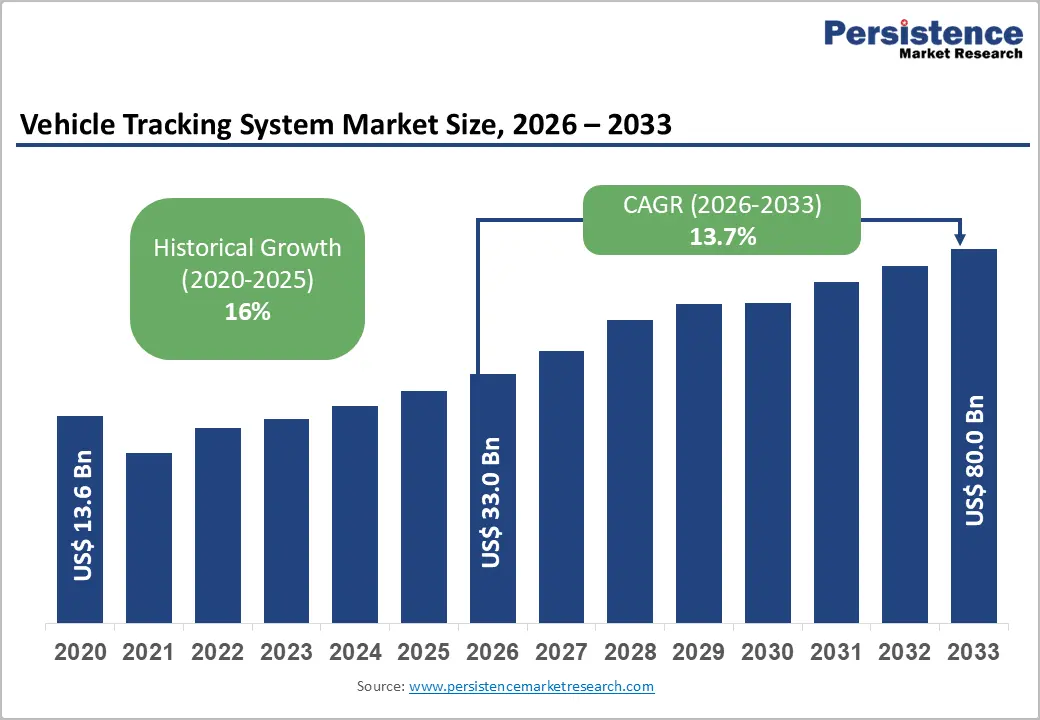
The global vehicle tracking system market size is likely to be valued at US$ 33.0 billion in 2026, and is projected to reach US$ 80.0 billion by 2033, growing at a CAGR of 13.5% during the forecast period 2026 - 2033.
Growth is primarily driven by rising fleet digitization, regulatory mandates for vehicle monitoring and emergency response, and the integration of vehicle tracking with analytics-led operational platforms rather than standalone hardware. Demand is increasingly shifting from device-centric deployments toward software- and service-led recurring-revenue models, as fleet operators, insurers, and public agencies prioritize real-time visibility, predictive insights, and compliance automation. Regulatory enforcement related to road safety, emissions compliance, electronic logging, and emergency call systems remains a structural demand anchor across Europe, North America, and parts of the Asia Pacific. At the same time, emerging economies are accelerating adoption through public transport modernization, last-mile logistics expansion, and growth in insurance penetration. From a strategic standpoint, competitive advantage is increasingly determined by data ownership, depth of analytics, ecosystem integration, and scalability, rather than by hardware differentiation alone.
Key Industry Highlights
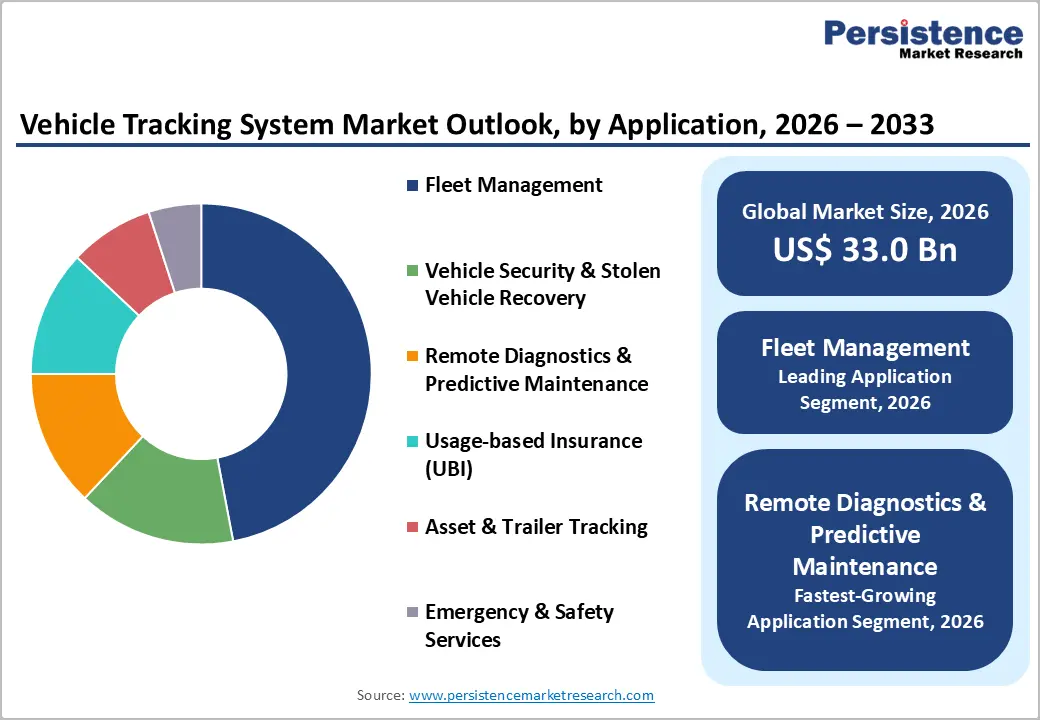
- Component Leadership: Hardware-based systems are projected to lead, with an estimated 43% revenue share in 2026, while software platforms are expected to grow fastest through 2033, driven by rising demand for recurring, insight-led services.
- Application Dominance: Fleet management is expected to dominate, with a projected 47% revenue share in 2026, while insurance telematics and predictive maintenance are likely to grow the fastest through 2033 due to greater data monetization potential.
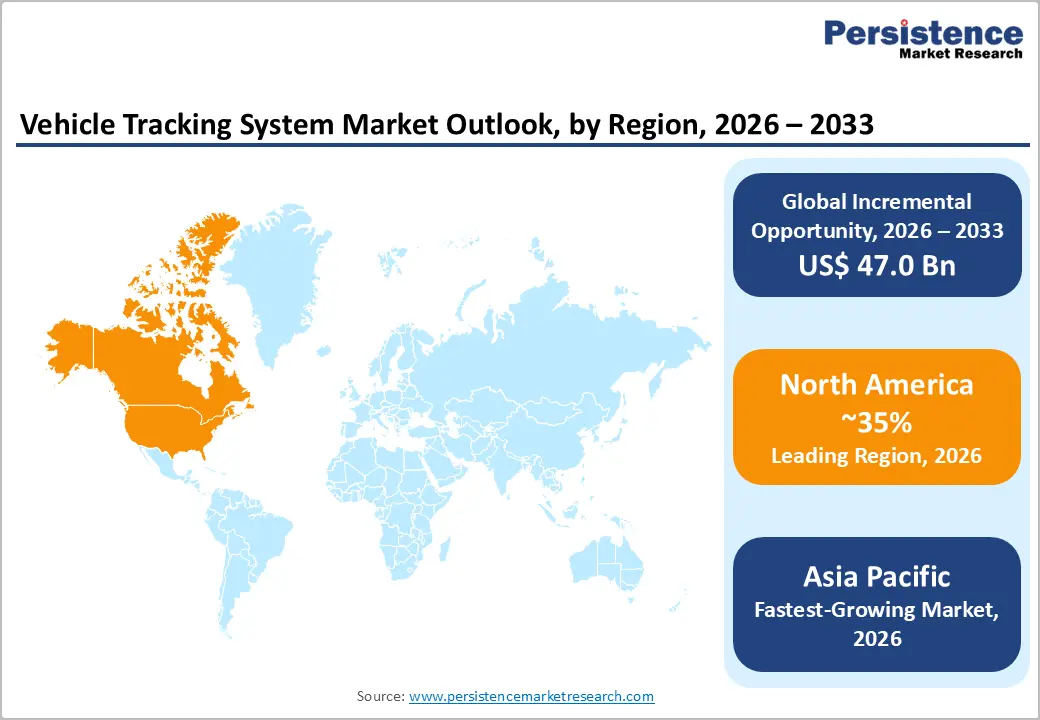
- Regional Dynamics: Asia Pacific is forecast to be the fastest-growing market through 2033, supported by rapid logistics expansion, public transport digitization, and government-mandated vehicle safety mandates.
- Prime Driver: Regulatory-led digitization of commercial and public vehicle fleets is serving as the primary structural demand driver for vehicle tracking systems globally.
- Key Opportunity: The convergence of vehicle tracking data with insurance analytics, predictive maintenance, and AI-enabled fleet optimization is driving high-margin growth.
- November 2025: Geotab Inc. and Applied Information Inc. partnered to integrate Geotab GO telematics with Applied Information’s Glance Smart City platform to provide green-light priority for freight and commercial fleets.
| Key Insights | Details |
|---|---|
| Vehicle Tracking System Market Size (2026E) | US$ 33.0 Bn |
| Market Value Forecast (2033F) | US$ 80.0 Bn |
| Projected Growth (CAGR 2026 to 2033) | 13.5% |
| Historical Market Growth (CAGR 2020 to 2025) | 13.5% |
Market Factors - Growth, Barriers, and Opportunity Analysis
Regulatory-led Digitization of Commercial and Public Vehicle Fleets
Regulatory mandates are increasingly serving as non-discretionary drivers of vehicle tracking system adoption across commercial fleets and public transport networks. Governments and transport authorities are tightening enforcement of road safety, driver working hours, emissions monitoring, and emergency response, thereby increasing demand for compliant telematics and tracking platforms. Mandates such as electronic logging device (ELD) requirements in North America, emergency call (eCall) regulations in the European Union (EU), and national vehicle tracking standards for public transport and hazardous goods movement in Asia are compelling fleet operators to deploy certified systems rather than optional solutions. As is evident, compliance is increasingly a prerequisite for operating permits, cross-border movement, and regulatory approvals, thereby driving adoption even among cost-sensitive operators.
Public-sector fleet digitization is accelerating and reinforcing this demand base. Municipal transport agencies are expanding Global Positioning System (GPS)-enabled fleet monitoring to improve route efficiency, reduce fuel leakage, and strengthen passenger safety accountability. National transport ministries and road safety authorities are increasingly linking funding eligibility, route licensing, and contract renewals to verified tracking and reporting capabilities. From a market impact perspective, regulatory-led demand is favoring integrated hardware, software, and services bundles, as compliance requires continuous data transmission, secure data storage, and auditable reporting trails. Vendors offering end-to-end platforms are capturing higher contract values and longer customer lifecycles. Over the 2026 to 2033 period, regulatory enforcement intensity is expected to remain elevated and will have strengthened the structural nature of this driver rather than allowing it to peak or normalize.
Total Cost of Ownership and Integration Complexity for Multi-Vehicle Fleets
Despite strong demand fundamentals, total cost of ownership (TCO) and system integration complexity continue to constrain faster market penetration, particularly among small and mid-sized fleet operators. While hardware prices are gradually declining, overall deployment economics are remaining under pressure from recurring connectivity charges, platform subscription fees, professional installation costs, and ongoing system maintenance. Integration with existing enterprise software, such as transport management systems (TMS) and enterprise resource planning (ERP) platforms, is increasing both upfront and operational costs. For many operators, these cumulative expenses are delaying full-scale deployment and are encouraging phased or limited implementations rather than comprehensive fleet-wide rollouts.
For large fleets operating across multiple jurisdictions, regulatory fragmentation further increases compliance-related costs and operational complexity. Variations in data retention rules, cybersecurity requirements, and certification standards across regions are forcing operators to maintain parallel system architectures and customized reporting workflows. This fragmentation is raising integration costs and is slowing procurement and investment decision cycles, particularly for cross-border logistics providers. Telematics deployment can account for approximately 2-4% of annual operating expenditure for smaller fleets, which is material in highly competitive transport and logistics segments. As a result, adoption of vehicle tracking systems often remains limited to compliance-minimum configurations rather than advanced analytics-driven solutions.
Data Monetization through Insurance, Predictive Maintenance, and Mobility Analytics
The most lucrative opportunity in the vehicle tracking system market is emerging at the convergence of tracking data, analytics, and third-party monetization, particularly across insurance, maintenance, and mobility intelligence use cases. Usage-based insurance (UBI) programs are expanding beyond pilot deployments, as insurers increasingly seek granular driving-behavior data to improve underwriting accuracy, reduce loss ratios, and design dynamic pricing structures. Vehicle tracking platforms that are delivering standardized, insurer-grade datasets are becoming essential enablers of this transition. Demand is shifting toward solutions that support continuous data validation, secure data exchange, and regulatory-aligned reporting, which is strengthening the strategic relevance of advanced tracking platforms within the insurance value chain.
Predictive maintenance represents another high-value growth pathway. As fleet sizes increase and asset utilization intensifies, unplanned vehicle downtime is becoming a critical cost driver for operators. Integrating tracking data with vehicle diagnostics and artificial intelligence (AI)-driven analytics is enabling earlier fault detection and more efficient maintenance scheduling. This capability is increasing customer willingness to pay for advanced analytics subscriptions rather than basic location-tracking services, thereby materially raising average revenue per user (ARPU). Emerging economies are proving particularly attractive, as insurance penetration, electric vehicle (EV) adoption, and organized logistics networks are expanding in parallel.
Category-wise Analysis
Component Insights
Hardware is expected to account for an estimated 43% of the vehicle tracking system market revenue share in 2026. Demand continues to be driven by large-scale installations across legacy vehicle fleets and by regulatory mandates requiring certified tracking devices. Components such as GPS and Global Navigation Satellite System (GNSS) modules, cellular communication modems, and on-board diagnostics (OBD)-based trackers are seeing strong adoption, particularly across commercial transport fleets and public sector vehicles. However, price competition is intensifying as device standardization increases and low-cost manufacturers enter the market. As a result, hardware margins are gradually compressing, and strategic value is increasingly determined by how effectively hardware deployments enable downstream software adoption and long-term service monetization, rather than by standalone device sales.
Software platforms and analytics are poised to emerge as the fastest-growing segment from 2026 to 2033. The growth of this segment is driven by Software-as-a-Service (SaaS) fleet management platforms, advanced analytics engines, and mobile applications that transform raw tracking data into actionable operational insights. Customers are prioritizing real-time performance dashboards, automated compliance reporting, and predictive analytics capabilities to improve fleet efficiency and risk management. This shift is supporting recurring revenue models and higher customer lifetime value. Vendors that are investing in cloud-native system architectures and AI-enabled analytics are strengthening competitive differentiation and pricing power, positioning software as the primary long-term value creation layer within the component landscape.
Channel Insights
The aftermarket and retrofit channel is expected to remain the dominant deployment route in 2026, accounting for an estimated 60% of total vehicle tracking system installations. This dominance is driven by the large global population of existing vehicles without factory-embedded telematics. Retrofit solutions are seeing particularly strong adoption across logistics, construction, and public transport fleets, where vehicle replacement cycles are long and capital expenditure planning is conservative. This channel is highly price-sensitive and volume-driven, which is making manufacturing scale, distribution coverage, and installation efficiency critical competitive success factors.
Original equipment manufacturer (OEM)-embedded telematics is likely to post the highest 2026-2033 CAGR, supported by the rising standardization of factory-installed telematics systems and the expansion of OEM-bundled digital service offerings. Automakers are positioning telematics as subscription-enabled feature sets that extend beyond vehicle sales, which is strengthening data ownership and enabling long-term customer engagement. This structural shift is gradually reducing the aftermarket share of new vehicle installations. However, the large installed base of legacy vehicles continues to sustain retrofit demand, ensuring both channels remain strategically relevant over the forecast period.
Application Insights
Fleet management is poised to be the largest application area in 2026, commanding roughly 47% of the vehicle tracking system market share. Widespread logistics optimization, fuel cost control, regulatory compliance, and driver safety monitoring are driving growth in this segment. Enterprises are increasingly treating fleet tracking as a productivity and risk-management capability rather than a discretionary cost. This shift is supporting sustained investment in integrated platforms that deliver real-time visibility, operational efficiency, and compliance assurance across large and distributed vehicle fleets.
Insurance telematics and predictive maintenance are slated to be the fastest-growing application areas during the 2026 - 2033 forecast period, expanding at an estimated 17.5% CAGR. Insurers and large fleet operators are adopting data-driven risk assessment models and proactive maintenance strategies to reduce accident-related losses and unplanned vehicle downtime. Integrating vehicle tracking data with advanced analytics is enabling more accurate underwriting, dynamic pricing, and early fault detection. This segment is delivering higher margins due to its analytics-intensive nature and strong willingness to pay, positioning it as a key area of value creation within the broader market landscape.
Regional Insights
North America Vehicle Tracking System Market Trends
North America is projected to account for an estimated 35% of the vehicle tracking system market share in 2026 and is continuing to function as a mature but innovation-led region. Market growth is being driven by strict regulatory enforcement around ELD compliance, widespread adoption of advanced fleet analytics, and early integration of AI-based predictive tools. Fleet operators across the region are increasingly prioritizing real-time visibility, regulatory compliance, and data-driven decision-making, thereby sustaining demand for sophisticated tracking platforms rather than basic location services.
The North American market is projected to grow at a moderate CAGR through 2033, driven by high penetration and structural maturity. The United States will continue to dominate regional demand, supported by large commercial fleets and strong uptake of insurance-driven telematics programs. Investment activity is increasingly concentrating on software platforms, advanced data analytics, and ecosystem integrations with insurance providers and logistics platforms. Hardware expansion is playing a secondary role, as value creation is shifting toward recurring digital services and long-term data monetization strategies.
Europe Vehicle Tracking System Market Trends
Europe is projected to account for approximately 28% of the vehicle tracking system market value in 2026 and is strongly shaped by regulatory frameworks governing road safety and emissions compliance. Emergency call mandates, cross-border logistics requirements, and expanding sustainability reporting obligations are continuing to sustain demand across commercial and public vehicle fleets. Fleet operators are increasingly prioritizing certified and regulation-compliant tracking systems to meet audit, reporting, and operational standards, which is reinforcing the importance of vendor credibility and compliance capabilities within the region.
The market for vehicle tracking systems in Europe is likely to showcase a CAGR of about 13% between 2026 and 2033. Western Europe leads the region in revenue generation owing to broader technology adoption and stricter regulatory enforcement, whereas Eastern Europe contributes incremental volume growth as logistics networks modernize and fleet digitization accelerates. Competitive intensity is relatively consolidated, with established providers benefiting from long-standing regulatory alignment, certified product portfolios, and strong relationships with public authorities and large fleet operators.
Asia Pacific Vehicle Tracking System Market Trends
Asia Pacific is anticipated to hold nearly 32% of the market share in 2026 and is firmly establishing itself as the fastest-growing regional market for vehicle tracking systems. Market growth here is being bolstered by the rapid expansion of logistics and e-commerce networks, large-scale public transport modernization initiatives, rising private and commercial vehicle ownership, and government-led digitization programs. Regulatory emphasis on fleet visibility, safety compliance, and service reliability is increasing across multiple countries, which is accelerating adoption among logistics providers, municipal transport agencies, and state-owned fleet operators. The scale of vehicle populations in the region is creating sustained demand for both retrofitting and the installation of new tracking systems.
The Asia-Pacific vehicle tracking system market is forecast to achieve the highest 2026-2033 CAGR of nearly 16%, driven by strong volume growth and increasing technology adoption. China and India are the largest contributors owing to massive infrastructure investment, public sector digitization, and the formalization of logistics and transport services. Southeast Asia is emerging as a high-growth sub-region as cross-border trade, urban mobility services, and last-mile delivery networks are scaling rapidly. Although price sensitivity remains high in many markets, the region offers exceptional long-term growth potential. Vendors that are combining cost-efficient hardware with scalable software platforms and localized service models are strengthening their ability to capture durable market share across diverse regulatory and economic environments.
Competitive Landscape
The global vehicle tracking system market is remaining moderately fragmented, with the top ten players collectively accounting for an estimated 40% of global revenues. Competitive intensity is increasing as hardware differentiation continues to decline due to component standardization and price compression. As a result, vendors are increasingly competing on software capabilities, data analytics depth, and platform reliability rather than on device performance alone. Buyers are placing greater emphasis on solution scalability, compliance readiness, and long-term service continuity, which is reshaping vendor selection criteria across both commercial and public sector customers.
Market leaders are responding by expanding advanced analytics capabilities, strengthening OEM partnerships, and pursuing targeted mergers and acquisitions to accelerate geographic reach and technology integration. Strategic acquisitions are enabling faster entry into high-growth markets and are helping vendors add specialized capabilities such as predictive analytics and industry-specific dashboards. At the same time, deeper OEM relationships are improving access to factory-installed deployments and long-term data streams. This strategic shift is gradually increasing market concentration within the software and services layers, even as hardware competition remains fragmented and price-driven.
Key Industry Developments
- In December 2025, Ford Pro introduced Ford Pro Telematics with Asset Tracking along with a suite of year-end software upgrades to help fleet managers improve visibility, monitor equipment location, and manage operational data through enhanced mobile and web tools. These updates include real-time GPS tracking, low-battery alerts, enhanced geofencing, customizable dashboards, and analytics that streamline fleet oversight during peak activity periods.
- In September 2025, Mexico’s government implemented new rules requiring all tank trucks carrying gasoline, diesel, and liquefied petroleum gas to display a QR code issued by the National Energy Commission (CNE). The trucks must be equipped with active GPS tracking systems that transmit location data at least every 30 seconds to improve fuel distribution traceability and curb illicit activity.
- In July 2025, the Tripura State Government launched the Vehicle Location and Tracking System (VLTS) to monitor public transport vehicles in real time and strengthen emergency response and road safety through dedicated GPS tracking and a panic alert feature linked to a central control room. The initiative is expected to enhance passenger safety, emergency coordination, and transparency in the transport ecosystem.
Companies Covered in Vehicle Tracking System Market
- Geotab Inc.
- Verizon Connect
- Trimble Inc.
- TomTom Telematics BV
- CalAmp Corp.
- Samsara Inc.
- Teletrac Navman Group
- Masternaut Limited
- MiX Telematics
- Gurtam
- AT&T Fleet Complete
- Queclink Wireless Solutions
Frequently Asked Questions
The global vehicle tracking system market is projected to reach US$ 33.0 billion in 2026.
Fleet digitization drives, regulatory mandates for vehicle monitoring and emergency response, and the integration of vehicle tracking with analytics-led operational platforms are fueling market growth.
The market is poised to witness a CAGR of 13.5% from 2026 to 2033.
Shift toward software- and service-led recurring revenue models, public transport modernization in emerging economies, and last-mile logistics expansion are opening new market opportunities.
Geotab Inc., Verizon Connect, Trimble Inc., and TomTom Telematics are some of the key players in the market.


