




- Medical Devices
- Vascular Stents Market
Vascular Stents Market Size, Share, and Growth Forecast 2026 - 2033
Vascular Stents Market by Technology (Drug-eluting, Covered), Product (Coronary, Peripheral), Mode of Deployment (Balloon-expandable, Self-expanding), Material (Metal, Polymer), End-User (Hospitals, Cardiac Centers), and Regional Analysis, 2026 - 2033

Vascular Stents Market Size and Trend Analysis
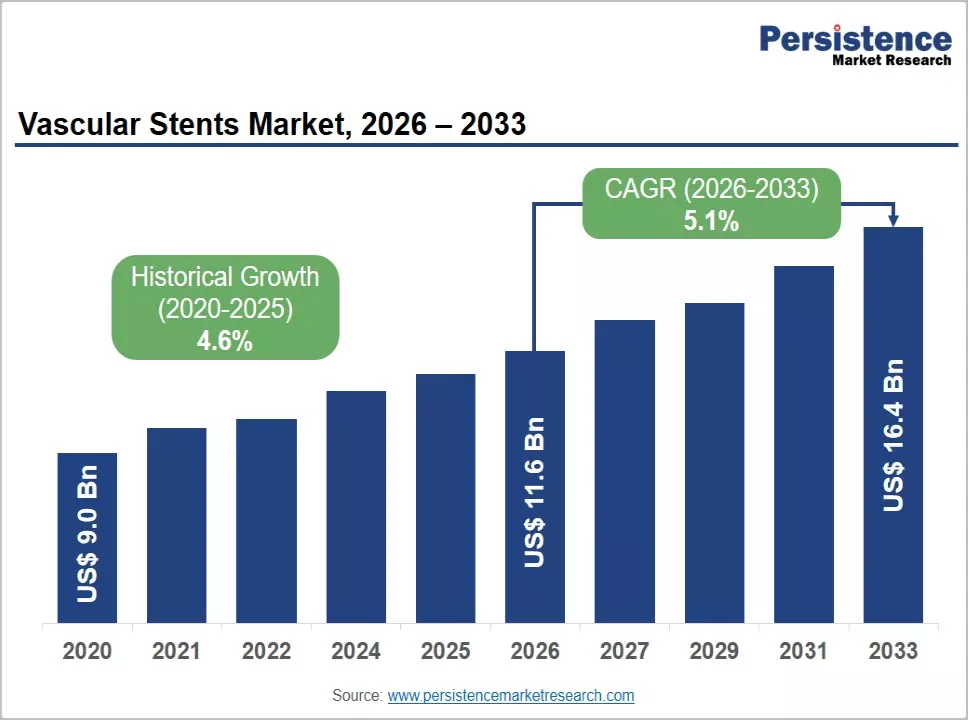
The global vascular stents market size is likely to be valued at US$ 11.60 billion in 2026, and is estimated to reach US$ 16.43 billion by 2033, growing at a CAGR of 5.1% during the forecast period 2026 - 2033.
Cardiovascular disease remains the world's leading cause of mortality, and the clinical imperative to restore arterial patency is reshaping capital allocation across the interventional cardiology supply chain. Growth is underpinned by an aging global population, rising atherosclerotic disease burden, and accelerating procedural volumes in minimally invasive coronary and peripheral interventions. The World Health Organization (WHO) estimates that cardiovascular diseases account for around 17.9 million deaths annually, sustaining near-inelastic demand for percutaneous coronary intervention (PCI) and stent implantation.
Sustained pipeline investment from incumbents such as Medtronic plc and Boston Scientific Corporation, combined with expanding reimbursement frameworks in emerging markets, supports this measured but durable growth.
Key Industry Highlights
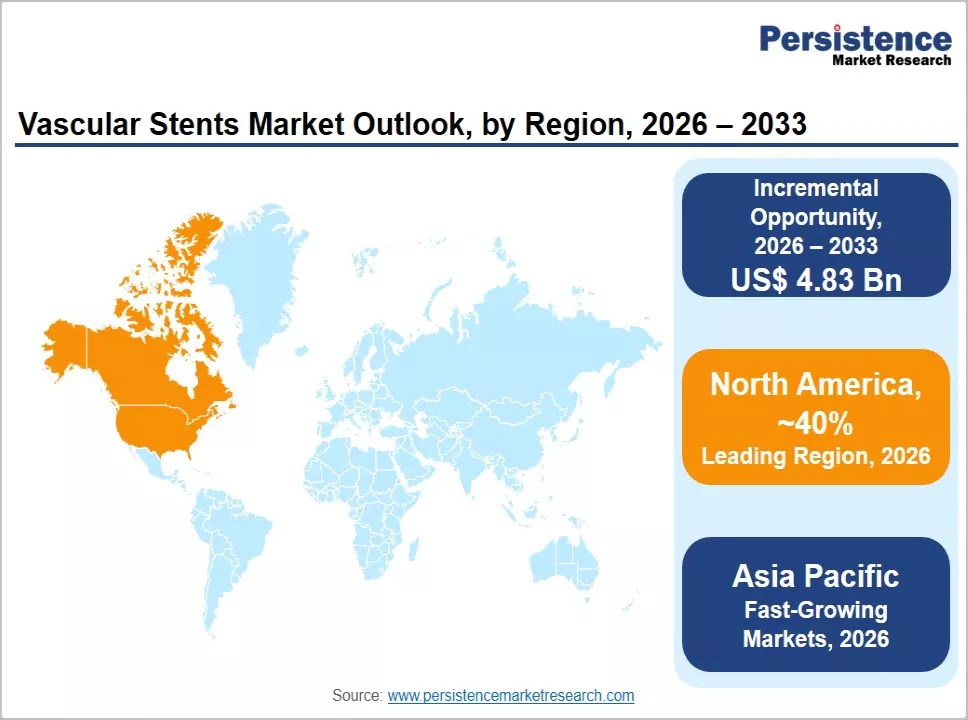
- Regional Leadership: North America is anticipated to command 40% of the vascular stents market share in 2026, sustained by CMS-reimbursed PCI volumes and a mature catheterization laboratory infrastructure that absorbs premium DES pricing.
- Dominant Technology: Drug-eluting stents are expected to lead with 75.0% of the total market share, supported by ACC and ESC guideline preference and biodegradable-polymer and ultra-thin-strut platform innovations.
- Emerging Segment: Polymer bioresorbable scaffolds remain nascent but strategically important, as renewed clinical trial activity and CE-marked European approvals indicate that the concept is re-entering commercial consideration, with potential market disruption after 2028.
- Fastest-growing Region: Asia Pacific is poised to register the highest regional growth at an estimated 4% CAGR, driven by China's volume-based procurement expansion, India's PM-JAY insurance coverage broadening, and Japan's aging cardiovascular patient population.
DRO Analysis
Drivers: Escalating Global Cardiovascular Disease Burden
Ischemic heart disease and peripheral artery disease affect hundreds of millions of patients globally, generating a structurally elevated demand base for endovascular interventions. According to the Global Burden of Disease Study, ischemic heart disease alone accounted for around 197 million prevalent cases worldwide as of the most recent reporting cycle. Catheterization laboratory volumes have risen commensurately, with hospitals across North America, Western Europe, and increasingly South and East Asia performing higher numbers of PCI procedures annually. This sustained procedural growth directly lifts consumption of coronary and peripheral stents, particularly drug-eluting platforms, creating a durable revenue floor for market participants regardless of near-term macroeconomic volatility.
Technological Innovation and Clinical Evidence Supporting Drug-Eluting Stents
Next-generation drug-eluting stent (DES) platforms have progressively displaced bare-metal alternatives as the clinical standard of care. Long-term clinical registries, including those published by the European Society of Cardiology (ESC), demonstrate that contemporary thin-strut, biodegradable-polymer DES achieve significantly lower rates of target lesion revascularization compared with earlier-generation devices. Abbott Laboratories launched its XIENCE Sierra coronary stent system with an ultra-thin cobalt-chromium scaffold engineered to improve strut-to-artery conformability in complex bifurcation lesions.
Procedural guidelines issued by the American College of Cardiology (ACC) and the ESC now favor DES for virtually all PCI-eligible anatomies, institutionalizing demand and reducing price-based competition at the device selection level.
Restraints: Stringent Regulatory Approval Pathways and Reimbursement Pressures
Regulatory approval timelines for novel stent designs remain a significant commercial friction point. In the United States, the U.S. Food and Drug Administration (FDA) requires Premarket Approval (PMA) for new coronary stent systems, a pathway that typically demands extensive clinical trial data, often spanning three to five years of follow-up. Payers such as the Centers for Medicare & Medicaid Services (CMS) have also applied downward pressure on procedure-level reimbursement rates, compressing hospital margins and, by extension, procurement budgets available for premium-priced stent platforms.
Risk of In-Stent Restenosis and Procedural Complications
Despite meaningful clinical advances, in-stent restenosis and late stent thrombosis persist as device-related complications that constrain clinician confidence in expanding indications. Patients requiring dual antiplatelet therapy following stent implantation face bleeding risk, limiting procedural eligibility in elderly or anticoagulated cohorts. This clinical boundary effectively caps the addressable procedural volume in specific patient subgroups, notably those with high hemorrhagic risk, moderating the expansionary demand trajectory that demographic aging might otherwise produce.
Opportunities: Bioresorbable Scaffold Technology and Next-Generation Polymers
Bioresorbable vascular scaffolds (BVS) represent the most consequential product-category inflection point in the vascular stents market in over a decade. Although first-generation BVS platforms encountered clinical setbacks, refined designs incorporating high-molecular-weight poly-L-lactic acid (PLLA) and improved delivery systems are re-entering clinical evaluation. Elixir Medical Corporation has advanced its DESolve novolimus-eluting bioresorbable scaffold through European CE marking, positioning next-generation absorbable platforms for broader commercial deployment. As scaffolds dissolve post-healing, vessel vasomotion is theoretically restored, a clinically meaningful differentiator that is likely to create a premium pricing tier and new competitive dynamics within the market.
Expanding Peripheral Vascular Intervention in Emerging Markets
Rising prevalence of diabetes-related peripheral artery disease across South and Southeast Asia is opening a substantive new demand pocket for peripheral stents. The International Diabetes Federation (IDF) projects that Asia will account for the largest absolute increase in diabetic patients through 2045, with diabetic vasculopathy a principal driver of critical limb ischemia requiring endovascular treatment. Healthcare infrastructure investment programs, including India's Ayushman Bharat Pradhan Mantri Jan Arogya Yojana (PM-JAY) scheme, which extends coverage to over 500 million lower-income beneficiaries, are progressively bringing peripheral vascular procedures within reach of previously untreated patient populations.
Category-wise Analysis
Why Do Drug-Eluting Stents Lead the Vascular Stents Market?
Drug-eluting stents are the leading technology segment, accounting for 75.0% of the vascular stents market share in 2026, equivalent to US$ 8.70 billion. Guideline-mandated clinical preference and superior long-term patency outcomes make them the default implant for virtually every PCI-eligible anatomy. Interventional cardiologists at high-volume tertiary centers rely on DES platforms such as Medtronic's Resolute Onyx for their thin-strut zotarolimus-eluting design, which delivers measurably lower restenosis rates in calcified and bifurcation lesions compared with bare-metal alternatives.
Procurement committees at these institutions treat DES as a clinical necessity, not a premium option, effectively insulating segment revenues from cost-reduction pressure.
Covered stents are likely to be the fastest-growing technology segment, gaining procedural traction in aortic aneurysm repair and traumatic arterial injury management. W. L. Gore & Associates expanded its VIABAHN endoprosthesis indications following FDA clearance for superficial femoral artery disease in 2023, opening a new reimbursable use case that is drawing interventional radiologists toward covered-stent solutions previously reserved for vascular surgery suites.
Product Insights
Coronary stents account for 68.0% of the vascular stents market share in 2026, equivalent to US$ 7.89 billion. The segment leads because acute coronary syndrome management, including ST-elevation myocardial infarction (STEMI) treated via primary PCI, constitutes an emergency, time-sensitive clinical pathway with no clinically acceptable alternative to stent implantation. Cath lab teams at Level I cardiac centers deploy coronary stents under a door-to-balloon time imperative, making brand familiarity and device availability the primary procurement criteria.
Boston Scientific's SYNERGY biodegradable-polymer everolimus-eluting stent has gained strong penetration in complex chronic total occlusion (CTO) procedures at referral centers across North America and Europe.
Peripheral stents are expected to be the fastest-growing product segment, driven by rising rates of critical limb-threatening ischemia in diabetic patient populations. Becton, Dickinson and Company's acquisition of peripheral intervention assets has accelerated commercial focus on below-the-knee arterial disease, an anatomic territory where nitinol self-expanding designs are displacing surgical bypass as the first-line revascularization strategy.
Mode of Deployment Insights
Balloon-expandable stents account for 58.0% of the vascular stents market share in 2026, equivalent to US$ 6.73 billion. Their dominance reflects precise deployment control requirements in coronary ostial lesions and renal artery stenosis, where interventionalists cannot tolerate the foreshortening or positional variability inherent in self-expanding designs. Interventional cardiologists at cardiac catheterization laboratories select balloon-expandable platforms for left main coronary artery interventions, among the highest-acuity PCI procedures performed, because the radial force profile and accurate positioning reduce the risk of stent mal-apposition in anatomy where misplacement carries life-threatening consequences.
Self-expanding stents are likely to grow faster, propelled by expanding carotid artery stenting (CAS) and thoracic aortic applications. BIOTRONIK SE & Co. KG received CE marking for its Pulsar-18 self-expanding nitinol stent in superficial femoral and popliteal artery disease in 2024, reinforcing the segment's expanding peripheral vascular footprint.
Why Do Metal Stents Lead the Vascular Stents Market?
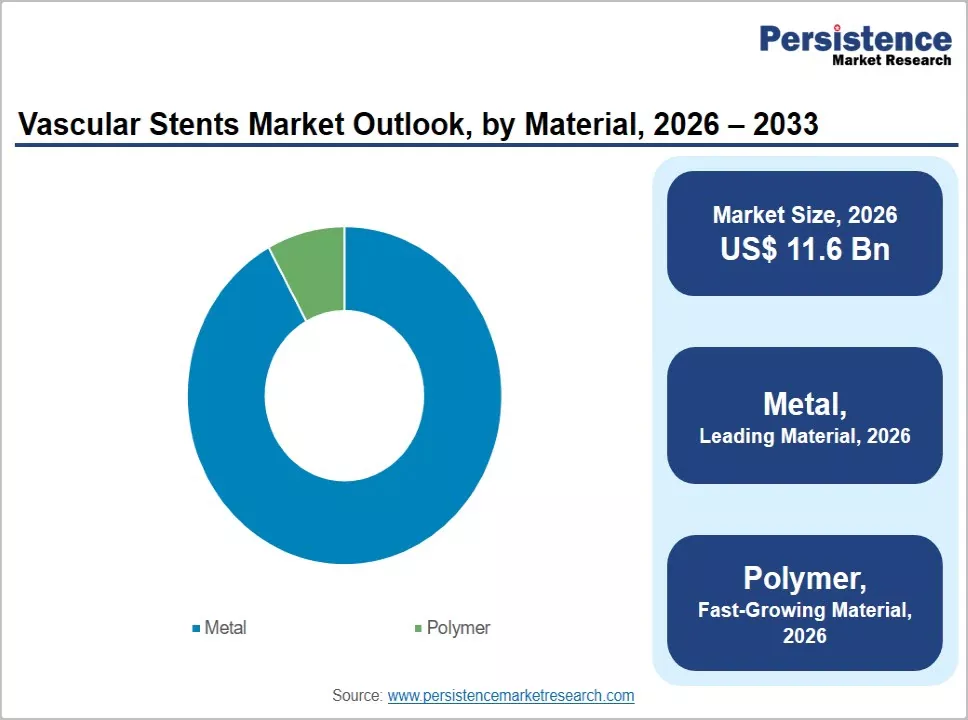
Metal stents, specifically cobalt-chromium and nitinol alloy platforms, account for 92.0% of the market share in 2026, equivalent to US$ 10.67 billion, as no currently commercialized alternative matches their combination of radial strength, fluoroscopic visibility, and long-term structural integrity in high-pressure arterial environments. Cobalt-chromium coronary stents manufactured to sub-80-micron strut thickness, the design standard now employed by Abbott Laboratories in its XIENCE family, deliver the mechanical scaffolding required to maintain coronary patency under the cyclical hemodynamic stresses of cardiac contraction, a performance threshold that polymer-only constructs cannot yet consistently meet at commercial scale.
Polymer stents are expected to be the fastest-growing material segment. Clinical programs evaluating PLLA-based fully bioresorbable scaffolds, including trials registered under the U.S. National Institutes of Health (NIH) ClinicalTrials.gov platform, are generating outcomes data that, if positive, could support regulatory submissions and accelerate polymer scaffold adoption among patients seeking a leave-nothing-behind implant strategy.
End-User Insights
Hospitals account for 72.0% of the vascular stents market share in 2026, equivalent to US$ 8.35 billion. Full-service acute care hospitals with integrated cardiac catheterization laboratories and vascular surgery suites command this share because complex multi-vessel coronary disease, aortic pathology, and emergency interventional cases require the full perioperative infrastructure, including perfusion services, intensive care, and surgical backup, that only hospital settings provide.
Large academic medical centers such as the Cleveland Clinic and Massachusetts General Hospital function as high-volume stent implantation sites and as clinical evaluation platforms where new device iterations are first adopted, reinforcing hospital-channel primacy in both volume and innovation diffusion.
Cardiac centers are likely to be the fastest-growing end-user segment. Standalone catheterization facilities, structured as ambulatory surgical centers focused exclusively on cardiac and vascular intervention, are gaining traction under CMS outpatient prospective payment system reforms that incentivize lower-cost elective PCI settings. Cardiovascular Systems, Inc. and several regional health systems in the United States announced dedicated outpatient cardiac cath center expansion programs between 2023 and 2025.
Regional Analysis
North America Vascular Stents Market Trends and Insights
North America is anticipated to hold around 40.0% share of the global vascular stents market in 2026, representing US$ 4.64 billion, making it the largest regional market. The region's position is anchored by the highest per-capita PCI procedure rates globally and a mature reimbursement infrastructure. CMS reimbursement codes covering coronary DES implantation remain among the most favorable in the world, sustaining physician and hospital willingness to adopt premium-tier devices. Continued growth through 2033 is expected to be shaped by outpatient PCI site-of-care migration and expanding peripheral vascular intervention volumes.
U.S. Vascular Stents Market Size
The U.S. is estimated to account for around 85.0% of the North America vascular stents market share in 2026, equivalent to US$ 3.94 billion. Demand is sustained by around 500,000 PCI procedures performed annually, according to ACC registry data, combined with a growing pipeline of FDA-cleared next-generation DES platforms. Expansion of ambulatory cardiac intervention centers is likely to further lift procedural volumes through the forecast period.
Canada Vascular Stents Market Size
Canada is projected to represent around 15.0% of the North America market share in 2026, equivalent to US$ 0.70 billion. Health Canada's progressive medical device licensing framework supports timely market entry for stent innovations already approved in the United States or under CE marking in Europe. Population aging, with Canada's over-65 cohort projected to reach 25% of the total population by 2033, is expected to sustain procedural volume growth across provincial cardiac programs.
Europe Vascular Stents Market Trends and Insights
Europe is estimated to account for around 25.0% of the vascular stents market share in 2026, representing US$ 2.90 billion. Demand is underpinned by universal healthcare systems and ESC clinical guidelines that standardize DES use across member state hospital networks. The European Union Medical Device Regulation (EU MDR 2017/745), fully operative since May 2021, has elevated clinical evidence requirements for stent approval and post-market surveillance, creating compliance costs while reinforcing quality barriers that benefit established manufacturers. Reimbursement harmonization efforts across EU member states are likely to be a medium-term growth enabler.
Germany Vascular Stents Market Size
Germany is anticipated to account for around 22.0% of the Europe vascular stents market share in 2026, equivalent to US$ 0.64 billion. Germany operates the highest density of cardiac catheterization laboratories per capita in Europe, per German Society of Cardiology (DGK) registry data, sustaining premium stent demand. Early technology adoption, supported by the broader health-tech openness of the Digital Health Applications (DIGA) reimbursement model, is likely to position Germany as a first-mover market for next-generation stent platforms.
U.K. Vascular Stents Market Size
The U.K. is projected to account for around 17.0% of the Europe vascular stents market share in 2026, equivalent to US$ 0.49 billion. The National Health Service (NHS) Long Term Plan commits to reducing cardiovascular disease mortality by 25% by 2028, directly supporting investment in PCI infrastructure and stent procurement volumes. Post-EU MDR regulatory alignment via the Medicines and Healthcare products Regulatory Agency (MHRA) is streamlining device approvals and improving manufacturers' access timelines to the UK market.
Why Is Asia Pacific Expected to Be the Fastest-Growing Region in the Vascular Stents Market?
Asia Pacific is projected to account for around 27.0% of the vascular stents market in 2026, representing US$ 3.13 billion. The region is also anticipated to register the fastest growth, expanding at an estimated CAGR of 4%, propelled by rising cardiovascular disease incidence, expanding public health insurance coverage, and accelerating catheterization laboratory construction across China, India, and Southeast Asia. China's National Healthcare Security Administration (NHSA) volume-based procurement program has introduced significant coronary stent price compression but has simultaneously driven volume expansion by broadening procedural access to lower-tier hospital networks, with higher unit volumes offsetting per-unit revenue decline.
China Vascular Stents Market Size
China is estimated to represent around 32.0% of the Asia Pacific market share in 2026, equivalent to US$ 1.00 billion. The NHSA centralized tendering mechanism, which reduced domestic coronary stent prices by over 90% at its 2021 implementation, has restructured competitive dynamics, favoring domestic manufacturers such as MicroPort Scientific Corporation while compelling multinationals to compete on clinical differentiation. Rising complex PCI volumes at Tier-1 hospitals are expected to sustain demand for premium imported platforms through 2033.
Japan Vascular Stents Market Size
Japan is anticipated to account for around 22.0% of the Asia Pacific market share in 2026, equivalent to US$ 0.69 billion. Japan's Pharmaceuticals and Medical Devices Agency (PMDA) approval pathway, though rigorous, supports a premium-price market where advanced DES and bioresorbable platforms command strong clinician preference. The country's rapidly aging population, with over 29% of citizens aged 65 or above per Statistics Bureau of Japan data, is generating sustained growth in both coronary and peripheral vascular intervention volumes.
Competitive Landscape
The global vascular stents market structure is moderately concentrated at the premium end and intensely competitive in volume segments. Abbott Laboratories, Medtronic plc, and Boston Scientific Corporation collectively dominate the global coronary DES segment through proprietary drug-polymer combinations, extensive clinical registry support, and deep catheterization laboratory relationships.
Terumo Corporation and BIOTRONIK SE & Co. KG hold strong positions in specific anatomic niches, namely peripheral and carotid stenting, respectively. In China, MicroPort Scientific Corporation and Cordis are gaining share under volume-based procurement frameworks. Competitive advantage hinges on clinical evidence depth, stent strut geometry, deliverability in tortuous anatomy, and post-market surveillance infrastructure rather than price alone in markets outside China's centralized tendering system.
Key Industry Developments
- In January 2025, Boston Scientific Corporation announced completion of enrollment in the AGENT IDE trial evaluating its paclitaxel-coated balloon for in-stent restenosis treatment, with pivotal data expected to influence peripheral intervention protocols across U.S. cardiac centers.
- In September 2024, BIOTRONIK SE & Co. KG initiated the commercial launch of its Orsiro Mission ultra-thin-strut sirolimus-eluting coronary stent across ten Asia Pacific markets, strengthening its competitive position in the region's fastest-growing procedural volumes.
- In March 2024, Abbott Laboratories received FDA PMA approval for expanded indications of its XIENCE Sierra stent system to include high-bleeding-risk patients on one-month dual antiplatelet therapy, a labeling change that materially broadens the eligible patient population for premium DES implantation.
Companies Covered in Vascular Stents Market
- Abbott Laboratories
- Medtronic plc
- Boston Scientific Corporation
- Terumo Corporation
- BIOTRONIK SE & Co. KG
- Becton
- Dickinson and Company
- W. L. Gore & Associates, Inc.
- Cook Medical
- Cordis
- MicroPort Scientific Corporation
Frequently Asked Questions
The global vascular stents market is valued at US$ 11.60 billion in 2026 and is projected to reach US$ 16.43 billion by 2033, expanding at a CAGR of 5.1% during 2026 - 2033.
The accelerating global prevalence of atherosclerotic cardiovascular disease, which the WHO estimates causes nearly 17.9 million deaths annually, and expanding public health insurance coverage in emerging economies, including India's PM-JAY program, are driving the market.
Metal stents hold the largest material share at 92.0% of the vascular stents market, as cobalt-chromium and nitinol alloy platforms are preferred for their radial strength and long-term structural integrity under cyclical arterial hemodynamic loading.
North America dominates the market with a 40.0% share, equivalent to US$ 4.64 billion in 2026, supported by the world's highest per-capita PCI procedure rates and a reimbursement structure administered through CMS prospective payment systems.
Peripheral vascular intervention across diabetic patient populations in South and Southeast Asia is the most significant opportunity, with manufacturers offering nitinol self-expanding peripheral stents backed by localized clinical evidence and competitive pricing best positioned to capture demand.
The market is led by Abbott Laboratories, Medtronic plc, and Boston Scientific Corporation, competing on clinical evidence depth, stent strut geometry, and deliverability. The landscape is moderately concentrated at the premium coronary DES tier but increasingly competitive in peripheral and emerging markets, where MicroPort Scientific Corporation and BIOTRONIK SE & Co. KG are challenging incumbents.


