




- Medical Devices
- U.S. Medical Imaging Market
U.S. Medical Imaging Market Size, Share, and Growth Forecast 2026 - 2033
U.S. Medical Imaging Market by Equipment Type (Computed Tomography Systems, X-ray Systems, MRI Systems, Ultrasound Systems, Nuclear Imaging Equipment, Mammography Equipment, Contrast Media Injectors, C-Arms & Fluoroscopy Devices), Modality (Stand-Alone Devices, Portable Devices, Hand-Held Devices), Application, End-user, and Analysis for 2026 - 2033

U.S. Medical Imaging Market Size and Trend Analysis
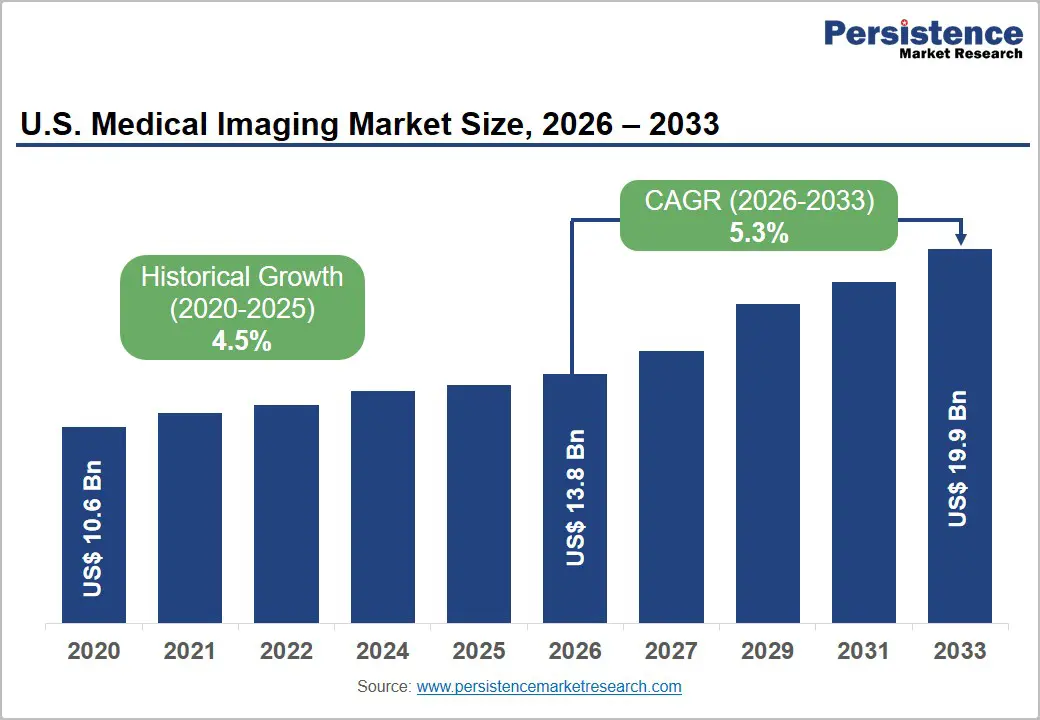
The U.S. medical imaging market size is expected to be valued at US$ 13.8 billion in 2026 and projected to reach US$ 19.9 billion by 2033, growing at a CAGR of 5.3% between 2026 and 2033.
The U.S. medical imaging market represents one of the largest and most technologically advanced healthcare imaging industries globally, driven by strong healthcare infrastructure, rapid adoption of advanced diagnostic technologies, and rising chronic disease prevalence.
Increasing demand for early disease detection and image-guided treatment planning continues to accelerate imaging procedure volumes nationwide. According to the Centers for Disease Control and Prevention (CDC), nearly 6 in 10 U.S. adults live with at least one chronic disease, creating sustained demand for CT, MRI, ultrasound, X-ray, and nuclear imaging systems across hospitals and diagnostic centers. Furthermore, growing integration of artificial intelligence into radiology workflows, favorable Medicare reimbursement policies, and ongoing replacement of aging imaging equipment are supporting long-term market expansion through the forecast period.
Key Industry Highlights:
- Leading Zone: The Northeast U.S. holds ~29% of the national medical imaging market in 2026, anchored by the highest concentration of academic medical centers, NCI-designated cancer centers, and flagship health systems including Mass General and NewYork-Presbyterian, driving continuous imaging equipment investment.
- Fast-Growing Zone: The Southeast is the fastest-growing U.S. regional market, fueled by population migration to Florida, Georgia, and North Carolina, HCA Healthcare's expanding network, and Florida's 5 million+ Medicare beneficiaries generating structurally elevated diagnostic imaging utilization rates.
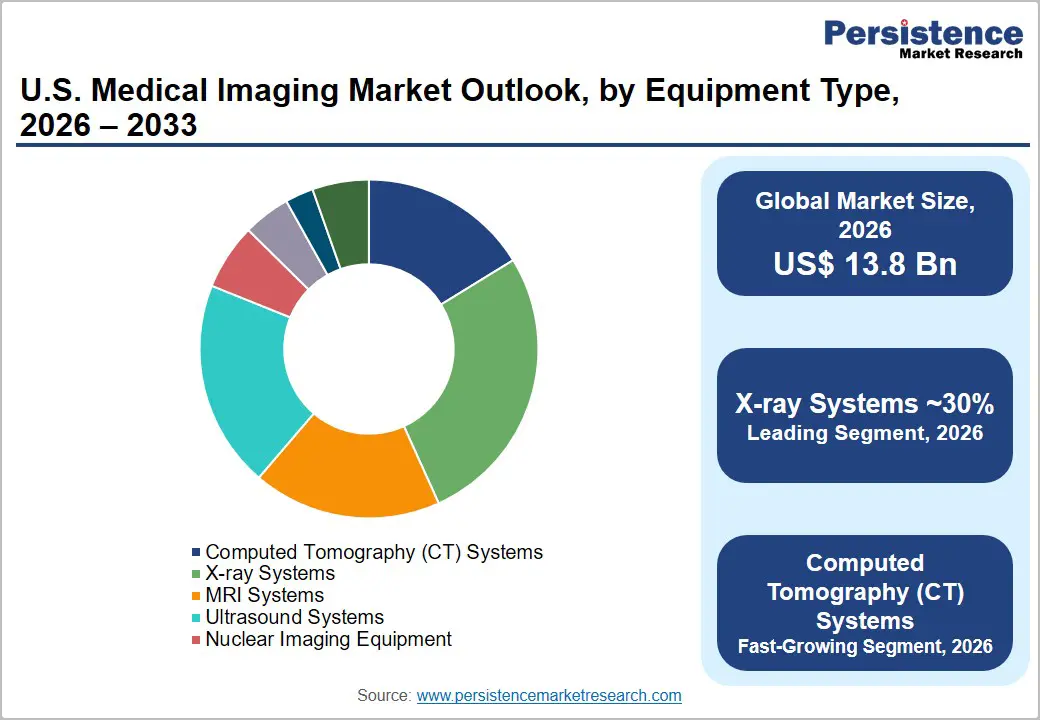
- Dominate Equipment Type: X-ray Systems command ~30% of the U.S. medical imaging equipment market in 2026, driven by unmatched procedural volume, ongoing digital radiography upgrade cycles, and broad deployment across hospitals, urgent care centers, and outpatient clinics nationwide.
- Fastest-Growing Equipment: CT Systems are the fastest-growing equipment segment, driven by USPSTF lung cancer screening guidelines for 50–80-year-old high-risk adults, CMS reimbursement for LDCT, and Siemens/Canon photon-counting CT commercialization catalyzing health system upgrade cycles.
- Key Growth Opportunity: Portable and handheld imaging including POCUS and mobile X-ray represents the highest-growth opportunity, with CMS reporting 4.5 million annual home health patients, ACEP POCUS guidelines, and Butterfly iQ+ and GE Vscan Air expanding imaging beyond traditional radiology departments.
Market Dynamics
Drivers - AI Integration and Digital Transformation of Radiology Workflows
The integration of artificial intelligence (AI) and machine learning into medical imaging systems is significantly improving radiology efficiency, diagnostic precision, and workflow automation across the U.S. The U.S. FDA had authorized more than 950 AI/ML-enabled medical devices by early 2024, with radiology representing the largest application category. AI-powered tools such as automated lesion detection, organ segmentation, image reconstruction, and workflow prioritization are increasingly embedded into CT, MRI, and mammography platforms. Healthcare providers are adopting these technologies to address growing imaging volumes and persistent radiologist shortages nationwide.
Leading companies including Siemens Healthineers, Philips, and Canon Medical Systems are heavily investing in AI-integrated imaging solutions to enhance clinical productivity and improve patient outcomes. A 2023 study published in Radiology: Artificial Intelligence reported that AI-assisted CT interpretation reduced diagnostic error rates by nearly 28%, strengthening confidence in AI-supported imaging workflows. As hospitals increasingly prioritize operational efficiency and precision diagnostics, demand for advanced AI-enabled imaging equipment continues to accelerate across the U.S. healthcare system.
Restraints - High Capital Expenditure and Equipment Replacement Cycles
The high acquisition and maintenance cost of advanced medical imaging equipment remains a major challenge for healthcare providers across the U.S. Premium imaging modalities such as MRI, CT, and PET systems require substantial upfront investment, limiting adoption among small hospitals, rural healthcare centers, and independent diagnostic facilities. A clinical-grade MRI system typically costs between US$ 1 million and US$ 3 million, while advanced CT scanners can range from US$ 500,000 to US$ 2.5 million depending on configuration and technology integration. Additional installation, shielding, software, and service expenses further increase total ownership costs.
Financial pressures on U.S. healthcare institutions continue to slow equipment modernization and replacement cycles. According to the American Hospital Association (AHA), more than 30% of hospitals have recently operated on negative or near-zero margins, reducing their ability to invest in next-generation imaging systems. Many facilities continue using aging imaging infrastructure beyond recommended replacement timelines due to budget constraints. These financial limitations particularly affect community hospitals and rural providers, restricting broader adoption of technologically advanced imaging platforms despite growing clinical demand.
Opportunities - Portable and Point-of-Care Imaging Expanding Beyond Traditional Settings
Portable and handheld imaging technologies are creating significant growth opportunities within the U.S. medical imaging market. The increasing adoption of portable ultrasound, mobile X-ray, and compact imaging systems is transforming healthcare delivery beyond conventional radiology departments. The COVID-19 pandemic accelerated the use of bedside imaging in intensive care units, emergency departments, and temporary healthcare facilities, driving long-term acceptance of portable diagnostic solutions. These systems improve accessibility, reduce patient transport risks, and support faster clinical decision-making in critical care and outpatient settings.
Innovative products such as Butterfly Network iQ+™ and GE HealthCare Vscan Air™ are expanding the commercial adoption of handheld imaging devices across emergency medicine, home healthcare, and primary care environments. The American College of Emergency Physicians (ACEP) has also endorsed point-of-care ultrasound (POCUS) for multiple clinical applications, further supporting adoption. Additionally, CMS reports that more than 4.5 million patients receive home healthcare services annually in the U.S., creating strong long-term demand for portable imaging technologies across decentralized care settings.
Category-wise Analysis
Equipment Type Insights
X-ray Systems dominate the U.S. medical imaging equipment market, accounting for ~30% of total equipment revenue in 2026. X-ray's leadership is grounded in its unmatched combination of clinical utility, procedural volume, and cost-accessibility. According to the American College of Radiology (ACR), X-ray examinations including chest, skeletal, and dental radiography represent the highest-volume diagnostic imaging procedure in the U.S., with hundreds of millions of X-ray studies performed annually. Digital radiography (DR) and computed radiography (CR) system upgrades, supported by FDA 510(k) clearances for flat-panel detector systems from Fujifilm, Canon Medical, and Carestream Health, continue to drive equipment replacement cycles across hospitals, urgent care centers, and outpatient clinics nationwide.
End-user Insights
Hospitals represent the dominant end-user segment, accounting for ~55% of total U.S. medical imaging market revenue in 2026. Hospitals particularly large academic medical centers and integrated health systems are the primary deployment sites for high-capital, high-complexity imaging systems including 3T MRI, 128-slice CT, PET-CT, and digital mammography units. The American Hospital Association (AHA) reports over 6,100 registered hospitals in the U.S., with radiology departments generating among the highest revenue contributions per department. Hospital consolidation trends with large health systems acquiring community hospitals are concentrating capital imaging investment and standardizing equipment platforms, further reinforcing the hospital end-user segment's revenue dominance through the forecast period.
Regional Insights
Northeast U.S. Medical Imaging Market Trends and Insights
The Northeast U.S. leads the domestic medical imaging market with an estimated 29% share in 2026, anchored by the highest density of academic medical centers, major health systems, and research hospitals in the country. States including New York, Massachusetts, and Pennsylvania host flagship institutions Massachusetts General Hospital, NewYork-Presbyterian, and Penn Medicine that drive early adoption of next-generation imaging technology and maintain large, multi-modality radiology departments with continuous equipment upgrade cycles.
Boston & New York Metro U.S. Medical Imaging Hubs
Boston and New York metropolitan corridors collectively account for an estimated 55% of Northeast regional imaging revenue, driven by concentration of NIH-funded research hospitals, comprehensive cancer centers designated by the National Cancer Institute (NCI), and high-volume tertiary care systems with advanced CT, MRI, and PET-CT infrastructure supporting both clinical care and investigational imaging protocols.
Southeast U.S. Medical Imaging Market Trends and Insights
The Southeast U.S. is the fast-growing regional market, reflecting the region's rapid population growth, expansion of large health systems including HCA Healthcare and Ascension Health, and an aging demographic in states such as Florida, Georgia, and North Carolina. Florida, home to one of the highest proportions of Medicare beneficiaries nationally, generates disproportionately high medical imaging utilization, supported by CMS reimbursement for diagnostic imaging procedures across outpatient and ASC settings.
Florida U.S. Medical Imaging Market
Florida represents the largest individual state contributor in the Southeast region, accounting for ~31% of Southeast imaging market revenue in 2025. With over 5 million Medicare beneficiaries per CMS data and a growing network of independent diagnostic imaging centers and ASCs, Florida exemplifies the demographic-driven imaging demand surge shaping the Southeast's above-average growth trajectory through 2033.
Competitive Landscape
The U.S. medical imaging market is moderately consolidated at the high-end equipment tier, with multinational OEMs including Siemens Healthineers, Koninklijke Philips N.V., Canon Medical Systems, Fujifilm, Hologic, and Shimadzu Corporation dominating revenue share through differentiated portfolios spanning CT, MRI, X-ray, ultrasound, and mammography. Key competitive differentiators include AI software integration, dose reduction technology, detector innovation, and service contract ecosystems. Emerging business model trends include equipment-as-a-service (EaaS) subscription offerings and outcome-based imaging platform contracts. Samsung Medison and Carestream Health are aggressively competing in portable and digital radiography segments, while Fonar Corporation and Hitachi maintain niche differentiation in open and specialty MRI systems.
Key Developments
- In March 2026, Samsung Medison unified its two U.S. medical imaging subsidiaries, Boston Imaging and NeuroLogica, under the new brand Samsung HME (Healthcare and Medical Equipment) America.
- In December 2025, GE HealthCare launched advanced imaging solutions integrated with NVIDIA technology to enhance diagnostic speed and optimize clinical workflow efficiency.
- In March 2025, the FDA granted 510(k) clearance for the expanded NAEOTOM Alpha photon-counting CT portfolio, including the single-source NAEOTOM Alpha.Prime and dual-source NAEOTOM Alpha.Pro, while renaming the original 2021 system as NAEOTOM Alpha.Peak.
- In March 2024, GE Healthcare produced its newest research model, SonoSAMTrack1, employing NVIDIA technology. The novel approach is based on a promptable fundamental model called SonoSAM1, specifically engineered for object segmentation in ultrasound images.
- In January 2024, Canon launched Aplio Me, an advanced shared-service ultrasound system designed to meet the diverse requirements of routine users across various medical settings.
Companies Covered in U.S. Medical Imaging Market
- Bio-Rad Laboratories Inc.
- Hitachi, Ltd
- Shimadzu Corporation
- Siemens Healthineers
- Koninklijke Philips N.V.
- Hologic, Inc.
- Samsung Medison Co. Ltd
- Fujifilm holdings Corporation
- Carestream Health, Inc.
- Fonar Corporation
- Genesis Medical Imaging Inc.
- Canon Medical Systems Corp.
- FONAR Corp
- Toshiba Corporation
- Others
Frequently Asked Questions
The U.S. medical imaging market is estimated at US$ 13.8 billion in 2026.
Rising chronic disease burden, growing elderly population, expanding AI-enabled imaging adoption, favorable Medicare reimbursement policies, and increasing cancer screening programs are strongly driving imaging procedure volumes.
The Northeast region leads the market due to advanced healthcare infrastructure, high concentration of academic hospitals, strong research funding, and continuous investments in imaging technologies.
Portable and point-of-care imaging presents major growth opportunities, supported by rising home healthcare demand, emergency care applications, and increasing adoption of handheld ultrasound devices.
Major companies include GE HealthCare, Siemens Healthineers, Philips, Canon Medical, Fujifilm, Hologic, Samsung Medison, Butterfly Network, Carestream Health, and Agfa-Gevaert.


