




- Aerospace & Defense
- Underwater Drones Market
Underwater Drones Market Size, Share, and Growth Forecast, 2026 – 2033
Underwater Drones Market by Product Type (Remotely Operated Vehicle (ROV), Autonomous Underwater Vehicle (AUV), Hybrid Vehicles), Application (Defense and Security, Scientific Research, Commercial Exploration), and Regional Analysis for 2026 – 2033

Underwater Drones Market Size and Trends Analysis
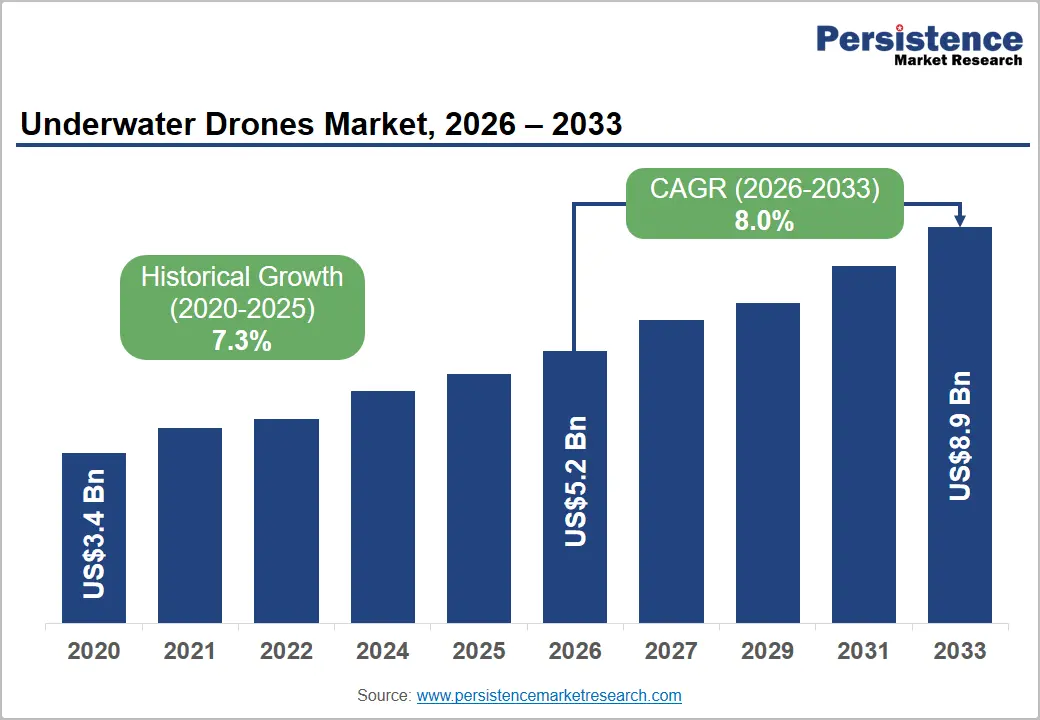
The global underwater drones market size is likely to be valued at US$5.2 billion in 2026 and is expected to reach US$8.9 billion by 2033, growing at a CAGR of 8.0% during the forecast period from 2026 to 2033, driven by increasing investments in maritime security, offshore energy inspection, ocean mapping, and scientific exploration.
Recent advancements in autonomous navigation, AI-enabled data processing, high-resolution sonar, and long-endurance battery systems are expanding the capabilities of remotely operated and autonomous underwater vehicles. According to the U.S. National Oceanic and Atmospheric Administration (NOAA), only 26.1% of the global seafloor had been mapped using modern high-resolution technologies as of 2024, highlighting substantial demand for underwater surveying and exploration solutions.
Key Industry Highlights:
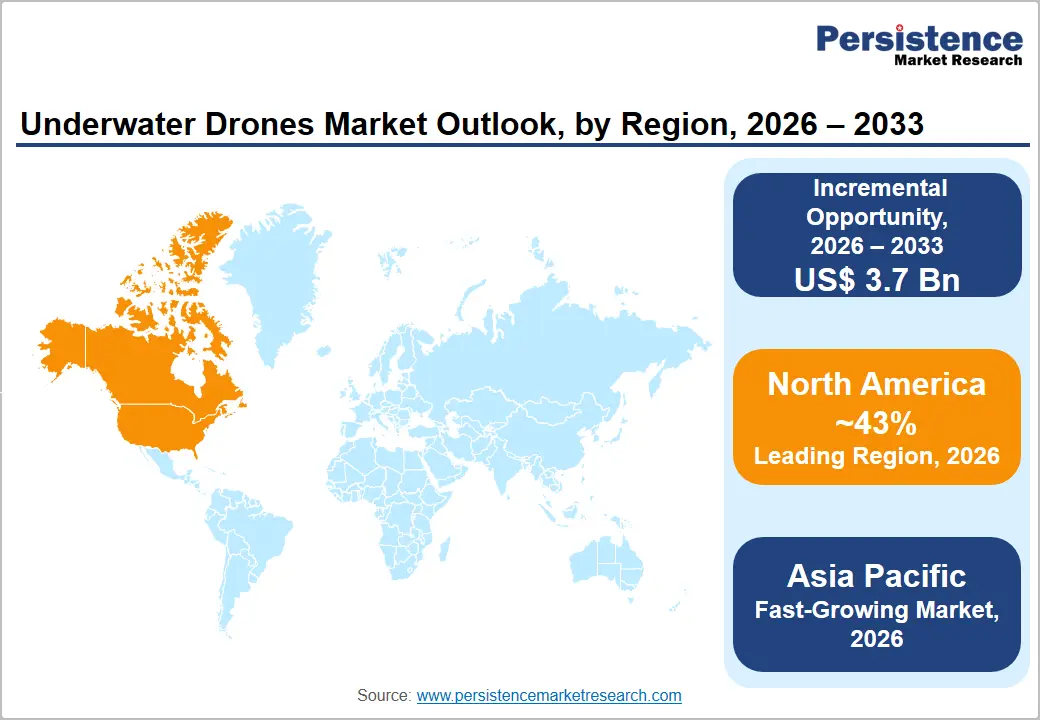
- Leading Region: North America is anticipated to be the leading region, accounting for a market share of 43% in 2026, driven by strong defense investments, advanced maritime technologies, and extensive offshore operations.
- Fastest-growing Region: Asia Pacific is likely to be the fastest-growing region, supported by expanding naval capabilities, offshore development activities, and growing investments in maritime technologies.
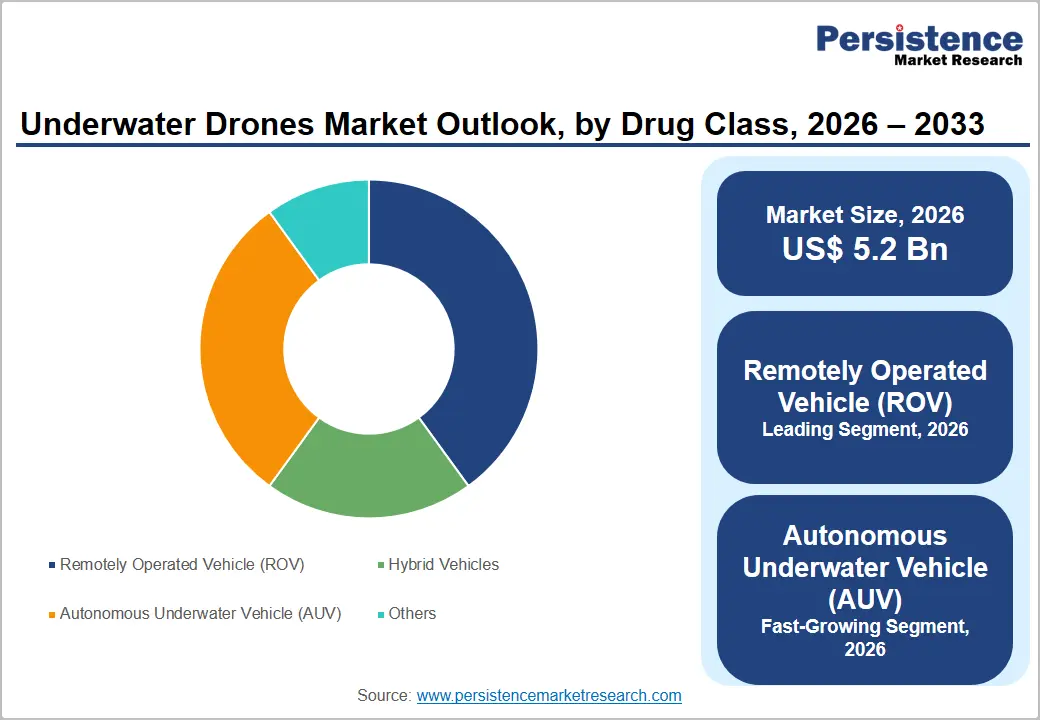
- Leading Product Type: Remotely operated vehicles (ROVs) are projected to remain the leading product type in 2026, accounting for 54% of the revenue share, driven by their extensive deployment in offshore oil & gas inspection, subsea intervention, and defense applications that require precise real-time control, operational flexibility, and high payload capabilities.
- Leading Application: Defense and security is anticipated to be the leading application, accounting for over 46% of the revenue share in 2026, supported by increasing naval modernization programs, maritime surveillance requirements, mine countermeasure missions, and underwater security operations worldwide.
- Key Opportunity: Expanding investments in autonomous maritime technologies, offshore infrastructure monitoring, deep-sea exploration, and underwater security are creating substantial growth opportunities for advanced underwater drone solutions across defense, commercial, and research sectors.
DRO Analysis
Driver - Rising Defense Modernization, Offshore Exploration, and Maritime Security Demand
The increasing focus on maritime security, naval modernization, and underwater surveillance is a major driver of the underwater drone market. Governments worldwide are investing heavily in unmanned underwater systems to strengthen coastal monitoring, mine countermeasure operations, anti-submarine warfare, and intelligence gathering. Underwater drones provide cost-effective and safer alternatives to manned missions while enabling extended underwater operations in challenging environments.
Growing geopolitical tensions, protection of critical subsea infrastructure, and expanding defense budgets are accelerating adoption. Military organizations increasingly deploy autonomous and remotely operated vehicles to improve operational efficiency, situational awareness, and strategic readiness across diverse underwater environments. Beyond defense applications, rising offshore oil and gas exploration activities are creating substantial demand for underwater drones.
Energy companies increasingly utilize remotely operated and autonomous underwater vehicles for pipeline inspections, seabed surveys, equipment monitoring, and maintenance activities. These systems reduce operational risks while improving data collection accuracy and lowering inspection costs. Increasing investments in offshore wind farms, subsea telecommunications cables, and marine infrastructure projects are expanding commercial demand.
Restraint - Regulatory and Standardization Challenges
Different countries maintain varying regulations governing underwater autonomous operations, maritime surveillance activities, defense applications, and environmental compliance requirements. The absence of universally accepted standards creates operational complexity for manufacturers and service providers seeking international deployment opportunities. Companies often face lengthy approval processes, certification requirements, and compliance obligations before launching products in new regions.
The lack of standardization across communication systems, navigation technologies, software platforms, and interoperability frameworks presents additional barriers. Operators frequently encounter integration challenges when deploying underwater drones alongside existing maritime systems and infrastructure. Inconsistent technical standards may limit compatibility between equipment supplied by different manufacturers, reducing operational flexibility. Underwater environments create communication constraints that complicate safe and reliable autonomous operations.
Opportunity - Technological Convergence and Customization
Technological convergence is creating significant opportunities across the underwater drone’s market as artificial intelligence, advanced sensors, machine learning, robotics, and high-capacity batteries become increasingly integrated into underwater platforms. These advancements enable improved navigation, obstacle avoidance, autonomous decision-making, and real-time data processing capabilities. Modern underwater drones can perform longer missions while collecting high-resolution imagery, sonar data, and environmental information.
Enhanced autonomy reduces dependence on human operators and improves mission efficiency. As technologies continue to mature, underwater drones are becoming more capable of supporting complex applications across defense, energy, scientific research, and infrastructure inspection sectors. Customization capabilities represent another major growth opportunity for market participants. End-users increasingly seek application-specific underwater drone solutions tailored to unique operational requirements, environmental conditions, and mission objectives.
Manufacturers are responding by offering modular platforms that support interchangeable sensors, cameras, sonar systems, sampling equipment, and communication technologies. This flexibility enables deployment across diverse industries, including offshore energy, aquaculture, marine conservation, and defense. Growing demand for specialized underwater solutions is encouraging innovation and product differentiation.
Category-wise Analysis
Product Type Insights
Remotely operated vehicles (ROVs) are expected to account for 54% of revenue in 2026, due to their established role in underwater inspection, intervention, maintenance, and surveillance activities. ROVs remain the preferred choice for missions that require continuous operator control, high maneuverability, and the ability to perform complex underwater tasks in challenging environments. A notable example includes the use of advanced ROV systems by Kongsberg Maritime for subsea inspection and offshore asset maintenance, where operators require direct control to execute detailed underwater operations safely and efficiently.
Autonomous underwater vehicles (AUVs) are likely to represent the fastest-growing segment, supported by increasing demand for autonomous subsea exploration, seabed mapping, environmental monitoring, and intelligence-gathering missions. These vehicles are increasingly used for hydrographic surveys, offshore energy assessments, marine research, and defense reconnaissance applications. For example, the deployment of HUGIN AUVs by Kongsberg Maritime, which are widely utilized for seabed mapping, underwater surveying, and naval missions requiring autonomous performance.
Application Insights
The defense and security segment is projected to lead the underwater drone market, capturing around 46% of the revenue share in 2026, supported by increasing naval modernization initiatives, maritime surveillance requirements, and growing concerns regarding underwater security threats. The ability to conduct covert operations and gather real-time intelligence has made underwater drones an essential component of modern naval capabilities. For instance, the use of underwater drones by the U.S. Navy for mine detection and underwater reconnaissance missions supporting maritime defense objectives in complex operational environments.
Commercial exploration is likely to be the fastest-growing application due to expanding offshore energy projects, subsea infrastructure development, marine resource assessments, and underwater inspection requirements. A notable example includes the use of underwater drones by offshore energy operators for inspecting subsea pipelines and offshore platforms, helping ensure asset integrity and operational safety.
Regional Insights
North America Underwater Drones Market Trends
North America is anticipated to be the leading region, accounting for a market share of 43% in 2026, supported by strong defense spending, offshore energy operations, subsea infrastructure monitoring, and advanced marine technology development. The region benefits from extensive investments in autonomous maritime systems, underwater surveillance capabilities, and oceanographic research programs. For instance, Lockheed Martin continues to advance unmanned underwater technologies for naval reconnaissance and mine countermeasure operations.
U.S. Underwater Drones Market Trends
The U.S. is expected to dominate the regional market, accounting for approximately 88% of the market share in 2026, driven by ongoing naval modernization initiatives and increasing investment in autonomous maritime systems. The U.S. Navy continues expanding the deployment of unmanned underwater vehicles for intelligence gathering and seabed monitoring. A growing focus on protecting subsea communication cables and critical infrastructure is driving procurement activities. Offshore wind developments along the Atlantic coast are increasing demand for underwater inspection technologies.
Canada Underwater Drones Market Trends
Canada is likely to be a significant market for underwater drones, holding approximately 12% of the regional market share in 2026, supported by the rising adoption of underwater drones for Arctic monitoring, offshore energy inspection, and marine environmental assessment. The country's extensive coastline creates substantial demand for subsea monitoring technologies. Offshore energy projects in Atlantic Canada continue to utilize underwater inspection solutions. Research institutions are increasingly deploying autonomous underwater vehicles for oceanographic studies.
Europe Underwater Drones Market Trends
Europe is likely to be a significant market for underwater drones in 2026, due to strong naval modernization efforts, offshore renewable energy expansion, and increasing investments in autonomous marine systems. The region is benefiting from growing demand for underwater inspection, offshore wind farm monitoring, and maritime security applications. A notable example includes Kongsberg Maritime, which continues expanding its autonomous underwater vehicle portfolio for seabed mapping, offshore inspection, and defense applications.
U.K. Underwater Drones Market Trends
The U.K. is likely to be a significant market for underwater drones, accounting for 15% of Europe market share in 2026, supported by its strong naval capabilities and extensive offshore energy infrastructure. The Royal Navy continues investing in autonomous underwater systems for mine countermeasure and reconnaissance missions. Offshore wind farm expansion is creating demand for underwater inspection technologies. Growing emphasis on protecting critical subsea communication and energy infrastructure is driving adoption.
Germany Underwater Drones Market Trends
Germany is anticipated to dominate the regional market, accounting for around 38% of the Europe market share in 2026, due to offshore wind energy expansion and maritime infrastructure monitoring requirements. The country continues investing in marine robotics and autonomous navigation technologies. Offshore energy operators are deploying underwater drones for turbine foundation inspections and cable monitoring. Research institutions are utilizing advanced underwater vehicles for environmental and oceanographic studies.
Asia Pacific Underwater Drones Market Trends
The Asia Pacific region is likely to be the fastest-growing region, driven by naval expansion programs, offshore resource exploration, and increasing domestic manufacturing capabilities. Rising maritime security concerns and growing investments in autonomous technologies are driving widespread adoption. A notable example is QYSEA, which has expanded its portfolio of commercial underwater drones for inspection, exploration, and research applications.
China Underwater Drones Market Trends
China is projected to dominate the regional market, holding around a 30% share of the regional market in 2026. The country is expanding the deployment of autonomous underwater vehicles for naval and research purposes. Increasing offshore energy activities are generating demand for subsea inspection technologies. Domestic manufacturers are strengthening technological capabilities and production capacity. Ocean mapping and seabed resource exploration projects are supporting market growth.
India Underwater Drones Market Trends
India is expected to emerge as a significant market, accounting for approximately a 22% share in 2026, due to increasing naval modernization efforts and expanding blue economy initiatives. The Indian Navy is actively exploring unmanned underwater technologies for surveillance and underwater reconnaissance missions. Offshore energy exploration and subsea infrastructure projects are creating additional demand. Research organizations are deploying underwater drones for oceanographic studies and coastal monitoring.
Competitive Landscape
The global underwater drones market exhibits a moderately fragmented structure, driven by increasing demand for autonomous subsea operations, maritime surveillance, offshore infrastructure inspection, oceanographic research, and naval modernization programs. The market consists of a combination of established defense contractors, specialized marine robotics companies, and emerging underwater technology developers focused on remotely operated vehicles (ROVs), autonomous underwater vehicles (AUVs), and hybrid systems.
With key leaders including Kongsberg Maritime, Lockheed Martin, QYSEA, CHASING Innovation, Deep Trekker, Hydromea, OceanAlpha, and Xera Robotics, the competitive landscape is characterized by continuous technological innovation and strategic expansion initiatives. These players compete through product innovation, autonomous navigation advancements, AI-powered analytics, high-resolution imaging systems, strategic partnerships, defense contracts, and expansion of application-specific solutions.
Key Industry Developments:
- In May 2026, the U.S., U.K., and Australia announced a major AUKUS initiative to jointly develop advanced unmanned underwater vehicles (UUVs) equipped with next-generation sensors and autonomous technologies to strengthen maritime security, protect critical undersea infrastructure, and enhance naval defense capabilities.
- In June 2026, Saildrone expanded deployment of its weather-powered autonomous maritime drones in partnership with the U.S. Coast Guard, utilizing wind and solar energy to conduct long-endurance maritime surveillance, environmental monitoring, and border security operations across the Great Lakes and North Atlantic regions, highlighting growing adoption of sustainable autonomous marine drone technologies.
Companies Covered in Underwater Drones Market
- QYSEA
- CHASING Innovation
- Deep Trekker
- Kongsberg Maritime
- Hydromea
- OceanAlpha
- Lockheed Martin
- Xera Robotics
Frequently Asked Questions
The global underwater drones market is projected to reach US$5.2 billion in 2026.
Increasing demand for maritime security, offshore infrastructure inspection, ocean exploration, and autonomous underwater surveillance is driving the underwater drones market.
The underwater drone market is expected to grow at a CAGR of 8.0% from 2026 to 2033.
Growing investments in AI-enabled autonomous underwater vehicles for subsea monitoring, offshore energy projects, and critical infrastructure protection present significant market opportunities.
QYSEA, CHASING Innovation, Deep Trekker, Kongsberg Maritime, and Hydromea are the leading players.


