




- Inks, Coatings, Adhesives & Sealants (ICAS)
- Texture Paints Market
Texture Paints Market Size, Share, and Growth Forecast 2026 - 2033
Texture Paints Market by Product (Interior, Exterior), Texture Paints (Premixed Texture Paints, Self-mixing Paints, Smooth Textured Paint, Others), Technology (Water-Based, Solvent-Based), Application (Residential, Non-Residential), and Regional Analysis for 2026 - 2033

Texture Paints Market Size and Trend Analysis
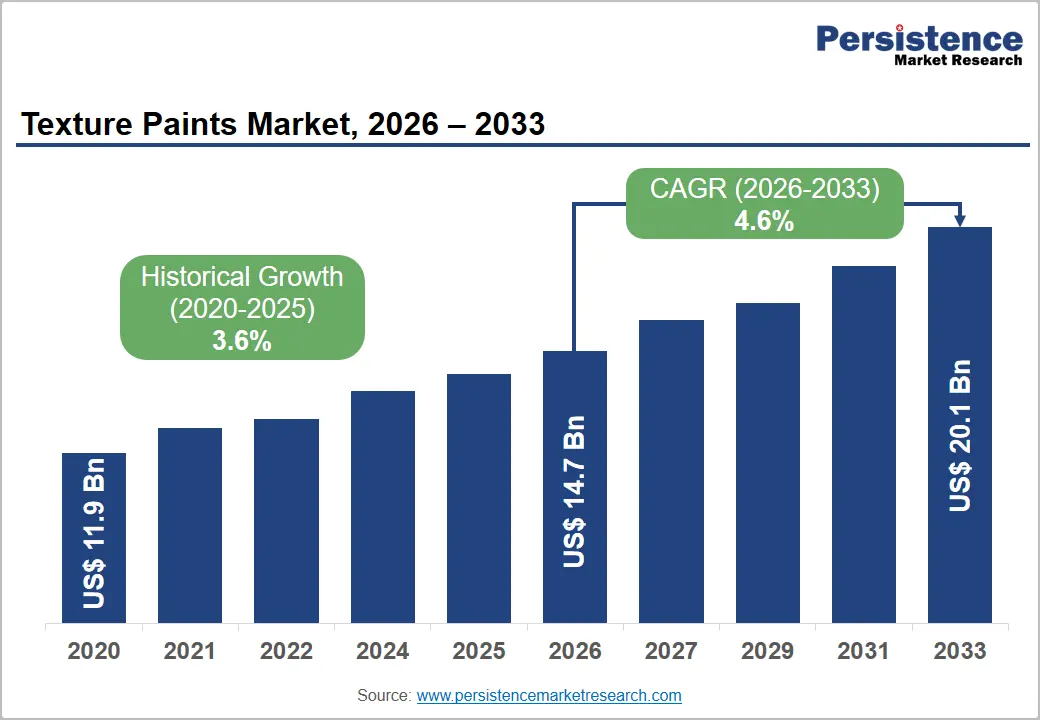
The global texture paints market is valued at US$ 14.8 billion in 2026 and is projected to reach US$ 20.1 billion, growing at a CAGR of 4.6% between 2026 and 2033. Accelerating urbanization, rising construction output, and growing consumer preference for aesthetically differentiated wall finishes are the core forces propelling market expansion.
Large-scale government housing programs in the Asia Pacific and Latin America have amplified residential construction volumes, while renovation-driven spending in North America and Europe sustains steady demand for premium texture paint solutions.
Key Industry Highlights:
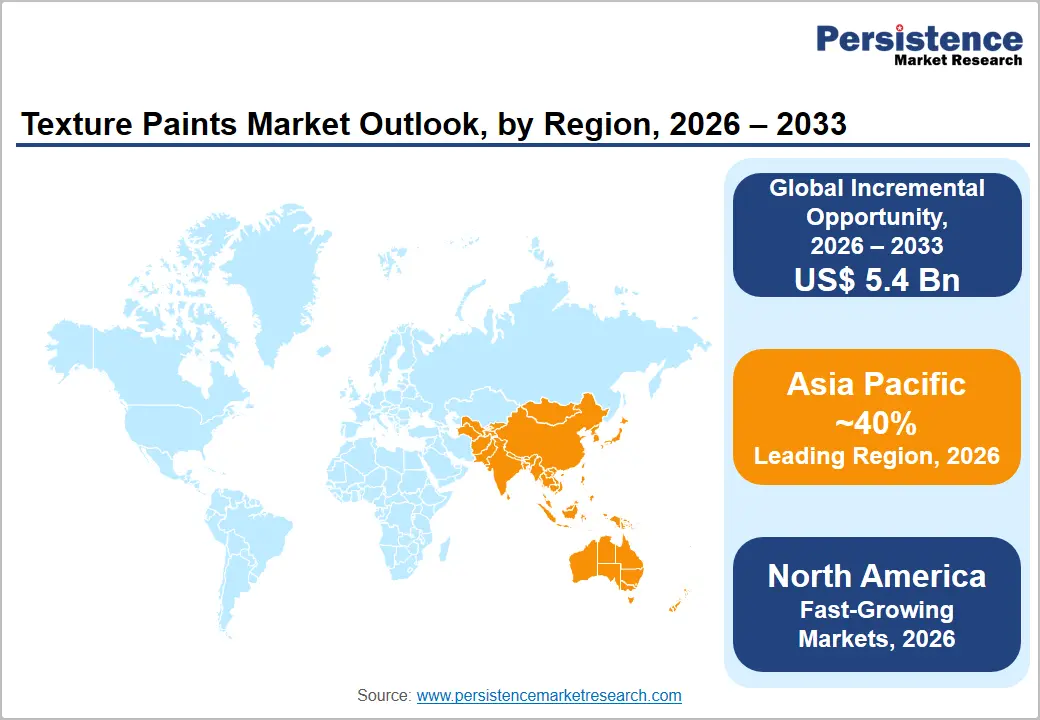
- Leading Region: Asia Pacific leads the global Texture Paints market, accounting for the largest regional share in 2026, driven by rapid urbanization, large-scale government housing programs, and sustained infrastructure investment in China, India, and Southeast Asia.
- Fast-Growing Market: North America accounts for a substantial share of the global texture paints market, underpinned by a mature construction industry, elevated home renovation expenditure, and a pronounced consumer preference for premium and sustainable decorative coatings.
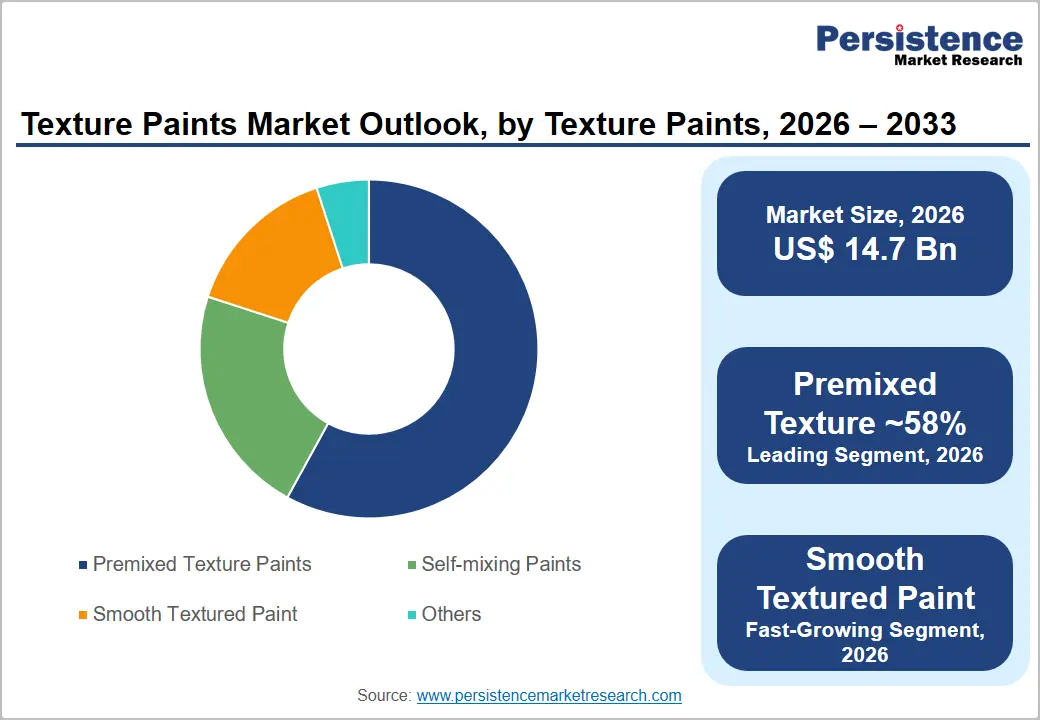
- Dominant Segment: Interior Texture Paints lead the product category, commanding approximately 62% of global market share in 2026, supported by robust residential and commercial construction activity and rising consumer demand for premium, personalized wall finishes globally.
- Fast-Growing Segment: Water-based texture paints represent the fast-growing technology segment, driven by tightening VOC emission regulations globally, growing sustainability awareness among consumers, and continuous improvements in water-based formulation performance across durability and adhesion.
- Key Market Opportunity: The surge in green and sustainable building construction, evidenced by accelerating LEED certification uptake across 180 countries, presents a transformative opportunity for texture paint manufacturers offering eco-certified, low-VOC, and sustainably produced decorative coating solutions.
DRO Analysis
Drivers - Rapid Urbanization and Global Construction Boom
Global urbanization continues at an unprecedented pace, with the United Nations projecting that approximately 68% of the world's population will reside in urban areas by 2050. This demographic transition has been a decisive catalyst for heightened construction activity worldwide, directly fuelling demand for texture paints across residential and commercial buildings.
According to the Oxford Economics Global Construction Report, global construction output is expected to grow by approximately 42% to reach US$ 15.2 trillion by 2030, with emerging economies in Asia, Africa, and Latin America accounting for a significant portion of incremental growth. Texture paints, prized for their ability to conceal surface imperfections, add visual depth, and enhance weather resistance, are increasingly specified in architectural projects.
Growing Consumer Preference for Aesthetic Interior and Exterior Solutions
The expanding middle class across emerging and developed economies has elevated consumer expenditure on home décor and renovation. According to the Harvard Joint Center for Housing Studies (JCHS), home improvement and repair spending in the United States alone exceeded US$ 567 billion in 2023, reflecting a robust appetite for premium and customized decorative solutions.
Texture paints, available in a diverse array of finishes from sand-textured and stone-effect to venetian plaster and bark-effect, cater to rising consumer demand for personalized living spaces. The proliferation of social media platforms such as Pinterest and Instagram has accelerated design trend awareness, encouraging homeowners and interior designers to experiment with distinctive wall textures that convey unique aesthetics.
Restraints - Volatile Raw Material Prices
Texture paint production relies heavily on petrochemical-derived raw materials, including titanium dioxide, acrylic resins, and specialized solvents, which are subject to considerable price volatility. According to the U.S. Geological Survey (USGS), global titanium dioxide production is concentrated among a limited number of large-scale producers, rendering the supply chain highly sensitive to demand shocks and geopolitical disruptions.
In 2022, titanium dioxide prices surged by approximately 15-20%, significantly compressing the profit margins of paint manufacturers. Fluctuations in crude oil prices, supply chain bottlenecks arising from global trade disruptions, and energy cost escalation all compound input cost uncertainty. These dynamics limit manufacturers' ability to maintain stable pricing in competitive markets, potentially curtailing consumption growth, particularly in price-sensitive developing economies and constraining the pace of product innovation and capacity expansion.
Stringent Environmental and Regulatory Compliance Challenges
Increasingly stringent environmental regulations governing volatile organic compound (VOC) emissions represent a material headwind for the texture paints market, particularly for solvent-based product lines. The European Union's Directive 2004/42/EC and its subsequent amendments impose strict VOC content ceilings on decorative paints and varnishes. Similarly, the U.S. Environmental Protection Agency (EPA) continues to tighten standards under the Clean Air Act, targeting VOC emissions from architectural coatings.
Compliance necessitates substantial investment in product reformulation, manufacturing process upgrades, and laboratory testing, raising operational costs considerably for manufacturers. Smaller and mid-sized companies with constrained R&D budgets may face material difficulties adapting, potentially limiting their product innovation capacity and competitive positioning in regulated markets, thereby creating uneven competitive dynamics and barriers to entry for smaller market participants.
Opportunities - Surge in Green and Sustainable Building Construction
The global construction sector's accelerating transition toward sustainability presents a compelling opportunity for manufacturers of eco-friendly texture paints. The U.S. Green Building Council (USGBC) reported that over 100,000 LEED-certified commercial and institutional projects have been registered across more than 180 countries, with certifications continuing to grow year-on-year.
Green building standards increasingly mandate low-VOC or zero-VOC interior and exterior coating solutions, directly benefiting manufacturers that have proactively invested in water-based texture paint technologies. The Global Alliance for Buildings and Construction (GlobalABC), a multi-stakeholder platform operating under the United Nations Environment Programme (UNEP), has identified the buildings sector as a critical lever in achieving net-zero carbon targets, further driving public and private investment into sustainable building practices.
Infrastructure Development and Smart City Initiatives in Emerging Economies
Governments across Asia, Africa, and Latin America are making unprecedented investments in smart city development and urban infrastructure, representing a high-value growth opportunity for the texture paints market. India's Smart Cities Mission, encompassing 100 cities across the country, and China's sustained new urban development under its Five-Year Plans are generating massive demand for decorative and protective coatings in public buildings, transport infrastructure, and large-scale residential complexes.
According to the Asian Development Bank (ADB), developing Asia's infrastructure investment needs are estimated at approximately US$ 26 trillion through 2030, with building and urban infrastructure accounting for a substantial proportion of this expenditure. The African Development Bank (AfDB) has similarly identified a critical infrastructure gap across Sub-Saharan Africa, signalling long-term construction demand growth.
Category-wise Analysis
Product Insights
Interior texture paints represent the leading segment within the product category, accounting for approximately 62% of total revenue in 2026. This dominance is primarily attributable to the strong and growing global demand for premium interior decoration in both residential and commercial buildings. Consumers increasingly seek distinctive wall finishes such as Venetian plaster, sand, and suede effects to personalize their living and working spaces, driving robust consumption of interior texture paints.
The proliferation of interior design culture, amplified by digital media and home improvement programming, has further accelerated the adoption of specialty finishes among DIY consumers and professional contractors. Government-supported affordable housing programs in high-population nations such as India, Indonesia, and Brazil have bolstered the volume of interior painting activity considerably.
Texture Paints Insights
Premixed texture paints constitute the dominant segment within the texture type category, holding an estimated market share of approximately 58% in 2026. The leadership of premixed formulations is underpinned by their inherent convenience, consistent quality, and ease of application, attributes highly valued by professional painters and DIY consumers alike.
Unlike self-mixing paints, premixed variants eliminate the risk of inconsistent mixture ratios and pigmentation errors, ensuring reliable and reproducible surface finishes on every application. Leading manufacturers, including Asian Paints, AkzoNobel, and Nippon Paint, have invested substantially in expanding their premixed texture paint portfolios across diverse colors, finishes, and specialty effects, broadening consumer accessibility.
Technology Insights
Water-based texture paints are the leading technology segment, commanding approximately 68% of total market share in 2026. The dominance of water-based formulations is driven by their significantly superior environmental profile, including markedly lower VOC emissions compared to solvent-based alternatives, which aligns with increasingly stringent global regulatory requirements.
The U.S. EPA and the European Union's Directive 2004/42/EC have been instrumental in accelerating the industry-wide transition from solvent-based to water-based architectural coatings. Beyond regulatory compliance, water-based texture paints offer practical advantages such as faster drying times, easier equipment cleanup, and substantially reduced odour during application, making them the preferred choice across residential and commercial applicator segments.
Application Insights
The residential application segment leads the texture paints market, accounting for approximately 65% of total market value in 2026. This dominance reflects the strong and expanding global base of housing construction and renovation activity. Accelerating urbanization, rising disposable incomes, and growing homeownership rates in emerging economies have significantly elevated demand for texture paints in residential projects.
In developed markets, home renovation spending remains robust; the Harvard Joint Canter for Housing Studies (JCHS) indicates that renovation expenditure in the U.S. has maintained sustained growth momentum, underpinned by an aging housing stock and rising consumer aspiration for upgraded interior aesthetics.
Regional Analysis
North America Texture Paints Market Trends & Analysis
North America holds a substantial share of the global texture paints market, underpinned by a mature construction industry, elevated home renovation expenditure, and a pronounced consumer preference for premium and sustainable decorative coatings.
Regulatory standards established by the U.S. Environmental Protection Agency (EPA) and state-level air quality boards, particularly the California Air Resources Board (CARB) continue to drive widespread adoption of low-VOC and water-based texture paint formulations across the region. The region's robust DIY consumer culture and the strong penetration of home improvement retail chains such as The Home Depot and Lowe's further sustain high product volumes.
U.S. Texture Paints Market Size
The United States is the dominant national market in North America, accounting for the largest proportion of regional revenue. Home improvement and repair spending in the country surpassed US$ 567 billion in 2023, according to the Harvard Joint Center for Housing Studies, reflecting strong renovation-led demand for texture paint products. The country's emphasis on sustainable building standards, including LEED certification requirements, continues to stimulate demand for eco-certified texture paint formulations.
Europe Texture Paints Market Trends, Drivers, & Insights
Europe represents one of the most mature and regulatory-driven markets for texture paints globally, where environmental compliance and design innovation converge. The European Union's Directive 2004/42/EC on VOC emissions and its successor regulations have been decisive in accelerating the shift to water-based and low-VOC texture formulations across member states. The region benefits from a high density of professional painters, architects, and interior designers who consistently drive premium product consumption.
Germany Texture Paints Market Size
Germany is the largest texture paints market in Europe, supported by one of the continent's most active construction sectors. Government-backed housing programs, strong commercial real estate investment, and Germany's deep cultural emphasis on building quality and material sustainability underpin consistent demand for texture paint products.
U.K. Texture Paints Market Size
The United Kingdom texture paints market is driven by a vibrant home renovation culture and a large stock of aging residential properties. The UK's post-pandemic home improvement boom, which saw a significant rise in DIY and professional renovation activity, has provided sustained momentum to the texture paints market.
France Texture Paints Market Size
France's texture paints market benefits from a strong heritage in design, architecture, and decorative arts, with premium and specialty texture finishes, particularly Venetian plaster and clay-based textures, enjoying broad acceptance among architects and interior designers. The French government's MaPrimeRénov' scheme, which incentivizes residential energy renovations, has been instrumental in sustaining renovation activity and paint consumption.
Asia Pacific Texture Paints Market Drivers & Analysis
Asia Pacific is the fastest-growing market for texture paints, propelled by rapid urbanization, large-scale infrastructure development, and rising disposable incomes across China, India, Japan, and Southeast Asia. The region accounts for the highest volume of new construction globally, estimated to represent over 50% of global construction output by 2030 according to the Oxford Economics Global Construction Report, and is a primary beneficiary of government-led housing and smart city programs.
China Texture Paints Market Size
China is the single largest national market for texture paints in the Asia Pacific, driven by massive urban construction activity and an enormous residential building stock. Government initiatives under the 14th Five-Year Plan (2021-2025) and the subsequent 15th Five-Year Plan continue to channel investments into new urban housing, commercial real estate, and public infrastructure.
India Texture Paints Market Size
India represents one of the highest-potential growth markets for texture paints globally. The government's Pradhan Mantri Awas Yojana (PMAY) housing scheme, targeting the construction of tens of millions of affordable homes for urban and rural populations, has substantially expanded the residential construction base. India's Smart Cities Mission and growing private real estate investment in metropolitan and tier-2 cities are further driving non-residential demand.
Japan Texture Paints Market Size
Japan's texture paints market is characterized by exacting product quality standards, technological sophistication, and a deeply entrenched renovation culture. According to the Ministry of Land, Infrastructure, Transport and Tourism (MLIT) of Japan, housing renovation expenditure has been a steadily growing component of the country's construction economy, driven by the aging building stock and cultural norms of regular residential maintenance.
Competitive Landscape
The global texture paints market is moderately fragmented, with a combination of multinational conglomerates and regional manufacturers competing on product innovation, brand equity, distribution reach, and price competitiveness.
Multinational leaders such as AkzoNobel, Asian Paints, Nippon Paint Holdings, Berger Paints, and Kansai Paint command significant market shares through diversified product portfolios, advanced R&D capabilities, and extensive distribution networks. Market leaders differentiate primarily through continuous investment in eco-friendly and specialty texture formulations, leveraging technological innovation to meet evolving regulatory standards and shifting consumer preferences.
Key Developments:
- In March 2025, Asian Paints launched a new range of premium water-based texture paints under its flagship Royale brand, featuring enhanced washability, stain resistance, and low-VOC formulations specifically targeting the premium residential segment across India and Southeast Asia, reinforcing its leadership in the decorative coatings space.
- In November 2024, AkzoNobel announced the expansion of its Dulux texture paint portfolio in the Asia Pacific region, introducing five new premium decorative finishes designed to address evolving architectural design trends in residential and commercial construction markets across the region.
Companies Covered in Texture Paints Market
- Asian Paints Limited
- AkzoNobel N.V.
- Nippon Paint Holdings Co., Ltd.
- Berger Paints India Limited
- Kansai Paint Co., Ltd.
- PPG Industries, Inc.
- The Sherwin-Williams Company
- Jotun A/S
- Sika AG
- RPM International Inc.
- Dulux Group (Australia)
- Caparol (DAW SE)
Frequently Asked Questions
The global Texture Paints market size is valued at approximately US$ 14.8 billion in 2026 and is projected to reach US$ 20.1 billion by 2033, expanding at a CAGR of 4.6% over the forecast period of 2026 - 2033.
The primary growth drivers include rapid urbanization and large-scale residential and commercial construction activity globally, particularly in the Asia Pacific, Latin America, and Africa. Rising consumer spending on home improvement and renovation is documented at over US$ 567 billion annually in the U.S. alone, per the Harvard Joint Centre for Housing Studies.
Interior texture paints represent the leading product segment, accounting for approximately 62% of total global market revenue in 2026. This dominance is driven by robust residential and commercial construction and renovation activity, increasing consumer demand for premium interior aesthetic solutions, and the growing influence of interior design culture propagated through digital media and social platforms.
Asia Pacific is the leading and fast-growing in the global texture paints market. The region benefits from rapid urbanization, government-backed housing programs including India's Pradhan Mantri Awas Yojana (PMAY) and China's Five-Year Plan urban development initiatives, and large-scale infrastructure investment.
The leading companies operating in the global Texture Paints market include Asian Paints Limited, AkzoNobel N.V., Nippon Paint Holdings Co., Ltd., Berger Paints India Limited, Kansai Paint Co., Ltd., PPG Industries, Inc., The Sherwin-Williams Company, Jotun A/S, Sika AG, and RPM International Inc., among others.


