




- Off-Road Equipment & Machinery
- Spreaders Market
Spreaders Market Size, Share, and Growth Forecast, 2026 - 2033
Spreaders Market by Product Type (Fertilizer Spreaders, Others), Application (Agriculture, Landscaping, Construction, Others), Distribution Channel (Online Stores, Others), and Regional Analysis for 2026 – 2033

Spreaders Market Size and Trends Analysis
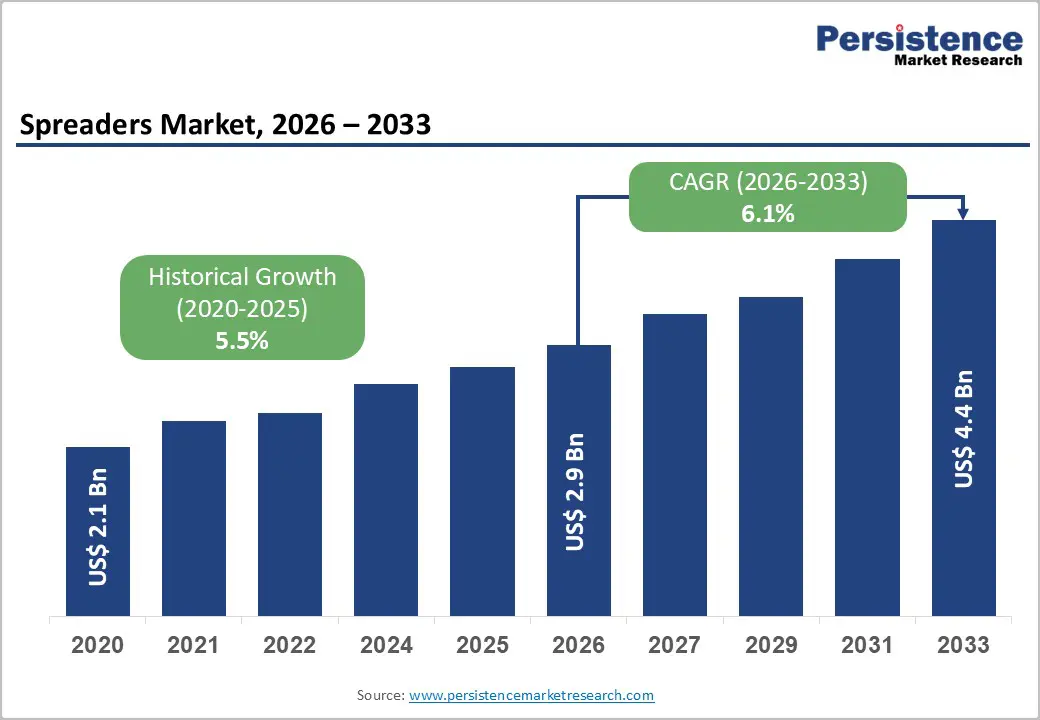
The global spreaders market size is likely to be valued at US$2.9 billion in 2026, and is expected to reach US$4.4 billion by 2033, growing at a CAGR of 6.1% during the forecast period from 2026 to 2033, driven by the increasing prevalence of precision agriculture practices, rising demand for efficient fertilizer and seed distribution equipment, and growing adoption of advanced spreaders in large-scale farming and landscaping.
Growing demand for high-capacity, accurate spreaders, especially fertilizer spreaders for agriculture and manure spreaders for sustainable nutrient management, is accelerating adoption across end-users. Advances in variable-rate technology and GPS-guided systems are further boosting uptake by offering better uniformity and reduced input waste. Increasing recognition of spreaders as critical for improving crop yields, soil health, and operational efficiency in emerging precision farming markets remains a major growth driver.
Key Industry Highlights:
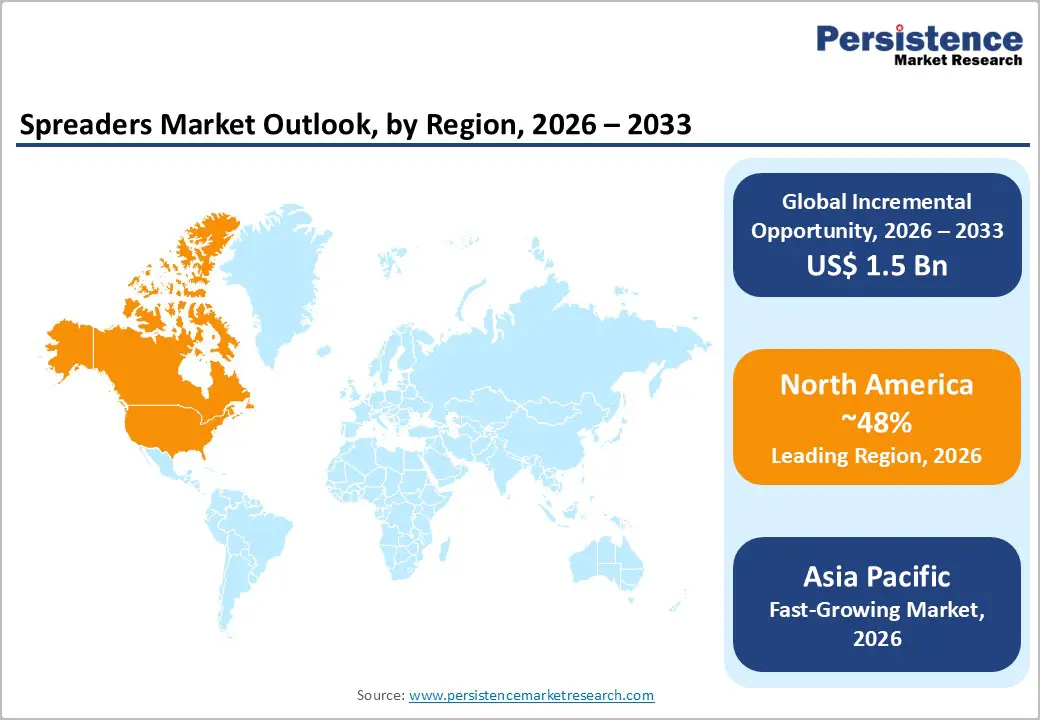
- Leading Region: North America, anticipated to account for a 48% market share in 2026, driven by extensive mechanization, large farm sizes, and early adoption of advanced precision equipment, particularly in the U.S. and Canada.
- Fastest-growing Region: Asia Pacific, driving rapid expansion due to increasing agricultural mechanization, supportive government policies, rising food demand, and investment in modern farming tools.
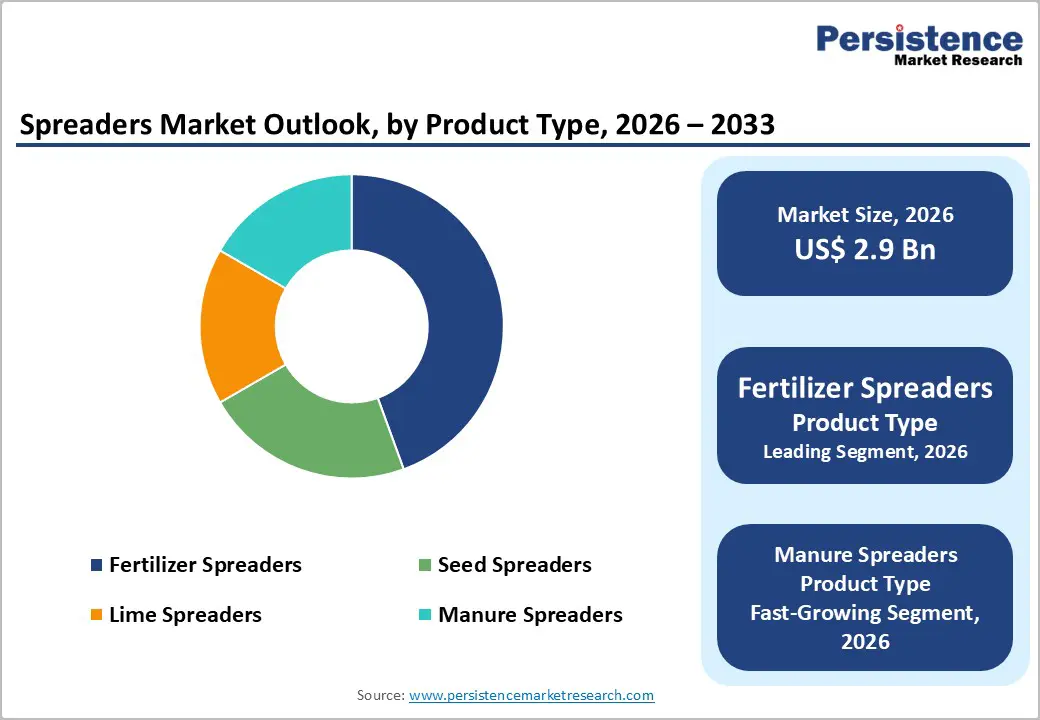
- Dominant Product Type: Fertilizer Spreaders, to hold approximately 52% of the market share, as they remain the core volume driver in crop nutrition management.
- Leading Application: Agriculture, to contribute nearly 68% of the market revenue, due to primary use in large-scale crop production.
| Global Market Attributes | Key Insights |
|---|---|
| Spreaders Market Size (2026E) | US$2.9 Bn |
| Market Value Forecast (2033F) | US$4.4 Bn |
| Projected Growth CAGR (2026-2033) | 6.1% |
| Historical Market Growth (2020-2025) | 5.5% |
Market Factors – Growth, Barriers, and Opportunity Analysis
Growth Analysis – Rising Mechanization and Precision Agriculture Adoption
Rising mechanization and the adoption of precision agriculture are reshaping modern farming by fundamentally changing how crops are produced and managed. Increasing labor shortages, rising wages, and the need to improve farm productivity are encouraging farmers to replace manual practices with mechanized solutions such as tractors, harvesters, and automated irrigation systems. These technologies help reduce dependency on labor while ensuring timely operations, which is critical for maximizing yields and minimizing losses.
Precision agriculture is gaining traction as farmers seek data-driven decision-making. The use of GPS-enabled equipment, sensors, drones, and farm management software allows for precise application of inputs such as seeds, fertilizers, and pesticides. This targeted approach reduces waste, lowers input costs, and improves crop health while supporting environmental sustainability. Farmers are increasingly recognizing the value of real-time field monitoring to manage variability in soil conditions and weather patterns.
Increasing Focus on Sustainable Nutrient Management and Organic Farming
The increasing focus on sustainable nutrient management and organic farming is being driven by the need to balance agricultural productivity with long-term environmental protection. Farmers are gradually moving away from excessive dependence on synthetic fertilizers and chemicals, which can degrade soil health and contaminate water resources. Instead, greater emphasis is being placed on practices that maintain soil fertility through natural and regenerative approaches.
Sustainable nutrient management involves the optimized use of organic manures, compost, biofertilizers, and crop residues to improve nutrient availability while enhancing soil structure and microbial activity. Precision application techniques are also being adopted to reduce nutrient losses and ensure that crops receive the right nutrients at the right time.
Organic farming is gaining acceptance as consumers increasingly prefer food produced with minimal chemical inputs and lower environmental impact. This shift is encouraging farmers to adopt crop rotation, green manuring, and biological pest control methods.
Barrier Analysis – High Initial Investment and Maintenance Costs
High initial investment and maintenance costs remain a significant challenge in the adoption of advanced agricultural technologies and modern farming practices. Mechanized equipment, precision farming tools, and automated systems often require substantial upfront capital, making them less accessible for small and marginal farmers.
The cost of purchasing machinery, installing digital monitoring systems, and upgrading farm infrastructure can strain financial resources, especially in regions with limited access to credit or subsidies.
Beyond the initial purchase, ongoing maintenance adds to the total cost of ownership. Regular servicing, replacement of wear-and-tear components, software updates, and the need for skilled technicians increase operational expenses over time. In many rural areas, limited availability of spare parts and technical support can further raise costs and cause downtime during critical farming periods. These financial barriers can slow technology adoption, despite clear long-term productivity benefits.
Fragmented After-Sales Service and Dealer Network Gaps
Fragmented after-sales service and gaps in dealer networks present a major constraint to the effective adoption of modern agricultural equipment and technologies. In many regions, especially rural and remote areas, farmers face limited access to authorized dealers and service centers. This results in delayed repairs, inconsistent maintenance quality, and longer equipment downtime during critical farming seasons. Even when advanced machinery is available, the lack of nearby support discourages farmers from investing in high-value equipment.
Inadequate training of service personnel further compounds the issue, as complex machines and digital systems require specialized technical expertise. Farmers may also struggle to source genuine spare parts, leading to reliance on local substitutes that can reduce equipment lifespan and performance. Poor coordination between manufacturers, dealers, and service providers often creates communication gaps, leaving farmers without timely guidance or support. These challenges increase operating costs, reduce productivity, and erode trust in mechanized solutions.
Opportunity Analysis – Growth in Precision and Variable-Rate Spreading Technologies
Growth in precision and variable-rate spreading technologies is transforming the way nutrients and soil amendments are applied in agriculture. Farmers are increasingly moving away from uniform application methods toward systems that adjust input rates based on field-level conditions. By using GPS guidance, sensors, and digital field maps, variable-rate spreaders can deliver fertilizers, lime, or organic inputs only where they are needed and in the required quantities.
This approach helps address natural variability in soil fertility, crop demand, and yield potential across a single field. Input use efficiency is improved, reducing over-application and minimizing nutrient losses through runoff or leaching. Precision spreading also supports better crop performance by ensuring balanced nutrient availability throughout the growing season.
Rising input costs and tighter environmental regulations are encouraging farmers to adopt technologies that provide measurable returns and improved compliance.
Expansion in Organic Farming and Manure Spreading Equipment
The expansion of organic farming is creating a growing demand for efficient manure spreading equipment, as organic systems rely heavily on natural nutrient sources. Unlike conventional farming, organic cultivation depends on livestock manure, compost, and other organic amendments to maintain soil fertility and crop productivity. This shift is encouraging farmers to invest in specialized equipment that can handle bulky, uneven materials and apply them evenly across fields.
Modern manure spreaders are being designed to improve application accuracy, reduce nutrient losses, and minimize odor and environmental impact. Features such as adjustable spreading rates, improved shredding mechanisms, and better control systems help farmers match nutrient application with crop requirements. As organic acreage increases, farmers are also seeking equipment that supports sustainable soil management by enhancing organic matter content and soil structure.
Category-wise Analysis
Product Type Insights
Fertilizer spreaders are anticipated to dominate the market, accounting for approximately 52% of the market share in 2026. Its dominance is due to its widespread use across diverse farming systems. These machines are essential for ensuring timely and uniform nutrient application, which directly influences crop yield and quality. Compared to other spreading equipment, fertilizer spreaders offer higher versatility, compatibility with different farm sizes, and ease of integration with both conventional and precision farming practices.
John Deere’s fertilizer spreaders are equipped with GPS-guided variable-rate technology and telematics integration through the John Deere Operations Center, enabling farmers to apply nutrients more accurately and efficiently across fields.
Manure spreaders are likely to be the fastest-growing segment, fueled by the need for sustainable nutrient management and organic farming. Unlike traditional fertilizer spreaders, manure spreaders help farmers efficiently recycle organic waste back into the soil, improving fertility and reducing reliance on synthetic fertilizers, a priority in many regions today. Demand is rising, particularly for advanced models that integrate precision features such as GPS guidance and variable rate application, which optimize manure distribution and reduce environmental impact.
The KUHN Group produces advanced manure spreaders such as the KUHN Knight HP 170 M ProPush® and PS 270 / PS 280 apron box models, which are widely used by livestock and crop farmers for efficient manure application. These machines feature durable construction, large capacity, and controlled spreading patterns that help farmers optimize nutrient distribution and improve soil fertility.
Distribution Channel Insights
Agricultural equipment dealers are expected to dominate the market, contributing nearly 45% of revenue in 2026, supported by the primary channel through which farmers access machinery, parts, and services. Dealers not only sell equipment but also provide financing options, demonstrations, and localized expertise that build trust with buyers. Many farmers prefer to work with dealers for after-sales support, maintenance, and training on new technologies. Dealers often maintain an inventory of multiple brands and models, giving customers more choice.
Titan Machinery, Inc. is one of the world’s largest farm equipment dealers. Titan operates about 151 dealership locations across the U.S. and internationally, selling and servicing brands such as Case IH and New Holland, and generated over US$2.2 billion in revenue in 2023 through equipment sales, parts, and services, illustrating the strong financial influence of dealer networks in the industry.
Online stores are likely to represent the fastest-growing distribution channel, propelled by convenience, broader product selection, and competitive pricing that traditional outlets cannot always match. Farmers can easily compare models, read reviews, and place orders anytime without visiting a physical dealership, which is especially valuable for remote or smaller growers. E-commerce platforms also support the rapid delivery of spare parts and accessories, reducing downtime during peak seasons.
BigHaat is an Indian e-commerce platform that allows farmers and agribusinesses to purchase a wide range of farm machinery, tools, and implements directly through its website. BigHaat offers products from numerous brands and categories, including tractors, sprayers, and irrigation tools, with detailed listings and online ordering, helping farmers bypass traditional dealership visits.
Regional Insights
North America Spreaders Market Trends
North America is projected to account for nearly 48% of the global spreaders market in 2026, driven by the region’s advanced mechanized farming, strong research and development capabilities, and high public awareness of precision agriculture benefits. Distribution systems in the U.S. and Canada provide extensive support for spreader programs, ensuring wide accessibility across fertilizer spreaders, agriculture, and agricultural equipment dealer populations. Increasing demand for variable-rate, convenient, and easy-to-calibrate forms is further accelerating adoption, as these formats improve nutrient efficiency and reduce barriers associated with manual spreading.
Innovation in spreader technology, including stable precision control, improved GPS delivery, and targeted manure enhancement, is attracting significant investment from both public and private sectors. Government initiatives and USDA campaigns continue to promote the use of inputs against input waste risks, soil health concerns, and emerging precision farming threats, creating sustained market demand. The growing focus on landscaping grades and specialty uses, particularly for agriculture and others, is expanding the target applications for spreaders.
Europe Spreaders Market Trends
Europe is propelled by increasing awareness of precision agriculture benefits, strong regulatory systems, and government-led sustainable farming programs. Countries such as Germany, France, the Netherlands, and Spain have well-established agricultural frameworks that support routine spreader use and encourage adoption of innovative equipment delivery methods, including spreaders.
These high-efficiency formulations are particularly appealing for agricultural populations, regulation-conscious farmers, and landscaping users, improving yield and coverage rates.
Technological advancements in spreader development, such as enhanced variable-rate, application-targeted delivery, and improved precision grades, are further boosting market potential. European authorities are increasingly supporting research and trials for spreaders against both routine and specialized needs, strengthening market confidence.
The growing emphasis on convenient, low-waste options is aligned with the region’s focus on preventive nutrient management and reducing runoff. Public awareness campaigns and promotion drives are expanding reach in both urban and rural areas, while suppliers are investing in technology and novel variants to increase efficacy.
Asia Pacific Spreaders Market Trends
Asia Pacific is likely to be the fastest-growing market for spreaders in 2026, driven by rising agricultural awareness, increasing government initiatives, and expanding application programs across the region. Countries such as China, India, Indonesia, and Vietnam are actively promoting spreader campaigns to address crop growth and emerging mechanization needs. Spreaders are particularly attractive in these regions due to their cost-effective administration, ease of operation, and suitability for large-scale farming drives in both urban and rural populations.
Technological advancements are supporting the development of stable, effective, and easy-to-use spreaders, which can withstand challenging field conditions and minimize application dependence. These innovations are critical for reaching smallholder farmers and improving overall nutrient coverage. Growing demand for fertilizer spreaders, agriculture, and agricultural equipment dealer applications is contributing to market expansion.
Public-private partnerships, increased farm mechanization expenditure, and rising investment in spreader research and manufacturing capacity are further accelerating growth. The convenience of spreader delivery, combined with improved accuracy and reduced risk of over-application, positions it as a preferred choice.
Competitive Landscape
The global spreaders market features competition between established agricultural machinery leaders and emerging precision-focused suppliers. In North America and Europe, Amazone GmbH & Co. KG and John Deere lead through strong R&D, distribution networks, and farmer ties, bolstered by innovative variable-rate and GPS programs. In Asia Pacific, Kubota Corporation advances with localized solutions, enhancing accessibility.
Precision delivery boosts nutrient efficiency, cuts waste risks, and enables mass integrations across farms. Strategic partnerships, collaborations, and acquisitions merge expertise, expand portfolios, and speed commercialization. Manure spreader formulations solve sustainability issues, aiding penetration in organic farming areas.
Key Industry Developments:
- In December 2025, Longree launched its next-gen all-terrain fertilizer spreaders. Built for durability, broad compatibility, and precise performance, the series boosts operational reliability, cuts input waste, and enhances efficiency for global agricultural dealers.
- In September 2025, RAUCH Landmaschinenfabrik GmbH introduced the VarioSmart system, the world’s first speed control system for mechanically driven fertilizer spreaders. It combines hydraulic-like precision with the efficiency of a mechanical drive, allowing stepless, remote speed adjustments directly from the tractor cab without additional hydraulic connections.
Companies Covered in Spreaders Market
- Amazone GmbH & Co. KG
- AGCO Corporation
- John Deere
- Kuhn Group
- Kubota Corporation
- CNH Industrial N.V.
- Kverneland Group
- Salford Group
- Buhler Industries Inc.
- Bogballe A/S
- Bredal A/S
- Sulky-Burel
- Fertilizer Equipment Specialists
- Vicon
- Lely Group
- Samasz Sp. z o.o.
- Teagle Machinery Ltd.
Frequently Asked Questions
The global spreaders market is projected to reach US$2.9 billion in 2026.
Higher fertilizer costs and environmental concerns are pushing farmers toward precise and controlled spreading solutions, boosting demand for advanced fertilizer and manure spreaders.
The spreaders market is poised to witness a CAGR of 6.1% from 2026 to 2033.
Rapid mechanization in emerging economies and growing awareness among small and mid-sized farmers are opening opportunities for affordable, compact, and multi-purpose spreaders.
Amazone GmbH & Co. KG, John Deere, Kuhn Group, Kubota Corporation, and AGCO Corporation are the key players.


