




- Home Care & Utilities
- Soundbar Market
Soundbar Market Size, Share, and Growth Forecast 2026 - 2033
Soundbar Market by Product Type (Tabletop, Wall Mount), by Installation Method (Active Soundbar, Passive Soundbar), Connectivity (Wi-Fi, Bluetooth, Others), Application (Home Audio, Commercial), by Distribution Channel (Online, Offline), and Regional Analysis, 2026 - 2033

Soundbar Market Size and Trend Analysis
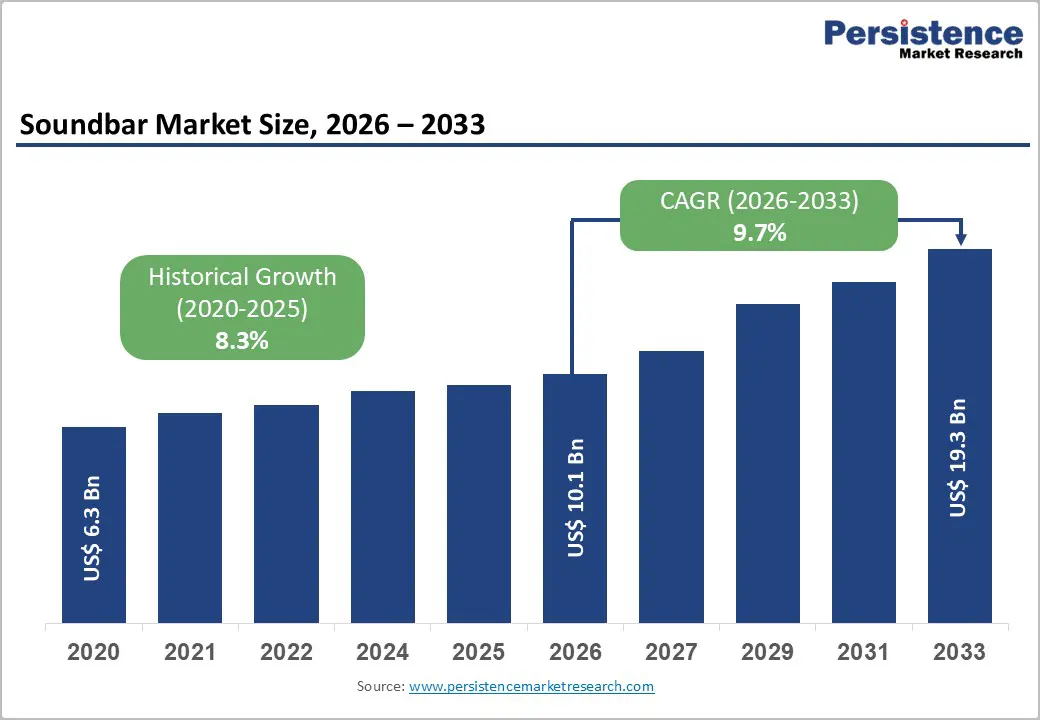
The global soundbar market size is expected to be valued at US$ 10.1 billion in 2026 and projected to reach US$ 19.3 billion by 2033, growing at a CAGR of 9.7% between 2026 and 2033.
Growth is driven by rising consumer demand for immersive home entertainment as households increasingly adopt high-resolution televisions and streaming platforms. Soundbars provide compact, high-quality audio solutions that enhance television viewing without complex speaker installations. The rapid expansion of streaming services and connected devices has increased demand for better sound performance. In addition, wireless connectivity features such as Bluetooth and Wi-Fi, and integration with smart home ecosystems, are encouraging consumers to upgrade their home audio systems.
Key Market Highlights
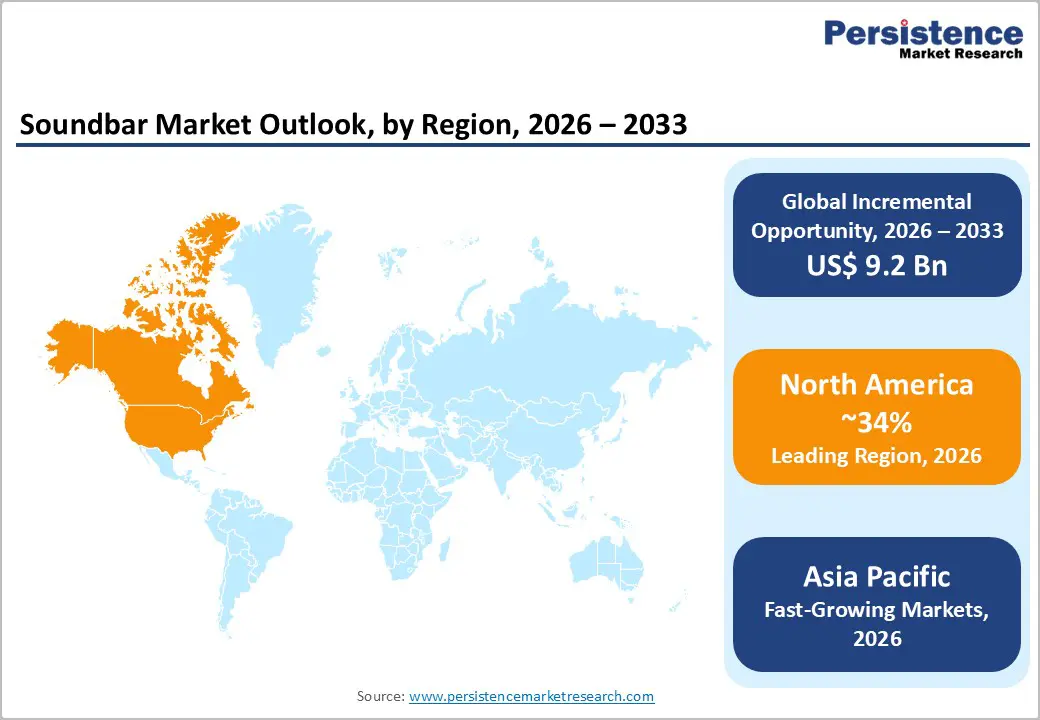
- Leading Region: North America leads the soundbar market with 34% share due to strong home entertainment adoption.
- Fastest Growing Region: Asia Pacific is the fastest-growing region, supported by expanding consumer electronics demand and strong manufacturing presence, while holding 31% market share.
- Leading Product Type: Tabletop soundbars dominate with 62% share owing to easy placement and compatibility with most TVs.
- Leading Installation: Active soundbars hold 75% share as built-in amplifiers simplify setup for consumers.
- Key Market Opportunity: The growing adoption of sound bars in commercial spaces, such as hotels and hospitality venues, creates new demand.
| Key Insights | Details |
|---|---|
| Soundbar Size (2026E) | US$ 10.1 billion |
| Market Value Forecast (2033F) | US$ 19.3 billion |
| Projected Growth CAGR (2026 - 2033) | 9.7% |
| Historical Market Growth (2020 - 2025) | 8.3% |
Market Dynamics
Drivers - Growing Consumer Preference for Compact Home Theater Audio Solutions
Consumers are increasingly investing in home entertainment as streaming platforms continue to dominate media consumption. With services such as Netflix and Disney+ driving a large share of global video streaming, households are seeking enhanced audio solutions to complement high-definition visual content. Soundbars offer a practical alternative to traditional multi-speaker setups, delivering immersive sound while requiring minimal space and installation.
Compact soundbar systems are particularly attractive for apartments and smaller living spaces where large home theater systems are impractical. Technologies such as Dolby Atmos further improve cinematic sound experiences, enabling users to achieve surround-sound effects without complex configurations. Growing interest in movie streaming, gaming, and smart television ecosystems is encouraging consumers to upgrade home audio equipment, supporting continued demand for soundbars.
Advancements in Wireless Connectivity Enhance Soundbar Integration and User Convenience
Advancements in wireless technologies are significantly contributing to soundbar adoption by improving ease of connectivity and user convenience. Modern soundbars increasingly integrate Bluetooth and Wi-Fi capabilities, enabling seamless streaming from smartphones, tablets, and other connected devices. Organizations such as the Bluetooth Special Interest Group highlight the rapid expansion of Bluetooth-enabled devices, supporting broader compatibility across consumer electronics.
Wireless connectivity also enables integration with smart home ecosystems and multi-room audio systems, allowing users to control audio playback across different rooms through mobile applications or voice assistants. Improved wireless standards and low-latency audio transmission enhance experiences for gaming, music streaming, and video content. As consumers prioritize convenience, clutter-free setups, and flexible connectivity, wireless-enabled soundbars continue to gain popularity across modern home entertainment environments.
Restraints - High Pricing of Advanced Soundbars Limiting Adoption Among Price-Sensitive Consumers
Premium soundbars with advanced features, such as immersive surround sound and integrated subwoofers, often come at relatively high price points, which can discourage adoption among budget-conscious consumers. Many households, particularly in price-sensitive markets, prefer affordable audio solutions or continue relying on built-in television speakers instead of investing in additional home audio equipment. The pricing gap between entry-level and premium soundbars also creates hesitation among first-time buyers who prioritize cost over enhanced audio quality. While high-end models offer superior sound performance and advanced technologies like Dolby Atmos, their higher costs limit accessibility for a broader consumer base, slowing overall market penetration in developing economies.
Improving Built-In Television Audio Systems: Reducing the Need for External Soundbars
Advancements in television audio technology are creating competition for soundbars as manufacturers enhance built-in speaker performance in modern televisions. Several brands now integrate advanced audio technologies designed to improve sound clarity and directional audio directly from the TV, reducing the need for external sound systems in some households. For example, technologies such as Object Tracking Sound developed by Samsung Electronics allow audio to follow on-screen movement, improving immersion without additional hardware. At the same time, personal audio devices like Apple AirPods continue to gain popularity for individual media consumption, further limiting demand for shared home audio systems such as soundbars.
Opportunity - Growing Adoption of Audio Solutions in Commercial and Hospitality Environments
Commercial establishments such as hotels, restaurants, bars, and conference venues increasingly require reliable and high-quality audio systems to enhance guest experiences. Soundbars are gaining attention in these environments because they offer compact designs, easy installation, and strong audio performance suitable for background music, presentations, and entertainment systems.
In hospitality settings, soundbars can be integrated with televisions in guest rooms or installed in common areas to deliver clear and immersive sound without complex speaker setups. Durable designs and flexible configurations make them suitable for professional installations. As commercial spaces continue to upgrade entertainment and communication systems, demand for soundbars in hospitality and corporate environments is expected to expand.
Rapid Expansion of Smart Homes Driving Integration of Connected Audio Devices
The rapid growth of smart home ecosystems is creating new opportunities for soundbar manufacturers to integrate advanced connectivity and voice control features. Modern soundbars increasingly support Wi-Fi connectivity and smart home protocols such as Matter, enabling seamless integration with connected home devices.
Voice-enabled soundbars that work with assistants like Amazon Alexa and Google Assistant let users control music, adjust volume, and manage smart home devices via voice commands. As smart home adoption grows in urban households, consumers are seeking integrated entertainment solutions that combine convenience, connectivity, and immersive audio, creating strong opportunities for advanced soundbar systems.
Category-wise Analysis
Product Type Insights
Tabletop soundbars lead the product type segment, accounting for around 62% of the market share in 2025. Their dominance is driven by easy placement on TV stands and compatibility with most television setups without requiring wall installation. First-time buyers widely prefer tabletop models for their plug-and-play functionality, compact form factor, and ability to deliver improved audio performance while maintaining simple installation in residential spaces.
Wall-mounted soundbars are emerging as the fastest-growing product type as more households adopt wall-mounted televisions to create modern and space-efficient entertainment setups. These soundbars visually align with mounted displays and deliver balanced sound projection. Growing demand for aesthetically integrated home theater systems and minimalist interior designs is prompting manufacturers to introduce slimmer, visually integrated wall-mounted soundbar models.
Installation Method Insights
Active soundbars dominate the installation method segment, holding approximately 75% of the market share due to their integrated amplifiers and simplified setup. These systems eliminate the need for external receivers or amplifiers, making them convenient for everyday consumers. Their popularity is also supported by the growing adoption of wireless subwoofers and built-in connectivity features that enable users to set up enhanced home audio systems with minimal technical effort.
Passive soundbars are the fastest-growing installation category as demand rises among home theater enthusiasts and professional audio installers. These systems require external amplification, allowing users to customize audio performance and integrate them into larger surround sound environments. Increasing interest in premium home entertainment rooms and customized audio installations is driving the adoption of passive soundbars in advanced home theater configurations.
Connectivity Insights
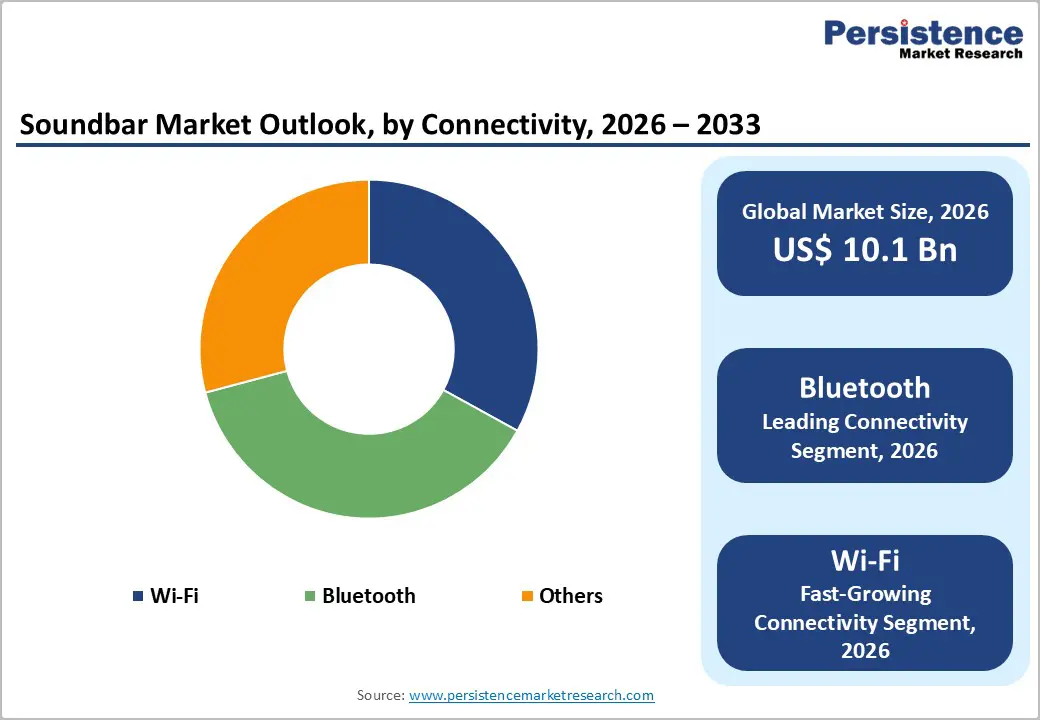
Bluetooth connectivity leads the connectivity segment with around 55% market share in 2025, primarily due to its universal compatibility with smartphones, tablets, and laptops. Consumers favor Bluetooth-enabled soundbars for everyday music streaming and quick device pairing. The widespread adoption of Bluetooth technology in consumer electronics has made it a standard feature in soundbars, enabling convenient wireless audio streaming without complex network configuration.
Wi-Fi connectivity is the fastest-growing segment as consumers increasingly adopt smart home ecosystems and connected entertainment devices. Wi-Fi-enabled soundbars support direct streaming from digital platforms and can be integrated with multi-room audio systems. They also offer higher bandwidth for improved sound quality and enable control via mobile apps or voice assistants, making them attractive for modern smart home environments.
Application Insights
Home audio dominates the application segment, accounting for approximately 82% of the global soundbar market share. The growth of this segment is strongly linked to the rising adoption of large-screen televisions, gaming consoles, and streaming services in residential settings. Soundbars provide a convenient way to upgrade television audio while maintaining a compact setup, making them a preferred choice for households seeking immersive entertainment experiences.
Commercial applications are emerging as the fastest-growing segment as businesses adopt compact audio systems for hospitality, retail, and corporate environments. Hotels, conference rooms, restaurants, and public entertainment venues increasingly install soundbars to improve sound clarity for television content, presentations, and background music. Their easy installation and space-efficient design make them suitable for professional environments requiring reliable audio performance.
Distribution Channel Insights
Offline retail channels lead the distribution segment, accounting for around 58% of global soundbar sales. Consumers often prefer visiting electronics stores and specialty audio retailers where they can test sound quality and compare models before making a purchase. In-store demonstrations and professional guidance help build trust, particularly when buying higher-end audio equipment, where performance evaluation is important.
Online distribution is the fastest-growing channel as e-commerce platforms expand product accessibility and competitive pricing. Consumers increasingly rely on online marketplaces to compare features, read reviews, and access promotional discounts. The convenience of home delivery and the ability to evaluate multiple products digitally are driving stronger adoption of online channels for purchasing soundbars.
Regional Insights
North America Soundbar Market Trends and Insights
North America holds a leading position in the global soundbar market, accounting for around 34% of the market. The United States represents the largest contributor, supported by strong consumer spending on home entertainment and advanced audio technologies. The widespread adoption of streaming services, large-screen televisions, and smart home ecosystems has increased demand for soundbars in residential households. In addition, the presence of major consumer electronics companies and strong retail networks continues to support product availability and innovation.
Technological innovation remains a key factor shaping the regional market. Companies such as Dolby Laboratories continue to develop immersive audio technologies that enhance cinematic sound experiences in compact devices. The region also benefits from strong research and development in consumer electronics, which encourages manufacturers to launch premium soundbar models with advanced connectivity, voice assistant integration, and improved surround sound capabilities.
Europe Soundbar Market Trends and Insights
Europe is a mature soundbar market and is projected to grow at a CAGR of around 9.3% over the forecast period. Countries such as Germany and the United Kingdom contribute significantly to regional demand due to strong adoption of advanced home entertainment technologies and high smart television penetration. Consumers in the region are increasingly seeking compact audio solutions that complement modern living spaces while providing enhanced sound quality for streaming content and television viewing.
Growing focus on sustainability and product efficiency is also shaping the European market landscape. Regulatory frameworks related to electronics safety, environmental standards, and energy efficiency encourage manufacturers to design eco-friendly and energy-efficient soundbar systems. Urban housing trends across countries such as France and Spain further support the demand for space-efficient wall-mounted soundbars that integrate seamlessly into apartment-style living environments.
Asia Pacific Soundbar Market Trends and Insights
Asia Pacific represents a rapidly expanding market and accounts for approximately 31% of the global soundbar market share. China plays a dominant role as both a major manufacturing hub and a large consumer electronics market. The region benefits from strong production capabilities, competitive pricing, and large-scale exports of audio equipment, which contribute significantly to global supply chains and product availability.
Demand across the region is also supported by rising disposable incomes and expanding middle-class populations in countries such as India, Japan, and Southeast Asian economies. Increasing adoption of smart televisions, digital streaming platforms, and connected home devices is encouraging consumers to upgrade their home audio systems. As urban households continue to invest in modern entertainment setups, soundbar manufacturers are introducing feature-rich models with wireless connectivity and smart home integration tailored to regional preferences.
Competitive Landscape
The global soundbar market features a moderately consolidated competitive environment, characterized by several established consumer electronics manufacturers and emerging audio technology companies. Competition is largely driven by continuous product innovation, improved sound performance, and the integration of advanced technologies, including immersive audio formats, wireless connectivity, and smart home compatibility. Companies are increasingly focusing on enhancing user experience through seamless connectivity with televisions, smartphones, and streaming platforms.
Strategic initiatives in the market include partnerships with digital entertainment platforms, investment in artificial intelligence-enabled sound optimization, and expansion of product ecosystems. Manufacturers are also emphasizing modular sound systems, customizable setups, and premium design aesthetics to differentiate their offerings. In addition, firms are strengthening regional manufacturing and distribution networks to improve supply chain efficiency and expand their presence across emerging consumer electronics markets.
Key Developments:
- In August 2025, Samsung Electronics introduced its 2025 soundbar lineup featuring HW-Q990F with AI Sound Optimization and Q-Symphony Pro technology, designed to synchronize sound between compatible televisions and soundbars to deliver improved immersive home entertainment audio performance.
- In January 2025, Sony Group Corporation launched the Bravia Theatre Bar 9 soundbar, engineered to synchronize acoustically with compatible televisions and enhance cinematic sound quality through integrated processing and improved surround audio performance for home entertainment systems.
- In 2025, Bose Corporation introduced the Bose Smart Ultra soundbar featuring AI-powered dialogue clarity technology, designed to enhance speech intelligibility and optimize audio output for streaming content, movies, and television viewing in modern home audio setups.
Companies Covered in Soundbar Market
- Samsung Electronics
- Sony Corporation
- Bose Corporation
- Sonos Inc.
- LG Electronics
- Yamaha Corporation
- Vizio Holdings
- Polk Audio
- JBL
- Creative Technology
Frequently Asked Questions
The global soundbar market is projected to reach US$ 10.1 billion in 2026.
Rising home entertainment consumption and streaming adoption are key drivers, with home audio accounting for 82% share.
North America leads the soundbar market with around 34% share due to strong home entertainment adoption.
Expansion of smart home ecosystems and wireless connectivity is a key opportunity, while Bluetooth currently holds about 55% share in connectivity.
Leading companies include Samsung Electronics, Sony Group Corporation, Bose Corporation, and LG Electronics.


