




- Home Care & Utilities
- Disposable Bed Sheets Market
Disposable Bed Sheets Market Size, Share, and Growth Forecast 2026 - 2033
Disposable Bed Sheets Market by Product Type (Waterproof / Fluid-Resistant, Non-Woven, Standard Disposable Bed Sheets), Nature (Eco-Friendly, Regular), Price Range (Economy / Mid-Range, Premium), Application (Hospitals, Home Care, Salon & Spa, Clinics, Others), and Regional Analysis for 2026 - 2033

Disposable Bed Sheets Market Size and Trend Analysis
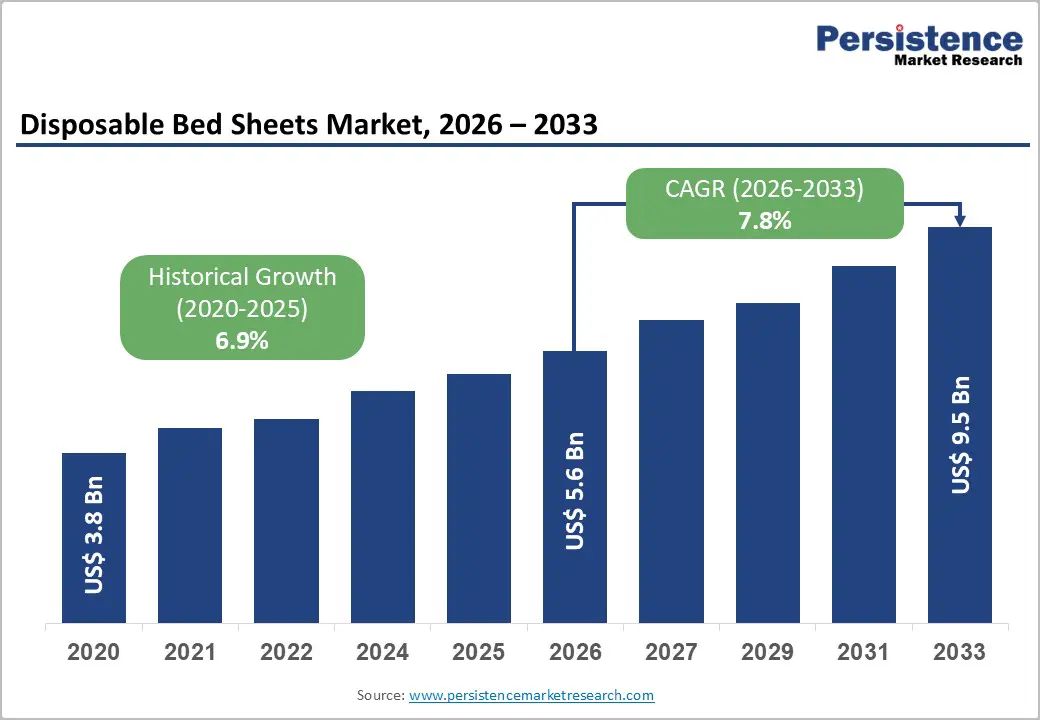
The global disposable bed sheets market size is expected to be valued at US$ 5.6 billion in 2026 and is projected to reach US$ 9.5 billion by 2033, growing at a CAGR of 7.8% between 2026 and 2033. This growth is driven by healthcare infrastructure investment, stricter infection control protocols, and increasing consumer demand for single-use hygiene products across hospitals, home care, and personal care settings.
Disposable bed sheets are single-use protective coverings designed to prevent stains and contamination on beds and treatment tables. They are widely deployed in surgical and emergency care settings, beauty clinics, and spas. The market registered US$ 3.8 billion in 2020 and grew at a historical CAGR of 6.9%, reinforced by the post-pandemic prioritization of hospital-acquired infection (HAI) prevention standards, expansion in home healthcare service delivery, and rapid growth in salon and spa industries across Asia Pacific and the Middle East.
Key Industry Highlights:
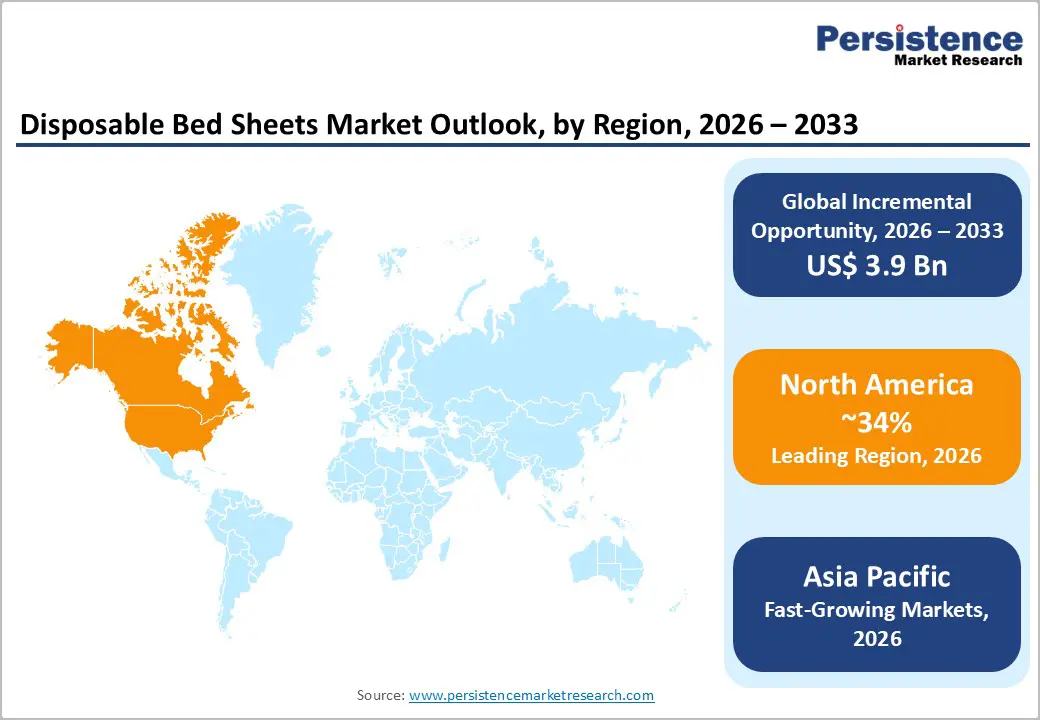
- Leading Region: North America holds 34% global disposable bed sheets market share in 2026, anchored by over 6,100 U.S. hospitals, CDC/Joint Commission infection control mandates, and expanding home healthcare utilization driven by 80 million Americans projected to be aged 65+ by 2040.
- Statistics: As of 2026, the U.S. has approximately 6,100 hospitals, ranging from major academic medical centers to community facilities, with a strong trend toward large, integrated health systems.
- Fastest Growing Region: Asia Pacific is the fastest growing region through 2026 - 2033, driven by China's Healthy China 2030 hospital expansion, India's PM-JAY covering 500 million beneficiaries, and rapidly growing urban salon and spa industry demand across Southeast Asia and GCC markets.
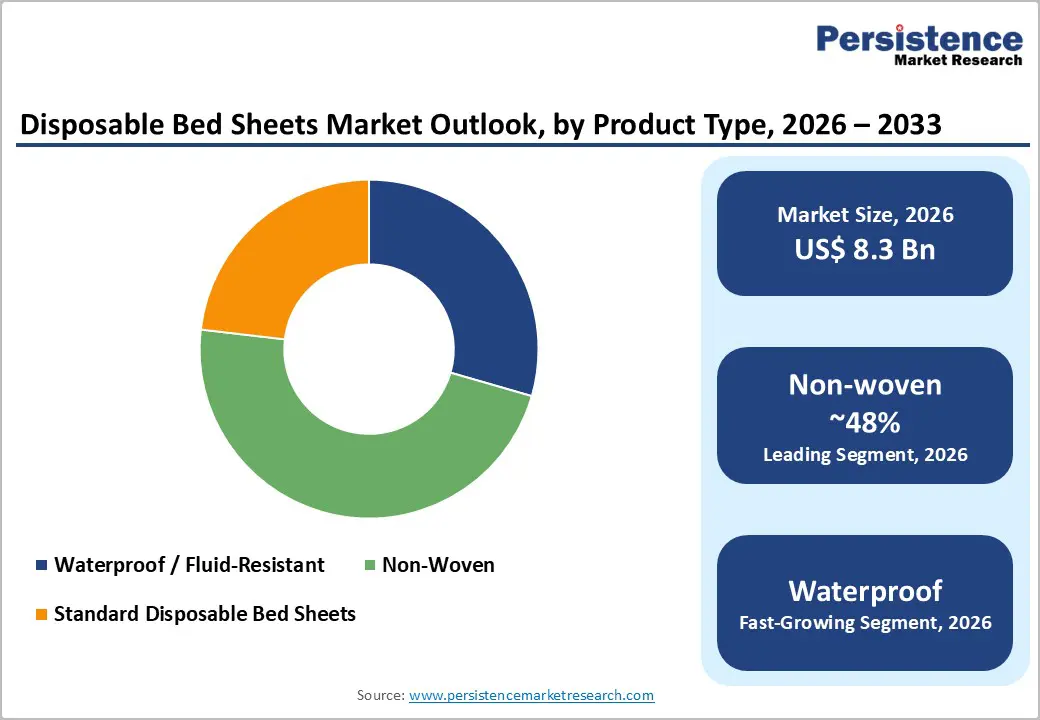
- Dominant Segment: Non-woven disposable bed sheets hold 48% market share in 2025, dominating through superior softness, breathability, and infection barrier performance validated by EDANA hygiene sector data, with major PP spunbond material suppliers, including Berry Global, supporting deep supply chain availability.
- Fastest Growing Segment: Eco-friendly disposable bed sheets are the fastest growing segment, driven by EU Green Deal sustainable healthcare procurement mandates, U.S. Practice Greenhealth network of 1,500+ facilities, and growing demand for PLA, bamboo, and recycled PET nonwoven alternatives in premium market tiers.
- Key Opportunity: Professional beauty and spa industry growth across Asia Pacific and GCC under Saudi Arabia's Vision 2030 and ASEAN's expanding wellness sector presents a high-margin, underpenetrated opportunity for premium waterproof and aesthetically designed single-use disposable bed sheet product lines through 2033.
Market Dynamics
Driver - Intensifying Hospital-Acquired Infection (HAI) Prevention Mandates Driving Healthcare Applications
Healthcare-associated infections (HAIs) represent one of the most significant patient safety challenges globally, with the World Health Organization (WHO) estimating that at any given time, approximately 7% of patients in high-income countries and 15% in low- and middle-income countries acquire at least one HAI during their hospital stay.
Contaminated bed linen is a documented vector for pathogen transmission, prompting healthcare regulators and accreditation bodies including the Joint Commission International (JCI) and the U.S. Centers for Disease Control and Prevention (CDC) to strengthen guidelines on linen hygiene in clinical settings. Single-use disposable bed sheets eliminate the cross-contamination risks inherent in centralized laundry processing, making them the preferred hygiene protection solution in intensive care units, surgical wards, and infectious disease departments.
The European Centre for Disease Prevention and Control (ECDC) reports that HAI-related costs to European healthcare systems exceed €7 billion annually, further incentivizing institutional investment in disposable healthcare applications that demonstrably reduce infection transmission risk.
Expanding Home Healthcare Sector and Growing Awareness of Personal Hygiene Products
The global shift toward home-based healthcare delivery accelerated by aging populations, post-acute care discharge programs, and telehealth expansion is creating a rapidly growing demand base for disposable bed sheets in the home care segment. The U.S. Centers for Medicare & Medicaid Services (CMS) has consistently expanded reimbursement for home health services, with the U.S. home health market serving over 5 million Medicare beneficiaries annually.
In parallel, Japan's Ministry of Health, Labour and Welfare reports that its long-term care insurance system supports in-home care for millions of elderly citizens, each generating recurring demand for hygiene and bed protection products. Beyond healthcare, growing consumer awareness of personal hygiene reinforced by the COVID-19 pandemic's lasting behavioral impact on cleanliness standards has elevated disposable bed sheet adoption in salon & spa, hotel housekeeping, and travel segments.
The cost efficiency of single-use products, which eliminates laundry processing costs estimated at US$ 0.50-US$ 1.50 per reusable sheet per wash cycle, further strengthens the economic case for institutional and consumer adoption.
Restraints - Environmental Concerns and Growing Regulatory Pressure on Single-Use Plastics and Disposables
The environmental impact of single-use disposable products including bed sheets derived from polypropylene-based nonwoven materials is attracting increasing regulatory scrutiny. The European Union's Single-Use Plastics Directive (EU) 2019/904 and expanding national legislation in markets including France, India, and the UK are tightening restrictions on certain disposable products. While medical-grade disposables typically receive exemptions, the broader regulatory trend creates reputational risk and potential compliance cost exposure for manufacturers whose product lines include non-biodegradable disposable materials.
Environmental advocacy pressure is also influencing procurement decisions in sustainability-conscious healthcare and hospitality sectors globally.
Logistics and Storage Costs Limiting Penetration in Price-Sensitive Emerging Markets
Disposable bed sheets are inherently voluminous relative to their weight, creating disproportionate logistics and storage costs that limit cost-competitiveness in price-sensitive emerging markets where reusable alternatives remain cost-effective. In markets across Sub-Saharan Africa and rural South Asia, where healthcare facility budgets are severely constrained, the per-unit cost of disposable bed sheets, even economy grades, may exceed the all-in cost of reusable options when local labor costs for laundering are low. This economic barrier limits broad healthcare adoption in lower-income markets, restricting volume growth in regions that represent significant future population and healthcare service expansion potential.
Opportunities - Eco-Friendly and Biodegradable Disposable Bed Sheets: Fastest Growing Nature Segment
The rapid growth of sustainable and biodegradable disposable product alternatives represents the most dynamic commercial opportunity in the disposable bed sheets market. Consumer and institutional buyers, particularly in Europe and North America, are actively seeking eco-friendly single-use products that deliver the hygiene benefits of traditional disposables without the environmental burden of non-degradable synthetic nonwoven materials. Manufacturers developing disposable bed sheets from bio-based polylactic acid (PLA), bamboo fiber, organic cotton, and recycled PET nonwoven fabrics are gaining traction in premium market segments.
The EU Green Deal and Sustainable Healthcare Coalition initiatives are driving European hospital procurement policies toward lower environmental impact disposables. The U.S. Practice Greenhealth network, representing over 1,500 U.S. healthcare facilities, promotes sustainable product procurement, creating an organized institutional buyer base for eco-friendly disposable bed sheets. The regulatory pressure and consumer environmental awareness positions the eco-friendly segment for CAGR meaningfully above the overall market average through 2033.
Salon, Spa, and Beauty Industry Expansion Across Asia Pacific and the Middle East
The rapid expansion of the professional beauty, wellness, and personal care industry, particularly across the Asia Pacific and the Middle East, presents a significant, underpenetrated growth opportunity for disposable bed sheet manufacturers. The Professional Beauty Association (PBA) reports consistent global growth in licensed spa and salon establishments, with Asia Pacific representing the fastest expanding regional market.
In the Gulf Cooperation Council (GCC), the beauty and wellness sector is a priority diversification focus under national vision programs, including Saudi Arabia's Vision 2030, with hundreds of new luxury spa, hotel, and wellness center developments requiring hygienic single-use linen solutions. The salon & spa segment's willingness to adopt premium-priced, aesthetically designed disposable bed sheets offering waterproof functionality and soft texture alongside hygiene compliance creates a high-margin, high-growth niche.
Disposable bed sheet suppliers that develop dedicated beauty professional product lines with differentiated colors, sizes, and moisture-barrier properties are well-positioned to capture this expanding vertical.
Category-wise Analysis
Product Type Insights
Non-woven disposable bed sheets dominate the product type segment, accounting for approximately 48% market share in 2025. These sheets, primarily made from spunbond polypropylene (SMPP) and spunlace nonwoven fabrics, are widely preferred due to their optimal balance of softness, breathability, strength, and cost efficiency. Compared to traditional film-based sheets, non-woven materials provide enhanced patient comfort while maintaining sufficient liquid resistance, making them ideal for hospitals, clinics, and personal care environments such as salons and spas. Their lightweight structure and high tensile durability further improve usability in high-turnover settings.
Additionally, the global availability of nonwoven raw materials, supported by major suppliers such as Berry Global, Freudenberg Group, and Ahlstrom-Munksjö, ensures stable supply chains and competitive pricing. Industry data from EDANA further reinforces that medical and hygiene applications are the largest consumers of nonwoven materials globally.
The fastest-growing sub-segment within product types is waterproof laminated disposable bed sheets, projected to grow at a CAGR of approximately 8.6%. Increasing demand for enhanced fluid protection in surgical, maternity, and elderly care settings is driving adoption. These sheets combine nonwoven layers with polyethylene films to offer superior leakage prevention, making them critical in high-risk contamination environments. Growth is particularly strong in developed healthcare systems and premium private hospitals, where infection control standards are stringent and product performance outweighs cost considerations.
Nature Insights
Regular disposable bed sheets lead the nature segment, accounting for nearly 72% of the total market share in 2025. These sheets are typically manufactured using polypropylene-based nonwoven materials or polyethylene-laminated films, offering cost-effective solutions with reliable infection control performance. Their dominance is largely driven by large-scale institutional demand from hospitals, clinics, and long-term care facilities, particularly in emerging economies where procurement decisions are highly price-sensitive.
Established production infrastructure, high-volume manufacturing capabilities, and strong global distribution networks further reinforce the widespread use of regular disposable sheets. Despite growing awareness around sustainability, the massive consumption scale running into billions of units annually ensures that conventional products continue to maintain a significant share in the near-to-medium term. Healthcare providers often prioritize affordability and consistent supply over environmental considerations, especially in public healthcare systems with constrained budgets.
The fastest-growing sub-segment is eco-friendly disposable bed sheets, expected to expand at a positive CAGR. Rising environmental concerns, regulatory pressures on plastic usage, and increasing adoption of sustainable procurement policies in hospitals are driving demand for biodegradable and compostable alternatives. Materials such as bamboo fiber, viscose, and biodegradable polymers are gaining traction, particularly in Europe and North America. Additionally, green certifications and ESG commitments by healthcare providers are accelerating the shift toward eco-friendly solutions, creating strong growth momentum despite their current smaller market base.
Price Range Insights
The economy and mid-range price segment are dominant, accounting for 68% share in 2025. This segment primarily caters to government hospitals, healthcare centers, and high-volume service providers such as salons and clinics, especially in developing regions. Cost efficiency remains the key purchasing driver, with buyers prioritizing functional performance such as basic fluid resistance and disposability over premium features.
The widespread presence of low- and middle-income countries, particularly in Asia Pacific, Latin America, and the Middle East & Africa, further strengthens the dominance of this segment. According to global healthcare data, a significant proportion of hospital infrastructure operates under budget constraints, making economy-tier products essential for large-scale adoption. Manufacturers focus on bulk production, standardized specifications, and cost optimization strategies to serve this segment effectively, ensuring consistent demand and high-volume sales.
The premium price range is the fast-growing segment projected to reach a CAGR of approximately 8.4%. Growth is driven by increasing demand for high-performance, hospital-grade disposable sheets offering superior softness, higher absorbency, antimicrobial coatings, and enhanced barrier protection. Private hospitals, luxury healthcare facilities, and premium wellness centers are key adopters. Additionally, rising patient expectations, medical tourism, and improved healthcare infrastructure in emerging economies are contributing to the expansion of this segment, despite its higher cost structure.
Application Insights
Hospitals dominate the application segment, accounting for approximately 45% of the global disposable bed sheets market in 2025. Hospitals represent the largest and most consistent consumers due to the necessity of maintaining strict hygiene standards and preventing hospital-acquired infections (HAIs). Each patient admission typically requires fresh disposable bedding, resulting in high-frequency replacement cycles.
The scale of hospital infrastructure globally, with millions of beds across acute care, surgical, and long-term facilities, ensures sustained demand. Regulatory frameworks and accreditation requirements further reinforce usage, as hospitals must comply with strict sanitation and infection control protocols. Manufacturers supplying hospital-grade disposable sheets must adhere to stringent quality certifications, including ISO and clinical safety standards, which creates entry barriers and favors established suppliers with proven capabilities.
Home healthcare and personal care applications are fast-growing with a CAGR of approximately 8.8% in the forecast period. The rise in the aging population, increasing prevalence of chronic diseases, and growing preference for home-based care are key growth drivers. Additionally, post-pandemic awareness regarding hygiene and infection prevention has significantly boosted demand for disposable products in residential settings. The expansion of home nursing services and outpatient care further accelerates adoption, making this segment a key future growth driver in the market.
Regional Insights
North America Disposable Bed Sheets Market Trends
North America leads the global disposable bed sheets market with approximately 34% market share in 2025, supported by a mature, highly regulated healthcare system, strong institutional procurement infrastructure, and deeply embedded infection control compliance culture. The U.S. Centers for Disease Control and Prevention (CDC) guidelines on environmental infection control in healthcare settings explicitly endorse single-use linen in high-risk clinical environments, driving consistent institutional adoption across American hospital systems.
The region is also witnessing growing demand from the home care and salon & spa segments, as aging demographics with the U.S. Census Bureau projecting over 80 million Americans aged 65 or older by 2040, expand home-based healthcare service utilization. Eco-friendly disposable bed sheet product launches are gaining momentum among U.S. Practice Greenhealth network members committed to sustainable healthcare procurement, signaling a near-term shift toward premium biodegradable options.
- U.S. Disposable Bed Sheets Market Size
The United States is the single most important national market for disposable bed sheets, accounting for approximately 82% of North American market revenue in 2025, reflecting the country's massive healthcare infrastructure with over 6,000 registered hospitals and approximately 900,000 staffed beds per American Hospital Association (AHA) data. The U.S. disposable bed sheet market benefits from strong infection control mandates under The Joint Commission accreditation standards and CMS Conditions of Participation, both of which drive compliance-based procurement.
The U.S. home healthcare market, valued at over US$ 100 billion annually generates significant recurring demand for disposable hygiene products in non-clinical settings. The country is projected to maintain a CAGR slightly above the North American regional average through 2033, supported by continued aging population growth, insurance-covered home care expansion, and the premium eco-friendly product segment gaining institutional traction among sustainability-committed hospital purchasing organizations.
Europe Disposable Bed Sheets Market Trends
Europe represents the second-largest regional market, driven by stringent healthcare-associated infection control regulations across member states, mature spa and wellness cultures in Western Europe, and active sustainability-driven procurement policies under the EU Green Deal and EU Sustainable Healthcare Coalition frameworks. National healthcare systems including the UK NHS, French Assistance Publique - Hôpitaux de Paris, and German Gesetzliche Krankenversicherung represent large, centralized procurement pools for disposable medical linen.
The ECDC's ongoing campaigns to reduce HAI rates across European hospitals targeting the approximately 8.9 million HAI cases occurring in EU member states annually are sustaining policy-driven demand for single-use hygiene products including disposable bed sheets. The premium and eco-friendly product tiers are growing fastest in Northern and Western Europe, where environmental procurement criteria are most advanced.
- Germany Disposable Bed Sheets Market Size
Germany holds the largest share of the European disposable bed sheets market, accounting for approximately 26% of regional revenue in 2025. Germany operates one of Europe's most comprehensive hospital networks with over 1,900 acute care hospitals and approximately 500,000 beds per German Hospital Federation (DKG) data. Strong adoption of infection prevention standards and robust private healthcare expenditure support consistent institutional demand. Germany's CAGR for disposable bed sheets is projected at approximately 6.5% through 2033, driven by aging demographics, expanding ambulatory care, and growing spa/beauty sector demand for premium single-use products.
- U.K. Disposable Bed Sheets Market Size
The United Kingdom represents approximately 16% of the European disposable bed sheets market in 2025. NHS England's infection prevention and control (IPC) guidelines mandate rigorous linen hygiene protocols across Trust-operated facilities. The UK's growing private healthcare and wellness sector, including a thriving beauty therapy and spa industry, supplements NHS-driven institutional demand.
The UK market is projected to grow at approximately 6.8% CAGR through 2033, with eco-friendly product adoption accelerating as NHS Sustainable Development Unit green procurement targets gain procurement influence.
- France Disposable Bed Sheets Market Size
France accounts for approximately 13% of the European disposable bed sheets market in 2025. France's extensive public hospital network, anchored by Assistance Publique - Hôpitaux de Paris operating 39 hospitals in the Paris region alone drives large-scale institutional procurement. France's well-developed spa, thalassotherapy, and luxury hospitality sectors generate additional premium product demand. The French market is forecast to grow at approximately 6.2% CAGR through 2033, with the French National Agency for the Safety of Medicines (ANSM) maintaining quality standards for medical-grade disposables.
- Italy Disposable Bed Sheets Market Size
Italy contributes approximately 9% of the European disposable bed sheets market revenue in 2025. Italy's extensive network of approximately 1,000 public hospitals and a growing private healthcare and aesthetic medicine sector drives consistent demand. Italy's premium beauty and wellness industry, including thermal spa resorts and luxury beauty clinics, represents a significant non-medical application channel. The Italian market is projected to grow at approximately 6.4% CAGR through 2033, supported by ongoing healthcare modernization investment and growing spa culture adoption among younger demographics.
Asia Pacific Disposable Bed Sheets Market Trends
Asia Pacific is the fastest-growing regional market, driven by massive healthcare infrastructure expansion, rapidly growing salon and spa industries, and accelerating urban middle-class demand for hygiene-conscious personal care products. The region benefits from significant manufacturing cost advantages, with China and India serving as major production hubs for nonwoven materials and finished disposable healthcare products.
Government healthcare investment programs including China's Healthy China 2030 initiative, India's Ayushman Bharat Pradhan Mantri Jan Arogya Yojana (PM-JAY) expanding hospital coverage to over 500 million beneficiaries, and ASEAN's regional healthcare harmonization programs are driving rapid capacity additions in hospital beds and clinical facilities that generate growing disposable linen procurement demand. The region's CAGR is projected to exceed the global average through 2033.
- China Disposable Bed Sheets Market Size
China is the dominant Asia Pacific market, accounting for approximately 46% of regional revenue in 2025. China's Healthy China 2030 plan targets expanding hospital bed density toward 7.4 per 1,000 population, implying tens of millions of new hospital beds requiring disposable linen procurement. China is simultaneously the world's largest manufacturer of spunbond polypropylene nonwoven fabrics the primary raw material for disposable bed sheets giving Chinese producers a structural cost advantage in domestic and export markets.
China is expected to reach nearly 9.1% CAGR through 2033, driven by hospital expansion, aging demographics, and rapidly growing urban spa and beauty professional markets demanding hygiene-compliant single-use products.
- India Disposable Bed Sheets Market Size
India represents approximately 15% of Asia Pacific disposable bed sheets market revenue in 2025. PM-JAY the world's largest health insurance scheme covering over 500 million beneficiaries is driving rapid private hospital construction across tier-2 and tier-3 cities, each requiring disposable hygiene supplies. India's booming beauty and wellness industry estimated at over US$ 7 billion by FICCI and growing rapidly generates substantial salon & spa segment demand. The Indian market is forecast to record a CAGR of approximately 10.2% through 2033, reflecting a low base effect combined with strong structural growth across both healthcare and personal care application segments.
- South Korea Disposable Bed Sheets Market Size
South Korea contributes approximately 9% of Asia Pacific disposable bed sheets market revenue in 2025. South Korea's advanced healthcare system ranked among the most efficient globally by Bloomberg Health Efficiency Index and its world-leading beauty and K-beauty professional care industry drive premium disposable bed sheet demand. The country's National Health Insurance Service (NHIS) supports broad hospital network utilization, creating consistent institutional procurement. South Korea's CAGR is projected at approximately 8.0% through 2033, with K-beauty salon export culture also expanding the professional beauty application channel across ASEAN markets served by Korean-brand disposable hygiene products.
Competitive Landscape
The global disposable bed sheets market exhibits a highly fragmented competitive structure, with a large number of regional manufacturers competing alongside a smaller set of multinational nonwoven and medical products companies. No single player commands more than a mid-single-digit global revenue share, reflecting the market's product commoditization at lower tiers and the dominance of regional supply chains.
Key differentiators include material innovation (biodegradable and PLA-based nonwovens), medical-grade quality certifications (ISO 13485, CE marking), private label manufacturing capabilities for healthcare purchasing organizations, and a growing focus on sustainable packaging. E-commerce and direct-to-consumer channels are emerging as important distribution vectors for the home care and salon & spa segments, supplementing traditional medical supply distributor networks.
Key Developments:
- September 2024: Medline Industries introduced an expanded range of fluid-resistant disposable bed protection sheets with enhanced moisture barrier performance, targeting ICU and surgical ward procurement across U.S. hospital systems under updated CDC environmental infection control guidance.
- April 2025: Cardinal Health expanded its medical-grade disposable bed sheet product line with the launch of a new biodegradable spunlace series targeting JCI-accredited hospital networks in North America and Europe, aligning with U.S. Practice Greenhealth sustainable procurement guidelines.
- January 2023: Kimberly-Clark Professional launched eco-certified disposable patient care linens incorporating 30% recycled fiber content for European hospital markets, responding to EU Green Deal sustainable healthcare procurement directives gaining traction across NHS and European public hospital systems.
Companies Covered in Disposable Bed Sheets Market
- Medline Industries LP
- Cardinal Health Inc.
- Kimberly-Clark Corporation
- Dynarex Corporation
- Graham Medical Products
- TIDI Products LLC
- Halyard Health (Owens & Minor)
- Mölnlycke Health Care
- Paul Hartmann AG
- Lohmann & Rauscher International GmbH
- Zhende Medical Co. Ltd.
Frequently Asked Questions
The global disposable bed sheets market is projected to reach US$ 9.5 billion by 2033, up from US$ 5.6 billion in 2026, representing an incremental opportunity of US$ 3.9 billion over the forecast period at a CAGR of 7.8%. Growth is driven by healthcare infection control mandates, expanding home care services, and accelerating salon & spa industry adoption of hygiene-compliant single-use products globally.
Primary demand drivers include WHO-documented HAI rates affecting 7-15% of hospital patients globally, with CDC and JCI guidelines endorsing single-use bed linen in high-risk clinical settings. The U.S. home health sector serving over 5 million Medicare beneficiaries annually, Japan's long-term care insurance system, and the COVID-19 pandemic's lasting impact on hygiene behavior collectively sustain growing demand for disposable hygiene protection products across healthcare and personal care applications.
Non-woven disposable bed sheets are the leading product type, holding approximately 48% market share in 2025. Their dominance reflects superior material properties softness, breathability, and infection barrier performance validated by EDANA hygiene sector industry data. Spunbond polypropylene and spunlace non-woven substrates are the standard specification across hospital, clinic, and salon & spa applications, with major nonwoven material suppliers including Berry Global and Freudenberg Group providing deep global supply chain support.
North America leads the global market with approximately 34% market share in 2025, driven by the U.S. healthcare system's over 6,000 hospitals and 900,000 staffed beds per American Hospital Association data, Joint Commission and CMS infection control compliance mandates, and a rapidly expanding home healthcare sector serving over 80 million Americans projected to be aged 65 or older by 2040 per U.S. Census Bureau projections.
The foremost opportunity lies in eco-friendly and biodegradable disposable bed sheets, the fastest growing nature sub-segment. EU Green Deal sustainable procurement mandates and the U.S. Practice Greenhealth network of over 1,500 healthcare facilities are driving institutional adoption of PLA, bamboo, and recycled PET nonwoven alternatives. Concurrently, the GCC beauty and wellness sector expansion under Saudi Arabia's Vision 2030 and ASEAN spa industry growth create high-margin salon & spa application opportunities for premium single-use product lines.
Key companies include Medline Industries LP, Cardinal Health Inc., Kimberly-Clark Corporation, Mölnlycke Health Care, Paul Hartmann AG, Dynarex Corporation, TIDI Products LLC, Halyard Health (Owens & Minor), Lohmann & Rauscher International GmbH, and Zhende Medical Co. Ltd.


