Solo Microwave Oven Market Size, Share, and Growth Forecast 2026 - 2033

Solo Microwave Oven Market by Capacity (Below 20 Liters, 20-25 Liters, Above 25 Liters), by Installation Type (Countertop, Built-in), by End User (Residential, Commercial), by Distribution Channel (Online, Offline), by Regional Analysis, 2026 - 2033

ID: PMRREP36385
Calendar

March 2026

210 Pages

Author : Rajat Zope

Solo Microwave Oven Market Size and Trend Analysis

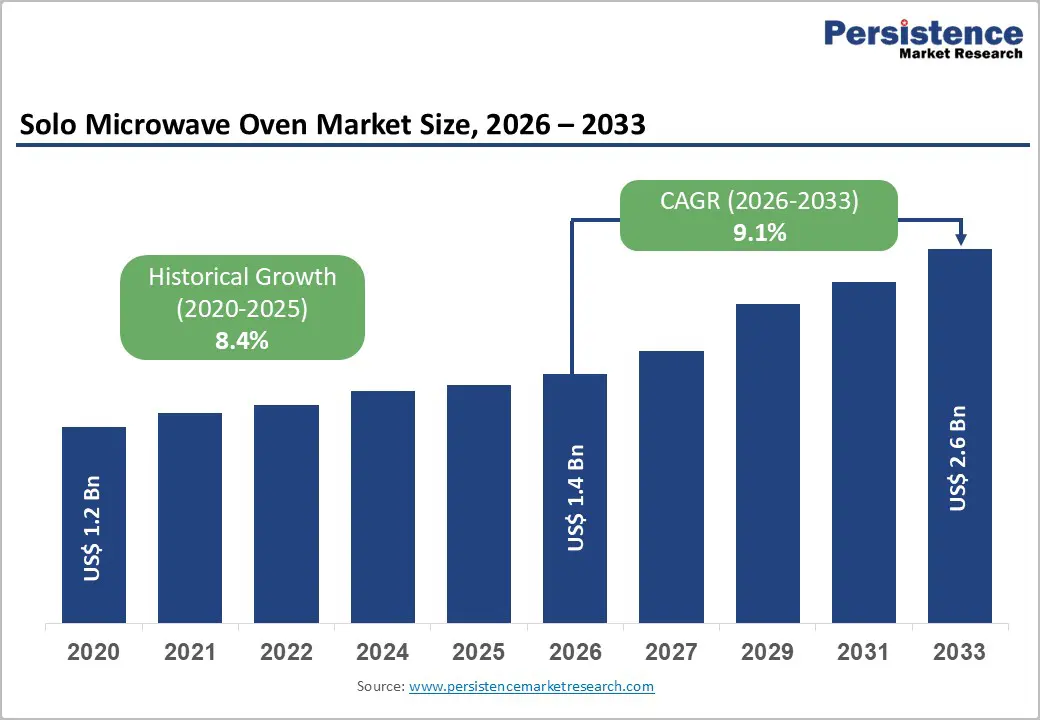
The global solo microwave oven market size is expected to be valued at US$ 1.4 billion in 2026 and projected to reach US$ 2.6 billion by 2033, growing at a CAGR of 9.1% between 2026 and 2033.

Urbanization and busy lifestyles are driving demand for compact, easy-to-use cooking appliances that simplify everyday meal preparation. Solo microwave ovens, known for their efficiency in basic heating, cooking, and defrosting tasks, are increasingly preferred in households and small commercial spaces. Rising disposable incomes in emerging economies and a focus on energy-efficient appliances, typically 700-1000 watts, further support market expansion.

Key Industry Highlights:

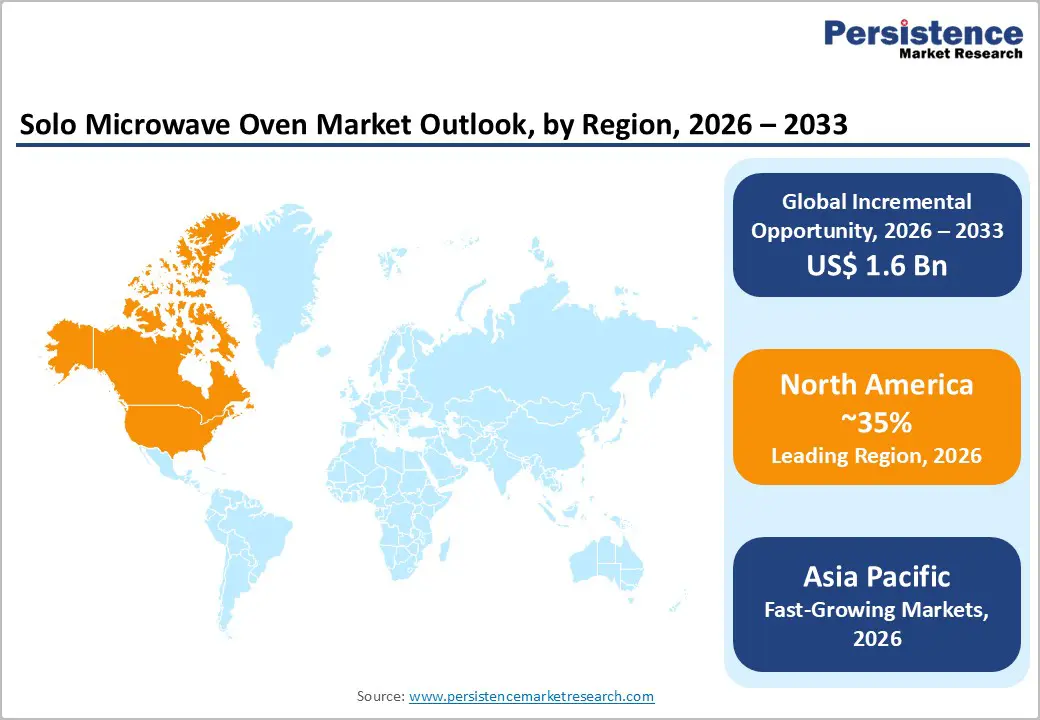
  • Leading Region: North America dominates the solo microwave oven market with a 35% share in 2025, supported by high household penetration and technological innovation.
  • Fastest-Growing Region: Asia Pacific is the fastest-growing region with a 12% CAGR (2025 - 2032), driven by urbanization and cost-efficient manufacturing hubs.
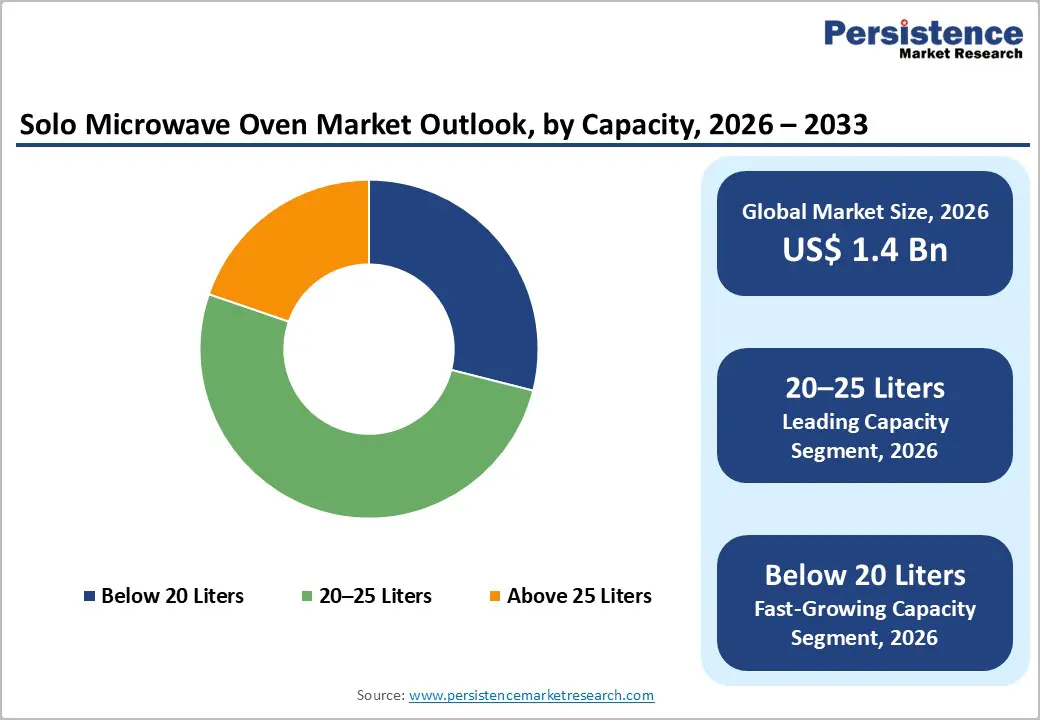
  • Leading Category Capacity: The 20-25 liter segment leads with a 45% market share in 2025, preferred by urban families for its balanced size and versatility.
  • Fastest-Growing Installation Type: Countertop installations grow fastest, driven by convenience, plug-and-play use, and rising demand in rental housing markets.
  • Key Market Opportunity: Smart IoT integrations in solo microwaves present a significant growth opportunity, projected to boost demand by 20% by 2030.
Key Insights Details
Solo Microwave Oven Size (2026E) US$ 1.4 billion
Market Value Forecast (2033F) US$ 2.6 billion
Projected Growth CAGR (2026 - 2033) 9.1%
Historical Market Growth (2020 - 2025) 8.4%

solo-microwave-oven-market-size-2026-2033-001

Market Dynamics

Drivers - Rising Demand for Compact and Convenient Kitchen Appliances in Urban Households

Urbanization and the growth of smaller living spaces are driving significant demand for compact, efficient kitchen appliances. Solo microwave ovens, designed for basic heating, defrosting, and cooking, fit perfectly into apartments, dormitories, and single-person households. Their small footprint allows consumers to save valuable kitchen space while still meeting daily cooking needs. The convenience and portability of these appliances make them ideal for fast-paced urban lifestyles.

Consumer preferences increasingly favor simple, easy-to-use solutions that offer functionality without complexity. Solo microwaves cater to this trend by providing reliable performance for everyday tasks. As a result, adoption rates continue to rise, particularly in rapidly urbanizing regions, fueling market growth. The combination of convenience, space efficiency, and affordability makes these ovens highly attractive to modern households.

Energy Efficiency Standards and Increasing Consumer Awareness Driving Adoption of Solo Microwaves

Global focus on energy efficiency and sustainability is shaping consumer choices, boosting the adoption of solo microwave ovens. These appliances typically operate at lower wattages (700-1000 W) compared to convection or grill models, making them cost-effective and environmentally friendly. Many regions enforce energy labeling and efficiency standards, promoting A-rated solo microwaves that consume up to 30% less power, helping households reduce energy costs.

Rising awareness of energy consumption and environmental impact has led consumers to prioritize efficiency when selecting kitchen appliances. Solo microwaves satisfy both financial and ecological considerations, aligning with sustainability goals. This combination of lower operating costs, compliance with energy regulations, and environmentally conscious consumer behavior is contributing to steady, long-term growth in the global solo microwave oven market.

Restraints - High Initial Costs and Maintenance Concerns Limiting Adoption of Solo Microwave Ovens

Premium solo microwave ovens equipped with advanced features often come at higher price points, which can deter budget-conscious consumers. Rising appliance costs, influenced by global supply chain disruptions, have made even entry-level models less affordable in developing regions. This cost barrier limits market penetration, particularly among low- and middle-income households that prioritize value over additional functionality.

Maintenance requirements further restrict adoption, as repairs especially for components like magnetrons can cost between US$ 150 and 300. The perceived risk of high upkeep discourages consumers from investing in solo microwaves, slowing growth in price-sensitive markets. Together, elevated initial costs and ongoing maintenance concerns act as significant restraints, particularly in regions where affordability is a critical factor in appliance purchasing decisions.

Competition from Multi-Function Ovens Posing Challenges to Solo Microwave Growth

Multi-function ovens that combine microwave, grill, and convection capabilities are increasingly appealing to consumers seeking all-in-one solutions. These versatile appliances captured a substantial share of the small appliance market, offering users the convenience of multiple cooking functions within a single device. Their growing popularity reduces the relative demand for basic solo microwave ovens in both residential and commercial settings.

In commercial environments, where kitchen space is often limited, multi-function ovens provide a more efficient alternative, further challenging the solo segment. This shift in consumer preference toward integrated, multifunctional appliances creates a competitive restraint on solo microwave oven growth. As versatility becomes a key purchase criterion, standalone solo models face increasing pressure in mature and space-conscious markets.

Opportunities - Expansion of Solo Microwave Oven Sales into Rapidly Growing Emerging Markets

Emerging markets, particularly in Asia Pacific, offer significant growth opportunities for solo microwave ovens, driven by rapid urbanization and rising disposable incomes. Mid-sized models, such as the 20-25 liter capacity segment, are especially popular among residential users in apartments and small homes. Targeting these consumers with affordable, compact models allows manufacturers to increase market penetration while supporting local production growth.

Government incentives and policies promoting energy-efficient appliances further enhance adoption in these regions. As urban populations expand, demand for space-saving, low-power cooking solutions rises, creating a favorable environment for solo microwave ovens. With strategic pricing and distribution, manufacturers can capitalize on these trends to capture new customers and strengthen their presence in high-growth emerging markets.

Technological Advancements and Integration of Smart Features Driving Market Growth

The integration of IoT, app-based controls, and smart features is creating new growth avenues for solo microwave ovens, particularly in countertop installations. By 2025, over 25 billion connected devices are expected worldwide, enabling remote operation, energy monitoring, and personalized cooking programs. Smart ovens with voice compatibility or app controls appeal to tech-savvy residential and commercial users alike.

These developments allow manufacturers to target the expanding smart kitchen segment, which is projected to contribute a 20% market uplift by 2030. The adoption of smart functionalities not only enhances user convenience but also opens additional revenue streams, positioning solo microwave ovens as essential components in modern connected households and commercial kitchens.

Category-wise Analysis

Capacity Insights

The 20-25 liter segment leads the market with a 45% share in 2025, offering an ideal balance between capacity and compact design. This size is suitable for small families, typically 3-4 members, and fits well in urban homes across Europe and Asia. Its versatility for reheating meals and defrosting, combined with countertop compatibility, enhances its appeal in apartments, solidifying its dominance among residential consumers.

The fastest-growing segment is the below 20-liter capacity, favored by single-person households and smaller kitchens. Its compact footprint and portability make it highly suitable for dormitories, studio apartments, and shared living spaces. Growing urbanization and the trend of minimalistic kitchen setups are driving adoption, as users increasingly seek appliances that deliver essential microwave functions without occupying significant space.

Installation Type Insights

Countertop installations dominate with a 60% share in 2025, due to easy setup without the need for structural modifications. Most modern urban homes provide dedicated counter space for plug-and-play appliances, making countertop models highly convenient. Their affordability, mobility, and suitability for small kitchens contribute to widespread residential adoption, reinforcing the segment’s market leadership amid rising rental housing trends.

The fastest-growing installation type is built-in microwaves, increasingly chosen for integrated kitchen designs. These models appeal to consumers looking for seamless aesthetics and space optimization in premium apartments and modern homes. As kitchen remodeling and customization become more common, built-in solo ovens are gaining traction, particularly among households that value design, convenience, and a clean, modern appearance.

End-user Insights

Residential users hold a dominant 70% share in 2025, driven by post-pandemic cooking habits and demand for quick meal preparation. Globally, 90% of households use microwaves daily for convenience, with urban adoption at 55%. Busy professionals and small families favor solo microwave ovens for their simple, fast, and reliable operation, keeping this segment well ahead of commercial applications.

The fastest-growing end-user segment is commercial kitchens, including cafes, offices, and small restaurants. These environments increasingly adopt solo microwaves for quick heating tasks and staff convenience, especially in compact spaces. The trend of fast-service and ready-to-eat meals is encouraging commercial establishments to invest in standalone microwave ovens to streamline operations and reduce dependency on larger, multifunctional cooking appliances.

Distribution Channel Insights

Offline channels lead with a 55% share in 2025, as physical stores allow consumers to inspect features, compare models, and seek guidance before purchase. In North America, 65% of appliance sales occur through brick-and-mortar stores, where warranty assurance and hands-on experience drive trust, particularly among first-time buyers.

The fastest-growing channel is online retail, driven by e-commerce convenience, easy doorstep delivery, and a wide selection of brands and models. Online platforms are increasingly used by tech-savvy and younger consumers who prefer digital comparison, customer reviews, and quick access to promotions. The rising adoption of smartphones and internet connectivity accelerates growth in this segment, making it a key avenue for future market expansion.
solo-microwave-oven-market-outlook-by-capacity-2026-2033-002

Regional Insights

North America Solo Microwave Oven Market Trends and Insights

North America leads the global solo microwave oven market with a 35% share in 2025, anchored by the United States, which has over 80 million microwave-owning households. Energy Star certifications and Department of Energy standards encourage innovation and efficiency, ensuring that appliances meet strict energy consumption requirements. The region’s well-established ecosystem supports R&D, with smart home integrations in states like California driving upgrades to modern, energy-efficient solo models.

The fastest-growing trend in North America is the adoption of smart and IoT-enabled solo microwaves. Consumers increasingly prefer connected devices that allow remote operation, app control, and voice compatibility. This trend is particularly strong in urban households and tech-savvy residential users, creating opportunities for manufacturers to introduce innovative, feature-rich products that enhance convenience while maintaining energy efficiency.

Europe Solo Microwave Oven Market Trends and Insights

Europe shows steady growth in the solo microwave oven market, with a projected CAGR of 9% between 2025 and 2032. Germany and the U.K. lead in adoption, supported by 92% household penetration and regulatory measures such as EU energy labeling, which favor low-wattage solo models. France and Spain benefit from rising tourism and urban residential demand, further supporting market expansion. The U.K.’s initiatives to cut household energy consumption by 25% highlight the focus on sustainability and appliance efficiency.

The fastest-growing segment in Europe is the mid-sized 20-25 liter solo microwave category, driven by urban households and small families seeking compact, versatile appliances. Demand is also rising for countertop models with energy-efficient designs, reflecting the combination of regulatory encouragement and increasing consumer awareness of energy savings. Manufacturers can leverage these trends to strengthen regional market share.

Asia Pacific Solo Microwave Oven Market Trends and Insights

Asia Pacific is the fastest-growing region in the solo microwave oven market, capturing a 31% share in 2025 and registering a high adoption rate due to rapid urbanization and rising disposable incomes. China, Japan, and India lead the market, with ASEAN countries benefiting from lower manufacturing costs that reduce appliance prices by up to 20%. China’s exports surged 18% in 2024, supported by government incentives, while India’s urban population growth drives online and retail sales.

The fastest-growing trend in Asia Pacific is the increasing adoption of online distribution channels and affordable countertop models targeting urban young professionals. Consumers seek compact, energy-efficient microwaves that suit small apartments and fast-paced lifestyles. Manufacturers focusing on digital marketing, e-commerce availability, and cost-effective designs are positioned to capitalize on the region’s rapid urbanization and expanding middle-class demand.
solo-microwave-oven-market-outlook-by-region-2026-2033

Competitive Landscape

The solo microwave oven market is moderately consolidated, with leading players focusing on innovation in energy efficiency and smart technologies to differentiate their offerings. Companies are investing in R&D to enhance performance, integrate IoT and app controls, and improve user convenience, while targeting both residential and commercial segments.

Expansion strategies include setting up local manufacturing in high-growth regions and introducing advanced features such as inverter technology for precise cooking. Emerging models are exploring subscription-based services and value-added functionalities, increasing competition in budget and mid-range segments. This dynamic landscape encourages continual innovation and positions manufacturers to capture evolving consumer preferences globally.

Key Developments:

  • In January 2025, LG Electronics launched a new energy-efficient solo microwave series designed to comply with updated EU energy standards. The range targets residential users, offering compact designs and reduced power consumption for sustainable, everyday cooking.
  • In June 2024, Samsung introduced IoT-enabled countertop solo microwave models in the Asia Pacific region. These appliances feature remote control via mobile apps, smart scheduling, and enhanced connectivity, catering to tech-savvy consumers seeking convenience and integration with smart home ecosystems.
  • In October 2023, Panasonic expanded its built-in solo microwave oven lineup in North America. The new models include antimicrobial interiors, advanced safety features, and modern aesthetics, appealing to residential kitchens focused on hygiene, space efficiency, and reliable cooking performance.

Companies Covered in Solo Microwave Oven Market

  • LG Electronics
  • Samsung Electronics
  • Panasonic Corporation
  • Whirlpool Corporation
  • Electrolux
  • Sharp Corporation
  • Midea Group
  • Toshiba
  • Haier Group
  • Galanz
  • Robert Bosch GmbH
  • Siemens AG
  • Breville Group
  • GE Appliances
  • Teka Group
Frequently Asked Questions

The global solo microwave oven market is expected to reach US$ 1.4 billion in 2026.

Urbanization and energy efficiency regulations drive demand, with compact designs suiting busy lifestyles and standards promoting low-wattage models.

North America leads with 35% share in 2025, supported by high penetration and U.S. innovation.

IoT smart features offer growth, forecasting 20% uplift by 2030 in connected kitchens.

Leading companies include LG Electronics, Samsung Electronics, Panasonic, and Whirlpool, focusing on efficiency and smart tech.

Solo Microwave Oven Market Report Scope
Report Attributes Details
Historical Data/Actuals 2020 - 2025
Forecast Period 2026 - 2033
Market Analysis Units Value: US$ Bn, Volume: As Applicable
Geographical Coverage
  • North America
  • Europe
  • East Asia
  • South Asia & Oceania
  • Latin America
  • Middle East & Africa
Segmental Coverage
  • Capacity
  • Installation Type
  • End User
  • Distribution Channel
  • Region
Competitive Analysis
  • LG Electronics
  • Samsung Electronics
  • Panasonic Corporation
  • Whirlpool Corporation
  • Electrolux
  • Sharp Corporation
  • Midea Group
  • Toshiba
  • Haier Group
  • Galanz
  • Robert Bosch GmbH
  • Siemens AG
  • Breville Group
  • GE Appliances
  • Teka Group
Report Highlights
  • Market Forecast and Trends
  • Competitive Intelligence and Share Analysis
  • Growth Factors and Challenges
  • Strategic Growth Initiatives
  • Pricing Analysis
  • Future Opportunities and Revenue Pockets
  • Market Analysis Tools
Market Segmentation

By Capacity

  • Below 20 Liters
  • 20-25 Liters
  • Above 25 Liters

By Installation Type

  • Countertop
  • Built-in

By End User

  • Residential
  • Commercial

By Distribution Channel

  • Online
  • Offline

By Regions

  • North America
  • Europe
  • Asia Pacific
  • Latin America
  • Middle East & Africa

Related Reports

  1. Executive Summary
    1. Global Solo Microwave Oven Market Snapshot 2026 and 2033
    2. Market Opportunity Assessment, 2026-2033, US$ Bn
    3. Key Market Trends
    4. Industry Developments and Key Market Events
    5. Demand Side and Supply Side Analysis
    6. PMR Analysis and Recommendations
  2. Market Overview
    1. Market Scope and Definitions
    2. Market Dynamics
      1. Driver
      2. Restraint
      3. Opportunities
      4. Trends
    3. Macro-Economic Factors
      1. Global GDP Outlook
      2. Global Prison Growth Outlook
      3. Global Crime Rates by Country
      4. Global Prison Population by Country
      5. Global Private Prison Market Growth Outlook
      6. Other Macro-economic Factors
    4. Forecast Factors - Relevance and Impact
    5. COVID-19 Impact Assessment
  3. Value Added Insights
    1. Value Chain analysis
    2. Key Market Players
    3. Product Adoption Analysis
    4. Key Promotional Strategies by key players
    5. PESTLE Analysis
    6. Porter's Five Forces Analysis
    7. Regulatory and Technology Landscape
  4. Price Trend Analysis, 2025
    1. Region-wise Price Analysis
    2. Price by Segments
    3. Price Impact Factors
  5. Global Solo Microwave Oven Market Outlook: Historical (2020 - 2025) and Forecast (2026 - 2033)
    1. Key Highlights
    2. Global Solo Microwave Oven Market Outlook: Capacity
      1. Introduction/Key Findings
      2. Historical Market Size (US$ Bn) and Volume (Units) Analysis by Capacity, 2020-2025
      3. Current Market Size (US$ Bn) and Volume (Units) Forecast, by Capacity, 2026-2033
        1. Below 20 Liters
        2. 20-25 Liters
        3. Above 25 Liters
      4. Market Attractiveness Analysis: Capacity
    3. Global Solo Microwave Oven Market Outlook: Installation Type
      1. Introduction/Key Findings
      2. Historical Market Size (US$ Bn) and Volume (Units) Analysis by Installation Type, 2020-2025
      3. Current Market Size (US$ Bn) and Volume (Units) Forecast, by Installation Type, 2026-2033
        1. Countertop
        2. Built-in
      4. Market Attractiveness Analysis: Installation Type
    4. Global Solo Microwave Oven Market Outlook: End User
      1. Introduction/Key Findings
      2. Historical Market Size (US$ Bn) and Volume (Units) Analysis by End User, 2020-2025
      3. Current Market Size (US$ Bn) and Volume (Units) Forecast, by End User, 2026-2033
        1. Residential
        2. Commercial
      4. Market Attractiveness Analysis: End User
    5. Global Solo Microwave Oven Market Outlook: Distribution Channel
      1. Introduction/Key Findings
      2. Historical Market Size (US$ Bn) and Volume (Units) Analysis by Distribution Channel, 2020-2025
      3. Current Market Size (US$ Bn) and Volume (Units) Forecast, by Distribution Channel, 2026-2033
        1. Online
        2. Offline
      4. Market Attractiveness Analysis: Distribution Channel
  6. Global Solo Microwave Oven Market Outlook: Region
    1. Key Highlights
    2. Historical Market Size (US$ Bn) and Volume (Units) Analysis by Region, 2020-2025
    3. Current Market Size (US$ Bn) and Volume (Units) Forecast, by Region, 2026-2033
      1. North America
      2. Europe
      3. East Asia
      4. South Asia & Oceania
      5. Latin America
      6. Middle East & Africa
    4. Market Attractiveness Analysis: Region
  7. North America Solo Microwave Oven Market Outlook: Historical (2020 - 2025) and Forecast (2026 - 2033)
    1. Key Highlights
    2. Pricing Analysis
    3. North America Market Size (US$ Bn) and Volume (Units) Forecast, by Country, 2026-2033
      1. U.S.
      2. Canada
    4. North America Market Size (US$ Bn) and Volume (Units) Forecast, by Capacity, 2026-2033
      1. Below 20 Liters
      2. 20-25 Liters
      3. Above 25 Liters
    5. North America Market Size (US$ Bn) and Volume (Units) Forecast, by Installation Type, 2026-2033
      1. Countertop
      2. Built-in
    6. North America Market Size (US$ Bn) and Volume (Units) Forecast, by End User, 2026-2033
      1. Residential
      2. Commercial
    7. North America Market Size (US$ Bn) and Volume (Units) Forecast, by Distribution Channel, 2026-2033
      1. Online
      2. Offline
  8. Europe Solo Microwave Oven Market Outlook: Historical (2020 - 2025) and Forecast (2026 - 2033)
    1. Key Highlights
    2. Pricing Analysis
    3. Europe Market Size (US$ Bn) and Volume (Units) Forecast, by Country, 2026-2033
      1. Germany
      2. Italy
      3. France
      4. U.K.
      5. Spain
      6. Russia
      7. Rest of Europe
    4. Europe Market Size (US$ Bn) and Volume (Units) Forecast, by Capacity, 2026-2033
      1. Below 20 Liters
      2. 20-25 Liters
      3. Above 25 Liters
    5. Europe Market Size (US$ Bn) and Volume (Units) Forecast, by Installation Type, 2026-2033
      1. Countertop
      2. Built-in
    6. Europe Market Size (US$ Bn) and Volume (Units) Forecast, by End User, 2026-2033
      1. Residential
      2. Commercial
    7. Europe Market Size (US$ Bn) and Volume (Units) Forecast, by Distribution Channel, 2026-2033
      1. Online
      2. Offline
  9. East Asia Solo Microwave Oven Market Outlook: Historical (2020 - 2025) and Forecast (2026 - 2033)
    1. Key Highlights
    2. Pricing Analysis
    3. East Asia Market Size (US$ Bn) and Volume (Units) Forecast, by Country, 2026-2033
      1. China
      2. Japan
      3. South Korea
    4. East Asia Market Size (US$ Bn) and Volume (Units) Forecast, by Capacity, 2026-2033
      1. Below 20 Liters
      2. 20-25 Liters
      3. Above 25 Liters
    5. East Asia Market Size (US$ Bn) and Volume (Units) Forecast, by Installation Type, 2026-2033
      1. Countertop
      2. Built-in
    6. East Asia Market Size (US$ Bn) and Volume (Units) Forecast, by End User, 2026-2033
      1. Residential
      2. Commercial
    7. East Asia Market Size (US$ Bn) and Volume (Units) Forecast, by Distribution Channel, 2026-2033
      1. Online
      2. Offline
  10. South Asia & Oceania Solo Microwave Oven Market Outlook: Historical (2020 - 2025) and Forecast (2026 - 2033)
    1. Key Highlights
    2. Pricing Analysis
    3. South Asia & Oceania Market Size (US$ Bn) and Volume (Units) Forecast, by Country, 2026-2033
      1. India
      2. Southeast Asia
      3. ANZ
      4. Rest of SAO
    4. South Asia & Oceania Market Size (US$ Bn) and Volume (Units) Forecast, by Capacity, 2026-2033
      1. Below 20 Liters
      2. 20-25 Liters
      3. Above 25 Liters
    5. South Asia & Oceania Market Size (US$ Bn) and Volume (Units) Forecast, by Installation Type, 2026-2033
      1. Countertop
      2. Built-in
    6. South Asia & Oceania Market Size (US$ Bn) and Volume (Units) Forecast, by End User, 2026-2033
      1. Residential
      2. Commercial
    7. South Asia & Oceania Market Size (US$ Bn) and Volume (Units) Forecast, by Distribution Channel, 2026-2033
      1. Online
      2. Offline
  11. Latin America Solo Microwave Oven Market Outlook: Historical (2020 - 2025) and Forecast (2026 - 2033)
    1. Key Highlights
    2. Pricing Analysis
    3. Latin America Market Size (US$ Bn) and Volume (Units) Forecast, by Country, 2026-2033
      1. Brazil
      2. Mexico
      3. Rest of LATAM
    4. Latin America Market Size (US$ Bn) and Volume (Units) Forecast, by Capacity, 2026-2033
      1. Below 20 Liters
      2. 20-25 Liters
      3. Above 25 Liters
    5. Latin America Market Size (US$ Bn) and Volume (Units) Forecast, by Installation Type, 2026-2033
      1. Countertop
      2. Built-in
    6. Latin America Market Size (US$ Bn) and Volume (Units) Forecast, by End User, 2026-2033
      1. Residential
      2. Commercial
    7. Latin America Market Size (US$ Bn) and Volume (Units) Forecast, by Distribution Channel, 2026-2033
      1. Online
      2. Offline
  12. Middle East & Africa Solo Microwave Oven Market Outlook: Historical (2020 - 2025) and Forecast (2026 - 2033)
    1. Key Highlights
    2. Pricing Analysis
    3. Middle East & Africa Market Size (US$ Bn) and Volume (Units) Forecast, by Country, 2026-2033
      1. GCC Countries
      2. South Africa
      3. Northern Africa
      4. Rest of MEA
    4. Middle East & Africa Market Size (US$ Bn) and Volume (Units) Forecast, by Capacity, 2026-2033
      1. Below 20 Liters
      2. 20-25 Liters
      3. Above 25 Liters
    5. Middle East & Africa Market Size (US$ Bn) and Volume (Units) Forecast, by Installation Type, 2026-2033
      1. Countertop
      2. Built-in
    6. Middle East & Africa Market Size (US$ Bn) and Volume (Units) Forecast, by End User, 2026-2033
      1. Residential
      2. Commercial
    7. Middle East & Africa Market Size (US$ Bn) and Volume (Units) Forecast, by Distribution Channel, 2026-2033
      1. Online
      2. Offline
  13. Competition Landscape
    1. Market Share Analysis, 2025
    2. Market Structure
      1. Competition Intensity Mapping
      2. Competition Dashboard
    3. Company Profiles
      1. LG Electronics
        1. Company Overview
        2. Product Portfolio/Offerings
        3. Key Financials
        4. SWOT Analysis
        5. Company Strategy and Key Developments
      2. Samsung Electronics
      3. Panasonic Corporation
      4. Whirlpool Corporation
      5. Electrolux
      6. Sharp Corporation
      7. Midea Group
      8. Toshiba
      9. Haier Group
      10. Galanz
      11. Robert Bosch GmbH
      12. Siemens AG
      13. Breville Group
      14. GE Appliances
      15. Teka Group
  14. Appendix
    1. Research Methodology
    2. Research Assumptions
    3. Acronyms and Abbreviations

Research Methodology Framework for Market Research Excellence

At Persistence Market Research, we implement a comprehensive, validated, and multi-dimensional approachto market analysis that delivers actionable insights across complex market landscapes. Our methodology combines the analytical rigor of leading consulting firms with innovative research techniques, ensuring robust market assessments that guide strategic decision-making with confidence.

Core Research Philosophy

Our methodology is built on four foundational pillars:

Research Philosophy Image

At Persistence Market Research, our methodology is designed to transcend conventional market studies by combining analytical rigor, multi-source validation, and future-focused insights.

We integrate advanced research frameworks, robust data collection strategies, cutting-edge analytics, and innovative technologies to deliver a 360-degree view of complex markets.

We integrate advanced research frameworks, robust data collection strategies, cutting-edge analytics, and innovative technologies to deliver a 360-degree view of complex markets.

Each stage spanning from strategic scoping and hypothesis-building to competitive intelligence, quality validation, and actionable recommendations is engineered to provide clients with unmatched clarity, precision, and confidence in decision-making.

By embedding innovation and technology at the core, our approach ensures that insights are not only comprehensive but also predictive, empowering businesses to seize opportunities, mitigate risks, and achieve sustainable growth

Research Philosophy Image

Capturing Key Information and Events

During this phase, key research objectives focus on essential information and data points for assessing the market, including:

Research Philosophy Image

TAM-SAM-SOM Framework Implementation

We employ both top-down and bottom-up approaches to ensure accurate market sizing.

Top-Down Market SizingBottom-Up Market Sizing
Universe Definition: Total global/regional market identificationUnit Economics: Average transaction values, purchase frequencies, customer lifecycle
Segmentation Filters: Geographic, demographic, and behavioral constraintsCustomer Segmentation: Detailed buyer persona development and sizing
Market Share Analysis: Competitive landscape assessment and share allocationPenetration Analysis: Market penetration rates by segment and geography
Growth Rate Application: Historical trends and forward-looking growth assumptionsScaling Methodology: Extrapolation techniques with confidence intervals

Validation & Cross-Verification

  • Triangulation: Comparing top-down and bottom-up results for consistency
  • Sensitivity Analysis: Testing key assumptions and parameter variations
  • Peer Benchmarking: Comparison with analogous markets and industry benchmarks
  • Expert Review: External validation through industry specialist consultation

Research Philosophy Image

Forecasting & Projection Modeling

Our proprietary forecasting models incorporate multiple variables and scenarios.

Forecasting Components

  • Historical Trend Analysis: 10-year historical growth patterns and cyclical variations
  • Driver-Based Modeling: Economic indicators, demographic shifts, technology adoption
  • Scenario Planning: Base case, optimistic, and conservative projections
  • Monte Carlo Simulations: Probability-weighted outcomes and risk assessments

Model Validation

  • Back-Testing: Historical accuracy assessment over 3–5-year periods
  • Cross-Validation: Multiple modeling approaches for result comparison
  • External Benchmarking: Comparison with established market forecasts
  • Continuous Calibration: Quarterly model updates based on new data

Comprehensive Data Collection Strategy

Our secondary research phase establishes a robust knowledge base utilizing diverse, credible sources.

Secondary Data Sourcess

  • Industry Publications & Reports
  • Government & Regulatory Data
  • Financial Intelligence (filings & reports)
  • Academic Research & Digital Intelligence

Quality Assurance Protocol

  • Source credibility assessment and publication date validation
  • Data consistency checks across multiple sources
  • Bias identification and neutralization techniques
  • Information gap tracking for primary research prioritization

Research Philosophy Image

Primary Research Excellence

Our primary research methodology employs best-in-class techniques to capture unique market insights.

Quantitative Research Methods

  • Large-Scale Surveys: Statistically representative samples with 95% confidence intervals
  • Survey Methodology: Multi-channel deployment (online, telephone, in-person)
  • Question Architecture and Response Optimization

Qualitative Research Methods

  • Executive Interviews
  • Focus Groups
  • Expert Consultations

Quality Assurance & Validation Framework

Multi-Stage Validation Process

  • Source Verification and Consistency Testing
  • Outlier Detection and Bias Assessment
  • Peer Review Process and External Validation
  • Sensitivity Analysis and Confidence Intervals

Research Philosophy Image

Methodology Validation & Credibility

Our research methodology has been extensively validated through:

  • Academic Partnerships: Collaborations with top-tier business schools and research institutions
  • Client Success Stories: Documented case studies demonstrating research impact and ROI
  • Continuous Benchmarking: Performance comparison with leading global research firms

This comprehensive methodology framework positions Persistence Market Research at the forefront of market intelligence, combining the analytical sophistication of top-tier consulting firms with innovative research techniques. Our approach ensures that every market assessment delivers precise, actionable, and strategically valuable insights that drive business success in competitive market environments.

Ready to unlock your market potential? Contact our research experts to discuss how our validated methodology can transform your strategic decision-making with data-driven market intelligence.

Copyright © 2026 Persistence Market Research. All Rights Reserved

Connect With Us -
Solo Microwave Oven Market Size, Share & Analysis, 2033