




- Home Appliances
- Electric Kettle Market
Electric Kettle Market Size, Share, and Growth Forecast 2026 - 2033
Electric Kettle Market by Capacity (Less Than 1.0 L, 1.0-1.5 L, More Than 1.5 L), Application (Residential, Commercial), Material Type (Stainless Steel, Plastic, Glass, Others), and Regional Analysis for 2026 - 2033

Electric Kettle Market Size and Trend Analysis
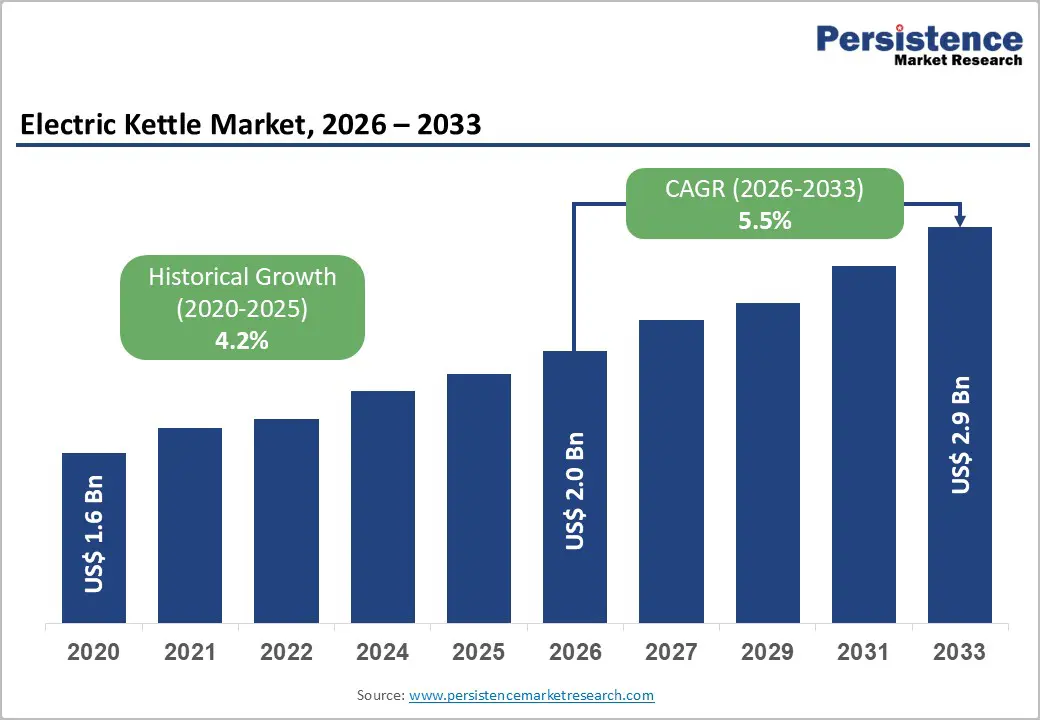
The global electric kettle market size is expected to be valued at approximately US$ 2.04 billion in 2026 and is projected to reach US$ 2.9 billion by 2033, growing at a CAGR of 5.5% between 2026 and 2033. This sustained growth is anchored in the accelerating consumer shift from stovetop kettles and conventional heating appliances to electric kettles, driven by energy-efficiency awareness, convenience preferences in time-pressed urban lifestyles, and the global proliferation of tea and specialty hot-beverage culture beyond its traditional UK and Asia-Pacific strongholds.
Key Industry Highlights:
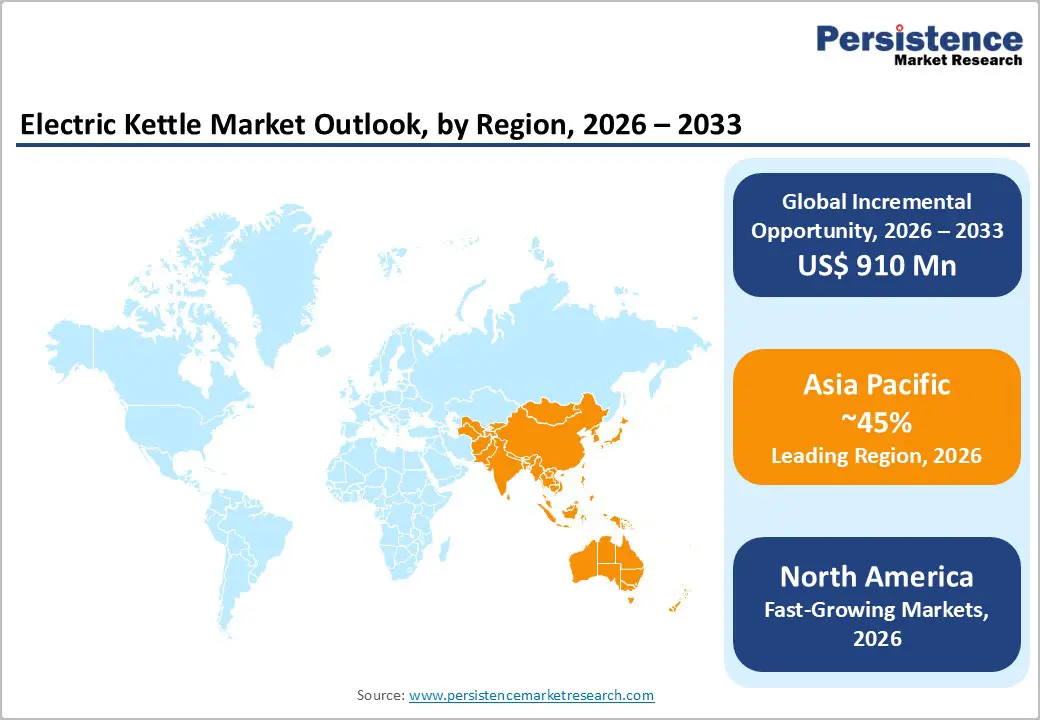
- Leading Region - Asia Pacific commands approximately 45% of the global electric kettle market in 2025, anchored by China's world-scale production and consumption, Japan's technically advanced premium segment, and India and Southeast Asia's rapidly expanding first-time buyer middle class, driving above-market growth rates.
- Fastest Growing Region - North America is a late but accelerating adopter of electric kettles, historically dominated by drip coffee makers that precluded a strong electric kettle category where the specialty coffee and premium tea renaissance of the past decade is converting a previously underserved appliance category into a meaningful growth segment.
- Dominant Capacity Segment - The 1.0-1.5 L capacity range leads with approximately 55% market share in 2025, entrenched as the universal household standard with optimal speed-per-boil-cycle performance at 2,200-2,400W heating elements, validated by Philips, Russell Hobbs, and Tefal reporting it as their highest-volume capacity SKU.
- Fastest Growing Segment - Smart electric kettles with Wi-Fi/Bluetooth connectivity and app control are the fastest-growing premium sub-category, with Matter protocol certification enabling cross-ecosystem integration and consumer willingness to pay 40-80% price premiums validated by Breville and Smarter commercial performance data.
- Key Market Opportunity: Asia Pacific's 3.5 billion middle class by 2030 (ADB projection) largely first-time kettle buyers with deep tea culture heritage combined with Tmall, JD.com, Flipkart, and Shopee channel growth, creates the market's largest volume expansion opportunity for brands who invest in localized pricing and e-commerce distribution now.
DRO Analysis
Drivers - Urbanization and Time-Constrained Lifestyles Are Elevating Electric Kettle Adoption as a Kitchen Convenience Standard Across Emerging Markets
The global urbanization trend, with the United Nations projecting that 68% of the world's population will reside in urban areas by 2050, is creating structural demand for kitchen appliances that deliver speed, convenience, and minimal space footprint as the primary purchase criteria in households where breakfast preparation windows are measured in minutes rather than tens of minutes.
Electric kettles meet this demand profile with unmatched specificity: their 2,200-3,000 watt heating elements deliver boiling water in 90 seconds to 3 minutes, depending on capacity a speed advantage over stovetop methods that is compelling for the dual-income urban households that constitute the fastest-growing consumer demographic across China, India, Southeast Asia, and Brazil.
Premium Tea and Specialty Hot Beverage Culture Is Driving Above-Entry-Level Electric Kettle Adoption with Variable Temperature Control Features
The global specialty tea and artisan coffee culture encompassing pour-over coffee, Japanese matcha, and premium loose-leaf tea preparation is creating measurable commercial pull for variable-temperature electric kettles that deliver precise water temperature control between 60°C and 100°C, a feature that commands USD 30-80 price premiums over standard fixed-boil models.
The Tea Association of the USA documents that specialty and premium tea consumption has grown consistently year-over-year in the United States, and the UK Tea and Infusions Association (UKITA) reports the UK remains the world's highest per-capita tea-consuming nation, in each market segment where premium tea preparation behaviours directly motivate electric kettle purchase or upgrade.
Restraints - Intense Price Competition from Low-Cost Asian Manufacturers Compresses Margins and Commoditizes the Entry-Level Segment
The electric kettle market's entry-level segment basic 1.0-1.5L plastic models at the USD 10-25 price tier faces intense commodity competition from Chinese and Southeast Asian manufacturers who have progressively commoditized standard kettle functionality, creating a structural price floor that limits volume-tier revenue growth.
This compression in entry-level products reduces total category average selling prices and makes it difficult for established Western brands, including Breville and KitchenAid to maintain premium pricing across their full product range without clear feature differentiation that justifies the price premium to value-conscious shoppers comparing options on Amazon.
Variable Voltage and Socket Standard Fragmentation Create Product Proliferation Costs and Market Entry Barriers in Emerging Geographies
Electric kettle manufacturers operating globally must manage significant product variant proliferation driven by electrical standard fragmentation, with 220-240V/50Hz standards predominant in Europe, Asia, and Africa, 120V/60Hz in North America, and multiple socket standard variants across markets. The International Electrotechnical Commission (IEC) manages global electrical standard coordination, but national adoption variations require manufacturers to produce and certify distinct product variants for major market clusters, multiplying tooling, testing, and inventory costs that particularly burden small and mid-tier brands attempting multi-region distribution.
Opportunities - Smart Connected Electric Kettles Are the Fastest-Growing Premium Segment, Integrating Wi-Fi and App Control for Smart Home Ecosystems
Smart electric kettles featuring Wi-Fi or Bluetooth connectivity, smartphone app control, voice assistant integration with Amazon Alexa and Google Home, and scheduled boil programmability represent the fastest-growing and highest-margin electric kettle product category, driven by the broader smart home appliance adoption wave and the growing consumer preference for connected kitchen device ecosystems.
The Consumer Technology Association (CTA) has documented consistent multi-year growth in connected kitchen appliance adoption in the U.S., and major kettle brands including Smarter (UK) and iKettle have demonstrated that connected kettle models command 40-80% price premiums over comparable non-connected alternatives while achieving strong repurchase intent scores from early adopters.
Asia Pacific's Expanding Middle Class and First-Time Electric Kettle Buyer Cohort Present the Market's Largest Volume Growth Opportunity
Asia Pacific is the electric kettle market's fastest-growing and most populous underpenetrated growth opportunity, where the combination of a rapidly expanding middle-class consumer base, deep tea-drinking cultural heritage, and progressive urbanization is simultaneously motivating first-time electric kettle purchases among hundreds of millions of households in India, Southeast Asia, and second- and third-tier Chinese cities.
The Asian Development Bank (ADB) projects Asia's middle class will reach 3.5 billion people by 2030, with a disproportionate share of this growth concentrated in countries including India, Indonesia, and Vietnam, where electric kettle household penetration remains well below the levels of China, Japan, and South Korea. India's rapidly expanding middle class, with urban household income rising consistently per Reserve Bank of India (RBI) economic reports, is the region's most actionable first-time buyer opportunity, where brands that establish distribution through Flipkart, Amazon India, and large format retail at accessible price points can secure early brand loyalty before the market consolidates.
Category-wise Analysis
Capacity Insights
The 1.0-1.5 L capacity range leads the market with approximately 55% market share in 2026, reflecting its optimal positioning as the universal household standard, large enough to serve 2-4 cups simultaneously for typical household or small office use, yet compact enough for modern urban kitchen counter space constraints where every centimetre of countertop is contested among competing appliances.
The 1.5L capacity ceiling aligns precisely with the maximum capacity that standard 2,200-2,400W European and Asian kettle elements can bring to boil within the 2-3-minute convenience window that consumers expect. A power-to-capacity ratio that makes larger models unnecessarily slow per boil cycle for the majority of household use cases.
Application Insights
Residential application leads the market with approximately 72% market share in 2026, anchored by the electric kettle's status as a standard-issue household small appliance in the UK, Australia, New Zealand, and progressively across Asia Pacific markets where tea preparation is a daily ritual that creates consistent, multiple-use-per-day kettle utilization patterns.
The commercial segment encompasses hospitality, office kitchens, and foodservice as the fast-growing application category, driven by hotel and business travel accommodation upgrades that specify premium stainless steel kettles for in-room amenity standards and the growing workplace hospitality culture that provides barista-quality beverage stations to attract and retain talent in competitive employment markets.
Material Type Insights
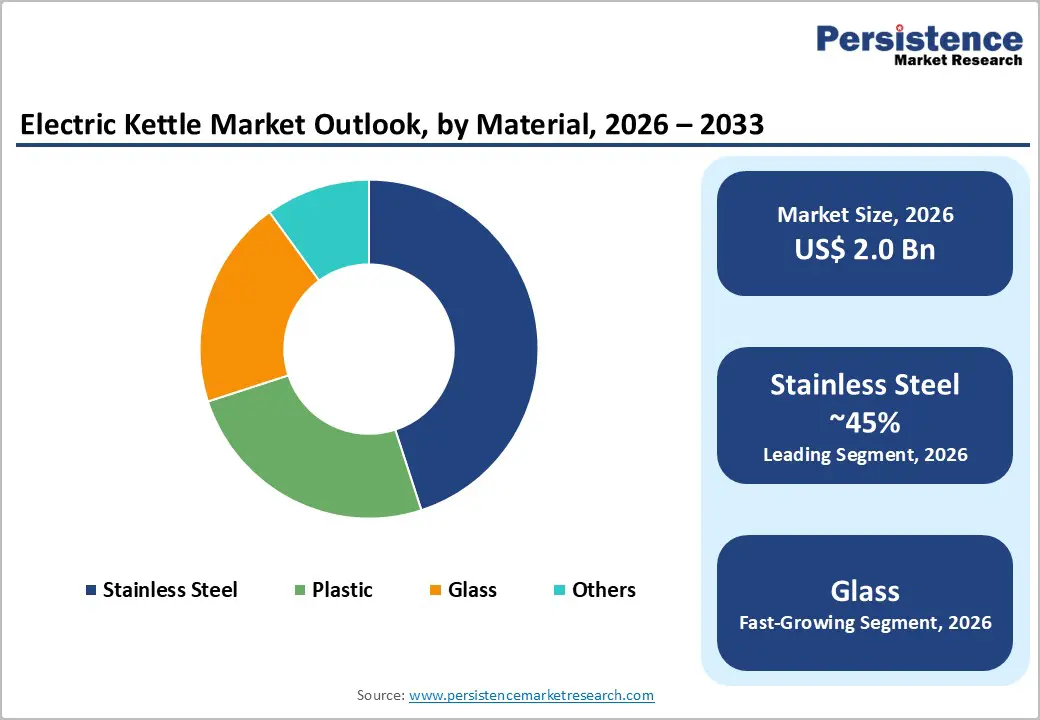
Stainless Steel leads the material type segment with approximately 44% market share in 2026, driven by its combination of premium aesthetic appeal, perceived durability and product longevity, absence of BPA and plastic leaching concerns, and compatibility with the commercial and premium residential segments where material quality is a decisive purchase criterion.
The consumer preference for stainless steel electric kettles has been amplified by growing health and safety awareness around plastic contact with hot beverages, published by the European Food Safety Authority (EFSA), including BPA migration limits that are generating consumer shift toward stainless steel alternatives. DeLonghi, Breville, and KitchenAid have each reported stainless-steel models as their highest average-selling-price kettle configurations, confirming the segment's revenue premium positioning.
Regional Analysis
North America Electric Kettle Market Trends & Analysis
North America is a late but accelerating adopter of electric kettles, historically dominated by drip coffee makers that precluded a strong electric kettle category, where the specialty coffee and premium tea renaissance of the past decade is converting a previously underserved appliance category into a meaningful growth segment. The U.S. market's penetration remains well below UK and Australian levels, presenting substantial headroom for growth as pour-over coffee, artisan tea, and wellness hot beverages normalize the need for precise-temperature electric kettles.
U.S. Electric Kettle Market Size
The United States commands approximately 80% of the North American electric kettle market, with unit sales growing steadily from a low base as specialty coffee and premium tea consumption broadens the electric kettle's appeal beyond its traditional UK-heritage buyer cohort. The U.S. market grows at approximately 5.8% CAGR through 2033, driven by variable temperature model adoption among the millennial and Gen Z consumer cohort discovering pour-over coffee and matcha through social media content.
Europe Electric Kettle Market Trends, Drivers, & Insights
Europe and the UK in particular is the world's most mature electric kettle market, where household penetration rates approach saturation and demand is driven primarily by product replacement cycles, capacity and feature upgrades, and gifting purchase occasions rather than first-time adoption. UKITA documents near-universal UK household electric kettle ownership, sustaining a large replacement demand base.
Germany Electric Kettle Market Size
Germany holds approximately 19% of the European electric kettle market, with demand driven by a quality-conscious consumer base that preferentially selects stainless steel and glass models from European brands including Siemens and Bosch (BSH Group) and international premium brands including DeLonghi and Philips. Germany's growing specialty tea and artisanal coffee culture with the number of independent specialty coffee shops growing consistently per Deutscher Kaffeeverband is driving variable-temperature kettle adoption.
U.K. Electric Kettle Market Size
The United Kingdom commands approximately 24% of the European market the region's largest by revenue with UKITA documenting near-universal household electric kettle ownership, sustaining Europe's highest annual unit replacement volume. The UK market is defined by its replacement cycle with an average kettle service life of 3-5 years driving consistent new unit procurement and by strong consumer loyalty to heritage brands including Russell Hobbs and Breville.
France Electric Kettle Market Size
France accounts for approximately 13% of the Europe, with electric kettle adoption growing as French consumer behavior shifts from traditional stovetop herbal tisane preparation toward electric kettle convenience for the country's historically strong herbal tea culture.
Tefal - headquartered in France, holds strong domestic market recognition and supports premium product upgrades. France's market growth is poised at approximately 5.2% CAGR, with glass and stainless-steel models gaining share as premium aesthetics align with French consumer design preferences.
Asia Pacific Electric Kettle Market Drivers & Analysis
Asia Pacific is the world's largest and fastest-growing electric kettle market, anchored by China's enormous consumer appliance market, Japan's mature and technically sophisticated small appliance culture, and India and Southeast Asia's rapidly expanding first-time buyer cohort. China is the world's dominant electric kettle manufacturer producing most global supply and simultaneously one of its largest domestic consumers, with tea preparation culture driving near-universal urban household penetration.
China Electric Kettle Market Size
China holds approximately 36% of the Asia Pacific electric kettle market the world's single largest national market as both the world's dominant producer and a massive domestic consumer. China's market grows at approximately 6.0% CAGR through 2033, driven by premiumization toward stainless steel and smart connected models as middle-class incomes rise, and by e-commerce channel growth on Tmall and JD.com that is progressively shifting purchases from offline appliance stores toward online, with faster model refresh cycles.
India Electric Kettle Market Size
India accounts for approximately 14% of the Asia Pacific electric kettle market and is the region's fastest-growing at approximately 7.2% CAGR through 2033. India's large and growing urban middle class with RBI data confirming consistent urban household income growth and the country's inherently deep tea culture sustain high first-time buyer conversion rates.
Japan Electric Kettle Market Size
Japan represents approximately 16% of the Asia Pacific market, operating a mature, technically advanced electric kettle segment where domestic brands, including Panasonic, Tiger Corporation, and Zojirushi, dominate through precision temperature control including variable temperature settings for specific Japanese green tea (sencha, gyokuro) preparation and premium construction quality.
Competitive Landscape
The global electric kettle market is highly fragmented at the volume tier but exhibits meaningful brand concentration at the premium segment, where Breville (Australia), DeLonghi (Italy), Philips (Netherlands), Russell Hobbs (UK/Spectrum Brands), and Tefal (France/Groupe SEB) collectively command the premium and mid-premium revenue tier across developed markets. Chinese volume manufacturers, including Midea, Xiaomi, and Haier, dominate unit volume in Asia and the entry-price tiers globally through e-commerce channels.
Strategic themes include smart home connectivity investment for premium products, stainless steel body premiumization, variable temperature feature commoditization as a mid-market standard, and direct-to-consumer brand website development to reduce retailer margin dependency.
Key Market Developments
- In February 2025, China’s home-appliance exports reached 4.48 billion units for 2024, a 20.80% year-on-year increase, under Belt and Road facilitation.
- In October 2024, Hamilton Beach posted Q3 2024 revenue of USD 156.7 million, citing premium line extensions.
Companies Covered in Electric Kettle Market
- Breville Group Limited
- Tefal (Groupe SEB)
- Philips (Koninklijke Philips N.V.)
- Russell Hobbs (Spectrum Brands)
- DeLonghi Group
- KitchenAid (Whirlpool Corporation)
- Zojirushi Corporation
- Tiger Corporation
- Panasonic Corporation
- Midea Group
- Xiaomi Corporation (Mijia)
- Smarter Technologies
- Fellow Products
- UFI Filters
Frequently Asked Questions
The global electric kettle market is valued at approximately US$ 2.04 billion in 2026. The market is projected to reach US$ 2.9 billion by 2033, expanding at a CAGR of 5.5%, driven by urbanization, premium tea and specialty coffee culture, smart home appliance adoption, and Asia Pacific's expanding middle-class first-time buyer cohort.
The primary demand drivers are global urbanization with the United Nations projecting 68% urban population by 2050 creating demand for fast, convenient kitchen appliances where electric kettles boil water in 90 seconds to 3 minutes, combined with the global specialty tea and pour-over coffee culture expansion documented by the Tea Association of the USA and UKITA sustaining consumer motivation for variable-temperature premium kettle upgrades above standard entry-level model specifications.
The 1.0-1.5 L capacity range leads with approximately 55% market share in 2025. This capacity tier dominates because it serves 2-4 cups simultaneously sufficient for typical household or small office use within the 2-3-minute boil time that consumer convenience expectations mandate, while remaining compact enough for modern urban kitchen countertop space constraints. Philips, Russell Hobbs, and Tefal each publicly report 1.5L models as their highest-volume individual SKUs globally.
Asia Pacific leads the global electric kettle market with approximately 48% revenue share in 2025. China dominates within the region at approximately 36% of Asia Pacific revenue, as both the world's largest manufacturer and a massive domestic consumer driven by tea preparation culture.
The leading companies in the global electric kettle market include Breville Group, Tefal (Groupe SEB), Philips, Russell Hobbs (Spectrum Brands), DeLonghi Group, KitchenAid (Whirlpool), Zojirushi, Tiger Corporation, Panasonic, Midea Group, Xiaomi (Mijia), Fellow Products, and Smarter Technologies.


