




- Chipsets & Processors
- Smart Motor Market
Smart Motor Market Size, Share, and Growth Forecast, 2025 - 2032
Smart Motor Market by Components (Variable Speed Drive, Control Center, Intelligent Motor, Others), Product Type (18V, 24V, 36V, 48V, Others), End-use (Industrial, Automotive, Consumer Electronics, Aerospace & Defense, Others), and Regional Analysis for 2025 - 2032

Smart Motor Market and Trend Analysis
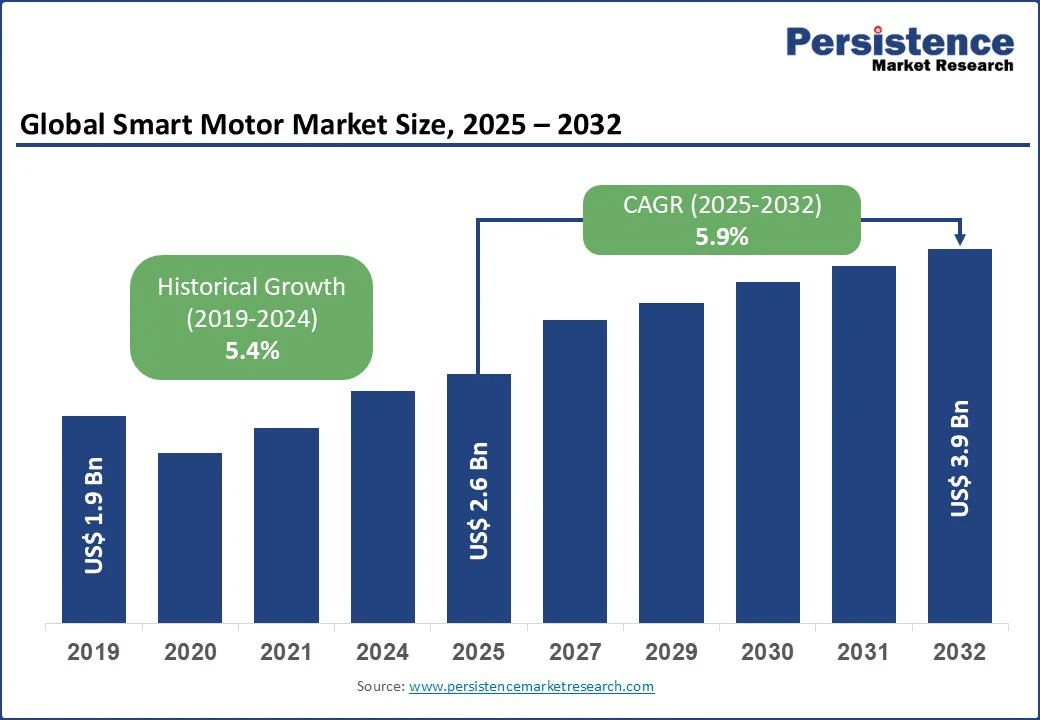
The global smart motor market size is likely to be valued at US$2.6 Bn by 2025 and is expected to reach US$3.9 Bn by 2032, growing at a CAGR of 5.9% during the forecast period from 2025 to 2032.
The smart motor market growth is driven by the rising adoption of smart motors and industrial automation technologies across manufacturing and industrial sectors. Increasing demand for energy-efficient motors, IoT-enabled motor solutions, and predictive maintenance systems is fueling market expansion.
Additionally, supportive government initiatives promoting smart infrastructure, sustainable energy solutions, and electric vehicle adoption are accelerating the deployment of smart motors across industrial, commercial, and automotive applications worldwide.
Key Industry Highlights
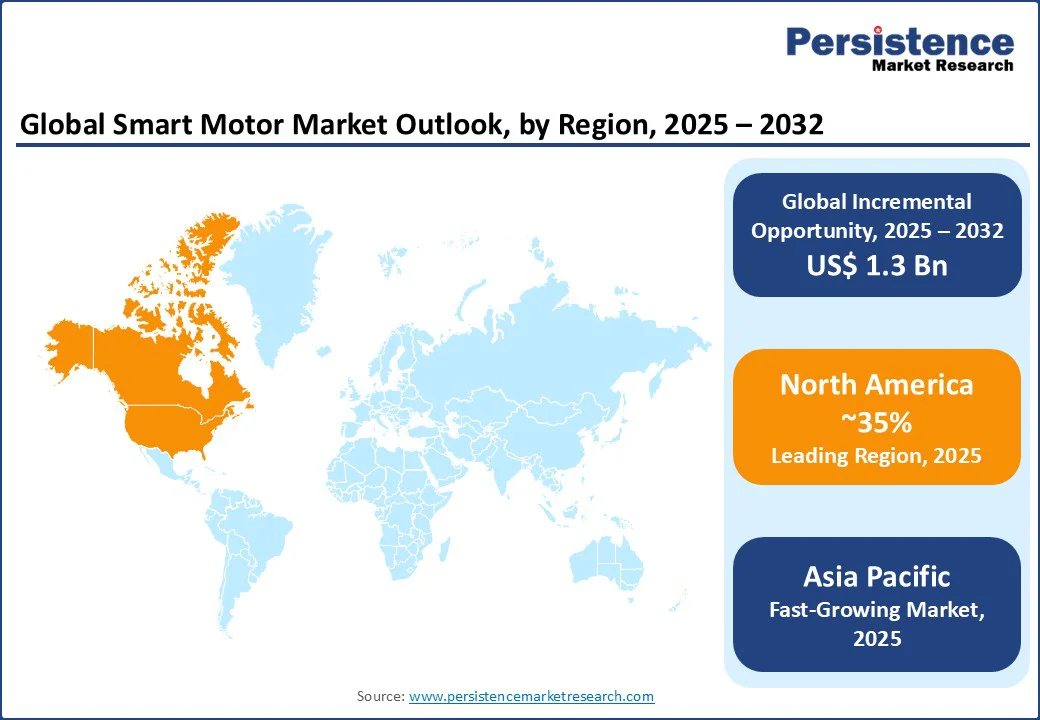
- Leading Region: North America dominates the smart motor market with a 35% global smart motor market share in 2025, supported by advanced industrial automation, energy efficiency regulations, and adoption of IoT-enabled manufacturing solutions.
- Fastest-Growing Region: Asia Pacific is the fastest-growing region, driven by rapid industrialization, increasing electric vehicle production in China and India, and rising adoption of Industry 4.0 technologies in manufacturing.
- Dominant Component: Variable speed drives lead with a 40% share, valued for optimizing energy consumption, improving operational efficiency, and reducing wear in industrial applications such as pumps, fans, and compressors.
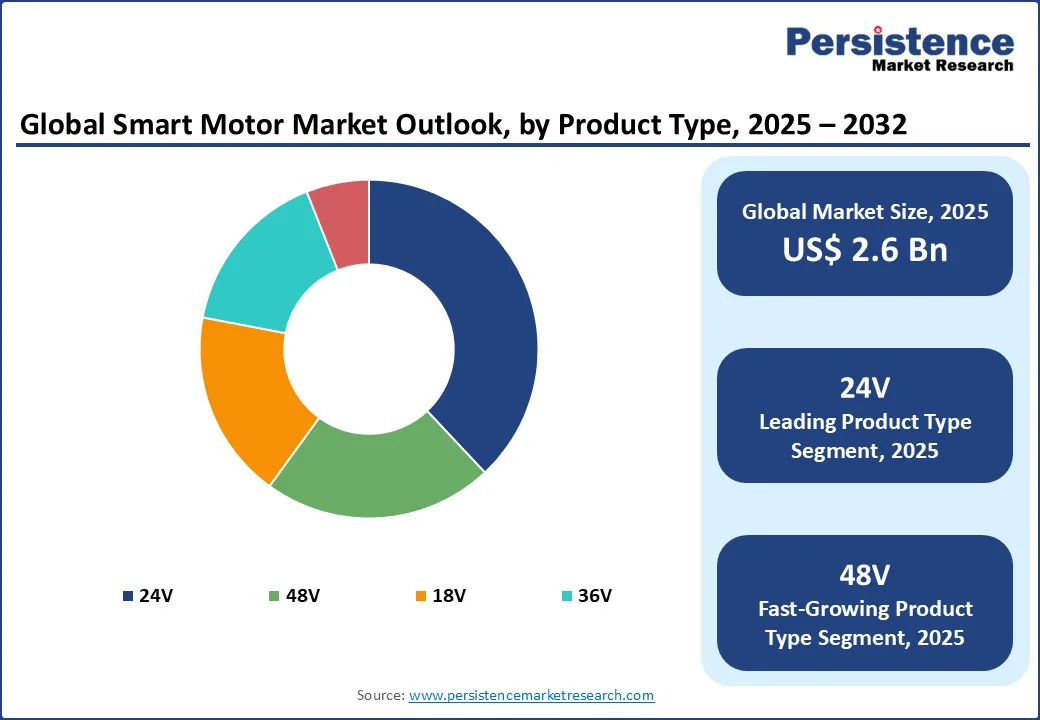
- Leading Product Type: 24V smart motors account for 38% market share due to their versatility in low-power applications, including automotive components, robotics, and IoT devices, offering reliability and cost-efficiency.
- Leading End-use: Industrial applications generate 37% of smart motor revenue, driven by automation in manufacturing, HVAC, and conveyor systems, improving energy efficiency, precision, and operational performance.
- Key Developments: In 2024, Siemens launched AI-driven smart motors for predictive maintenance, while Moog Animatics introduced the Class 6 D-style SmartMotor in 2023, enhancing robotics and automation adoption.
|
Global Market Attribute |
Key Insights |
|
Smart Motor Market Size (2025E) |
US$2.6 Bn |
|
Market Value Forecast (2032F) |
US$3.9 Bn |
|
Projected Growth (CAGR 2025 to 2032) |
5.9% |
|
Historical Market Growth (CAGR 2019 to 2024) |
5.4% |
Market Dynamics
Driver: Rising Industrial Automation and Industry 4.0 Technologies
The rapid adoption of industrial automation and Industry 4.0 technologies is a major driver of the smart motor market. These technologies enable manufacturers to enhance operational efficiency, reduce energy consumption, and achieve precise control over machinery. Smart motors with IoT-enabled sensors allow real-time monitoring and predictive maintenance, minimizing downtime and improving overall performance.
For instance, government initiatives in India, such as the National Strategy for Artificial Intelligence and the National Strategy for Robotics, are promoting AI and robotics adoption in manufacturing, with ARTPARK at the Indian Institute of Science in Bengaluru leveraging these technologies to improve mobility and infrastructure solutions.
This trend is particularly strong in sectors such as automotive, consumer electronics, and material handling, where automation is crucial for efficiency, precision, and cost reduction. By integrating digital technologies and smart motor systems, manufacturers can optimize production processes, enhance operational reliability, and strengthen competitiveness in a rapidly evolving industrial landscape.
Restraint: High Initial Costs and Complexity of Integration
One of the key restraints for the smart motor market is the high initial cost of these advanced systems. Smart motors, equipped with IoT sensors, integrated controllers, and predictive maintenance features, require a significantly higher investment compared to conventional motors.
This upfront cost can be a challenge for small and medium-sized enterprises, limiting widespread adoption. Additional expenses, such as specialized software, installation, and training for personnel, further increase the total cost of ownership and can delay implementation decisions.
Another important challenge is the complexity of integration. Incorporating smart motors into existing industrial setups often requires compatibility with current machinery, automation platforms, and communication networks. Integrators may face difficulties aligning these systems with legacy equipment, leading to potential downtime during installation. Careful system planning, technical expertise, and thorough testing are essential to address these challenges, which can slow adoption despite the clear operational benefits of smart motor technology
Opportunity: Growth in Electric Vehicles and IoT Integration
The growing adoption of electric vehicles (EVs) presents a significant opportunity for the smart motor market. EVs require highly efficient and precise motor systems to enhance performance, reduce energy consumption, and extend battery life.
Smart motors equipped with advanced sensors and controllers offer improved efficiency, real-time monitoring, and predictive maintenance, making them ideal for integration into electric drivetrains. As governments and manufacturers worldwide push for EV adoption to reduce carbon emissions, the demand for smart motor solutions in this sector is expected to rise substantially.
Additionally, the increasing integration of IoT technologies across industrial and commercial applications is creating new avenues for market growth. IoT-enabled smart motors allow remote monitoring, data analytics, and seamless connectivity with automated systems, enhancing operational efficiency and reducing downtime.
This convergence of IoT and smart motor technology is driving innovation, improving performance, and opening opportunities across automotive, manufacturing, and smart infrastructure sectors.
Category-wise Insights
Component Insights
Variable Speed Drives (VSDs) currently dominate the smart motor market, accounting for around 40% share in 2025. VSDs enhance energy efficiency by adjusting motor speed and torque according to operational requirements, leading to energy savings of 25-30% in applications such as pumps, fans, and compressors. In 2024, approximately half of industrial automation systems worldwide integrated VSDs, driven by their ability to lower operational costs, reduce equipment wear, and improve overall system efficiency.
Intelligent motors are emerging as the fastest-growing segment, fueled by advancements in IoT and AI integration. Their adoption is increasing rapidly, particularly for predictive maintenance and real-time performance optimization in sectors such as automotive and aerospace. The integration of smart sensors and analytics enables these motors to monitor conditions, optimize performance, and minimize downtime, making them a key driver of innovation and efficiency in modern industrial and commercial applications.
Product Type Insights
24V smart motors lead with a 38% share in 2025, owing to their versatility in low-power applications such as robotics, automotive components, and IoT devices. In 2024, around 40% of 24V motors were utilized in automotive systems, including power windows and seat adjusters, valued for their cost-efficiency and reliability.
48V smart motors are the fastest-growing segment, driven by rising demand in electric vehicles and heavy machinery. Their adoption is increasing significantly in EV propulsion systems and material handling equipment, supported by the need for higher power output and enhanced efficiency. The combination of energy efficiency, durability, and performance optimization is positioning 48V smart motors as a critical component for next-generation industrial and automotive applications.
End-use Insights
Industrial applications dominate the smart motor market, holding a 37% share in 2025, driven by widespread adoption in manufacturing automation, HVAC systems, and conveyor operations. In 2024, around 60% of smart motors deployed in industrial settings were used in automated machinery, enhancing energy efficiency, precision, and overall operational performance.
The automotive sector is the fastest-growing end-use segment, fueled by the global shift toward electric and autonomous vehicles. Smart motors are increasingly integrated into EV drivetrains and autonomous driving systems, supporting improved efficiency, reliability, and performance. This rising adoption highlights the critical role of smart motor technology in advancing next-generation automotive solutions while contributing to energy savings and sustainable mobility.
Regional Insights
North America Smart Motor Market Trends
North America dominates the smart motor market, holding a 35% share in 2025, driven by advanced industrial automation and early adoption of Industry 4.0 technologies. The region’s strong presence of manufacturing hubs, automotive production, and aerospace industries fuels demand for smart motors that enhance energy efficiency, precision, and operational reliability.
High investment in IoT integration, predictive maintenance, and smart infrastructure further supports market growth. Additionally, government initiatives promoting electric vehicles, renewable energy, and industrial modernization accelerate the deployment of smart motor solutions, making North America a leading market for innovative and energy-efficient motor technologies across industrial, automotive, and commercial applications.
Europe Smart Motor Market Trends
Europe holds a significant share in the smart motor market, driven by its focus on industrial automation, energy efficiency, and sustainable manufacturing practices. The region benefits from a strong automotive and aerospace industry, where smart motors are increasingly adopted for precision control, predictive maintenance, and operational optimization.
Government regulations and initiatives promoting energy-efficient technologies, electrification, and Industry 4.0 adoption further support market growth. Additionally, Europe’s investment in IoT-enabled industrial solutions and renewable energy infrastructure is accelerating the deployment of smart motors across manufacturing, commercial, and automotive sectors, reinforcing its position as a key market globally.
Asia Pacific Smart Motor Market Trends
Asia Pacific is the fastest-growing region in the smart motor market, driven by rapid industrialization, urbanization, and increasing adoption of Industry 4.0 technologies. The region’s expanding automotive, electronics, and manufacturing sectors are fueling demand for smart motors that offer energy efficiency, real-time monitoring, and predictive maintenance.
Government initiatives supporting electric vehicles, smart infrastructure, and renewable energy projects further accelerate market growth. Additionally, the integration of IoT and automation technologies in industrial and commercial applications is boosting the deployment of smart motors, positioning the Asia Pacific as a key growth hub in the global market.
Competitive Landscape
The global smart motor market is highly dynamic, characterized by continuous technological innovation and strategic collaborations. Companies are focusing on developing energy-efficient, IoT-enabled, and AI-integrated motors to enhance performance and operational reliability.
Strategic initiatives such as partnerships, mergers, and expansions are being leveraged to strengthen regional presence and product portfolios. Continuous investment in research and development, along with the launch of advanced solutions for industrial, automotive, and commercial applications, is intensifying competition and driving market growth globally.
Key Developments
- January 2024: Siemens introduced AI-driven smart motors for industrial automation, enhancing predictive maintenance and increasing efficiency by 15%. These advancements are part of Siemens' broader efforts to integrate AI into industrial automation, aiming to increase productivity and reduce downtime.
- March 2023: Moog Animatics launched the Class 6 D-style SmartMotor, featuring a battery-less multiturn encoder, boosting adoption in robotics by 10%. This innovation is particularly beneficial for applications in robotics, offering improved performance and reliability.
Companies Covered in Smart Motor Market
- Rockwell Automation
- Moog, Inc.
- Fuji Electric Co., Ltd.
- ABB Ltd.
- Siemens AG
- Schneider Electric SE
- General Electric
- Dunkermotoren GmbH
- Technosoft SA
- RobotShop, Inc.
- Roboteq, Inc.
- Others
Frequently Asked Questions
The smart motor market is projected to reach US$2.6 Bn in 2025, driven by automation and energy efficiency trends.
Key drivers include demand for energy-efficient motors, Industry 4.0 adoption, and growth in electric vehicle production.
The smart motor market will grow from US$2.6 Bn in 2025 to US$3.9 Bn by 2032, with a CAGR of 5.9%.
Opportunities include EV market expansion, IoT and AI integration, and growth in emerging markets such as India and China.
Leading players include Rockwell Automation, Moog, Inc., Fuji Electric Co., Ltd., ABB Ltd., Siemens AG, and Schneider Electric SE.


