




- Chipsets & Processors
- Digital Assurance and Testing Services Market
Digital Assurance and Testing Services Market Size, Share, and Growth Forecast, 2026 – 2033
Digital Assurance and Testing Services Market by Testing Mode (Manual Testing, Test Automation), Testing Type (Manual Testing, Test Automation, Others), Service Model (Consulting and Advisory, Others), and Regional Analysis for 2026 – 2033

Digital Assurance and Testing Services Market Size and Trends Analysis
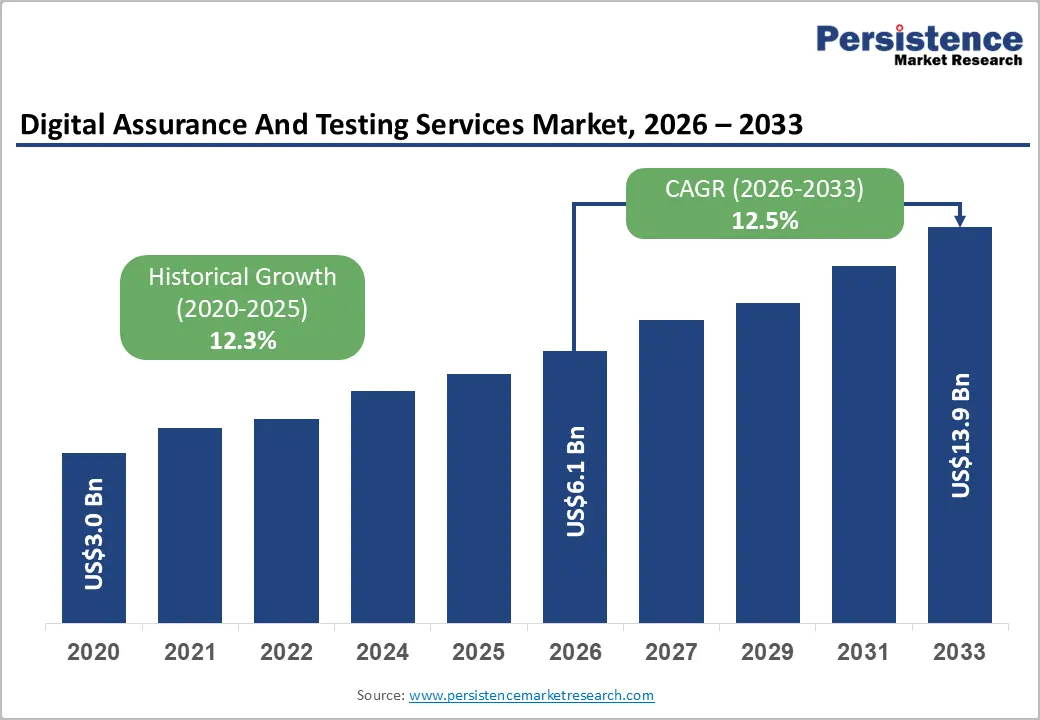
The global digital assurance and testing services market size is likely to be valued at US$6.1 billion in 2026 and is expected to reach US$13.9 billion by 2033, growing at a CAGR of 12.5% during the forecast period from 2026 to 2033, driven by the increasing complexity of enterprise digital ecosystems and the critical need to ensure seamless, secure, and high-performing user experiences across platforms.
Digital assurance has evolved beyond traditional quality assurance to become an integral component of software development lifecycles, deeply embedded within Agile and DevOps frameworks to enable continuous testing, real-time feedback, and faster release cycles. Organizations are prioritizing assurance capabilities to support large-scale digital transformation initiatives, where applications are built on cloud-native architectures, micro services, and containerized environments that demand continuous validation across multiple layers. The integration of advanced technologies such as artificial intelligence and machine learning is transforming testing approaches, enabling predictive defect detection, self-healing test scripts, and autonomous testing ecosystems that enhance efficiency and reduce manual intervention.
Key Industry Highlights:
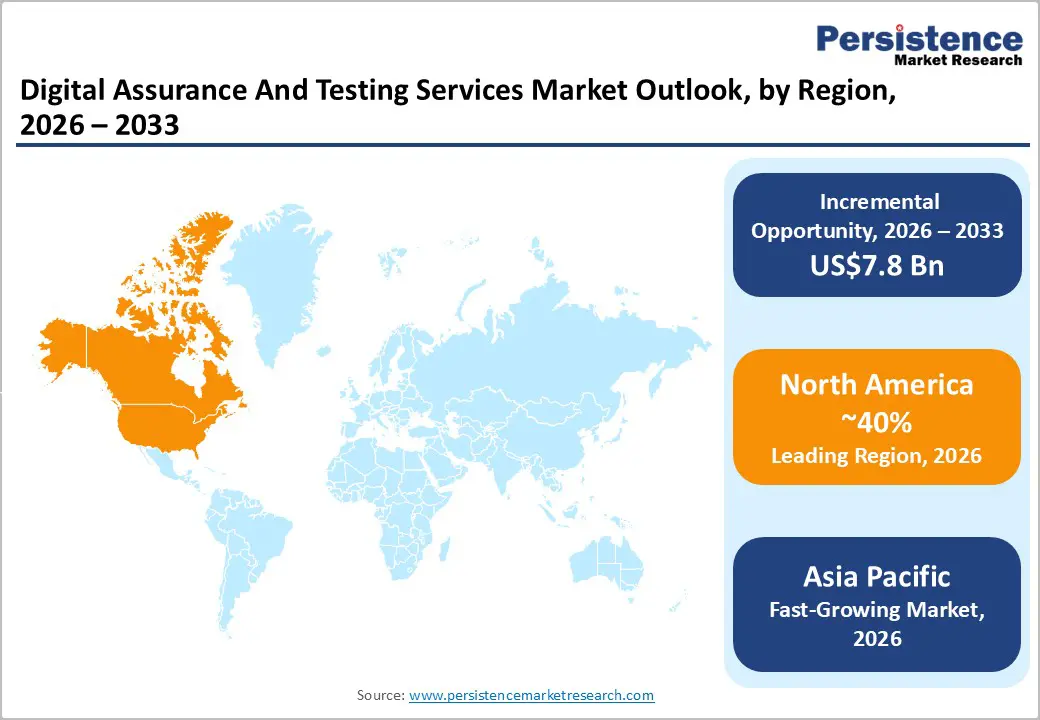
- Leading Region: North America is anticipated to be the leading region, accounting for a market share of 40% in 2026, driven by advanced digital adoption, strong enterprise IT ecosystems, and early integration of AI-driven testing and DevOps practices.
- Fastest-growing Region: Asia Pacific is likely to be the fastest-growing region, supported by rapid digital transformation, strong IT outsourcing ecosystems, and increasing adoption of AI-driven and cloud-based testing solutions across emerging economies.
- Leading Testing Mode: Manual testing is projected to represent the leading testing mode in 2026, accounting for 57% of the revenue share, driven by its strength in exploratory, usability, and complex UI validation scenarios.
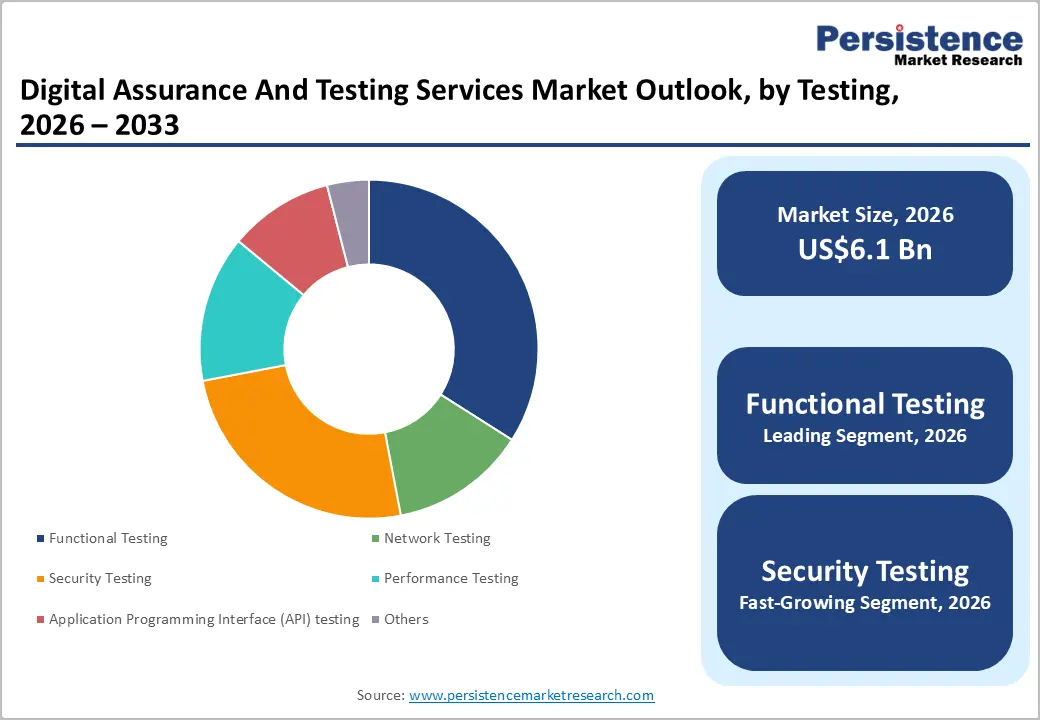
- Leading Testing Type: Functional testing is anticipated to be the leading testing type, accounting for over 33% of the revenue share in 2026, supported by its critical role in validating core business logic and ensuring applications perform as intended across diverse digital environments.
| Key Insights | Details |
|---|---|
|
Digital Assurance And Testing Services Market Size (2026E) |
US$6.1 Bn |
|
Market Value Forecast (2033F) |
US$13.9 Bn |
|
Projected Growth (CAGR 2026 to 2033) |
12.5% |
|
Historical Market Growth (CAGR 2020 to 2025) |
12.3% |
DRO Analysis
Driver Analysis- Accelerating Digital Transformation and Adoption of DevOps/Agile Methodologies
Organizations across industries are rapidly modernizing legacy systems and adopting cloud-native architectures, micro services, and containerized applications, which significantly increases the need for continuous validation. Agile and DevOps practices have shifted testing from a late-stage activity to an integrated, continuous process within development pipelines. This transformation drives demand for automated testing frameworks, real-time feedback loops, and continuous integration and delivery systems that ensure faster releases without compromising quality, enabling enterprises to remain competitive in increasingly dynamic digital environments while maintaining application reliability and scalability.
The widespread implementation of DevOps pipelines encourages shift-left testing approaches, where defects are identified early in the development cycle, reducing costs and improving software quality outcomes. Continuous testing across multiple environments, devices, and platforms has become essential as enterprises aim to deliver seamless omnichannel experiences. Integration of testing tools with CI/CD pipelines enhances collaboration between development and operations teams, improving efficiency. As businesses prioritize faster innovation cycles and customer-centric solutions, digital assurance services become critical in ensuring performance, reliability, and speed across evolving digital ecosystems.
Rising Cybersecurity Threats and Regulatory Compliance Requirements
The increasing frequency and sophistication of cyber threats are compelling organizations to strengthen their testing frameworks with advanced security validation techniques. Enterprises are investing heavily in security testing to identify vulnerabilities, prevent data breaches, and protect sensitive information across digital platforms. The expansion of APIs, cloud services, and interconnected systems has broadened the attack surface, making comprehensive testing essential. Security assurance is becoming a core component of digital testing strategies, ensuring that applications are resilient against evolving cyber risks.
Regulatory frameworks such as GDPR, PCI DSS, and other regional data protection laws are driving the adoption of stringent testing protocols to ensure compliance and avoid penalties. Organizations must demonstrate transparency, auditability, and data protection capabilities, which increases the need for continuous monitoring and validation. Compliance-driven testing requires frequent updates and validations across systems, increasing demand for digital assurance services. As industries such as BFSI and healthcare face strict regulatory scrutiny, security and compliance testing play a pivotal role in maintaining trust and operational continuity.
Restraint Analysis - Shortage of Skilled SDET and Quality Engineering Professionals
The growing complexity of digital ecosystems has created a significant demand for skilled software development engineers in test (SDET) and quality engineering professionals. the The availability of such specialized talent remains limited, creating a bottleneck in scaling testing operations. Advanced testing approaches, including AI-driven automation, performance engineering, and security testing, require expertise that is not widely available, leading to increased hiring costs and project delays. This talent gap affects the ability of organizations to fully leverage modern testing tools and methodologies.
The shortage also impacts the transition from traditional testing to quality engineering practices, as organizations struggle to upskill their workforce in areas such as automation scripting, DevOps integration, and AI-based testing. Training and retaining skilled professionals becomes a challenge, especially in competitive markets where demand exceeds supply. Enterprises may face inefficiencies, slower testing cycles, and increased dependency on third-party vendors. Addressing this gap requires continuous investment in workforce development and adoption of user-friendly, low-code testing platforms to reduce reliance on highly specialized skills.
Data Sovereignty and Regulatory Fragmentation across Jurisdictions
The increasing emphasis on data sovereignty and localization laws across different regions presents a significant challenge for testing operations. Organizations must ensure that data used in testing processes complies with local regulations, which often restrict cross-border data transfers. This creates complexities in managing testing environments, especially for multinational enterprises operating across multiple jurisdictions. Ensuring compliance requires the establishment of region-specific testing infrastructures, increasing operational costs, and limiting flexibility in testing strategies.
Regulatory fragmentation complicates the testing landscape, as varying standards and compliance requirements across countries demand customized testing approaches. Organizations must continuously adapt their testing frameworks to meet evolving legal requirements, which can delay deployment timelines and increase resource allocation. This lack of uniformity affects scalability and efficiency, particularly for cloud-based testing solutions. As regulations continue to evolve, companies must invest in compliance-driven testing models and localized infrastructure to ensure seamless operations while maintaining adherence to diverse regulatory frameworks.
Opportunity Analysis - Expansion of AI-Driven and Autonomous Testing Ecosystems
The integration of artificial intelligence and machine learning into testing processes is creating significant opportunities for enhancing efficiency and accuracy. AI-driven testing enables predictive analytics, intelligent test case generation, and self-healing automation, reducing manual intervention and improving test coverage. These advanced capabilities allow organizations to detect defects earlier, optimize testing cycles, and enhance overall software quality. Autonomous testing systems can continuously learn from past data, making them highly effective in dynamic and complex digital environments.
As enterprises increasingly adopt digital transformation strategies, the demand for intelligent testing solutions continues to grow. AI-powered platforms support continuous testing across multiple environments, enabling faster releases and improved user experiences. These technologies help reduce operational costs by minimizing repetitive tasks and improving resource utilization. The evolution of autonomous testing ecosystems is redefining traditional testing approaches, offering scalable and adaptive solutions that align with the needs of modern digital enterprises.
Growth in Emerging Markets and Cloud-Native QA for SMEs
Emerging markets are witnessing rapid digital adoption, creating strong demand for cost-effective and scalable testing solutions. Small and medium enterprises are increasingly leveraging cloud-based platforms to access advanced testing capabilities without significant upfront investments. Cloud-native QA solutions enable flexibility, scalability, and remote accessibility, making them highly attractive for organizations with limited resources. This democratization of testing services is expanding market reach and enabling broader adoption across diverse industry segments.
The rise of SaaS-based testing platforms and low-code solutions is supporting SMEs in implementing efficient testing strategies. These platforms reduce complexity and enable faster deployment of testing processes, allowing businesses to focus on innovation and growth. Increasing internet penetration and mobile-first economies in emerging regions are driving demand for robust digital assurance services. As SMEs continue to digitize their operations, cloud-native testing solutions present significant growth opportunities for service providers in the evolving digital assurance market.
Category-wise Analysis
Testing Mode Insights
Manual testing is expected to lead the digital assurance and testing services market, accounting for approximately 57% of revenue in 2026, driven by its effectiveness in handling complex, exploratory, and user-experience-driven scenarios that require human judgment. It remains indispensable in validating user interfaces, accessibility standards, and real-world usability conditions that automated scripts often struggle to interpret accurately. For example, a banking institution launching a new mobile application often employs manual testers to evaluate real-time user interactions, ensuring intuitive navigation and seamless customer experience before full-scale deployment across diverse user demographics.
Test automation is likely to represent the fastest-growing segment, supported by the increasing need for speed, scalability, and efficiency in modern software development. As organizations adopt continuous integration and continuous delivery pipelines, automated testing enables rapid execution of repetitive test cases across multiple environments, significantly reducing time-to-market. For example, a leading e-commerce platform leverages automated testing frameworks to validate thousands of transactions and user scenarios simultaneously during peak sale events, ensuring system stability, performance consistency, and uninterrupted customer experience across markets.
Testing Type Insights
Functional testing is projected to lead the market, capturing around 33% of the revenue share in 2026, as it forms the backbone of digital assurance by validating whether applications perform according to defined business requirements. It ensures that every feature, workflow, and interaction within an application functions correctly across web, mobile, and backend systems. For example, a fintech company launching a digital payment platform relies heavily on functional testing to validate transaction processing, user authentication, and account management features, ensuring that the application performs accurately under normal operating conditions.
Security testing is likely to be the fastest-growing testing type, driven by the rising frequency of cyber threats and increasing regulatory requirements for data protection. As digital ecosystems expand with cloud computing, APIs, and interconnected devices, the risk of vulnerabilities and breaches has intensified, making security validation a top priority for organizations. For example, a healthcare provider implements continuous security testing to safeguard patient records and ensure compliance with data protection regulations, preventing potential breaches while maintaining system integrity and confidentiality.
Regional Insights
North America Digital Assurance and Testing Services Market Trends
North America is anticipated to be the leading region, accounting for a market share of 40% in 2026, driven by strong adoption of advanced technologies, particularly AI-driven automation, cloud-native testing, and DevSecOps integration. Enterprises across the U.S. and Canada are increasingly embedding continuous testing into Agile and DevOps pipelines to ensure faster release cycles and improved software quality. The widespread use of multi-cloud environments such as AWS, Microsoft Azure, and Google Cloud has intensified the need for end-to-end validation of APIs, micro services, and distributed architectures.
The increasing investments in AI-led quality engineering and intelligent automation platforms by major industry players are enabling scalable and efficient testing ecosystems. Companies are focusing on integrating machine learning for predictive defect analysis and self-healing test scripts, reducing manual effort and improving accuracy. For example, Accenture is significantly expanding its AI capabilities and investing heavily in AI-focused solutions to support enterprise digital transformation and automated testing services, reflecting strong demand for intelligent assurance frameworks across North America.
Europe Digital Assurance and Testing Services Market Trends
Europe is likely to be a significant market for digital assurance and testing services in 2026, due to strong regulatory influence, advanced digital infrastructure, and increasing adoption of cloud-native and AI-driven testing frameworks. Organizations across key economies such as the U.K., Germany, and France are embedding assurance practices into digital transformation initiatives, particularly within financial services, healthcare, and manufacturing sectors. A major trend is the shift toward compliance-centric testing, where enterprises integrate security, performance, and risk validation to meet stringent European data protection and cybersecurity standards.
European enterprises are increasingly investing in cloud-based testing platforms and domain-specific assurance frameworks tailored to industry requirements, ensuring operational resilience and system reliability. For example, Capgemini is actively advancing AI-powered and cloud-driven solutions to support enterprise transformation, reflecting the region’s growing focus on intelligent automation and digital quality engineering. The market also demonstrates strong emphasis on cybersecurity testing and zero-trust architectures, driven by rising cyber risks and evolving EU regulations.
Asia Pacific Digital Assurance and Testing Services Market Trends
The Asia Pacific region is likely to be the fastest-growing region, driven by rapid digitalization across countries such as China, India, and Southeast Asia. Enterprises are increasingly adopting cloud-native architectures, mobile-first platforms, and microservice-based applications, significantly expanding the scope of testing requirements. The region has become a hub for cost-effective QA outsourcing, supported by a large and skilled IT workforce and competitive service pricing.
Organizations are investing in predictive analytics, self-healing automation, and real-time monitoring to improve testing efficiency and reduce time to market. Government-led digital initiatives and infrastructure investments support the expansion of digital assurance services, particularly in emerging economies. For example, Infosys Limited has been actively enhancing its AI-powered testing and cloud assurance capabilities to support clients, reflecting the region’s strong focus on automation-led quality engineering.
Competitive Landscape
The global digital assurance and testing services market exhibits a moderately fragmented structure, driven by the presence of numerous IT service providers, niche testing specialists, and emerging AI-driven platform vendors competing across diverse service offerings. The market is characterized by low concentration, with no single player dominating, as enterprises increasingly demand customized, scalable, and domain-specific testing solutions. Growth in cloud-native applications, DevOps adoption, and AI-based testing frameworks has intensified competition, encouraging vendors to expand capabilities through innovation and partnerships.
With key leaders including Accenture, Capgemini, Cognizant, Infosys Limited, Wipro Limited, and Tata Consultancy Services, the competitive environment reflects a mix of large-scale transformation providers and specialized digital assurance firms leveraging domain expertise and technological differentiation. These players compete through continuous innovation in AI-driven testing, expansion of cloud-based QA platforms, and integration of end-to-end quality engineering within broader digital transformation deals.
Key Industry Developments:
- In March 2026, STL Digital, a wholly owned subsidiary of Sterlite Technologies Limited, launched Securennov, a comprehensive cybersecurity portfolio designed to help enterprises build cyber-resilient, secure-by-design ecosystems by embedding advanced technologies, AI-driven analytics, and continuous monitoring across digital systems.
- In March 2026, SGS, in collaboration with its digital trust brand CertX, announced the expansion of its Digital Trust services to strengthen inspection, assessment, and certification support for AI-powered and autonomous systems across safety-driven industries. The enhanced offering extends SGS’s capabilities in AI assurance, cybersecurity assessment, and functional safety evaluation, supporting product lifecycle confidence and reducing late-stage remediation risks for regulated use cases such as autonomous vehicles, robotics, and industrial automation.
- In October 2025, PwC announced the launch of its first-to-market “Assurance for AI” solution, designed to provide independent validation of artificial intelligence systems, ensuring they are developed, deployed, and operated responsibly, transparently, and in alignment with evolving regulatory requirements.
Companies Covered in Digital Assurance and Testing Services Market
- Atos SE
- Micro Focus
- Capgemini
- Accenture
- Cigniti
- Cognizant
- Hexaware Software Inc.
- DXC Technology Company
- Maveric Systems
- Software Quality Systems AG
- Infosys Limited
- Wipro Limited
- Tata Consultancy Services Limited


