




- Consumer Goods
- Small Spy Drone Market
Small Spy Drone Market Size, Share, and Growth Forecast, 2026 – 2033
Small Spy Drone Market by Product Type (Fixed-Wing, Hybrid Wing, Rotary Wing), Weight Carrying Capacity (Less than 5Kg, 5Kg–25Kg, 25Kg–100Kg, 100Kg & Above), End-user (Aerospace & Defense, Construction, Others), and Regional Analysis for 2026 – 2033

Small Spy Drone Market Size and Trends Analysis
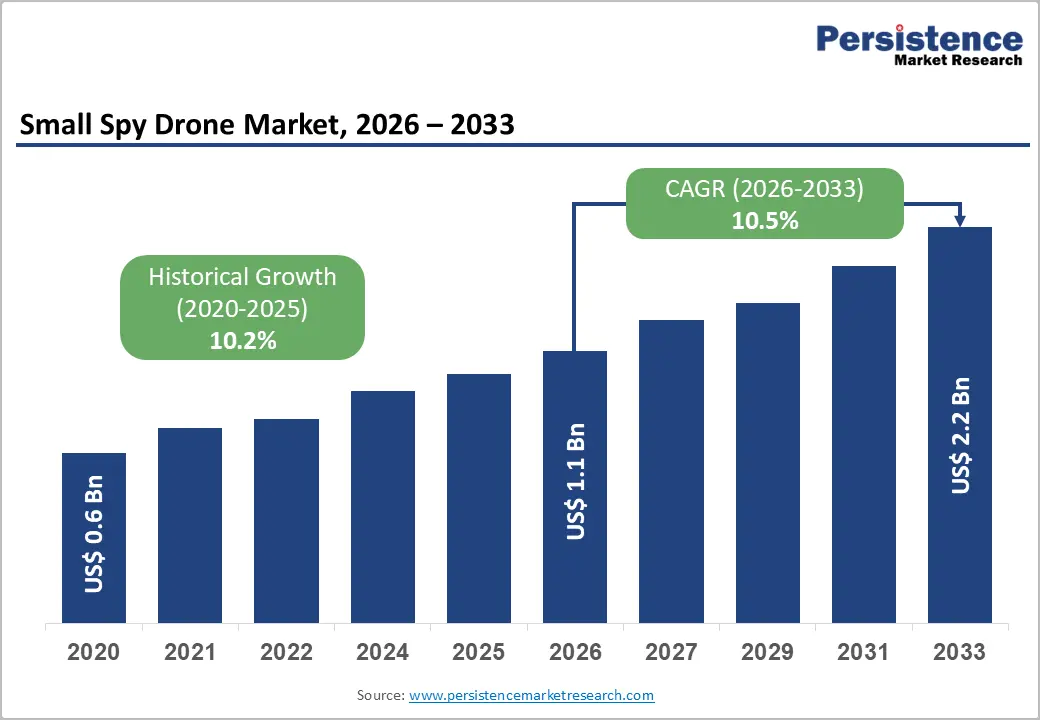
The global small spy drone market size is likely to be valued at US$1.1 billion in 2026 and is expected to reach US$2.2 billion by 2033, growing at a CAGR of 10.5% during the forecast period from 2026 to 2033, driven by rising demand for intelligence, surveillance, and reconnaissance (ISR) capabilities across defense and commercial sectors. According to the Stockholm International Peace Research Institute (2026), recent reports highlight continued growth in military drone procurement amid evolving security threats. NATO emphasizes increasing the adoption of unmanned systems for real-time situational awareness. Advancements in AI-enabled navigation, sensor miniaturization, and battery efficiency are accelerating deployment.
Key Industry Highlights:
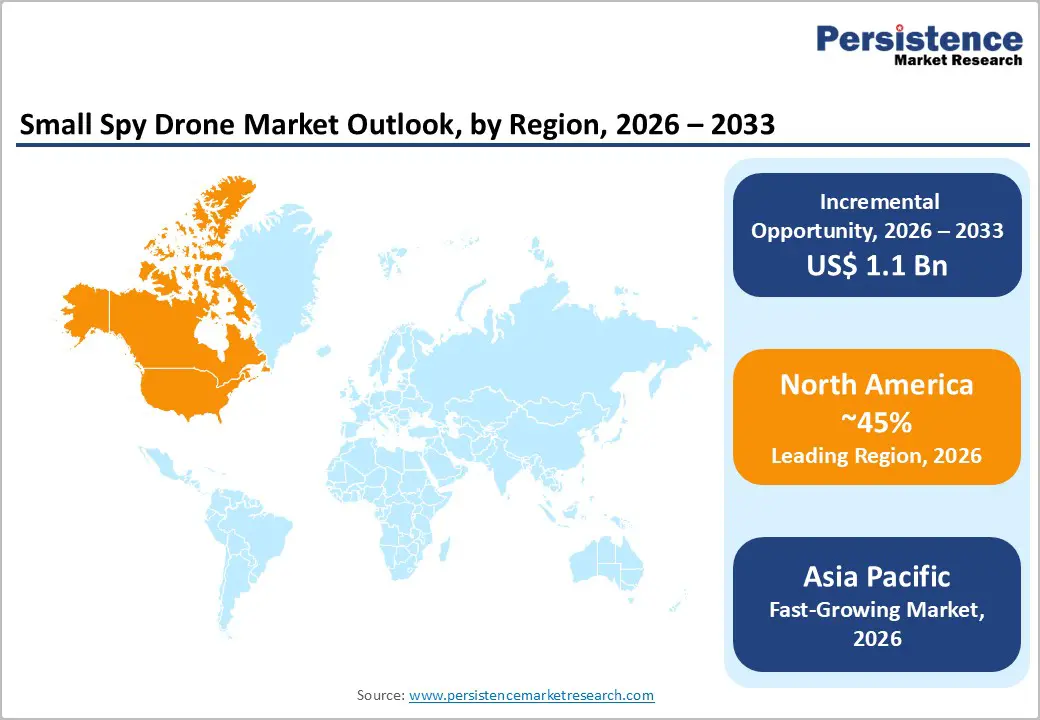
- Leading Region: North America is anticipated to be the leading region, accounting for a market share of 45% in 2026, driven by strong defense investments, an advanced innovation ecosystem, and supportive regulatory frameworks.
- Fastest-growing Region: Asia Pacific is likely to be the fastest-growing region, supported by strong manufacturing capabilities and rising defense investments.
- Leading Product Type: Rotary wings are projected to represent the leading product type in 2026, accounting for 60% of the revenue share, driven by their superior maneuverability and VTOL capabilities.
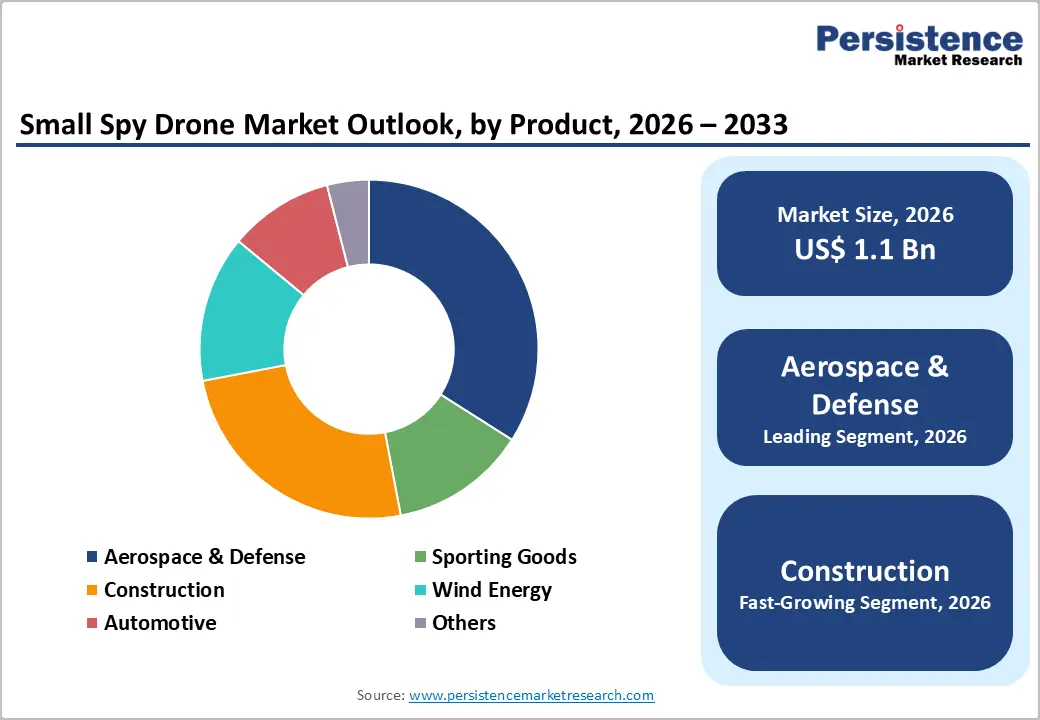
- Leading End-user: The aerospace & defense segment is anticipated to be the leading end-user, accounting for over 55% of the revenue share in 2026, supported by strong ISR demand and defense investments.
- Key Opportunity: The key market opportunity in the small spy drone market lies in the rapid integration of AI-enabled autonomy, swarm intelligence, and miniaturized ISR technologies across defense and commercial applications, enabling scalable real-time surveillance and multi-domain operational efficiency worldwide.
DRO Analysis
Driver - Rising Defense Spending and Security Imperatives
Growing geopolitical tensions and asymmetric warfare trends are significantly increasing demand for small spy drones across defense forces. Governments are prioritizing intelligence, surveillance, and reconnaissance capabilities to enhance situational awareness, border monitoring, and counterterrorism operations.
Small drones offer cost-effective, rapidly deployable solutions compared to traditional manned systems, making them essential in modern defense strategies. Their ability to operate in complex terrains and urban environments strengthens adoption. Military modernization programs are integrating advanced unmanned systems to maintain strategic superiority, driving procurement and continuous innovation in compact, stealth-focused drone platforms worldwide.
Rising defense budgets are accelerating investments in next-generation drone technologies, including autonomous navigation, real-time data transmission, and advanced sensor integration. Defense agencies are increasingly adopting swarm-enabled drones and network-centric warfare systems to improve operational efficiency and mission success rates.
Restraint - Privacy, Cybersecurity, and Data Sovereignty Concerns
Unauthorized surveillance, data collection, and potential misuse of sensitive information have led to increased public scrutiny and resistance. Regulatory authorities are implementing strict guidelines to govern drone usage, especially regarding data capture and storage. Compliance with varying international privacy laws creates complexity for manufacturers and operators.
Cybersecurity risks restrain market growth, as small spy drones are vulnerable to hacking, signal interference, and data breaches. Unauthorized access to drone systems can compromise mission-critical information and disrupt operations, especially in defense scenarios. Data sovereignty regulations require that collected data be stored and processed within national borders, complicating cross-border operations and cloud-based analytics.
Opportunity - Technological Convergence with AI, Swarming, and Multi-Domain Operations
AI-enabled drones can perform real-time object detection, target tracking, and decision-making, reducing the need for human intervention. Swarm technology allows multiple drones to operate collaboratively, enhancing mission efficiency and coverage in complex environments.
These innovations are transforming traditional surveillance into intelligent, adaptive systems. The convergence of these technologies is enabling new applications across defense, infrastructure monitoring, and disaster management, expanding the market’s scope and long-term growth potential.
The emergence of multi-domain operations is enhancing the strategic importance of small spy drones. These systems are increasingly integrated with land, air, and maritime platforms, enabling seamless data sharing and coordinated missions. Advancements in communication networks, including 5G and satellite connectivity, are improving real-time data transmission and operational reach.
Category-wise Analysis
Product Type Insights
Rotary wing drones are expected to lead the small spy drone market, accounting for approximately 60% of revenue in 2026, driven by their exceptional maneuverability, vertical takeoff and landing (VTOL) capability, and ability to hover for extended surveillance missions. These drones are highly effective in dense urban environments and confined operational zones where precision and stability are critical. A notable example includes the Black Hornet nano drone, widely used by military forces for close-range reconnaissance in complex terrains and urban warfare situations.
Hybrid wing drones are likely to represent the fastest-growing segment, supported by their unique ability to combine the endurance of fixed-wing platforms with the flexibility of VTOL systems. These drones are increasingly being adopted for extended ISR missions where both long-range coverage and operational versatility are required. For example, the Quantum Systems Trinity platform, which integrates VTOL capabilities with long-endurance flight for strategic reconnaissance missions.
Weight Carrying Capacity Insights
Less than 5Kg is projected to lead the market, capturing around 40% of the revenue share in 2026, supported by its widespread adoption in tactical and portable reconnaissance applications. These nano and micro drones are designed for soldier-level deployment, offering high mobility, low detectability, and ease of operation in challenging environments. For instance, the Black Hornet system provides real-time situational awareness to ground forces with minimal operational footprint.
The 5Kg–25Kg is likely to be the fastest-growing weight-carrying capacity, driven by the fact that it offers an optimal balance between payload capacity and operational flexibility. These drones can carry advanced sensors and lightweight surveillance systems while maintaining ease of deployment. A notable example includes the DJI Matrice series, which is widely utilized for industrial inspections and surveillance operations due to its reliability and payload versatility.
End-user Insights
The aerospace and defense industry is expected to lead the small spy drone market, accounting for approximately 55% of revenue in 2026, driven by strong demand for ISR capabilities, military modernization programs, and increasing geopolitical tensions. Small spy drones play a critical role in enhancing battlefield awareness, enabling real-time intelligence collection, and reducing risks to personnel. For example, AeroVironment’s Raven drone is extensively used by military forces for reconnaissance and surveillance in diverse operational environments.
The construction segment is likely to represent the fastest-growing segment, supported by increasing demand for efficient site monitoring, safety enhancement, and cost reduction. Small spy drones are being used for real-time project tracking, structural inspections, and progress analysis, reducing the need for manual intervention in hazardous environments. For instance, the use of Parrot drones in construction projects for site mapping and inspection enables faster and safer project execution.
Regional Insights
North America Small Spy Drone Market Trends
North America is anticipated to be the leading region, accounting for a market share of 45% in 2026, driven by strong defense spending, advanced R&D ecosystems, and rapid adoption of AI-enabled ISR systems. The region is witnessing increased deployment of compact drones for border surveillance, homeland security, and infrastructure monitoring. A notable example includes AeroVironment, which continues to expand its tactical drone portfolio with advanced reconnaissance systems for military applications.
U.S. Small Spy Drone Market Trends
The U.S. dominates the regional market, driven by substantial defense budgets and continuous investment in unmanned systems. The Department of Defense is actively expanding ISR capabilities through the deployment of compact and AI-enabled drones across multiple operational domains. Recent developments include the scaling of Blue UAS programs to ensure secure and domestically sourced drone technologies.
Canada Small Spy Drone Market Trends
Canada is a significant market for small spy drones supported by growing investments in defense modernization and surveillance technologies. The country is increasingly adopting small spy drones for Arctic monitoring, border security, and environmental surveillance applications. Recent initiatives focus on integrating drones into national defense strategies to enhance situational awareness in remote and challenging terrains. Canada is also promoting domestic drone innovation through partnerships with technology firms and research institutions.
Europe Small Spy Drone Market Trends
Europe is likely to be a significant market for small spy drones in 2026, due to increasing defense collaboration, regulatory standardization, and growing adoption of drones in both military and civilian applications. The region is focusing on enhancing surveillance capabilities through technological advancements and cross-border defense initiatives. For instance, Parrot SA is actively developing secure and defense-grade drone solutions aligned with European data protection standards.
U.K. Small Spy Drone Market Trends
The U.K. is a significant market for small spy drones, supported by ongoing defense modernization and advanced research initiatives. The U.K. is investing in next-generation drone technologies, including autonomous systems and swarm capabilities for military applications. Recent developments include increased deployment of drones for border surveillance and maritime security. The country is also promoting innovation through partnerships between defense agencies and private companies.
Germany Small Spy Drone Market Trends
Germany dominates the regional market, driven by strong industrial capabilities and increasing defense investments. The country is focusing on integrating unmanned systems into military operations to enhance reconnaissance and surveillance efficiency. Recent developments include collaborations between defense contractors and technology firms to develop AI-enabled drone systems. Germany is also investing in domestic production to strengthen supply chain resilience.
Asia Pacific Small Spy Drone Market Trends
The Asia Pacific region is likely to be the fastest-growing region, driven by rapid industrialization, increasing defense budgets, and strong manufacturing capabilities. The market is witnessing significant adoption in both military and commercial sectors, including infrastructure inspection and disaster management. For example, SZ DJI Technology, which dominates drone manufacturing and continues to innovate in compact and high-performance drone systems.
China Small Spy Drone Market Trends
China dominates the regional market, driven by its strong manufacturing ecosystem and significant investments in drone technology. The country is focusing on developing advanced unmanned systems for both defense and commercial applications. Recent developments include the expansion of AI-enabled drone capabilities and increased exports of compact surveillance drones. China is also strengthening its position through large-scale production and cost competitiveness.
India Small Spy Drone Market Trends
India is a significant market for small spy drones, supported by increasing defense procurement and policy support for domestic manufacturing. Recent developments include increased deployment of drones for border surveillance and security operations. India is also expanding drone usage in infrastructure inspection, agriculture, and disaster management. Government reforms and relaxed regulations are encouraging private sector participation.
Competitive Landscape
The global small spy drone market exhibits a moderately fragmented structure, driven by rapid technological innovation, evolving defense requirements, and the presence of both established defense contractors and emerging technology startups. The market is characterized by a mix of leaders and regional players focusing on miniaturization, advanced sensor integration, and AI-enabled autonomy.
With key leaders including SZ DJI Technology, AeroVironment, Parrot SA, Teledyne Technologies, and Skydio, the industry reflects a balance between large-scale manufacturers and agile innovators. These players compete through continuous product innovation, strategic partnerships, and expansion into high-growth regions. Companies are increasingly investing in AI-based navigation, real-time data analytics, and anti-jamming technologies to differentiate their offerings.
Key Industry Developments:
- In August 2025, Japan-based drone manufacturer ACSL announced new product developments, including the launch of its TAITEN smart controller, upgrades to its SAMO thermal payload, and a strategic collaboration with Teledyne FLIR. The enhancements feature improved zoom capabilities and advanced thermal imaging integration, aimed at strengthening public safety, surveillance, and industrial inspection applications.
- In June 2025, China unveiled a mosquito-sized spy drone developed by the National University of Defence Technology, designed for covert surveillance and reconnaissance missions. The insect-like microdrone, measuring only a few centimeters and weighing fractions of a gram, features flapping wings, miniature sensors, and the ability to evade traditional radar detection due to its extremely small size.
Companies Covered in Small Spy Drone Market
- ACSL
- AeroVironmment
- enRoute
- SZ DJI Technology
- Parrot SA
- Yuneec Holding
- Autel Robotics
- SKYDIO
- Insitu
- Delair
- EHang
- Freefly Systems
- AERIALTRONICS
Frequently Asked Questions
The global small spy drone market is projected to reach US$1.1 billion in 2026.
The small spy drone market is driven by rising demand for real-time intelligence, surveillance, and reconnaissance (ISR), along with rapid advancements in AI-enabled autonomous systems and increasing defense modernization worldwide.
The small spy drone market is expected to grow at a CAGR of 10.5% from 2026 to 2033.
Key market opportunities in the small spy drone market include the expansion of AI-driven autonomous surveillance, growing adoption in commercial inspection sectors, and increasing demand for swarm-enabled and multi-domain operational capabilities.
ACSL, AeroVironment, enRoute, SZ DJI Technology, and Parrot SA are the leading players.


