




- Healthcare IT
- Secure Hospital Communications Market
Secure Hospital Communications Market Size, Share, and Growth Forecast, 2026 – 2033
Secure Hospital Communications Market by Communication Type (Messaging Systems, Voice Communication, Video Communication, Others), Component (Software, Hardware, Services), End-User (Hospitals, Clinics, Others), and Regional Analysis for 2026-2033

Secure Hospital Communications Market Share and Trends Analysis
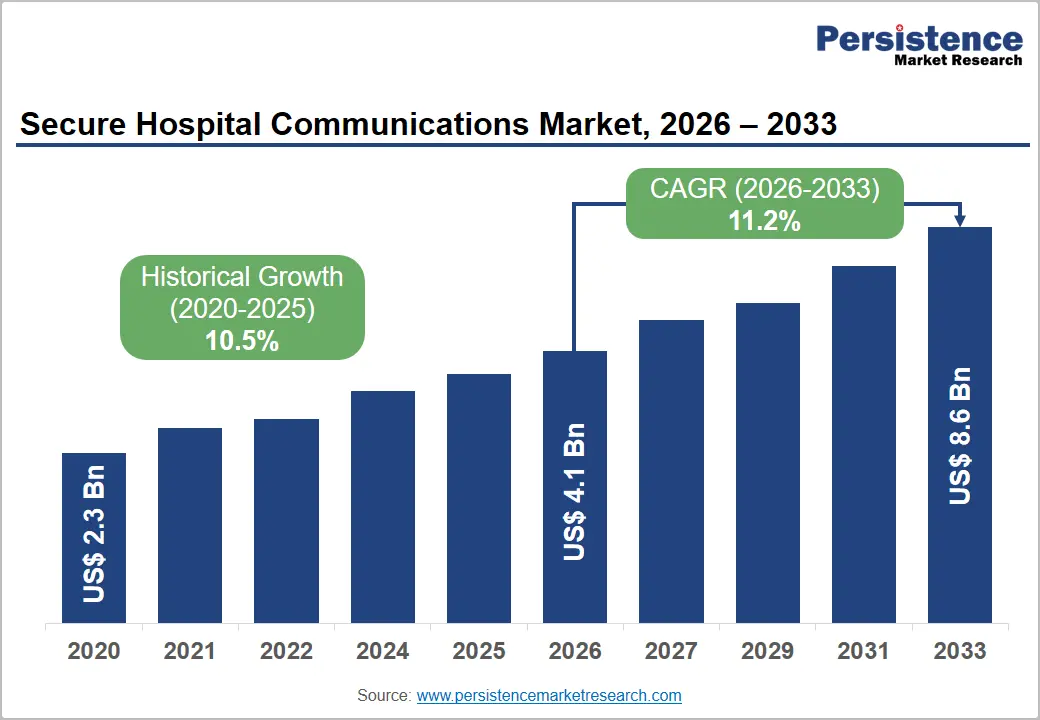
The global secure hospital communications market size is likely to be valued at US$4.1 billion in 2026 and is estimated to reach US$8.6 billion by 2033, growing at a CAGR of 11.2% during the forecast period from 2026 to 2033, driven by rising cybersecurity requirements, expansion of digital healthcare infrastructure, and increasing adoption of real-time clinical collaboration platforms.
Healthcare organizations are prioritizing secure communication ecosystems to reduce operational delays, improve care coordination, and protect sensitive patient information. Regulatory frameworks governing healthcare data privacy are accelerating the deployment of encrypted messaging, voice, and video communication platforms.
Key Industry Highlights:
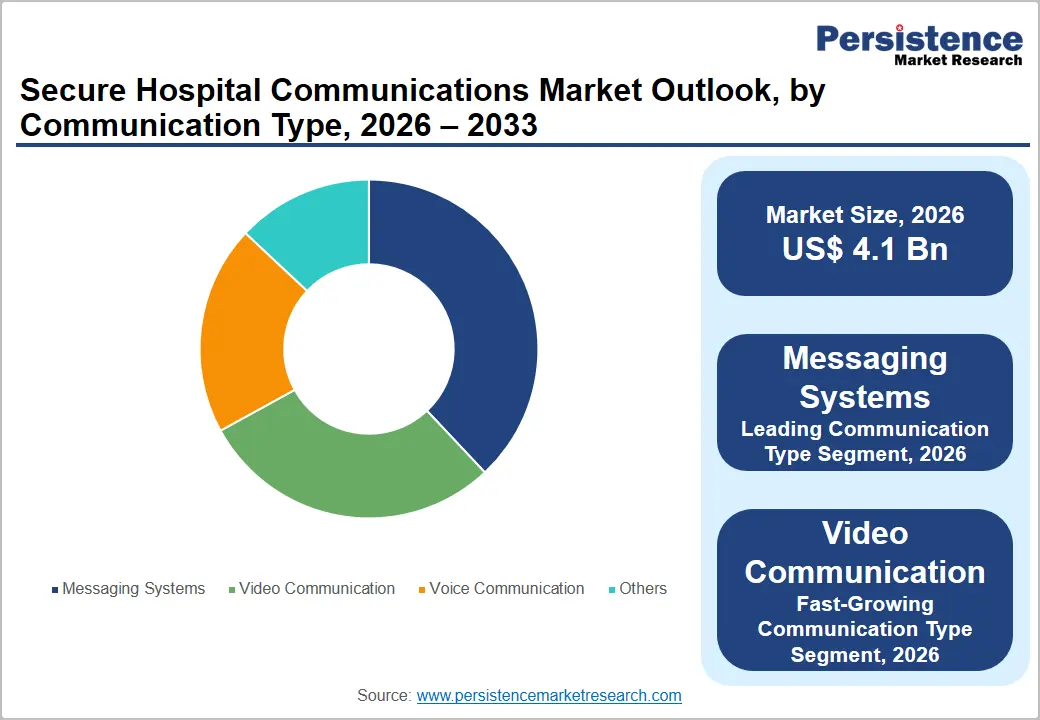
- Leading Communication Type: Messaging systems are set to hold around 38% revenue share in 2026, driven by institutional demand for encrypted, audit-trail-compliant text communication replacing legacy paging infrastructure.
- Fastest-Growing Communication Type: Video communication is projected as the fastest-growing segment, supported by the expansion of reimbursed telehealth consultation workflows across CMS-administered Medicare and Medicaid programs.
- Leading Component: Software is estimated to hold roughly 58% revenue share in 2026, driven by the deployment of integrated communication platforms.
- Fastest-growing Component: Services are forecast to record the fastest growth, driven by increasing implementation and integration requirements.
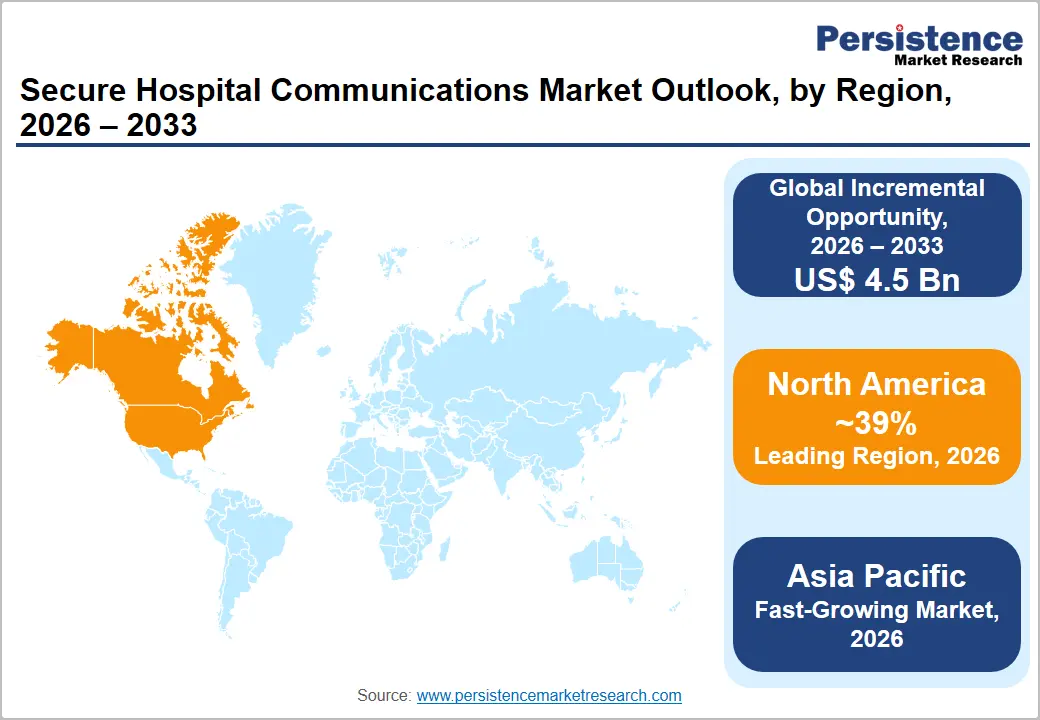
- Regional Leadership: North America is projected to capture roughly 39% of the market share by 2026, while Asia Pacific is forecast to record the fastest growth due to rapid clinical infrastructure expansion.
DRO Analysis
Driver - Rising Regulatory Focus on Healthcare Data Security
Healthcare providers are managing growing volumes of patient information across mobile devices, cloud platforms, and interconnected clinical systems. Regulatory agencies are strengthening cybersecurity expectations to reduce data breaches and operational disruptions. Secure communication platforms support encrypted data exchange, audit trails, authentication controls, and governance requirements, creating stronger demand across healthcare facilities.
The U.S. Department of Health and Human Services continued its expansion of healthcare cybersecurity performance goals during 2025, encouraging implementation of stronger security controls across healthcare organizations. Regulatory attention intensified following major healthcare cyber incidents that affected care continuity and patient privacy. As compliance requirements become more rigorous, healthcare facilities are increasing investments in secure communication infrastructure to reduce exposure to operational and legal risks.
Restraint - High Integration Complexity across Legacy Systems
Many healthcare facilities continue operating fragmented information technology environments containing legacy electronic medical records, communication tools, and departmental software. Integration challenges increase deployment timelines and implementation costs. Technical incompatibility often limits scalability and reduces efficiency gains expected from communication modernization initiatives.
Healthcare organizations frequently require customized interfaces, middleware investments, and extended testing procedures to achieve interoperability. These requirements increase capital expenditure and reduce margin flexibility for providers operating under budget constraints. Delayed implementation can postpone return on investment and slow organization-wide adoption.
Opportunity - AI-Enabled Clinical Communication Platforms
Artificial intelligence is creating opportunities to transform communication workflows through automated triage, message prioritization, intelligent routing, and clinical decision support. Healthcare organizations are seeking solutions that reduce communication bottlenecks while improving clinician productivity.
Technology providers can expand platform value by embedding predictive workflow management and intelligent escalation capabilities. Integration of AI-driven communication tools into clinical environments can reduce response times and improve coordination efficiency. Adoption of intelligent communication systems is expected to create new revenue streams across acute and ambulatory care environments.
Category-wise Analysis
Communication Type Insights
Messaging systems are anticipated to secure around 38% of the secure hospital communications market share in 2026, reflecting strong institutional preference for encrypted text-based workflows that reduce cognitive load on clinical staff compared to voice interruptions. Epic Systems' integrated secure messaging module, deployed across major U.S. health networks, exemplifies the scale at which messaging platforms embed within clinical operations. Demand is sustained by regulatory requirements for audit-trail preservation of all patient-related communications.
Video communication is expected to be the fastest-growing segment, propelled by accelerating telehealth program integration and rising use of secure video consultations for specialist referrals and multidisciplinary tumor board sessions. Platforms such as Zoom for Healthcare's HIPAA-compliant infrastructure demonstrate the commercial viability of high-definition, encrypted video in acute care settings. Reimbursement policy expansion for virtual consultations across CMS-administered programs reinforces sustained volume growth through the forecast period.
Component Insights
Software is poised to dominate with a forecast market share of over 58% in 2026, powered by growing demand for secure messaging applications, communication workflow management, and integrated clinical collaboration tools. Software platforms enable encryption, user authentication, and interoperability. CardMedic expanded communication capabilities supporting multilingual clinical interactions. Strong digital transformation initiatives continue supporting software adoption across healthcare organizations.
Services are estimated to be the fastest-growing segment, fueled by increasing implementation complexity, cybersecurity requirements, and integration demands. Healthcare organizations seek professional support for deployment, training, compliance management, and system optimization. Enterprise communication modernization programs often require extensive consulting and integration expertise. Service providers help healthcare facilities maximize platform utilization while maintaining regulatory alignment.
End-user Insights
Hospitals are likely to be the leading segment with a projected 62% of the secure hospital communications market share in 2026 due to extensive communication requirements across clinical departments, emergency services, diagnostic teams, and administrative functions. Large healthcare institutions require secure information exchange throughout care pathways. Major hospital systems continue expanding enterprise communication platforms. Operational complexity drives sustained technology investment.
Ambulatory surgical centers are anticipated to be the fastest-growing segment, fueled by rising procedure volumes, workflow digitization, and increasing emphasis on care coordination. Communication efficiency directly influences scheduling, patient management, and clinical outcomes. Ambulatory facilities increasingly adopt mobile communication platforms integrated with healthcare information systems. Digital transformation initiatives are accelerating deployment across outpatient care environments.
Regional Insights
North America Secure Hospital Communications Market Trends
North America is expected to account for approximately 39% of the market share in 2026, supported by advanced healthcare digital infrastructure and strong cybersecurity investments. Growing adoption of secure clinical communication platforms across hospitals and healthcare networks is improving operational efficiency and regulatory compliance.
U.S. Secure Hospital Communications Market Insights
The U.S. is expected to hold nearly 82% of the North America market share in 2026, driven by the extensive deployment of secure communication technologies. Federal cybersecurity initiatives and healthcare data protection requirements are encouraging hospitals to modernize communication systems. Expansion of digital health programs is supporting sustained technology adoption across healthcare facilities.
Canada Secure Hospital Communications Market Insights
Canada is projected to account for around 18% of the North America market share in 2026, supported by healthcare digitization and virtual care expansion. Healthcare providers are increasingly implementing secure messaging and collaboration solutions to improve care coordination. Investments in interoperable healthcare infrastructure are contributing to long-term market growth.
Europe Secure Hospital Communications Market Trends
Europe is projected to capture approximately 27% of the market share in 2026, driven by healthcare digital transformation and data privacy regulations. Healthcare organizations are investing in secure communication technologies to strengthen patient information security. The growing integration of communication platforms with digital healthcare systems is supporting regional expansion.
Germany Secure Hospital Communications Market Insights
Germany is expected to represent nearly 24% of the European market share in 2026, supported by hospital modernization initiatives and technology investments. Healthcare providers are implementing secure communication solutions to improve workflow efficiency and interoperability. Digital health infrastructure development continues to create opportunities for communication platform deployment.
U.K. Secure Hospital Communications Market Insights
The U.K. is forecast to account for approximately 19% of the Europe market share in 2026, driven by National Health Service digital transformation initiatives. Hospitals are expanding the adoption of secure communication systems to support clinical collaboration and patient engagement. Increasing investment in healthcare technology infrastructure is strengthening market development.
Asia Pacific Secure Hospital Communications Market Trends
Asia Pacific is forecast to be the fastest-growing market for secure hospital communications, stimulated by rapid healthcare infrastructure development and digital transformation programs. Governments invest in connectivity to support expanding patient populations. Local and international vendors form partnerships to address regional requirements.
China Secure Hospital Communications Market Insights
China is expected to account for nearly 38% of the Asia Pacific market share in 2026, driven by smart hospital initiatives and healthcare technology investments. Healthcare providers are integrating secure communication systems into broader digital healthcare ecosystems. Expansion of connected hospital infrastructure is supporting continued market growth.
India Secure Hospital Communications Market Insights
India is projected to capture around 16% of the Asia Pacific market share in 2026, supported by healthcare modernization and growing telehealth adoption. Hospitals are increasingly implementing secure communication platforms to improve operational efficiency and care coordination. Rising cybersecurity awareness is contributing to stronger technology deployment across healthcare facilities.
Competitive Landscape
The global secure hospital communications market is moderately fragmented, characterized by participation from established healthcare communication providers and enterprise technology companies. Key companies include TigerConnect, Vocera Communications (Stryker), Ascom Holding AG, Philips Healthcare, and Siemens Healthineers. Competitive positioning is influenced by interoperability capabilities, security architecture, compliance support, and workflow integration.
Technology providers continue investing in cloud communication platforms, artificial intelligence integration, and cybersecurity enhancements. Strategic partnerships with healthcare organizations support product validation and adoption. Competition is increasingly centered on enterprise-wide communication ecosystems capable of supporting secure messaging, voice communication, video collaboration, and clinical workflow automation.
Key Industry Developments:
- In December 2025, MEDHOST announced the general availability of MEDHOST Secure Communications, reinforcing secure clinical collaboration and workflow-integrated messaging across hospital care teams and healthcare facilities.
- In September 2025, KPJ Healthcare partnered with NetSfere to deploy an encrypted communication platform across 30 hospitals, strengthening secure clinical collaboration, data protection, and regulatory-compliant communication throughout its healthcare network.
Companies Covered in Secure Hospital Communications Market
- TigerConnect
- Vocera Communications (Stryker)
- Ascom Holding AG
- Philips Healthcare
- Siemens Healthineers
- Imprivata
- PatientSafe Solutions
- Klara Technologies
- Microsoft (Teams for Healthcare)
- Zoom Video Communications (Zoom for Healthcare)
- Cerner Corporation (Oracle Health)
- NEC Corporation
- Zebra Technologies
- Spok Holdings
Frequently Asked Questions
The global secure hospital communications market is projected to reach US$4.1 billion in 2026.
Growing cybersecurity requirements, increasing healthcare digitization, and rising demand for secure real-time clinical collaboration drive the secure hospital communications market.
The secure hospital communications market is poised to witness a CAGR of 11.2% from 2026 to 2033.
Expansion of AI-enabled communication platforms, cloud-based healthcare collaboration solutions, and interoperable digital hospital ecosystems creates key market opportunities.
Some of the key market players include TigerConnect, Vocera Communications (Stryker), Ascom Holding AG, Philips Healthcare, and Siemens Healthineers.


