




- Food Ingredients & Additives
- Seaweed Market
Seaweed Market Size, Share, and Growth Forecast 2026 - 2033
Seaweed Market By Product Type (Red, Brown, Green) Form Type (Liquid, Powdered, Flakes) Application (Food, Medicines, Chemicals and Fertilizers, Animal Feed Additives, Building Materials, Energy Sources), and Regional Analysis for 2026 - 2033

Seaweed Market Size and Trends Analysis
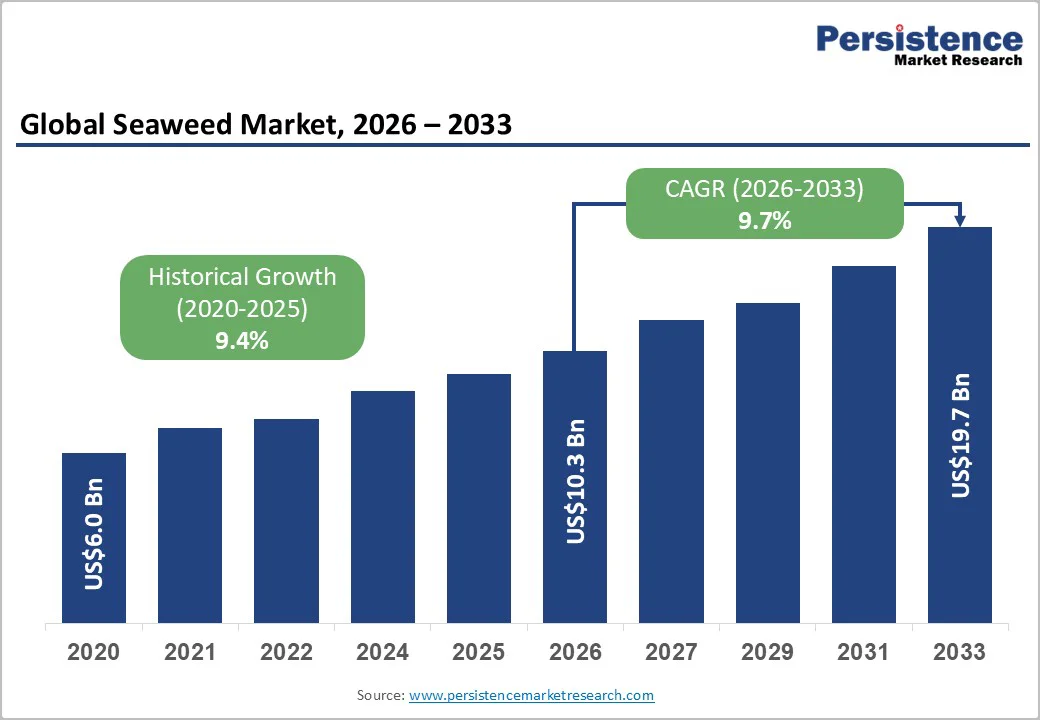
The global seaweed market size is likely to be valued at US$10.3 billion in 2026. It is expected to reach US$19.7 billion by 2033, growing at a CAGR of 9.7% during the forecast period from 2026 to 2033, driven by rising demand for plant-based and functional foods, increasing applications in cosmetics, pharmaceuticals, and agriculture, sustainability benefits, technological advances in cultivation and processing, and supportive regulatory and market trends.
Key Industry Highlights
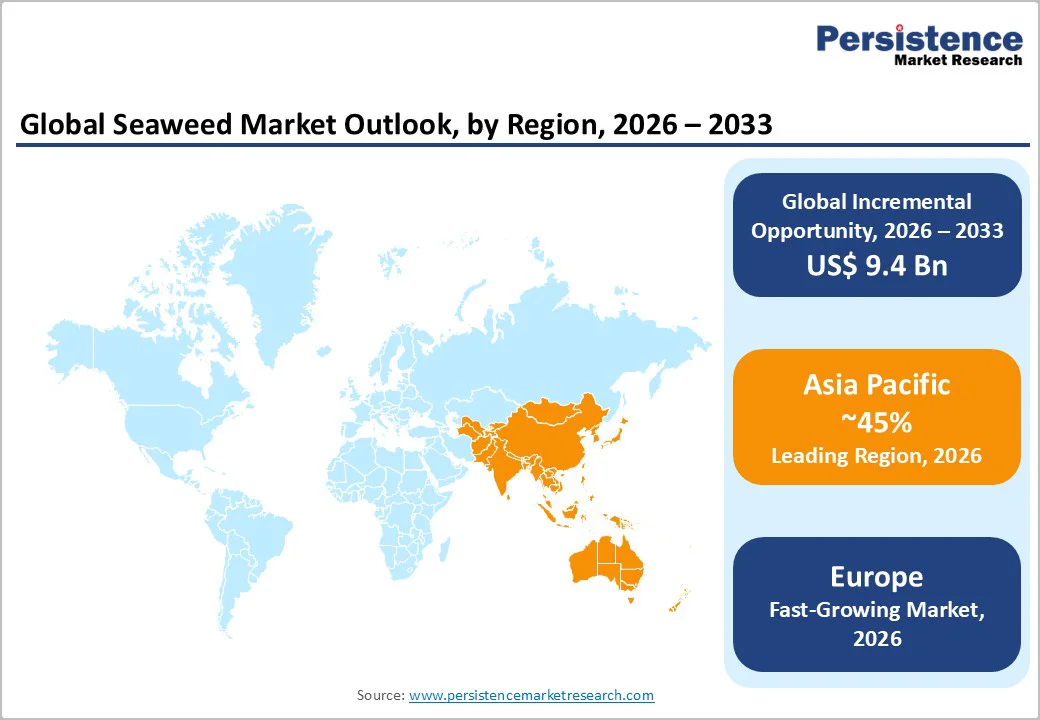
- Leading Region: Asia Pacific is anticipated to lead the market with around 45% share in 2026, driven by major producers such as China, Japan, India, and ASEAN countries, strong demand in food, medicine, and industrial applications, and advantages in processing infrastructure, despite regulatory and sustainability challenges.
- Fastest-growing Region: Europe is likely to be the fastest-growing region, driven by Germany, the U.K., France, and Spain, the EU regulations, rising demand in food, pharmaceuticals, and cosmetics, and investments in sustainable farming and bio-based applications.
- Leading Product Type: Red seaweed is expected to lead the product type segment with 40% share, widely used in food, pharmaceuticals, and cosmetics for its versatility and nutritional value.
- Fastest-growing Product Type: Brown seaweed is anticipated to be the fastest-growing segment, driven by increasing demand in fertilizers and bioenergy applications.
- Leading Form Type: Powdered seaweed is expected to lead the market, with about 48.2% share, owing to its long shelf life and ease of use in food and pharmaceutical products.
- Fastest-growing Form Type: Liquid seaweed is likely to be the fastest-growing segment, due to its applications in cosmetics and natural agricultural sprays.
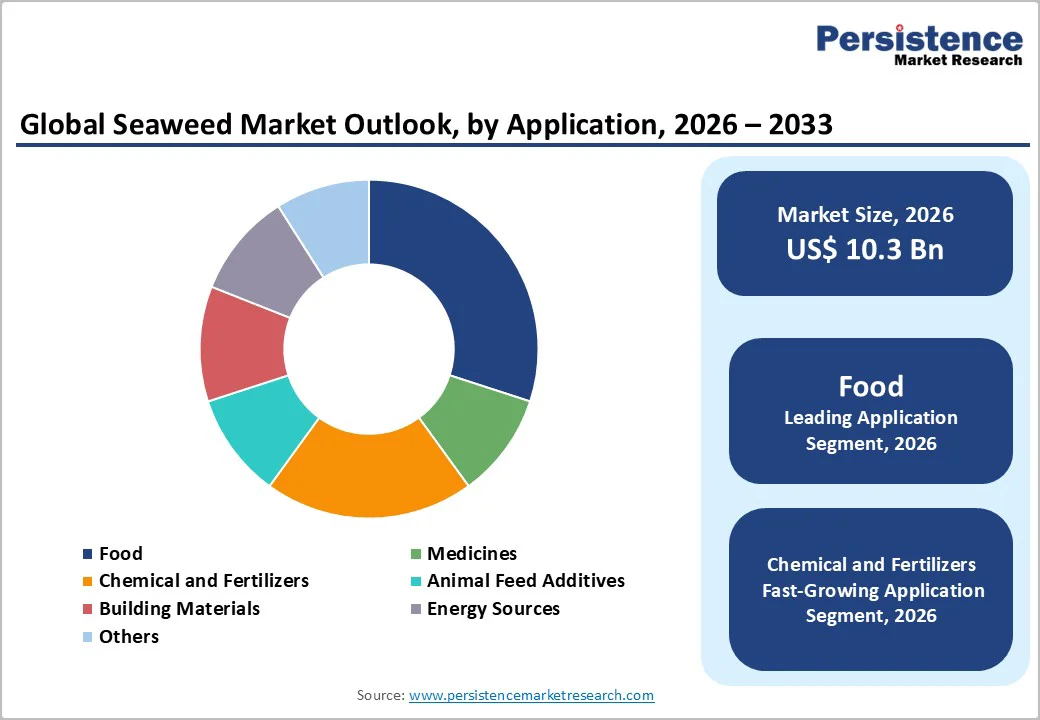
- Leading Application: The food segment is projected to hold the largest share in the market, at about 35%, driven by strict food safety regulations and the growing need for efficient baking, drying, and sterilization processes.
| Key Insights | Details |
|---|---|
|
Seaweed Market Size (2026E) |
US$10.3 Bn |
|
Market Value Forecast (2033F) |
US$19.7 Bn |
|
Projected Growth CAGR (2026-2033) |
9.7% |
|
Historical Market Growth (2020-2024) |
9.4% |
Market Factors - Growth, Barriers, and Opportunity Analysis
Growing Demand for Sustainable Nutrition and Natural Products
The growing demand for sustainable nutrition and natural products is rapidly boosting the seaweed market. Consumers around the world are increasingly gravitating toward plant-based, clean-label, and functional foods, and seaweed fits this trend well as it is nutrient-dense, offering vitamins, minerals, dietary fiber, antioxidants, and bioactive compounds, yet low in calories. Awareness of health, gut wellness, and preventive nutrition rises; seaweed’s versatility for contemporary diets and supplements makes it particularly attractive.
Seaweed cultivation and products align with global sustainability goals. Farming seaweed does not require arable land, fresh water, or chemical fertilizers, and it has a comparatively lower environmental footprint. Seaweed farming can even help improve water quality and store carbon, supporting marine ecosystems and climate-resilience efforts. Seaweed also helps lower carbon footprints and support healthier marine ecosystems, making it increasingly attractive in environmentally conscious markets.
Regulatory and Quality Compliance Challenges
The seaweed industry faces major obstacles due to inconsistent regulatory frameworks and a lack of standardized quality control. Due to different countries applying very different rules or sometimes none at all for seaweed cultivation, processing, and export, producers often struggle to meet the safety, purity, and traceability standards demanded by major markets, especially food, pharmaceuticals, and nutraceuticals. Lack of universal standards can cause product rejection and limit global trade for small suppliers.
In many producing regions, processing infrastructure is fragmented or underdeveloped. Harvesting often remains manual; drying, cleaning, and storage may lack adequate facilities; supply chains may not guarantee hygienic handling or environmental controls, all of which create risks of contamination or uneven product quality. Environmental and seasonal variability, such as salinity, water pollution, and heavy-metal contamination, can affect seaweed safety and consistency, making it harder to guarantee uniform quality across batches.
Innovation in Product Applications
The seaweed market is witnessing strong growth, driven by innovation in product applications, offering opportunities across multiple sectors. In the food industry, seaweed is increasingly used in functional foods, plant-based products, and health supplements, capitalizing on its high nutritional value, including proteins, vitamins, minerals, and bioactive compounds. Rising consumer awareness about natural and sustainable nutrition is encouraging manufacturers to develop innovative formulations such as seaweed-based snacks, beverages, and fortified food products.
Seaweed innovation is transforming cosmetics, agriculture, animal feed, and industrial products. In cosmetics, seaweed extracts are incorporated into skincare and haircare products for their moisturizing, anti-aging, and antioxidant properties. In agriculture, seaweed-based bio-fertilizers and soil conditioners improve crop yield sustainably. Emerging applications in animal feed and biodegradable materials highlight seaweed’s versatility and eco-friendly potential.
Category-wise Analysis
Product Type Insights
Red seaweed is expected to dominate the market, accounting for roughly 40% of total revenue in 2026, driven by extensive use across food, pharmaceutical, and cosmetic applications, supported by its versatility and rich nutritional profile, featuring proteins, vitamins, minerals, and bioactive compounds that significantly enhance its value. Red seaweed is widely used in functional foods and supplements, with carrageenan for dairy alternatives serving as a key example of its high-value applications.
Brown seaweed is anticipated to be the fastest-growing product type, driven by its expanding applications in agriculture and energy sectors. Increased adoption as a bio-fertilizer, soil conditioner, and raw material for bioenergy production is fueling growth. Its functional properties, such as high alginate content, make it ideal for sustainable agricultural practices and renewable energy solutions. Green seaweed, though smaller in share, is gaining attention for health-focused products and nutraceutical applications, offering diversification opportunities. A notable example is its use as alginate-based bio-fertilizers, which improve soil structure and enhance crop productivity, fueling its rapid market expansion.
Form Type Insights
Powdered seaweed is projected to dominate the market in 2026, capturing about 48.2% of total revenue due to its long shelf life, stability, and ease of integration into food, nutraceutical, and pharmaceutical formulations. Its fine texture and compatibility with modern processing technologies make it a preferred ingredient for manufacturers of snacks, beverages, supplements, and fortified foods. A key example is its use in protein-enriched smoothie powders and functional snack bars, which rely on powdered seaweed for added nutrients and natural color.
Liquid seaweed is expected to be the fastest-growing product type, supported by its expanding use in cosmetics, personal care, and natural agricultural inputs. Its quick absorption and smooth application make it ideal for skincare serums, hydrating facial mists, and hair-repair treatments, as well as organic foliar sprays and bio-stimulants used to enhance plant growth. Rising interest in clean-label beauty products and sustainable farming practices continues to accelerate the adoption of liquid seaweed extracts across both consumer and agricultural markets.
Application Type Insights
The food segment is projected to lead the market in 2026, accounting for about 35% of the total market share, supported by the growing use of seaweed in plant-based, functional, and clean-label food products. Its rich nutrient profile, featuring essential minerals, vitamins, antioxidants, and dietary fiber, makes it a preferred ingredient in snacks, beverages, seasonings, and fortified foods.
Examples include seaweed-infused noodles, plant-based seafood alternatives, and nutrient-enriched snack chips. Medicine and pharmaceutical applications also contribute significantly, with seaweed-derived compounds used in wound dressings and antiviral formulations.
The chemicals and fertilizers segment is expected to be the fastest-growing application category, driven by expanding demand for eco-friendly agricultural inputs and organic farming practices. Seaweed-based bio-fertilizers and plant-growth enhancers are increasingly valued for improving soil structure, nutrient uptake, and crop productivity. A strong example is the use of liquid seaweed extracts as natural foliar sprays in horticulture. Additional growth stems from emerging applications such as seaweed-enriched animal feed additives that boost gut health and immunity, and seaweed-based biopolymers used in sustainable building materials, supporting innovation in biodegradable construction solutions.
Regional Insights
North America Seaweed Market Trends
North America is anticipated to experience a steady growth in the seaweed market, driven by rising consumer interest in plant-based, functional, and sustainable nutrition. The demand for seaweed in food products such as snacks, beverages, seasonings, and meat alternatives is increasing as consumers seek nutrient-dense and clean-label ingredients. The region is also seeing greater adoption of seaweed-derived components in dietary supplements, supported by interest in natural sources of iodine, antioxidants, and bioactive compounds.
The region is also witnessing rapid expansion in agricultural, cosmetic, and industrial applications of seaweed. Seaweed-based bio-fertilizers and soil enhancers are gaining traction among farmers adopting regenerative and organic practices. In the cosmetics sector, seaweed extracts are increasingly used in skincare and haircare formulations for hydration, anti-aging, and natural wellness benefits. Industrial and research initiatives exploring seaweed’s potential in bioplastics, biodegradable packaging, and bioenergy are adding new opportunities for future growth.
Europe Seaweed Market Trends
Europe is emerging as the fastest-growing region in the seaweed market, driven by strong consumer demand for natural, sustainable, and health-enhancing products. The area is rapidly increasing its use of seaweed in plant-based foods, functional ingredients, and dietary supplements, supported by rising interest in clean-label nutrition and marine-based superfoods. Europe’s focus on reducing salt intake, improving gut health, and adopting nutrient-rich alternatives has accelerated the integration of seaweed into snacks, condiments, beverages, and meat substitutes.
The region is also witnessing a strong momentum across cosmetics, agriculture, and industrial applications, contributing to its rapid growth. Seaweed extracts are increasingly used in premium skincare, haircare, and wellness formulations due to their antioxidant, hydrating, and anti-aging properties. In agriculture, seaweed-based bio-stimulants and fertilizers are gaining significant adoption as Europe accelerates its shift toward organic and regenerative farming.
Asia Pacific Seaweed Market Trends
Asia Pacific is the leading region, accounting for approximately 45% market share in 2026, driven by its massive production base, long-established cultivation practices, and rapidly expanding industrial applications. China, Indonesia, South Korea, and the Philippines collectively account for the majority of global seaweed output, supported by favorable coastlines, skilled aquaculture communities, and strong government programs promoting marine farming. The region’s dominance is further strengthened by rising consumption of edible seaweed in Japan and Korea, where seaweed is deeply integrated into mainstream diets and increasingly used in functional, plant-based, and fortified foods.
Asia Pacific is showing accelerating momentum in industrial-scale processing, especially for hydrocolloids like agar, alginate, and carrageenan, which are extensively used in pharmaceuticals, cosmetics, and biotechnology. India, China, and Indonesia are increasingly investing in seaweed for bio-stimulants, biodegradable packaging, and bioenergy prototypes, reflecting a shift toward circular and ocean-based bio economies. Environmental goals, such as carbon reduction and marine restoration, are driving large-scale seaweed farming as a climate-friendly solution.
Competitive Landscape
The global seaweed exhibits a moderately fragmented structure, driven by diverse cultivation practices, regional availability of species, and the presence of both small coastal producers and large integrated processors. The industry is shaped by rising demand for food-grade, pharmaceutical, and industrial-grade seaweed ingredients, prompting companies to expand capacity and invest in advanced processing technologies.
With key leaders including Cargill Inc., Acadian Seaplants, Algaia, Gelymar, Roullier Group, Qingdao Gather Great Ocean Algae Industry Group, and DuPont, the market continues to consolidate through strategic expansions and technology upgrades. These players compete through innovations in extraction processes, high-purity hydrocolloids, improved cultivation methods, and expanded application portfolios across food, nutraceuticals, fertilizers, and biopolymers.
Key Market Developments:
- In October 2025, Global Seaweed Coalition (GSC) secured renewed funding to continue promoting sustainable seaweed industry development, supporting global standards, responsible farming practices, and cross-region collaboration among producers, researchers, and stakeholders.
- In June 2025, the KOASTAL-led initiative completed a three-year, EU-funded pilot project establishing six seaweed farms along Sweden’s west coast, validating the viability of high-quality, large-scale seaweed cultivation in European waters and demonstrating scalable, sustainable farm models for regions beyond traditional tropical zones.
Companies Covered in Seaweed Market
- Cargill, Incorporated
- DuPont
- Acadian Seaplants Limited (ASL)
- Biostadt India Limited
- Brandt Consolidated, Inc.
- COMPO Expert GmbH
- Gelymar
- Lonza Group Ltd.
- Marinalg International
- Ocean Harvest Technology
- Ocean Rainforest Sp/F
- Qingdao Bright Moon Group Co., Ltd.
- Groupe Roullier
Frequently Asked Questions
The seaweed market is valued at US$10.3 billion in 2026 and expected to reach US$19.7 billion by 2033, reflecting robust growth.
Key drivers include rising demand for sustainable nutrition, technological advancements in seaweed cultivation, and supportive government policies promoting renewable resources.
The red seaweed product segment leads the market with 40% share, widely used in food, pharmaceuticals, and cosmetics for its versatility and nutritional value.
Asia Pacific leads the seaweed market with around 45% share, driven by major producers, including China, Japan, India, and ASEAN countries, strong demand in food, medicine, and industrial applications, and advantages in processing infrastructure, despite regulatory and sustainability challenges.
Innovation in product applications such as bioenergy, biodegradable materials, and advanced pharmaceuticals presents significant growth opportunities.


