




- Automation & Robotics
- Robotic Gripping System Market
Robotic Gripping System Market Size, Share, and Growth Forecast, 2026 - 2033
Robotic Gripping System Market by Product Type (Vacuum Grippers, Pneumatic Grippers, Hydraulic Grippers, Servo-electric Grippers), Application (Automotive, Electronics, Food and Beverage, Pharmaceuticals, Logistics), and Regional Analysis for 2026 - 2033

Robotic Gripping System Market Size and Trends Analysis
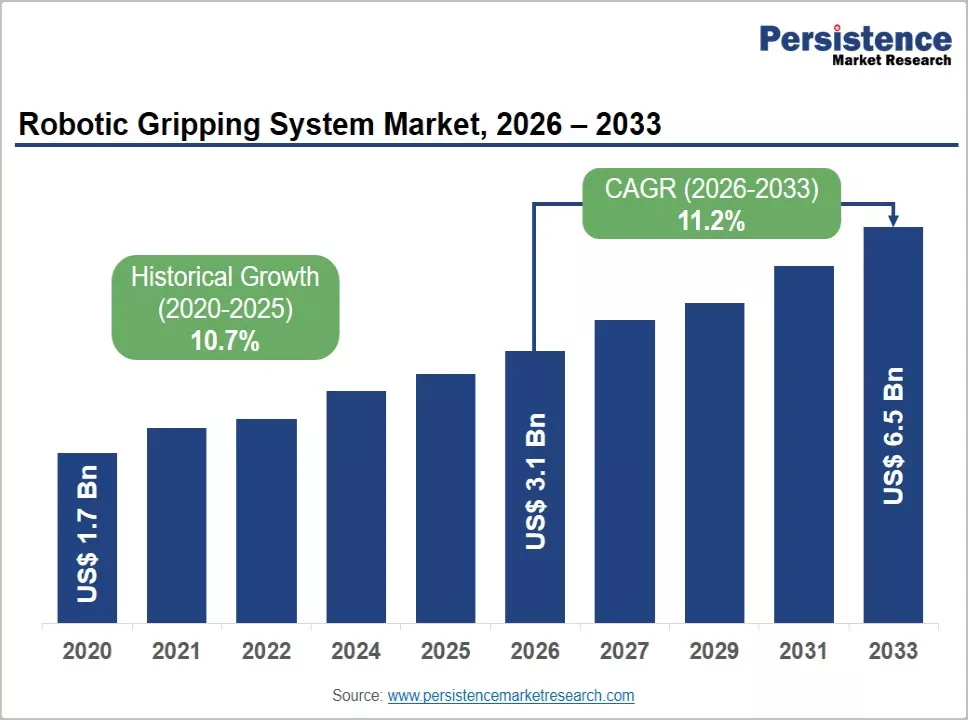
The global robotic gripping system market size is likely to be valued at US$3.1 billion in 2026 and is expected to reach US$6.5 billion by 2033, growing at a CAGR of 11.2% during the forecast period from 2026 to 2033, driven by accelerating industrial automation, rising robot deployment, and growing demand for flexible end-of-arm tooling across manufacturing and logistics.
According to the International Federation of Robotics (IFR), more than 600,000 industrial robots were installed globally in 2025, while the worldwide operational stock reached 5 million units, highlighting the expanding installed base requiring gripping and handling solutions.
Key Industry Highlights:
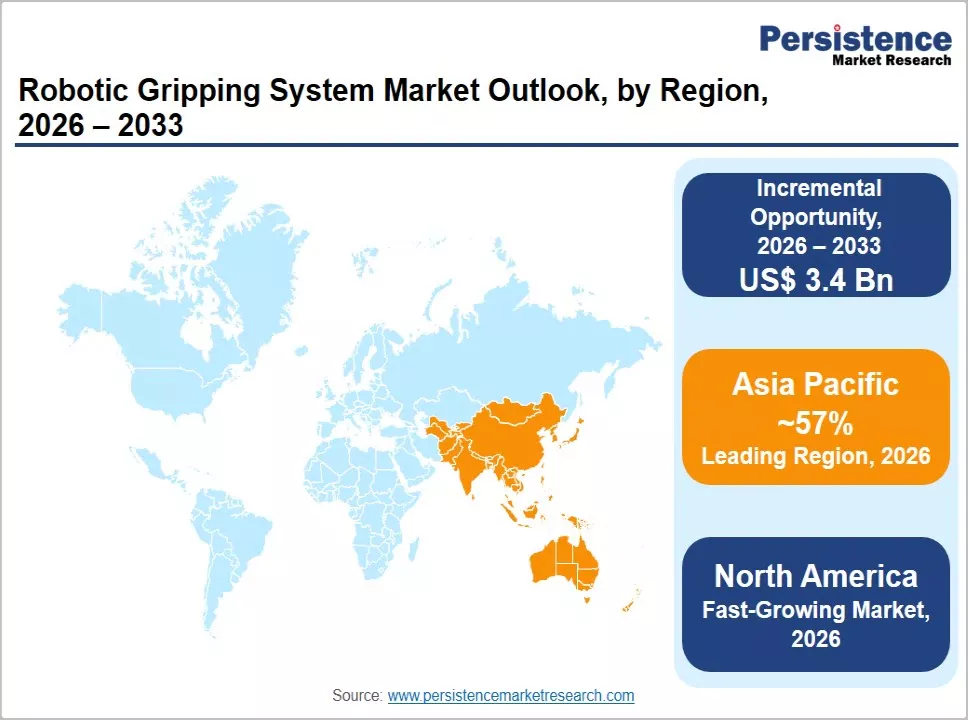
- Leading Region: Asia Pacific is anticipated to be the leading region, accounting for a market share of 43% in 2026, driven by large-scale manufacturing, expanding industrial robot deployment, electronics production, and smart-factory investments.
- Fastest-growing Region: North America is likely to be the fastest-growing region, supported by advanced industrial automation, reshoring, logistics robotics, and collaborative robot adoption.
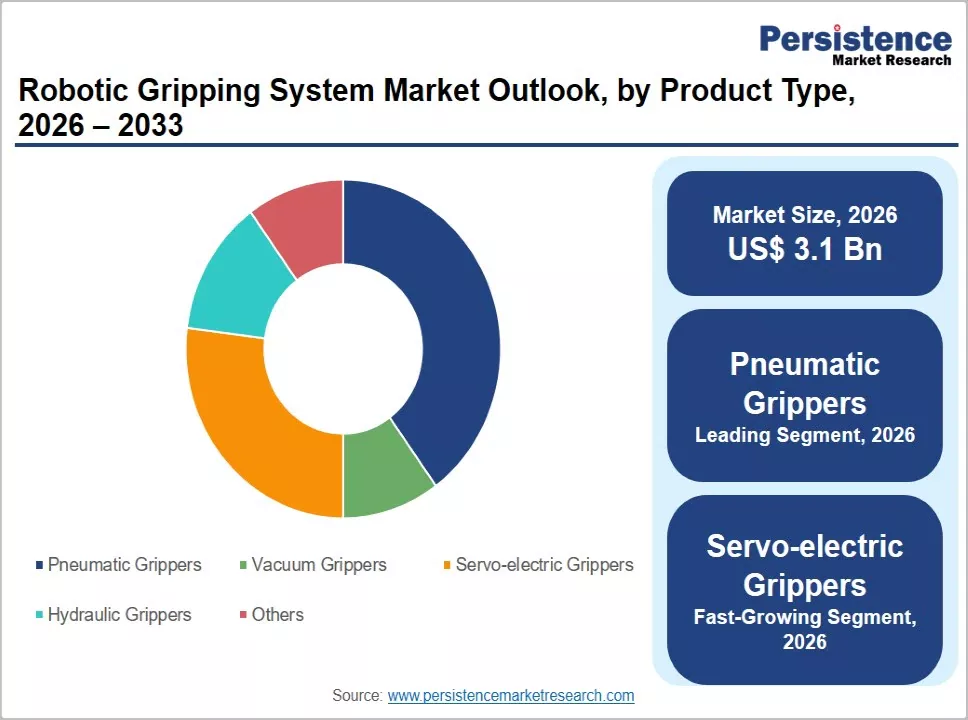
- Leading Product Type: Pneumatic grippers are projected to represent the leading product type in 2026, accounting for 38% of the revenue share, for high-speed operation, robust gripping force, and broad manufacturing adoption.
- Leading Application: The automotive segment is anticipated to be the leading application, accounting for over 30% of the revenue share in 2026, supported by extensive robotic automation across assembly, body shops, and powertrain manufacturing.
- Key Opportunity: The key market opportunity lies in the growing adoption of soft robotics, adaptive grippers, and AI-enabled vision systems for handling irregular, fragile, and variable-sized objects. Increasing demand for flexible automation in logistics, food processing, electronics, pharmaceuticals, and high-mix manufacturing is encouraging the development of intelligent gripping solutions with integrated sensing, force control, and adaptable finger configurations.
DRO Analysis
Driver - Expansion of Collaborative Robots and Precision Applications
Collaborative robots are expanding demand for robotic gripping systems by enabling automation in operations requiring close interaction between people and machines. Their flexible deployment supports smaller work cells, frequent task changes, and varied production requirements, creating demand for compact grippers with controlled force and reliable sensing. Automotive, electronics, and general manufacturing use collaborative systems for assembly, machine tending, inspection, and material handling.
Precision applications require repeatable positioning and careful object handling. This trend encourages suppliers to develop servo-electric, adaptive, and sensor-integrated grippers that accommodate varying workpieces while maintaining productivity, safety, and process consistency across automated production environments in multiple industries.
Precision manufacturing is strengthening demand for robotic grippers that provide accurate force, position, and movement control. Electronics, semiconductor, pharmaceutical, and laboratory applications often involve small, fragile, or high-value components where excessive gripping force can cause damage or process variation. Servo-electric grippers provide programmable gripping parameters, while integrated sensors enable monitoring of contact and handling conditions.
Restraint - Challenges in Handling Irregular, Deformable, or Porous Objects
Handling irregular, deformable, or porous objects remains a restraint for robotic gripping system adoption because conventional gripping mechanisms perform best with rigid, predictable geometries. Food products, textiles, flexible packaging, irregular components, and porous materials can change shape during contact or allow air leakage in vacuum applications. These characteristics make pickup, positioning, and release more difficult and may require specialized fingers, compliant materials, pressure control, or sensing.
Object variability can reduce gripping reliability when production lines handle mixed products with dimensions, textures, weights, or surface conditions. A gripper optimized for one work piece may require adjustment or replacement when product specifications change, affecting flexibility and equipment utilization. Vacuum systems can face difficulties with porous surfaces, while rigid mechanical grippers may struggle with soft or easily damaged products.
Opportunity - Soft Robotics and Adaptive Multi-finger Systems
Soft robotics and adaptive multi-finger systems create opportunities to expand robotic gripping into applications that conventional rigid grippers cannot handle. Soft fingers can conform to irregular shapes and distribute contact forces more gently, supporting food, pharmaceutical, logistics, and consumer-product handling. Multi-finger architectures can provide dexterity for picking objects with varied geometries and orientations.
Advances in compliant materials, embedded sensing, and control are improving the ability of grippers to detect contact and adjust gripping behavior. These capabilities can support handling and reduce the need for tooling, creating opportunities for flexible automation across high-mix production and fulfillment environments where variability is significant.
Adaptive gripping technologies can strengthen robotic automation in warehouses and manufacturing environments where product assortments change frequently. Perception, machine vision, tactile sensing, and force feedback can help robotic systems identify object characteristics and select suitable gripping strategies. Combining these technologies with soft or multi-finger mechanisms can improve handling of fragile, deformable, and irregular products while reducing manual intervention.
Category-wise Analysis
Product Type Insights
Pneumatic grippers are expected to lead, accounting for 38% of revenue in 2026, due to fast actuation, reliable gripping force, simple construction, and compatibility with established compressed-air infrastructure. Their suitability for repetitive material handling, machine tending, assembly, and automotive production makes them widely deployed across industrial robotic systems. Pneumatic grippers also offer robust performance in demanding manufacturing environments where consistent gripping and rapid cycling are important.
Servo-electric grippers are likely to represent the fastest-growing segment, supported by programmable gripping force, precise positioning, energy-efficient operation, and increasing adoption in flexible and collaborative automation. Unlike systems dependent on compressed air, electric grippers provide direct control over gripping parameters, supporting applications involving delicate components and frequent product changes.
Application Insights
The automotive segment is projected to lead the market, capturing around 29% of the revenue share in 2026, supported by extensive robotic automation across vehicle assembly, body shops, powertrain operations, machine tending, and component handling. Automotive production requires reliable gripping systems capable of maintaining repeatability across high-volume manufacturing processes while accommodating different component geometries and production stages. SCHUNK offers specialized pneumatic grippers for industrial applications, including handling components such as gears and rims.
The logistics segment is likely to be the fastest-growing application due to warehouse automation, e-commerce fulfillment, parcel handling, and increasing requirements for flexible picking and palletizing. Robotic gripping systems enable automated handling of boxes, containers, packages, and mixed items where product dimensions and packaging formats can vary considerably. Vacuum, electric, and adaptive grippers help robotic systems perform picking, sorting, depalletizing, and palletizing tasks while reducing manual handling requirements.
Regional Insights
North America Robotic Gripping System Market Trends
North America is likely to be the fastest-growing region, as manufacturers increase automation across automotive, electronics, food processing, logistics, and general manufacturing. Demand is shifting toward electric, adaptive, vacuum, and sensor-integrated grippers that provide greater flexibility for high-mix production. Collaborative robots are also creating demand for lightweight and programmable gripping solutions suitable for human-robot workspaces.
U.S. Robotic Gripping System Market Trends
The U.S. is expected to dominate the regional market, accounting for approximately 80% of the market share in 2026, driven by strong industrial automation across automotive, electronics, metalworking, logistics, and food manufacturing. Manufacturers are increasingly deploying robots for machine tending, assembly, picking, packaging, and material handling. The expansion of reshoring and domestic manufacturing facilities is creating additional automation requirements.
Canada Robotic Gripping System Market Trends
Canada is likely to be a significant market for robotic gripping systems, holding approximately 20% of the market share in 2026. Manufacturers are adopting robotic systems to improve productivity, maintain consistent quality, and address labor availability challenges. Automotive and automotive-component production remains an important application area for robotic material handling and assembly. Collaborative robots are also creating opportunities for lightweight grippers that can operate safely alongside workers.
Europe Robotic Gripping System Market Trends
Europe is likely to be a significant market, due to Industry 4.0 adoption, advanced manufacturing, collaborative robotics, and increasing demand for flexible production. Germany, Italy, France, and the U.K. have established automation ecosystems supporting the use of robotic grippers across automotive, machinery, electronics, logistics, and food processing.
U.K. Robotic Gripping System Market Trends
The U.K. is likely to be a significant market for robotic gripping system, accounting for 15% of Europe market share in 2026. Government assessments identify artificial intelligence, sensing, dexterity, materials, and autonomous control as important technologies for advancing robotics. These developments are supporting demand for sophisticated gripping technologies capable of precise manipulation and automated object handling. Collaborative robotics is also receiving greater attention, with U.K. authorities working with industry on guidance for safe collaborative-robot deployment.
Germany Robotic Gripping System Market Trends
Germany is anticipated to dominate, accounting for around 37% of the Europe market share in 2026. Automotive manufacturers are major users of robotic systems for component handling, assembly, machine tending, and production-line operations. Germany’s Industry 4.0 ecosystem is encouraging integration between robots, sensors, vision systems, and end-of-arm tooling. Manufacturers are increasingly requiring grippers that can accommodate multiple workpieces and production formats.
Asia Pacific Robotic Gripping System Market Trends
The Asia Pacific region is anticipated to be the leading region, accounting for a market share of 43% in 2026. Its extensive manufacturing base, rapid industrial automation, and strong electronics and automotive production. China, Japan, South Korea, and India are driving regional demand through investments in smart factories, automated assembly, logistics, and advanced manufacturing. Electronics and semiconductor production is increasing requirements for highly precise and contamination-conscious gripping solutions, while automotive and battery manufacturing require reliable high-speed material handling.
China Robotic Gripping System Market Trends
China is projected to dominate the regional market, holding around a 30% share of the market in 2026, due to its extensive electronics, automotive, battery, semiconductor, and consumer-product manufacturing industries. The country’s manufacturing automation is increasingly incorporating intelligent robots, machine vision, and AI-enabled systems. China’s latest industrial strategy also places greater emphasis on robotics and AI-powered physical systems, supporting continued investment in automated production.
India Robotic Gripping System Market Trends
India is expected to emerge as a significant market, accounting for approximately a 22% share in 2026. Automotive manufacturing accounted for around 45% of installations, while robot adoption among automotive-parts suppliers increased significantly. Increasing investment in domestic manufacturing is encouraging companies to automate assembly, machine tending, material handling, welding, and packaging operations.
Competitive Landscape
The global robotic gripping system market exhibits a moderately fragmented structure, supported by the growing adoption of factory automation, collaborative robots, and flexible end-of-arm tooling across automotive, electronics, logistics, food processing, and general manufacturing applications.
Key players, including SCHUNK, Festo, SMC Corporation, Zimmer Group, OnRobot, Robotiq, Piab, and Schmalz, comprise a mix of established industrial automation suppliers and specialized collaborative robotics companies. Competition is shaped by product innovation, modular and adaptable designs, plug-and-play integration, higher payload capacity, advanced sensing technologies, and enhanced software connectivity.
Key Industry Developments:
- In September 2026, BEUMER Group launched BEUMER robotpick, a fully autonomous robotic picking and singulation solution designed for courier, express, and parcel operations.
Companies Covered in Robotic Gripping System Market
- Schunk GmbH
- Zimmer Group
- Festo AG
- SMC Corporation
- Piab AB
- Destaco
- Robotiq
- OnRobot
- Weiss Robotics
- Soft Robotics
- ABB
- KUKA
- Yaskawa
- Fanuc
- Universal Robots
Frequently Asked Questions
The global robotic gripping system market is projected to reach US$3.1 billion in 2026.
The robotic gripping system market is driven by expanding industrial automation, increasing adoption of collaborative robots, and rising demand for flexible and precise end-of-arm tooling across manufacturing, logistics, electronics, automotive, and food processing applications.
The robotic gripping system market is expected to grow at a CAGR of 11.2% from 2026 to 2033.
Key opportunities include the growing adoption of soft and adaptive grippers, AI-enabled vision and sensing technologies, and flexible gripping systems designed to handle irregular, fragile, and variable-sized objects across manufacturing, logistics, food processing, and pharmaceutical applications.
Schunk GmbH, Zimmer Group, Festo AG, SMC Corporation, Piab AB, Destaco, and Robotiq are the leading players.


