




- Sensors & Controls
- Radio Frequency Identification Chips Market
Radio Frequency Identification Chips Market Size, Share, and Growth Forecast, 2026 - 2033
Radio Frequency Identification Chips Market by Product Type (Passive RFID Chips, Active RFID Chips, Others), Frequency Band (UHF RFID, HF RFID, Others), Application, and Regional Analysis for 2026 - 2033

Radio Frequency Identification Chips Market Size and Trends Analysis
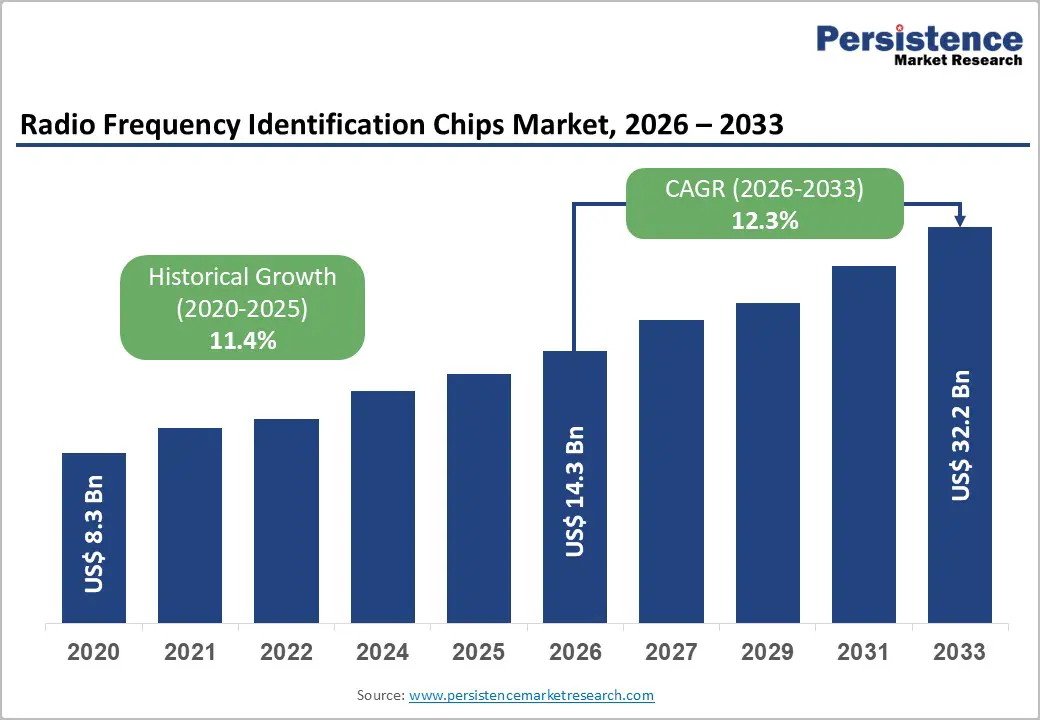
The global radio frequency identification chips market size is likely to be valued at US$14.3 billion in 2026 and is expected to reach US$32.2 billion by 2033, growing at a CAGR of 12.3% during the forecast period from 2026 to 2033, driven by the expanding adoption of RFID technology across retail, logistics, healthcare, and industrial manufacturing sectors to improve inventory visibility, supply-chain transparency, and operational efficiency.
Advancements in semiconductor design, including ultra-low-power integrated circuits and higher read sensitivity, are enabling broader RFID deployment at the item level. Increasing global standardization of UHF and HF frequency bands is improving interoperability across systems, which encourages enterprise-scale deployments. While price pressures and semiconductor supply fluctuations remain structural constraints, expanding digital transformation initiatives and strong manufacturing capacity in Asia Pacific create substantial growth opportunities for market participants.
Key Industry Highlights:
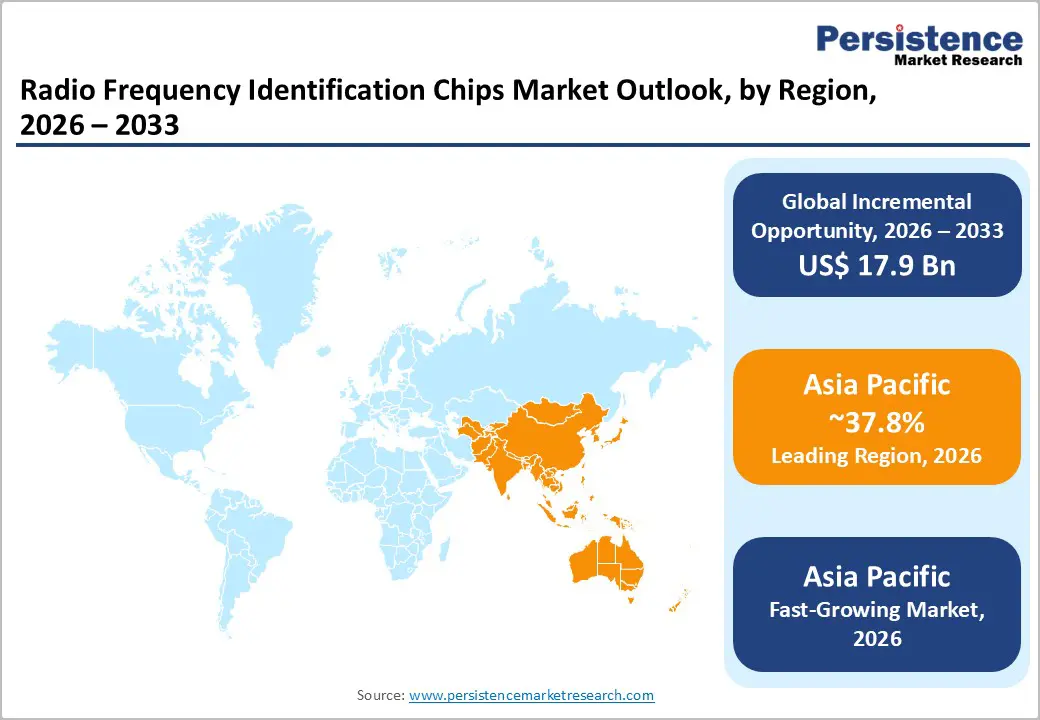
- Leading Region: Asia Pacific is projected to lead the market with the largest revenue share of 37.8%, driven by strong electronics manufacturing, large-scale logistics networks, and expanding retail sectors in China, Japan, and India.
- Fastest-growing Region: Asia Pacific is also the fastest-growing regional market, supported by increasing RFID adoption in supply-chain automation, e-commerce logistics, and smart manufacturing initiatives.
- Investment Plans: Technology companies and retailers are investing heavily in RFID-enabled supply-chain digitization, warehouse automation, and smart inventory systems, particularly in North America and Asia Pacific.
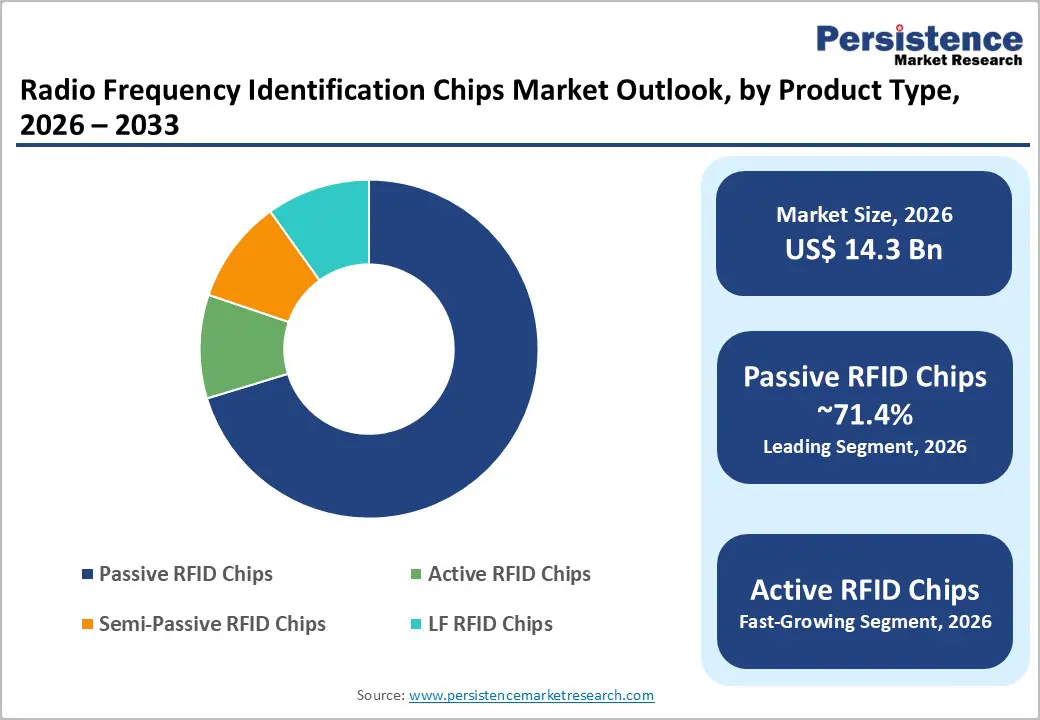
- Dominant Product Type: Passive RFID chips dominate with an anticipated market share of 71.4%, supported by their low cost and large-scale deployment in retail and logistics tagging applications.
- Leading Frequency Band: UHF RFID leads with an anticipated share of around 44.5%, due to its long read range and ability to scan large volumes of tags simultaneously in warehouse and retail environments.
| Key Insights | Details |
|---|---|
| Radio Frequency Identification Chips Market Size (2026E) | US$14.3 Bn |
| Market Value Forecast (2033F) | US$32.2 Bn |
| Projected Growth (CAGR 2026 to 2033) | 12.3% |
| Historical Market Growth (CAGR 2020 to 2025) | 11.4% |
Market Factors - Growth, Barriers, and Opportunity Analysis
Growth Analysis - Broadening Enterprise Digitalization and Supply-Chain Traceability
Global enterprises are accelerating digital transformation initiatives aimed at improving supply-chain transparency, asset visibility, and operational efficiency. RFID technology has emerged as a key enabler for automated identification and real-time tracking across complex supply networks. Retailers, logistics providers, and industrial manufacturers increasingly deploy RFID chips to improve inventory accuracy, minimize shrinkage, and streamline warehouse management. Item-level RFID tagging programs are becoming widespread in the retail apparel sector, allowing companies to monitor stock levels in real time and reduce out-of-stock events. Logistics providers also rely on RFID technology to track pallets, containers, and shipments across transportation networks. As enterprises transition from pilot deployments to large-scale operational rollouts, demand for RFID chips continues to increase. This shift toward digitized supply chains is expected to remain one of the strongest long-term drivers supporting market growth.
Semiconductor Performance Gains and Technology Innovation
Advancements in semiconductor engineering have significantly improved the performance capabilities of RFID chips. Modern tag integrated circuits offer enhanced receiver sensitivity, ultra-low power consumption, faster encoding speeds, and improved data storage capabilities. These innovations enable more reliable reading performance across longer distances and in complex environments. Improved chip sensitivity reduces the number of required reader devices in large deployments, lowering overall system costs for enterprise users. At the same time, advanced memory architecture allows RFID tags to store larger volumes of product information, enabling enhanced traceability and authentication features. Technological improvements also support the integration of RFID chips into unconventional substrates such as molded plastics, packaging materials, and in-mold labels. These innovations expand RFID applications beyond traditional labeling and increase the overall addressable market.
Industry Standards Harmonization and Ecosystem Maturity
The continued development of global RFID standards has significantly improved interoperability across hardware devices, readers, and software platforms. Standardized communication protocols enable RFID tags produced by different manufacturers to operate within the same infrastructure environment. This interoperability reduces implementation risk for large enterprises and simplifies system integration. Standardization of UHF spectrum allocation across major global markets has also improved cross-border deployment capabilities. Multinational corporations can now implement RFID solutions across international supply chains with greater efficiency and lower compliance complexity. As the RFID ecosystem matures through standardized hardware, software platforms, and integration frameworks, enterprises gain greater confidence in adopting RFID solutions at scale. This maturation process is accelerating market expansion.
Barrier Analysis - Price Pressure and Semiconductor Supply Constraints
RFID chips are highly cost-sensitive components, particularly in applications that require millions of tags annually. Retail and logistics customers often prioritize low-cost tags to ensure economic feasibility for item-level tracking. As a result, chip manufacturers face persistent pricing pressure that can compress profit margins. The semiconductor industry is also subject to cyclical supply disruptions, which may affect wafer availability and back-end packaging capacity. Shortages of semiconductor manufacturing resources can create temporary supply bottlenecks and delay deliveries to RFID solution providers. These supply fluctuations can influence production planning and pricing stability across the RFID chip value chain.
Regulatory and Spectrum Allocation Variability
Although RFID standards have improved significantly, regional spectrum allocation policies continue to vary across countries. Differences in permitted frequency ranges, transmission power limits, and regulatory certification requirements can complicate global RFID deployments. Manufacturers must often modify chip configurations or obtain separate regulatory approvals for different markets, increasing time-to-market and development costs. Smaller technology providers may face barriers when attempting to scale internationally due to these compliance requirements. Regulatory fragmentation, therefore, remains a structural challenge that can slow global adoption rates in certain regions.
Opportunity Analysis - Embedded RFID for Circular Economy and Product Lifecycle Management
The growing emphasis on sustainability and circular economy principles is creating new opportunities for RFID technology. Manufacturers and retailers are increasingly exploring embedded RFID tags within products and packaging to enable lifecycle tracking, reuse systems, and recycling management. Durable RFID tags integrated into reusable containers, pallets, and packaging materials allow companies to monitor product movement throughout extended lifecycle processes. These capabilities help businesses reduce waste, improve asset utilization, and comply with emerging environmental regulations. RFID chips designed for high durability and long operational lifetimes can therefore command higher value in sustainability-focused applications.
Healthcare Supply-Chain Traceability and Cold-Chain Monitoring
Healthcare and pharmaceutical supply chains require extremely high levels of product traceability, regulatory compliance, and inventory accuracy. RFID technology provides automated tracking solutions that improve visibility across hospital inventory systems, laboratory sample management, and pharmaceutical logistics. RFID chips equipped with secure memory and authentication capabilities enable product verification and anti-counterfeiting measures. Integration with sensor technologies also supports cold-chain monitoring for temperature-sensitive medical products. As healthcare systems continue to digitize their asset management and logistics infrastructure, RFID chip adoption within the medical sector is expected to grow at a rapid pace.
Category-wise Analysis
Product Type Analysis
Passive RFID chips are anticipated to account for approximately 71.4% of the market share in 2026, maintaining their position as the dominant product type in the RFID chips market. These chips operate without an internal power source and derive energy from electromagnetic signals transmitted by RFID readers. Their simplified design architecture significantly reduces manufacturing costs, allowing passive RFID tags to be produced at extremely large volumes. This cost advantage makes them highly suitable for mass deployment across retail, logistics, and industrial supply chains. The affordability and scalability of passive RFID chips enable organizations to implement item-level tracking across millions of products. Retail apparel companies widely deploy passive UHF RFID tags to improve inventory visibility and reduce stock discrepancies across physical stores and e-commerce fulfillment networks. For example, large global apparel retailers use passive RFID tagging to track garments from manufacturing facilities to retail shelves, enabling real-time stock monitoring and automated replenishment. In logistics environments, passive RFID tags are used to track pallets, cartons, and returnable transport items throughout warehouse operations. The technology also plays an increasing role in pharmaceutical packaging, airline baggage tracking, and library asset management systems, reinforcing its broad adoption across multiple industries.
Active RFID chips represent the fastest-growing segment within the product type category due to their advanced capabilities for long-range tracking and continuous monitoring. Unlike passive chips, active RFID devices contain onboard power sources that allow them to transmit signals independently, enabling greater read distances and more consistent data communication. These capabilities make active RFID chips particularly valuable for tracking high-value assets and equipment in complex operational environments. Industries such as transportation, mining, and energy frequently deploy active RFID systems to monitor vehicles, cargo containers, and heavy equipment across large geographic areas. For example, shipping ports and freight terminals use active RFID tags to track containers and automate gate entry processes. Similarly, industrial facilities rely on active RFID technology to monitor expensive machinery and tools through real-time location systems. Although active RFID chips carry higher production costs than passive alternatives, their enhanced functionality, longer read ranges, and continuous tracking capabilities justify their adoption in applications where asset visibility and operational efficiency are critical.
Frequency Band Insights
Ultra-high-frequency (UHF) RFID technology is anticipated to hold approximately 44.5% of the market share in 2026, making it the dominant frequency band within the RFID chips market. UHF RFID operates within the 860-960 MHz spectrum and is widely adopted for applications that require long read ranges and rapid data transmission. Its ability to read multiple tags simultaneously allows organizations to perform high-speed scanning across large inventories.
This capability is particularly valuable in logistics hubs and warehouse environments where thousands of items must be processed efficiently. For instance, large distribution centers deploy UHF RFID readers at dock doors and conveyor systems to automatically scan tagged products moving through the facility. Retail companies also rely heavily on UHF RFID technology for apparel tagging programs that enable real-time inventory tracking across stores and warehouses. In addition, airlines increasingly use UHF RFID systems for baggage tracking to improve operational efficiency and reduce mishandled luggage incidents. These diverse use cases highlight why UHF technology continues to dominate large-scale commercial deployments.
High-frequency (HF) RFID technology is emerging as the fastest-growing segment within the frequency band category due to its strong adoption in secure identification and consumer interaction applications. Operating at 13.56 MHz, HF RFID supports short-range communication with high reliability, making it ideal for contactless transactions and secure authentication systems. HF RFID chips are widely used in contactless payment cards, public transportation ticketing systems, smart access cards, and electronic passports.
The widespread integration of near-field communication (NFC) technology into smartphones has further accelerated HF RFID adoption by enabling direct interaction between consumer devices and tagged products. For example, brands increasingly embed HF RFID or NFC-enabled chips within product packaging to provide authentication services and digital customer engagement experiences. Luxury goods manufacturers use these chips to verify product authenticity and combat counterfeiting, while consumer electronics companies integrate them into smart device ecosystems. As mobile connectivity and secure digital interactions continue to expand, HF RFID technology is expected to experience significant growth across both enterprise and consumer-facing applications.
Regional Insights
North America Radio Frequency Identification Chips Market Trends - Retail Inventory Digitization, Logistics Automation, and Semiconductor Innovation
North America represents one of the most technologically advanced regions in the RFID chips market, supported by early technology adoption and strong investments in supply-chain digitization. The U.S. leads regional adoption due to extensive investments in logistics automation, omnichannel retail infrastructure, and digital inventory management. Many of the world’s largest retailers and logistics companies operate in the region, creating consistent demand for RFID chips and integrated tracking solutions. Large retailers and e-commerce companies have implemented extensive RFID tagging programs to improve operational efficiency and enhance customer experience. For example, major apparel retailers such as Walmart and Macy’s have deployed RFID tagging initiatives to track merchandise across stores and distribution centers, improving real-time inventory visibility and reducing stock inaccuracies. Similarly, logistics providers and parcel delivery companies use RFID-enabled tracking systems to manage high-volume distribution operations. These large-scale deployments significantly increase demand for passive RFID chips used in product labeling and warehouse automation.
Government and defense sectors also contribute to regional market growth by adopting RFID technology for asset tracking, equipment management, and security monitoring. The U.S. Department of Defense has implemented RFID systems within its logistics networks to track military equipment and supplies across global supply chains. This large-scale government use case has historically accelerated RFID technology development and created stable demand for high-performance RFID chips. The region also benefits from a strong semiconductor and technology innovation ecosystem that supports the development of advanced RFID chips. Companies such as Impinj and NXP Semiconductors continue to introduce next-generation RFID chip platforms designed for improved read sensitivity and energy efficiency. In recent years, Impinj announced significant shipment milestones for its RFID tag chips used across global retail and logistics sectors, demonstrating strong enterprise demand for UHF RFID technology. Venture capital investments, technology partnerships, and collaborations between semiconductor companies and retail solution providers continue to strengthen North America’s role as a leading hub for RFID innovation.
Europe Radio Frequency Identification Chips Market Trends-Industry 4.0 Manufacturing Integration and Supply-Chain Traceability Adoption
Europe represents a mature RFID market characterized by strong adoption across industrial manufacturing, logistics, transportation, and retail sectors. Countries such as Germany, the U.K., France, and Spain have implemented RFID technologies across multiple industries as part of broader digital transformation initiatives and Industry 4.0 strategies. Germany leads the region in industrial RFID applications, particularly within automotive manufacturing and advanced factory automation environments. Major automotive manufacturers such as BMW and Volkswagen use RFID systems within production facilities to track components, manage assembly processes, and monitor supply-chain flows across manufacturing plants. These deployments allow companies to improve production efficiency and maintain precise control over complex manufacturing operations.
The U.K. has implemented RFID solutions across retail, transportation, and public infrastructure systems. Several major fashion retailers operating in the U.K., including brands such as Marks & Spencer, have adopted RFID tagging systems to improve inventory accuracy and streamline store operations. Retailers use RFID technology to monitor product availability across store shelves and distribution centers, enabling faster stock replenishment and improved customer service. France and Spain are experiencing increasing adoption of RFID technologies within logistics and healthcare sectors. Logistics providers operating across European distribution networks use RFID-enabled tracking systems to monitor goods moving across cross-border supply chains. In addition, healthcare institutions in several European countries are deploying RFID technology to track medical equipment, pharmaceuticals, and laboratory samples within hospital environments. European regulatory policies related to sustainability and supply-chain transparency are also encouraging RFID adoption. Companies are increasingly integrating RFID into packaging and product lifecycle tracking systems to comply with environmental regulations and improve traceability across supply chains.
Asia Pacific Radio Frequency Identification Chips Market Trends - Electronics Manufacturing Scale, E-Commerce Logistics Expansion, and Smart Manufacturing Initiatives
Asia Pacific is projected to lead the market with the largest revenue share of 37.8% and is also the fastest-growing regional market. The region’s leadership is supported by large-scale electronics manufacturing capabilities, rapidly expanding retail sectors, and increasing investments in digital logistics infrastructure. Strong demand for RFID chips in Asia Pacific is also linked to the region’s position as a global manufacturing hub for consumer goods, electronics, and industrial products.
China plays a central role in RFID production and adoption due to its extensive electronics manufacturing ecosystem and large domestic logistics network. Chinese technology companies and manufacturers produce significant volumes of RFID tags and components used globally. Major e-commerce platforms such as Alibaba have implemented RFID technology within their warehouse operations to improve inventory tracking and logistics automation. The growth of large-scale online retail platforms across China continues to drive demand for RFID chips used in supply-chain management systems.
Japan is known for advanced RFID deployment in automotive manufacturing and industrial automation environments. Companies such as Toyota use RFID technologies to track automotive components and manage production workflows across manufacturing plants. These systems enable precise inventory monitoring and support just-in-time manufacturing practices that are central to Japan’s automotive production model. Government initiatives supporting smart logistics systems, digital infrastructure development, and industrial automation are further accelerating RFID adoption across the region. Programs focused on smart manufacturing, supply-chain modernization, and port digitization are encouraging companies to adopt RFID-based tracking technologies. Asia Pacific’s combination of manufacturing scale, technology adoption, and expanding consumer markets positions the region as the primary growth engine for the global RFID chips market.
Competitive Landscape
The global radio frequency identification chips market consists of both specialized RFID semiconductor companies and large diversified electronics manufacturers. A small group of leading technology providers holds significant market share due to strong intellectual property portfolios and advanced semiconductor design capabilities. While high-performance RFID chip segments remain relatively concentrated, the broader market includes numerous smaller suppliers focused on low-cost passive chips and integrated tag solutions. Competitive differentiation is driven by chip sensitivity, energy efficiency, memory architecture, and compatibility with global RFID standards. Leading companies focus on technological innovation, strategic partnerships with packaging and logistics providers, and the expansion of semiconductor manufacturing capabilities. Market leaders emphasize cost efficiency for high-volume passive chips while developing specialized high-performance chips for healthcare, industrial automation, and secure authentication applications.
Key Industry Developments:
- In January 2026, NXP Semiconductors announced the launch of its UCODE X RAIN RFID chip, designed to deliver higher read and write sensitivity, lower power consumption, and flexible configuration for high-volume deployments. The new chip enables smaller RFID labels and supports applications across retail, logistics, healthcare, and consumer goods, strengthening RFID adoption in large-scale supply-chain tracking systems.
- In November 2025, Impinj, Inc. introduced Gen2X innovations along with new M770 and M780 endpoint ICs to enhance enterprise RAIN RFID performance. The upgrade improves tag readability, reduces stray tag reads, and adds protection against fraudulent tags, enabling more reliable deployments in retail inventory management and industrial asset tracking systems.
Companies Covered in Radio Frequency Identification Chips Market
- NXP Semiconductors
- Impinj, Inc.
- Alien Technology LLC
- Texas Instruments Incorporated
- STMicroelectronics
- Infineon Technologies AG
- HID Global Corporation
- Avery Dennison Corporation
- Zebra Technologies Corporation
- Identiv, Inc.
- EM Microelectronic (Swatch Group)
- Smartrac N.V.
- Checkpoint Systems, Inc.
- Tageos SAS
- Invengo Information Technology Co., Ltd.
- ThingMagic (a JADAK company)
Frequently Asked Questions
The global radio frequency identification chips market is estimated to be valued at US$14.3 billion in 2026.
The radio frequency identification chips market is projected to reach US$32.2 billion by 2033.
Key trends include growing adoption of RFID-enabled inventory management in retail, increasing integration of RFID in logistics automation, expansion of contactless payment and NFC systems, and rising deployment of RFID in healthcare asset tracking and smart manufacturing environments.
Passive RFID chips represent the leading product segment, accounting for 71.4% of the market share, primarily due to their low cost and suitability for large-scale tagging applications.
The radio frequency identification chips market is expected to grow at a CAGR of 12.3% between 2026 and 2033.
Major companies include NXP Semiconductors, Impinj Inc., Alien Technology LLC, and Texas Instruments Incorporated.


