




- Automotive Components & Materials
- Rack Ends Market
Rack Ends Market Size, Share, and Growth Forecast, 2026 - 2033
Rack Ends Market by Product Type (Steering Rack End, Tie Rod End, Others), Vehicle Type (Passenger Cars, SUVs/Crossover, Others), Distribution Channel, Material, and Regional Analysis for 2026 - 2033

Rack Ends Market Size and Trends Analysis
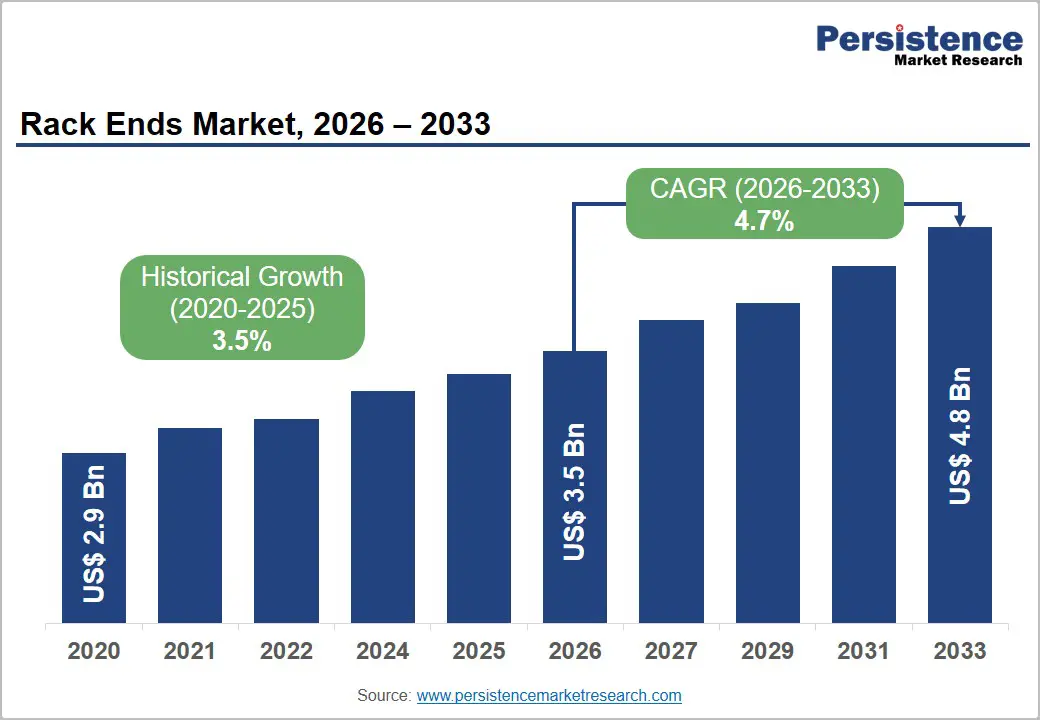
The global rack ends market is projected to be valued at US$3.5 billion in 2026 and is expected to reach US$4.8 billion by 2033, expanding at a CAGR of 4.7% during the forecast period from 2026 to 2033, driven by the increasing demand for reliable steering system components that enhance vehicle handling and safety.
Rack ends play a vital role in rack-and-pinion steering systems by transmitting steering input from the steering rack to the tie rods, ensuring accurate wheel alignment and directional control. Rising global automobile production, expanding adoption of electric power steering (EPS) systems, and growing replacement demand resulting from aging vehicle fleets are key factors supporting market growth. Ongoing advancements in steering system safety, improved component durability, and the use of lightweight materials are further boosting demand across both OEM and aftermarket segments.
Key Industry Highlights:
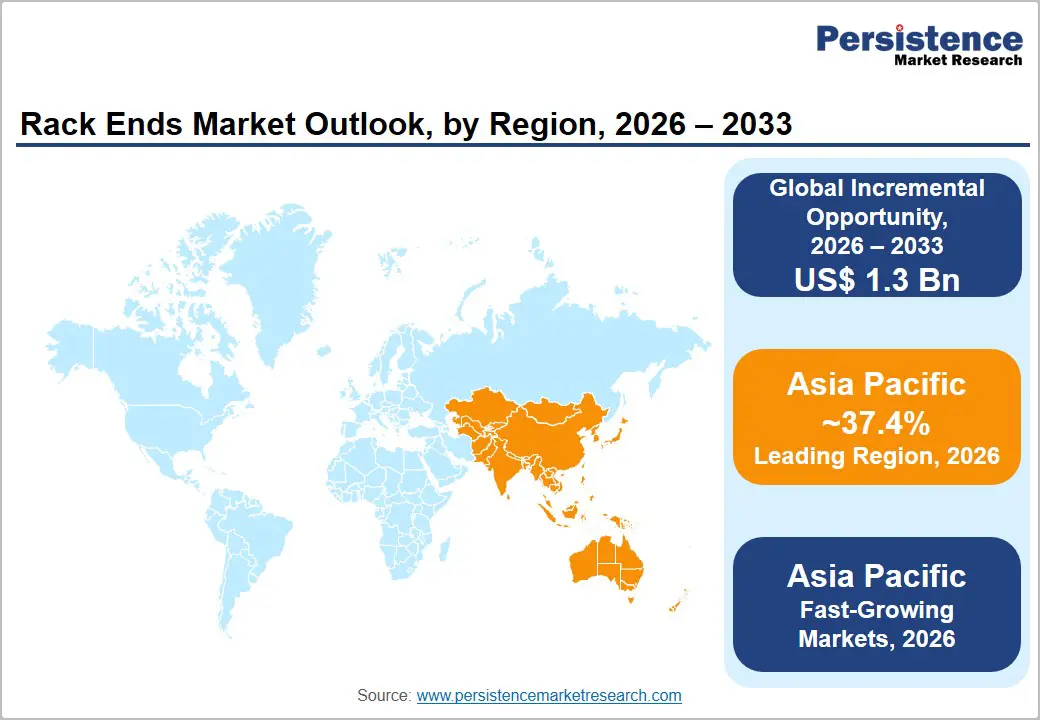
- Leading Region: Asia Pacific is projected to account for approximately 37.4% of the market in 2026, driven by high automotive production and strong manufacturing capabilities across China, Japan, and India.
- Fastest-growing Region: Asia Pacific, supported by rapid electric vehicle production, expanding vehicle ownership, and increasing investments in localized automotive component manufacturing.
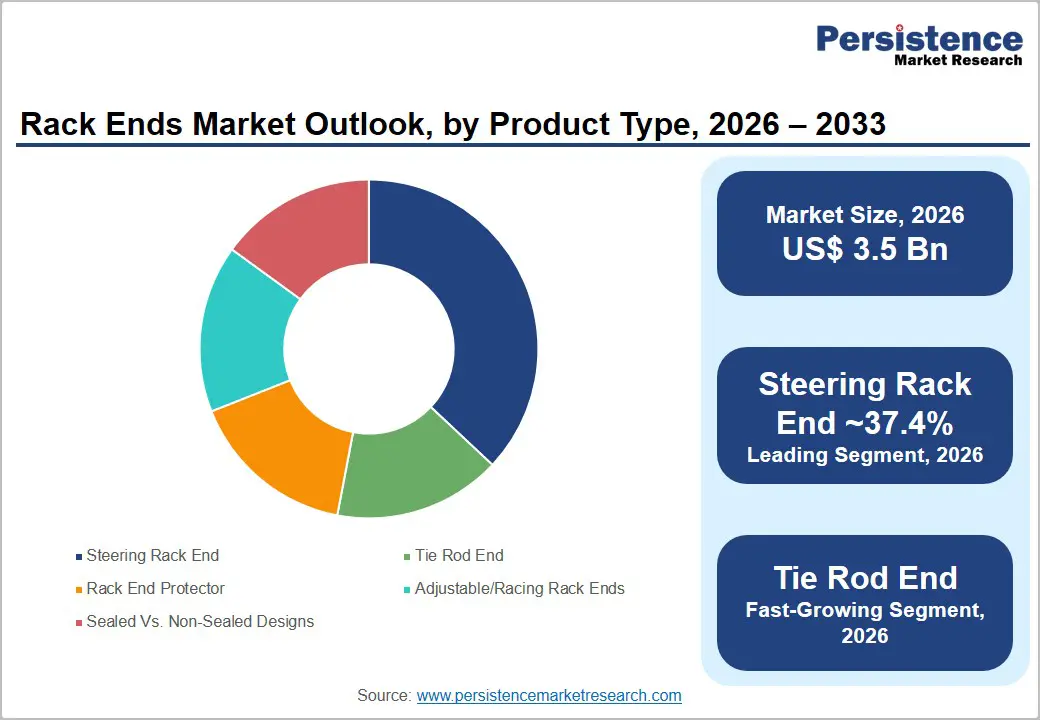
- Dominant Product Type: Steering rack end is anticipated to account for approximately 37.4% of the market share in 2026, due to its critical role in rack-and-pinion steering systems and strong OEM as well as replacement demand.
- Leading Vehicle Type: Passenger cars, anticipated to hold approximately 57.9% of market share in 2026, supported by high production volumes, a large installed vehicle fleet, and consistent aftermarket replacement demand.
DRO Analysis
Driver - Rising Global Vehicle Production and Expanding Vehicle Parc
Increasing global vehicle production remains the primary growth driver for the rack ends market. Passenger vehicles, SUVs, commercial vehicles, and electric vehicles all require steering linkage systems equipped with durable rack ends capable of maintaining steering precision throughout the vehicle lifecycle. Expanding automotive manufacturing in China, India, Southeast Asia, and North America continues to create substantial OEM demand. At the same time, the growing global vehicle parc increases long-term replacement opportunities as steering components naturally wear over time. Rising consumer demand for improved handling, steering stability, and driving comfort is encouraging automakers to adopt higher-quality steering components, supporting consistent market growth throughout the forecast period.
Advancements in Steering Technologies and Vehicle Safety Standards
Stricter vehicle safety regulations and continuous innovation in steering technologies are accelerating demand for premium rack end assemblies. Modern vehicles increasingly utilize electric power steering, advanced driver assistance systems (ADAS), and steer-by-wire technologies that require highly precise steering linkage components with tighter manufacturing tolerances. Manufacturers are investing in forged steel, corrosion-resistant coatings, and sealed rack end designs to improve durability and reduce maintenance requirements. As global safety standards continue to evolve, OEMs are emphasizing higher-quality steering components capable of supporting enhanced steering accuracy, reliability, and long-term vehicle performance.
Restraint - Intense Price Competition and Market Commoditization
The rack ends market remains highly competitive, with numerous regional and international manufacturers offering similar products across OEM and aftermarket channels. Although rack ends are critical safety components, limited product differentiation in conventional designs creates pricing pressure throughout the supply chain. Manufacturers must balance production costs with increasingly stringent quality requirements while maintaining competitive pricing. Volatility in steel prices, higher manufacturing costs, and growing customer expectations regarding durability and warranty coverage further compress profit margins. These structural challenges continue to limit pricing flexibility, particularly among aftermarket suppliers competing primarily on cost and product availability.
Opportunity - Manufacturing Expansion across Asia Pacific
Asia Pacific represents the largest and fastest-growing regional market for rack ends due to its strong automotive manufacturing base and rapidly expanding vehicle ownership. China, India, Japan, and ASEAN countries continue to attract significant automotive investments, creating opportunities for localized production and supply chain expansion. Rising electric vehicle manufacturing, supportive industrial policies, and increasing localization initiatives are encouraging component manufacturers to establish new production facilities and strengthen regional distribution networks. These trends are expected to increase demand for forged steering components, precision-machined rack ends, and lightweight steering assemblies throughout the forecast period.
Growing Aftermarket Replacement Demand
The global vehicle fleet continues to age, creating sustained demand for replacement steering components. Rack ends are subject to continuous mechanical stress and eventually require replacement to maintain steering accuracy and vehicle safety. Longer vehicle ownership cycles, expanding independent repair networks, and increasing availability of automotive parts through online distribution channels are driving aftermarket growth. Manufacturers are expanding product portfolios, improving vehicle coverage, and strengthening distribution partnerships to capitalize on replacement demand. Digital parts catalogs, faster logistics, and broader workshop networks are expected to further support aftermarket sales during the forecast period.
Category-wise Analysis
Product Type Insights
Steering rack ends are anticipated to account for approximately 37.4% of the market share in 2026, making them the leading product segment. Their dominance is driven by their critical role in rack-and-pinion steering systems, ensuring precise steering response and efficient force transmission. Widely used across passenger cars, SUVs, and light commercial vehicles, these components benefit from steady OEM demand and recurring replacement cycles. For example, manufacturers such as ZF, Nexteer Automotive, and JTEKT integrate high-strength forged steel and corrosion-resistant coatings to enhance durability and extend service life.
Tie rod ends are expected to register the fastest growth during the forecast period, supported by rising SUV production and increasing demand for advanced steering systems. Their ability to maintain steering accuracy while accommodating suspension movement makes them essential for modern vehicles. For example, premium sealed tie rod ends with precision-machined designs are increasingly adopted in electric SUVs and performance vehicles, while aftermarket suppliers continue expanding adjustable and heavy-duty variants to meet growing replacement demand.
Vehicle Type Insights
Passenger cars are anticipated to hold approximately 57.9% of the market share in 2026, making them the dominant vehicle segment. Strong global production volumes and a large installed vehicle base continue to drive OEM and aftermarket demand for rack ends. The segment includes conventional, hybrid, and electric passenger vehicles from manufacturers such as Toyota, Volkswagen, Hyundai, and Honda, all of which rely on precision steering systems to improve ride quality and safety.
Light commercial vehicles (LCVs) are anticipated to be the fastest-growing segment among non-SUV vehicle categories during the forecast period. Growth is driven by the rapid expansion of e-commerce, last-mile delivery services, and urban logistics, which are increasing demand for delivery vans and light-duty commercial fleets. LCVs operate under intensive driving conditions, resulting in higher wear of steering linkage components and greater replacement demand. For example, vehicles such as the Ford Transit, Mercedes-Benz Sprinter, and Toyota HiAce rely on durable rack ends to ensure steering precision and long-term operational reliability, supporting sustained demand across both OEM and aftermarket channels.
Regional Insights
North America Rack Ends Market Trends
North America represents a mature automotive market supported by strong OEM production and a well-established aftermarket. The region continues to generate steady demand for rack ends due to high vehicle ownership, an aging vehicle fleet, and increasing adoption of advanced steering technologies. Investments in electric vehicle manufacturing, precision automotive components, and regional supply chains further strengthen market growth.
U.S. Rack Ends Market Trends
The U.S. is expected to account for approximately 83.4% of the regional market share in 2026, making it the region's largest contributor. Strong vehicle production, extensive aftermarket replacement demand, and widespread adoption of electric power steering systems continue to support market expansion. Leading automotive manufacturers, including Ford, General Motors, and Tesla, are driving demand for high-performance steering components through continued investment in advanced vehicle platforms.
Canada Rack Ends Market Trends
Canada is expected to contribute approximately 8% of the regional market share in 2026 and benefits from its integrated automotive manufacturing ecosystem with the U.S. Rising investments in electric vehicle production, automotive parts manufacturing, and supply chain modernization are supporting demand for premium steering linkage components. Growth in replacement parts sales through independent repair networks further contributes to market expansion.
Europe Rack Ends Market Trends
Europe remains a significant market driven by advanced automotive engineering, strict vehicle safety regulations, and a mature replacement parts industry. The region continues to invest in lightweight vehicle technologies, electric mobility, and next-generation steering systems, creating sustained demand for high-quality rack ends across both OEM and aftermarket channels.
Germany Rack Ends Market Trends
Germany is expected to account for approximately 24% of the regional market share, making it the regional leader. As Europe's largest automotive manufacturing hub, the country is home to major vehicle manufacturers such as Volkswagen, BMW, Mercedes-Benz, and Audi. Continuous investments in premium passenger vehicles, electric mobility, and precision engineering support strong demand for advanced steering components.
U.K. Rack Ends Market Trends
The U.K. is expected to represent approximately 11% of the Europe market share in 2026. Growing production of premium and electric vehicles, combined with a well-developed automotive aftermarket, continues to support the demand for rack ends. Increasing investments in automotive innovation and vehicle electrification are further strengthening market opportunities.
France Rack Ends Market Trends
France is expected to hold approximately 9% of the regional market share in 2026. The country's automotive sector benefits from established manufacturers such as Renault and Stellantis, along with increasing investments in electric vehicle production and sustainable mobility. A large installed vehicle base also generates consistent demand for aftermarket steering components.
Asia Pacific Rack Ends Market Trends
Asia Pacific is expected to be the largest and fastest-growing region, accounting for approximately 37.4% of the global market share. Strong automotive production, expanding vehicle ownership, competitive manufacturing costs, and government support for domestic automotive industries continue to drive regional growth. The region serves as the primary manufacturing hub for steering components supplied to both domestic and international vehicle manufacturers.
China Rack Ends Market Trends
China is expected to contribute approximately 38% of the Asia Pacific market share in 2026, making it the region's largest country-level market. Its position as the world's largest automobile producer and electric vehicle manufacturer drives significant demand for rack ends across passenger cars, SUVs, and commercial vehicles. Continued investments in advanced automotive manufacturing and localization of component production further strengthen market growth.
Japan Rack Ends Market Trends
Japan is expected to account for approximately 17% of the regional market share in 2026. The country's globally recognized automotive manufacturers, including Toyota, Honda, Nissan, and Mazda, continue to emphasize high-quality steering systems and precision engineering. Strong exports and ongoing technological innovation support stable demand for premium rack end components.
India Rack Ends Market Trends
India is expected to represent approximately 13% of the regional market share and is emerging as one of the fastest-growing automotive manufacturing centers. Rising passenger vehicle sales, increasing SUV adoption, expanding electric vehicle production, and government initiatives promoting domestic manufacturing continue to stimulate demand. Growing investments in automotive component manufacturing and an expanding aftermarket industry further enhance the country's long-term growth potential.
Competitive Landscape
The global rack ends market is moderately fragmented, with competition among established multinational manufacturers and numerous regional suppliers. Leading companies compete through product quality, manufacturing efficiency, engineering capabilities, and global distribution networks. OEM contracts remain highly competitive, while the aftermarket segment emphasizes product availability, vehicle coverage, pricing, and brand reputation. Continuous investment in lightweight materials, precision manufacturing, and advanced steering technologies is reshaping the competitive landscape.
Leading manufacturers continue to prioritize product innovation, regional manufacturing expansion, aftermarket portfolio growth, and strategic partnerships. Investment in lightweight materials, advanced steering technologies, digital manufacturing, and localized supply chains remains central to maintaining competitiveness. Expanding global distribution networks and improving vehicle coverage are also key strategies supporting long-term market growth.
Key Industry Developments:
- In July 2025, ZF Friedrichshafen AG announced that Mercedes-Benz will introduce its Steer-by-Wire technology in series production beginning in 2026.
- In February 2025, ZF Friedrichshafen AG announced the start of series production of its Steer-by-Wire system, initially deployed in the NIO ET9.
Companies Covered in Rack Ends Market
- ZF Friedrichshafen AG
- Nexteer Automotive
- JTEKT Corporation
- thyssenkrupp Automotive Technology
- Schaeffler AG
- NSK Ltd.
- Rane Steering Systems Pvt. Ltd.
- Tenneco Inc. (MOOG)
- PHINIA Inc. (Delphi)
- GMB Corporation
- Sankei Industry Co., Ltd.
- CTR Corporation (Central Corporation)
- Masuma Auto Spare Parts Co., Ltd.
- 555 (Sankei Industry Co., Ltd.)
- ACDelco
- Febi Bilstein (Bilstein Group)
Frequently Asked Questions
The global rack ends market is projected to be valued at US$3.5 billion in 2026.
The rack ends market is expected to reach US$4.8 billion by 2033.
Key market trends include the increasing adoption of electric power steering (EPS) systems, growing demand for lightweight and corrosion-resistant steering components, expansion of the automotive aftermarket, and rising production of SUVs and electric vehicles.
Steering rack ends are anticipated to remain the leading product segment, accounting for approximately 37.4% of the market due to their widespread use in rack-and-pinion steering systems across passenger and commercial vehicles.
The rack ends market is projected to grow at a CAGR of 4.7% from 2026 to 2033.
Some of the major companies include ZF Friedrichshafen AG, Nexteer Automotive, JTEKT Corporation, thyssenkrupp AG, and Schaeffler AG.


