




- Automotive Components & Materials
- Automotive Timing System Market
Automotive Timing System Market Size, Share, and Growth Forecast, 2026 - 2033
Automotive Timing System Market by Type (Belt Drive Systems, Chain Drive Systems, Gear Drive Systems), Application (Passenger Cars, Commercial Vehicles, Industrial Equipment), Component (Timing Belts, Timing Chains, Timing Gears), Technology (Conventional, Variable Valve Timing (VVT), Continuously Variable Valve Timing (CVVT)), and Regional Analysis for 2026 - 2033

Automotive Timing System Market Share and Trends Analysis
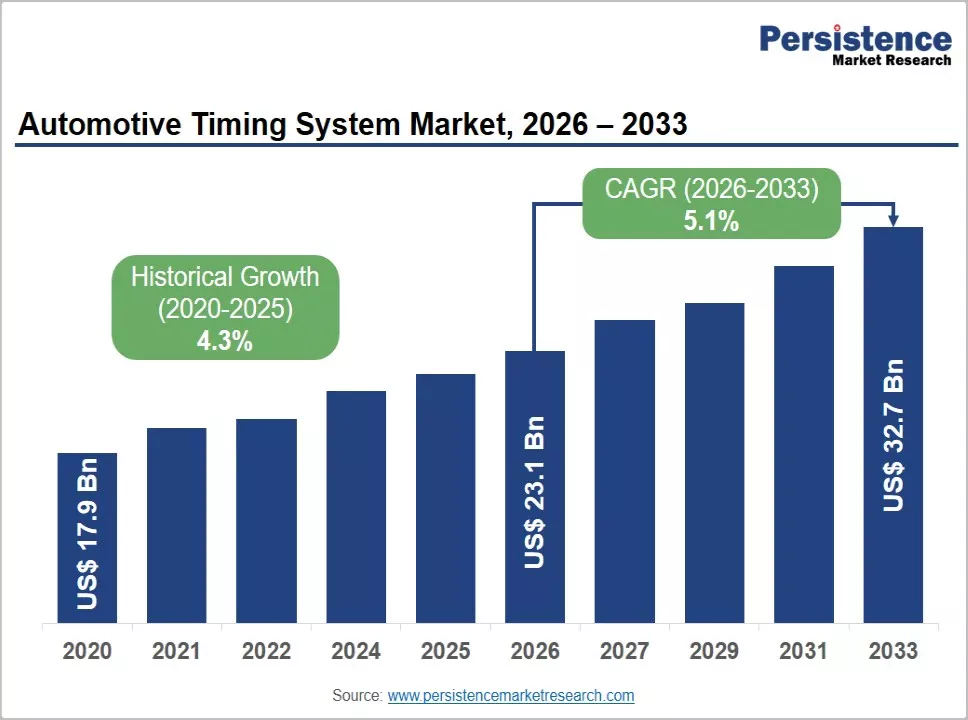
The global automotive timing system market size is likely to be valued at US$23.1 billion in 2026, and is estimated to reach US$32.7 billion by 2033, growing at a CAGR of 5.1% during the forecast period 2026 - 2033. Sustained production of fuel-efficient internal combustion and hybrid powertrains, rising adoption of variable valve timing architectures, and expanding aftermarket demand for timing kits across an ageing global vehicle parc are underpinning market expansion.
The market has been experiencing steady but moderate growth, reflecting semiconductor-related production disruptions and the uneven pace of electrification. The forecast period anticipates firmer momentum as hybrid vehicles gain share, emission norms tighten, and OEMs favor downsized, turbocharged engines that depend on precise valve actuation.
Key Industry Highlights
- Dominant Types: Chain drive systems are set to command around 48% of the revenue share in 2026, while gear drive systems are likely to grow the fastest at 5.9% CAGR through 2033, as heavy-duty and industrial engines demand durable, low-maintenance drives.
- Leading Applications: Passenger cars are expected to lead with 61% in 2026, while industrial equipment is likely to be the fastest-growing application at about 6.0% CAGR during 2026–2033, reflecting demand from power generation sets and off-highway machinery.
- Dominant Component and Technology: Timing chains are anticipated to hold an estimated 44% share in 2026, while Continuously Variable Valve Timing (CVVT) is slated to be the fastest-growing technology at 7.4% CAGR from 2026 to 2033.
- Regional Leadership: Asia Pacific is poised to dominate with an estimated 44% share in 2026 and register a 5.8% CAGR through 2033, led by high-volume vehicle production in China, India, Japan, and South Korea.
- November 2025: Schaeffler expanded its INA aftermarket range for the U.S. and Canada with additional timing chain kits, timing belt kits, accessory drive kits, and variable valve timing components.
DRO Analysis
Driver: Hybridization and Downsized Turbocharged Engines Sustaining Demand for Precision Timing
Hybrid electrification is emerging as a primary growth catalyst for the automotive timing system market. While battery electric vehicle sales have softened in several developed markets after the withdrawal of purchase incentives, hybrid vehicles have gained share quickly, with hybrids reaching roughly 17% of U.S. retail new-vehicle sales in September 2026. Every hybrid still depends on an internal combustion engine, and hybrid-specific engines operate through frequent start-stop cycles and wide load ranges, placing greater demand on timing chains, tensioners, and valve phasing components. Relaxed fuel economy standards and softened 2035 targets in some regions are also extending the production lifecycle of efficient ICE platforms.
The downsized turbocharged and direct-injection engines require accurate valve events to meet stringent CO2 and particulate regulations. Variable valve timing and CVVT systems allow engines to optimize volumetric efficiency, reduce pumping losses, and support Miller and Atkinson cycle operation. Suppliers are responding with compact silent chains, lower-friction coatings, and electrically actuated phasers, which improve fuel economy and durability. This convergence of regulatory pressure, powertrain innovation, and persistent ICE volumes ensures sustained demand for advanced timing systems over the coming years. Advances in materials, such as high-strength steel alloys, diamond-like carbon coatings, and low-viscosity oil compatibility, are lowering friction losses and extending service intervals. These refinements allow suppliers to protect pricing even as engine volumes plateau, since higher-value chain assemblies and electrically actuated phasers command meaningful content gains per engine.
Restraints: Accelerating Electrification and Cost Pressure on Suppliers
The rapid transition toward battery electric vehicles is the most significant structural restraint for the market. BEVs use single-speed reduction gearboxes and do not require camshaft-driven valvetrains, so each EV displacing an ICE vehicle removes the timing system content entirely. China and Europe are witnessing strong EV adoption, with electric vehicle share rising steadily across European markets during 2026, which is gradually eroding the long-term addressable base for chains, belts, and gears. Uncertainty over regional regulatory timelines further complicates capacity planning for suppliers.
Cost pressures add to the challenge. Volatile prices of steel, specialty alloys, and synthetic rubber compounds, together with tariff-related disruption in cross-border component trade, compress supplier margins. Global light-vehicle sales forecasts for 2026 have been revised downward to roughly 88–90 million units amid inflation and trade headwinds, which restricts OEM purchasing volumes. Moreover, OEM demands for lifetime-rated timing drives and wet-belt reliability concerns raise warranty and engineering costs, particularly for smaller suppliers lacking scale.
Opportunities: Expanding Aftermarket Timing Kits and Growth in Emerging Vehicle Markets
The aftermarket represents a high-potential opportunity as the average age of vehicles on the road continues to rise across North America, Europe, and Asia. Timing belt, chain, tensioner, and guide replacement is a recurring maintenance requirement, and workshops increasingly prefer complete application-specific kits that reduce labor time and comeback risks. Suppliers are broadening coverage accordingly; in 2026 several leading manufacturers have launched new kits covering popular Hyundai, Kia, GM, and Ford engines, including chain kits with oil pump drive components and wet timing belt solutions for EcoBoost engines.
Emerging markets provide additional upside. India, Southeast Asia, Brazil, and Mexico are expanding vehicle production and localizing component manufacturing, supported by rising incomes and government incentives for domestic automotive supply chains. Growing demand for commercial vehicles, generator sets, and construction machinery also supports gear and chain drive adoption in industrial equipment. Suppliers able to combine local production, aftermarket distribution, and hybrid-ready product portfolios are well positioned to capture this expansion.
Category-wise Analysis
Type Insights
Chain drive systems are the leading type segment, expected to hold about 48% of the automotive timing system market revenue share in 2026. Chains offer longer service life than belts, tolerate higher engine temperatures, and are well suited to compact, high-torque turbocharged engines. Modern roller and silent chain designs have reduced noise, vibration, and friction, and 6.35 mm inverted-tooth silent chains are being adopted by several Asian automakers to improve fuel economy by a fraction of a percent. Demand remains stable as chains are specified across gasoline, diesel, and hybrid platforms.
Gear drive systems are likely to grow the fastest through 2033 at 5.9% CAGR. Gear trains provide precise, backlash-controlled transmission of rotation and are widely used in heavy-duty diesel engines, industrial engines, and balance shaft or auxiliary drives. Their ability to handle high loads with minimal maintenance suits commercial vehicles, generator sets, and off-highway equipment, which are expanding in emerging economies. Belt drive systems retain relevance in cost-sensitive passenger cars and in wet-belt applications, supported by lower weight and quieter operation. Suppliers are also developing hybrid-ready gear trains with optimized tooth profiles and noise-damping features, as hybrid engines expose timing components to frequent restarts and heavier torsional loads. Standardization of module architectures across engine families is helping OEMs reduce validation cycles and lower unit costs.
Application Insights
Passenger cars dominate the application segment, projected to capture about 61% of the revenue share in 2026. High global production volumes, strong replacement demand, and the widespread use of VVT-equipped engines support the segment. Hybrid passenger cars are a key source of incremental content, since downsized engines in these vehicles use advanced phasers and robust chain drives. Although BEV penetration limits long-term volumes, the sheer size of the ICE and hybrid vehicle parc keeps the segment resilient.
Industrial equipment is the fastest-growing application, anticipated to record about 6.0% CAGR during 2026–2033. Demand stems from stationary power generation, agricultural machinery, construction equipment, and marine auxiliary engines, where durable timing drives are essential for continuous operation. Rising investments in backup power and infrastructure, together with the growth of off-highway equipment fleets in Asia and the Middle East, are strengthening demand. Commercial vehicles also contribute steady growth, driven by freight activity and replacement of heavy-duty timing gear sets.
Component Insights
Timing chains lead the component segment with an estimated 44% share in 2026. Their dominance reflects the shift of OEMs toward lifetime-rated drives and the integration of chains with tensioners, guides, and sprockets into engineered systems. Timing belts continue to serve cost-sensitive engines and benefit from replacement cycles, with suppliers promoting advanced rubber compounds and wet-belt designs for reduced friction. Timing gears are expected to grow at about 5.7% CAGR, supported by heavy-duty and industrial engine demand.
Replacement demand is a notable stabilizer, as chain, belt, and tensioner wear commonly triggers repairs in higher-mileage vehicles. Component suppliers are therefore investing in complete kits and application-specific repair content to improve technician convenience and reduce installation errors.
Technology Insights
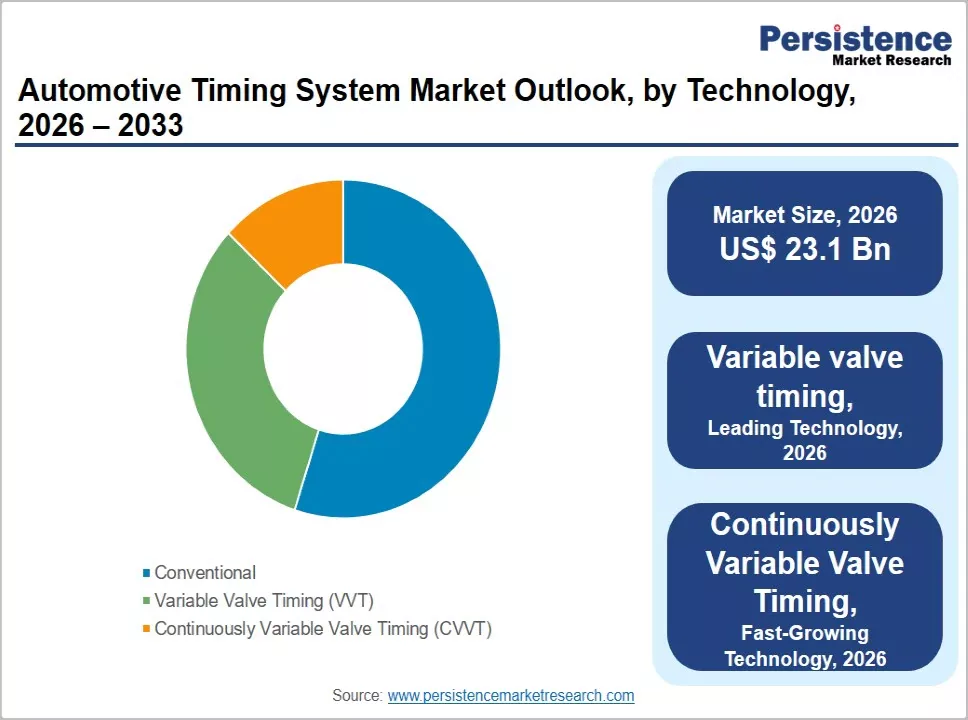
Variable valve timing (VVT) is the leading technology segment, projected to account for about 52% of the revenue share in 2026. VVT improves torque delivery, fuel efficiency, and emissions by adjusting camshaft phase according to engine load and speed, and it is now a standard feature in most new gasoline engines. Regulatory pressure on CO2 and nitrogen oxide emissions continues to anchor adoption, while the technology is increasingly paired with turbocharging and direct injection. VVT adoption is also broadening beyond intake-only phasing to dual independent systems that control both intake and exhaust camshafts, enabling internal exhaust gas recirculation and improved cold-start emissions. Cam phasers are increasingly paired with advanced engine control units, which makes calibration expertise a differentiator for suppliers.
Continuously Variable Valve Timing (CVVT) is anticipated to be the fastest-growing technology at 7.4% CAGR through 2033. CVVT provides smooth, infinitely adjustable phasing, enabling more precise control of intake and exhaust events across the entire operating range. Automakers are adopting it to support hybrid-optimized combustion strategies and compliance with tightening emission norms, and recent supplier awards for variable cam timing systems on hybrid and turbocharged gasoline engines in Europe and China reflect this momentum. Conventional timing systems persist mainly in entry-level vehicles and legacy engine families.
Regional Insights
North America Automotive Timing System Market Trends
North America is predicted to command an estimated 20% of the automotive timing system market share in 2026. The U.S. anchors the region, supported by a large vehicle parc averaging over 12 years in age, strong demand for light trucks and SUVs with turbocharged engines, and a rapidly growing hybrid segment. The end of federal electric vehicle credits and elevated fuel prices have pushed consumers toward hybrids, which raised hybrid share to around 17% of retail sales in September 2026. Aftermarket demand is particularly strong, and suppliers are adding timing chain kits, wet-belt kits, and VVT components for popular U.S. models.
Canada contributes through vehicle assembly and aftermarket distribution. The regional landscape is characterized by active consolidation, with Gates agreeing in May 2026 to acquire the belts business of Timken, expanding its industrial and aftermarket presence, while chain and phaser specialists compete aggressively on OEM platform awards. Dealer service networks and independent repair shops in the region are standardizing on complete kits that bundle chains, guides, tensioners, and sprockets, which supports average selling prices and repeat purchases. Light-truck platforms in particular drive volume, given their heavy use of V6 and V8 engines with multiple chain loops.
Europe Automotive Timing System Market Trends
Europe is likely to hold 25% of the global market share in 2026. The region is a center of engine technology innovation, with Germany, France, and Italy hosting leading automakers and tier-one suppliers. Stringent Euro 7 emission norms, CO2 fleet targets, and the proliferation of mild- and plug-in hybrid vehicles encourage adoption of advanced VVT and low-friction timing drives. Wet timing belts, which reduce friction and noise, are widely used in European small turbocharged gasoline engines, creating specialized demand for belt and aftermarket kit suppliers.
The market is shaped by a rapid electric vehicle transition, as battery electric models gain share across many European countries, restraining long-term growth. However, a large installed base of ICE and hybrid vehicles, a mature independent aftermarket, and export-oriented engine production sustain demand. Eastern European countries, including Poland, Czech Republic, Hungary, and Romania, serve as key manufacturing hubs for engines and components.
Asia Pacific Automotive Timing System Market Trends
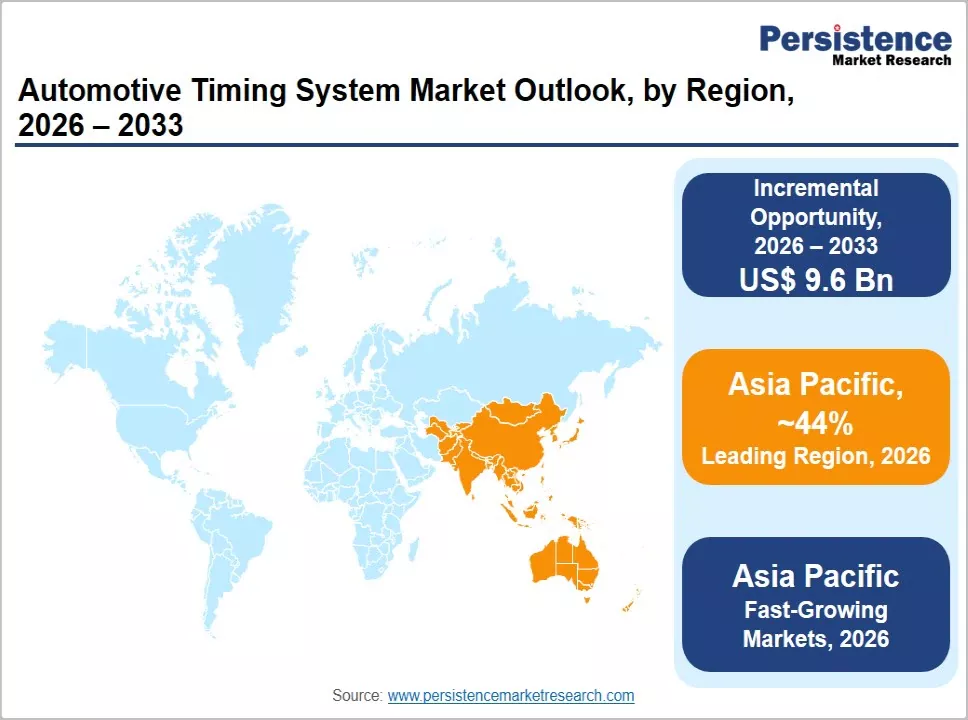
Asia Pacific is anticipated to capture the largest share of the automotive timing system market, commanding an estimated 44% in 2026 and projected to achieve a 5.8% CAGR through 2033. China provides the dominant production base, with a large domestic OEM ecosystem and rising hybrid and range-extended vehicle output that requires sophisticated engines. Japan and South Korea contribute significant technology leadership, with Japanese suppliers holding the largest global share of timing chain systems and expanding mass-production programs across Japan, the Americas, Europe, and the Indian Ocean Rim.
India is expected to offer dynamic growth, with record monthly vehicle sales in 2026, expanding SUV production, and government-backed localization efforts increasing demand for domestically manufactured timing components. Southeast Asian countries such as Thailand and Indonesia are also strengthening their roles as export-oriented production bases. Strong growth in commercial vehicles and industrial equipment across the region further supports demand for gear and chain drive systems.
Competitive Landscape
The global automotive timing system market structure is moderately consolidated, with the top vendors, including Tsubakimoto Chain, BorgWarner, Schaeffler, and Gates, controlling a substantial portion of the revenue share. These players leverage long-standing OEM relationships, in-house materials expertise, and global manufacturing networks, while investing in low-friction chains, compact silent chain designs, and electrified phasing solutions for hybrid engines.
Regional and niche competitors such as Dayco, Aisin, Hitachi Astemo, iwis, and Mahle are focusing on specialized segments, aftermarket kits, and regional strongholds. Barriers such as stringent durability requirements, precision manufacturing, and long OEM validation cycles limit new entrants. Consolidation is expected to continue as leading suppliers acquire complementary belt and chain businesses to expand aftermarket and industrial coverage, while ongoing portfolio realignments among diversified suppliers reshape the competitive field. Aftermarket brands continue to gain relevance as workshops demand application-specific kits, and supplier partnerships with distributors are widening coverage for hybrid and turbocharged engines.
Key Industry Developments
- In June 2026, Cloyes announced new vehicle-specific timing kits that include oil pump chain components, followed by an additional Hyundai/Kia kit in July, reflecting suppliers' push to broaden aftermarket coverage for chain-driven engines.
- In May 2026, Gates Industrial Corporation announced a definitive agreement to acquire the belts business of The Timken Company, including select manufacturing assets. The transaction is expected to close in the third quarter of 2026 and strengthens Gates' presence in the industrial OEM, aftermarket, and power sports channels across North America.
- In January 2026, Tsubakimoto Chain Co. made Daido Kogyo Co., Ltd. a subsidiary, while continuing mass-production launches of engine timing chain systems in Japan, the Americas, Europe, and the Indian Ocean Rim. The company has also begun expanding sales of timing chain products for electric and hybrid vehicle applications.
Companies Covered in Automotive Timing System Market
- Tsubakimoto Chain Co.
- BorgWarner Inc.
- Schaeffler AG
- Gates Corporation
- Dayco LLC
- Aisin Corporation
- Hitachi Astemo, Ltd.
- iwis Motorsysteme GmbH & Co. KG
- Mahle GmbH
- ContiTech (Continental AG)
- Bando Chemical Industries, Ltd.
Frequently Asked Questions
The global automotive timing system market is projected to reach US$23.1 billion in 2026.
Growing production of fuel-efficient internal combustion and hybrid engines, rising adoption of variable valve timing technologies, and expanding aftermarket demand for timing kits are driving the market.
The market is poised to witness a CAGR of 5.1% from 2026 to 2033.
Expansion of aftermarket timing kits, hybrid-specific engine platforms, and growing vehicle and industrial equipment production in emerging economies are key market opportunities.
Tsubakimoto Chain Co., BorgWarner Inc., Schaeffler AG, Gates Corporation, and Dayco LLC are some of the key players in the market.


