




- Biotechnology
- Protein Microarray Market
Protein Microarray Market Size, Share, and Growth Forecast 2026 - 2033
Protein Microarray Market by Product Type (Analytical, Functional), Offering (Products, Services), Application (Diagnostics, Proteomics), End-user (Pharmaceutical & Biotechnology Companies), and Regional Analysis, 2026 - 2033

Protein Microarray Market Size and Trends Analysis
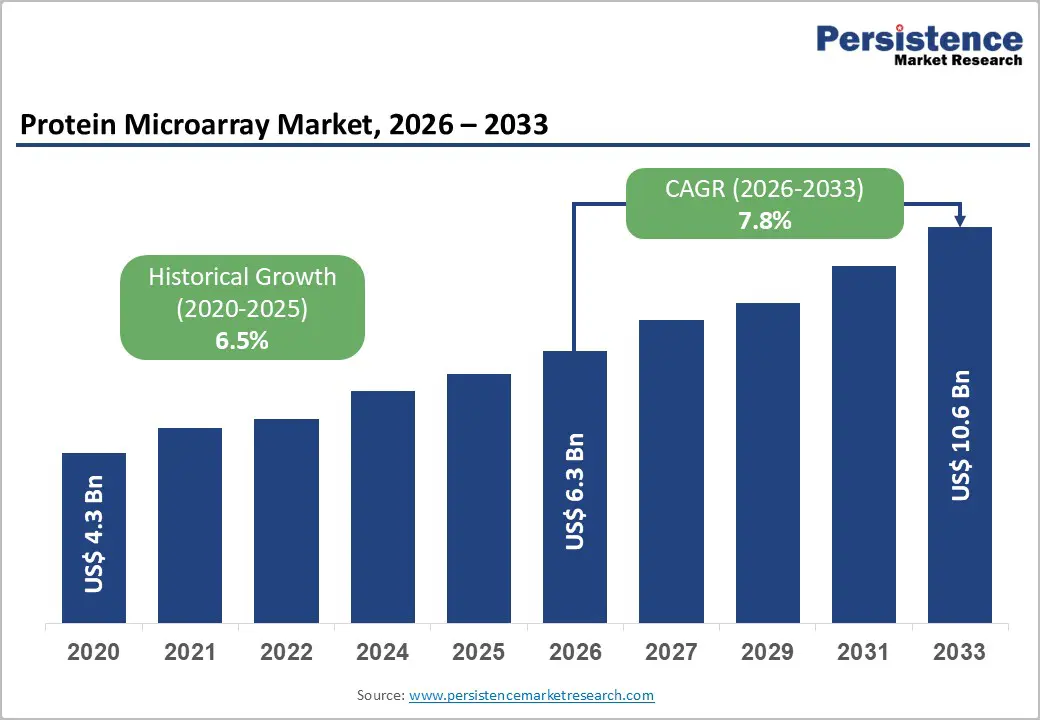
The global protein microarray market size is likely to be valued at US$6.3 billion in 2026 and is expected to reach US$10.6 billion by 2033, growing at a CAGR of 7.8% during the forecast period from 2026 to 2033, driven by rising demand for high-throughput proteomics tools in biomarker discovery and drug development.
Growth is also fueled by increasing adoption of multiplex diagnostics in infectious and autoimmune diseases, where simultaneous protein detection improves clinical efficiency.
Key Industry Highlights:
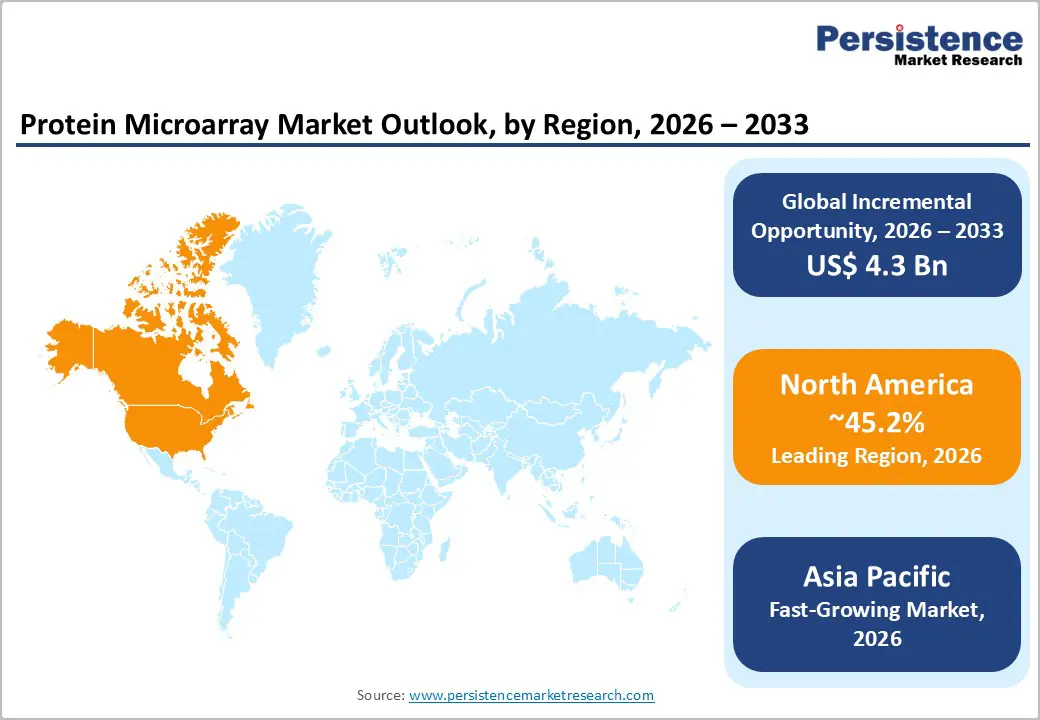
- Leading Region: North America, with about a 45.2% share in 2026, owing to increasing government funding from agencies such as the National Institutes of Health.
- Fast-growing Region: Asia Pacific, backed by rising investments in precision medicine.
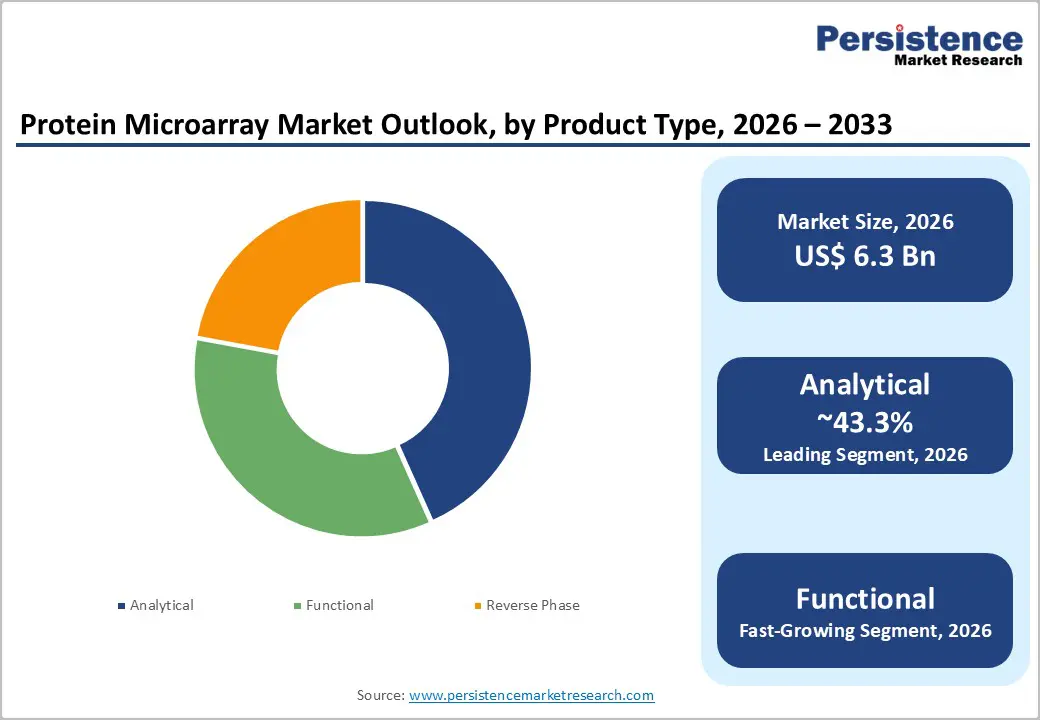
- Leading Product Type: Analytical microarrays, approximately 43.3% share in 2026, as they deliver standardized and high-throughput protein detection.
- Dominant Application: Proteomics, with a nearly 48.9% share in 2026, as it enables direct analysis of functional proteins.
- U.S. FDA Submission: In February 2025, AliveDx submitted a 510(k) premarket notification to the U.S. Food and Drug Administration (FDA) for its MosaiQ AiPlex Celiac Disease (CD) multiplex microarray. The multiplex assay is designed to improve the accuracy and speed of celiac disease diagnosis while simplifying laboratory workflows.
DRO Analysis
Driver - Demand for Parallel Protein Screening Across Large Sample Sets
Enzyme-Linked Immunosorbent Assay (ELISA) tests one protein at a time, which is slow and resource-heavy at scale. Protein microarrays break that bottleneck by running hundreds to thousands of protein interactions simultaneously in a single experiment. A 2025 Frontiers in Microbiology study confirmed this advantage directly. The microarray format was quicker, conserved precious reagents and samples, and enabled massive scaling of pairwise binding experiments in one run, compared to single-plex ELISA.
In clinical diagnostics, microarrays allow analysis of ten or more patient samples against multiple spatially isolated antigens on a single glass slide, with higher sensitivity than conventional ELISA. This translates to fewer technician hours, less reagent waste, and faster turnaround. All of these matter in busy diagnostic or drug discovery settings.
Need to Work with Scarce and Hard-to-Obtain Samples
One of the most practical strengths of protein microarrays is how little sample they actually require. A typical microarray spot is more than 25 times smaller than a microtiter plate well used in ELISA, which concentrates signal density and improves intensity. The amount of sample required drops in proportion to spot surface area, meaning just a few nanograms are sufficient for several experiments, down to 1/1,000th of what ELISA requires.
It is especially useful in clinical research, where rare biopsy tissue or limited blood draws are common. Researchers have shown that combining Dried Blood Spot (DBS) collection with protein microarray-based autoantibody detection could enable screening of at-risk remote populations for early cancer biomarkers. DBS is minimally invasive and requires no cold-chain infrastructure.
Restraint - Protein Structural Fragility during Surface Immobilization
Unlike DNA, proteins are structurally fragile, and this creates a persistent technical problem for microarray development. When proteins are immobilized onto membranes, glass slides, or micro/nanoparticles, their three-dimensional structure often collapses, causing loss of biological activity. The hydrophobicity of several solid surfaces, including glass and plastic, can trigger denaturation, leaving capture molecules inactive and producing lower sensitivity along with higher noise-to-signal ratios.
Orientation is another challenge. If the binding site of an immobilized protein faces away from the surface, it simply won't interact with its target. Various proteins are known to denature on contact with solid surfaces, and the mode of display significantly affects how the protein interacts with a binding partner. It means orientation at the array surface plays a prominent role in whether the device actually works. These issues raise development costs and limit reproducibility across labs, slowing broad clinical adoption.
Opportunity - AI-Assisted Analysis for Fast and Accurate Biomarker Discovery
As protein microarrays generate increasingly large datasets, AI is stepping in to make sense of the complexity. A 2025 study published in Advanced Science used antibody microarray technology combined with XGBoost machine learning to build a diagnostic model for Behçet's disease. It achieved an area under the curve (AUC) of 0.984 with an accuracy of 93.5% in the training set, marking the first AI-based diagnosis and stratification model for this condition.
Beyond single diseases, researchers have applied proteome-wide autoantibody screening using wet protein arrays covering approximately 90% of the human transcriptome. They successfully identified novel autoantibodies associated with G protein-coupled receptors in dementia using machine learning approaches. These examples show that AI is not just improving accuracy, but it is enabling discoveries that would be impractical to make manually.
Granular Epitope Mapping for Vaccine and Diagnostic Development
High-throughput peptide synthesis platforms have given researchers a powerful new tool for understanding exactly where and how antibodies bind. PEPperCHIP's SARS-CoV-2 Proteome Microarray contains 5,347 linear 15-mer peptides with a 13-mer overlap, covering the entire viral proteome, such as key spike mutations across Alpha, Beta, Delta, and Omicron variants. This enables proteome-wide epitope mapping, serum screening, and biomarker discovery in a single chip.
During the COVID-19 pandemic, this capability proved immediately valuable. Using a SARS-CoV-2 proteome microarray, researchers identified four immunodominant epitopes present in antibodies from more than 80% of COVID-19 patients, found in the N, S, and Orf3a proteins. It directly informs diagnostic test design and vaccine target selection. This type of resolution, down to the amino acid level, is simply not achievable with traditional antibody-based methods.
Category-wise Analysis
Product Type Insights
Analytical microarrays are expected to lead with a share of approximately 43.3% in 2026, as they offer reliable and expandable protein detection capabilities. These arrays focus on measuring protein expression, antibody interactions, and biomarker levels. They are easier to standardize compared to functional arrays. This makes them suitable for routine lab workflows and large cohort studies. Another advantage is compatibility with automation. Companies such as Thermo Fisher Scientific and Agilent Technologies provide integrated systems that combine analytical microarrays with automated liquid handling and imaging. This reduces manual errors and improves reproducibility.
Functional microarrays are estimated to be the fastest-growing segment over the forecast period, as they go beyond detection and study protein activity. These arrays help researchers understand enzyme functions, protein-protein interactions, and drug binding. This is important for drug discovery and precision medicine. Biotech firms are also launching advanced platforms. Sengenics developed its immunome protein array to study autoimmune responses using functional profiling. These platforms can analyze thousands of active proteins in one experiment. This depth of insight is bolstering adoption in pharma research & development, especially for target validation and toxicity studies.
Application Insights
The proteomics segment is anticipated to dominate with a share of nearly 48.9% in 2026, as it studies proteins, which are the functional molecules in cells. Unlike genomics, proteomics reflects real-time biological activity. Protein microarrays fit naturally into this field as they allow large-scale protein analysis in a compact format. Global research efforts are boosting this segment. The Human Proteome Organization continues to extend proteome mapping projects. These initiatives require tools that can analyze thousands of proteins quickly. Microarrays provide this capability at a lower cost and higher throughput compared to multiple mass spectrometry workflows.
The diagnostics segment is expected to remain in the second position in 2026, as protein microarrays enable multiplex testing. This means multiple biomarkers can be detected in one test. This reduces time and sample requirements, which is important in clinical settings. Another factor is early disease detection. Protein biomarkers often appear before symptoms. Microarrays can capture these early signals. In oncology, diagnostic panels based on protein arrays are being studied for early-stage cancer screening. Companies and hospitals are also exploring their use in autoimmune disease diagnosis, where multiple antibodies need to be assessed together.
Regional Insights
North America Protein Microarray Market Trends
North America is predicted to dominate in 2026 with a share of approximately 45.2%, as it has a superior research hub and early adoption of proteomics tools. The National Institutes of Health invests billions every year in biomedical research, including large-scale proteomics programs. This funding supports the use of protein microarrays in cancer, infectious disease, and autoimmune research. Another factor is the presence of leading companies such as Thermo Fisher Scientific and Danaher Corporation. These firms provide integrated platforms and continuously launch new products.
U.S. Protein Microarray Market Trends
A share of nearly 65.4% is expected to be held by the U.S. in 2026, owing to strong clinical translation of proteomics research. Programs such as the Cancer Moonshot by the National Cancer Institute focus on biomarker discovery and early detection. Protein microarrays are widely used in these studies. There is also constant growth in biotech start-ups. Various firms are working on multiplex diagnostics and immune profiling. For example, several U.S.-based studies published in journals, including Science Translational Medicine, have used protein arrays to track immune responses in diseases such as COVID-19 and cancer. This shift from research to real-world clinical use is boosting growth.
Asia Pacific Protein Microarray Market Trends
Asia Pacific is anticipated to be the fastest-growing region in 2026 with a share of nearly 32.7%, as governments are increasing investments in life sciences. Countries are building large research hubs and national proteomics programs. For example, Japan and South Korea are expanding precision medicine initiatives that rely on protein analysis. Another reason is the rising disease burden. According to the World Health Organization (WHO), Asia has a high share of cancer and infectious disease cases. This creates demand for advanced diagnostic tools. Local companies are also entering the market with cost-effective microarray solutions, making the technology more accessible.
China Protein Microarray Market Trends
China will likely lead Asia Pacific in 2026 with a share of around 38.7%, backed by superior government-backed research programs. The country’s Healthy China 2030 plan promotes early disease detection and precision medicine. This includes large-scale biomarker research where protein microarrays are used. Local institutions are also publishing high-impact research. Studies in journals such as Nature and Cell Research have shown the use of protein arrays for mapping immune responses and cancer pathways. Local companies are improving manufacturing capabilities, reducing dependence on imports, and increasing adoption in domestic labs.
India Protein Microarray Market Trends
In 2026, India is projected to account for a share of approximately 27.9%, due to rising focus on affordable diagnostics and academic research. Institutes such as the Indian Council of Medical Research are supporting studies on infectious diseases, where multiplex protein detection is useful. There is also growth in biotech start-ups and research labs. During COVID-19, local researchers used protein-based assays for antibody detection and serosurveys. Cost sensitivity remains a challenge, but increasing government funding and collaborations with global firms are improving access to advanced tools such as protein microarrays.
Europe Protein Microarray Market Trends
Europe will likely see decent growth over the forecast period, with a share of nearly 13.6% in 2026, owing to strong collaborative research and regulatory support. The European Commission funds large projects under Horizon Europe, many of which focus on proteomics and biomarker discovery. The region also has a well-established healthcare network. This allows gradual adoption of advanced diagnostics. Research organizations such as the European Molecular Biology Laboratory are actively working on proteomics technologies, including protein arrays. Growth is stable rather than rapid due to strict regulatory processes.
Germany Protein Microarray Market Trends
Germany will likely register a substantial share of approximately 33.5% in 2026, spurred by its focus on precision medicine and industrial research. Institutes such as the Max Planck Society are actively involved in proteomics studies. The country also has superior collaboration between academia and industry. Local biotech firms are working on protein-based diagnostics and drug discovery tools. Government funding and advanced lab infrastructure support steady adoption of microarray technologies.
U.K. Protein Microarray Market Trends
A share of around 20.8% is predicted to be held by the U.K. in 2026, boosted by genomics and proteomics integration. The U.K. Biobank provides access to large datasets that support biomarker research. Protein microarrays are used in such studies to validate protein-level changes. There is also superior government backing. The National Health Service (NHS) and research councils are investing in early disease detection and personalized medicine. Universities and biotech firms are collaborating on multi-omics platforms. This creates long-term opportunities for protein microarrays, especially in clinical research and diagnostics.
Competitive Landscape
The global protein microarray market is moderately consolidated with the presence of a small group of multinational life science companies controlling a significant share of the industry. Players such as Thermo Fisher Scientific, Agilent Technologies, Danaher Corporation, Merck KGaA, and Illumina utilize extensive product portfolios, global distribution networks, and strong research & development capabilities to maintain their positions. Their competitive advantage comes from integrating protein microarrays with automation platforms, bioinformatics tools, and multi-omics workflows rather than delivering standalone array products.
The market also features innovative mid-sized specialists such as Sengenics, RayBiotech, Creative Biolabs, CDI Laboratories, and Creative Proteomics. These companies differentiate themselves through proprietary technologies, customized protein arrays, autoimmune disease profiling, and specialized research services. Traditional genomics leaders such as Illumina and other life science conglomerates are extending into protein analysis, creating integrated multi-omics networks.
Key Industry Developments:
- In February 2026, a study published on PubMed used the HuProt protein microarray platform to identify downregulated autoantibodies as cancer biomarkers in Non-Small Cell Lung Cancer (NSCLC). Researchers used the HuProt protein microarray to identify downregulated autoantibodies in NSCLC serum, with indirect ELISA quantifying serum levels in 781 samples, and ten machine learning algorithms used to construct diagnostic models.
- In September 2025, AliveDx's MosaiQ instrument received Class II 510(k) exempt medical device status from the FDA. This marked a significant milestone for clinical laboratories in the U.S., enabling adoption of a multiplexing, high-throughput, and automated testing platform designed to deliver fast and comprehensive results in autoimmune and allergy testing.
- In February 2025, PathogenDx launched its rebranded D3 Array Combined, Bacterial, and Fungal assays, replacing the previous DetectX product line. Building on the company's suite of multiplexed microbial assays, the foundational D3 Array technology delivers a capability to multiplex up to 100 targets in a single-well test.
Companies Covered in Protein Microarray Market
- Agilent Technologies Inc.
- Applied Microarrays Inc.
- Arrayit Corp.
- Bio Rad Laboratories Inc.
- BioChain Institute Inc.
- Cambridge Protein Arrays Ltd.
- Cepheid Inc.
- Danaher Corp.
- Fluidigm Corp.
- Genotypic Technology Pvt. Ltd.
- Illumina Inc.
- LifeSpan BioSciences Inc.
- Merck and Co. Inc.
- Molecular Device LLC
- Perkin Elmer Inc.
- RayBiotech Life Inc.
- SCHOTT AG
- Sengenics Corp. LLC
- Thermo Fisher Scientific Inc.
- US Biomax Inc.
- Others
Frequently Asked Questions
The global protein microarray market is projected to be valued at US$6.3 billion in 2026.
The protein microarray market is expected to reach US$10.6 billion by 2033.
Key market trends include the integration of AI with proteomics and increasing use of multiplex assays in diagnostics.
Analytical microarrays are expected to be the leading product type with a share of nearly 43.3% in 2026, owing to their compatibility with automated platforms developed by key players.
The market is expected to grow at a CAGR of 7.8% from 2026 to 2033.
Agilent Technologies Inc., Applied Microarrays Inc., and Arrayit Corp. are a few key market players.


