




- Advanced Materials
- Polyvinyl Chloride Wood Plastic Composite Market
Polyvinyl Chloride Wood Plastic Composite Market Size, Share, and Growth Forecast, 2026 - 2033
Polyvinyl Chloride Wood Plastic Composite Market by Product Type (Decking, Cladding, Fencing), Application (Building & Construction, Automotive, Industrial & Consumer Goods), Manufacturing Process, End User, and Regional Analysis for 2026 - 2033

Polyvinyl Chloride Wood Plastic Composite Market Size and Trends Analysis
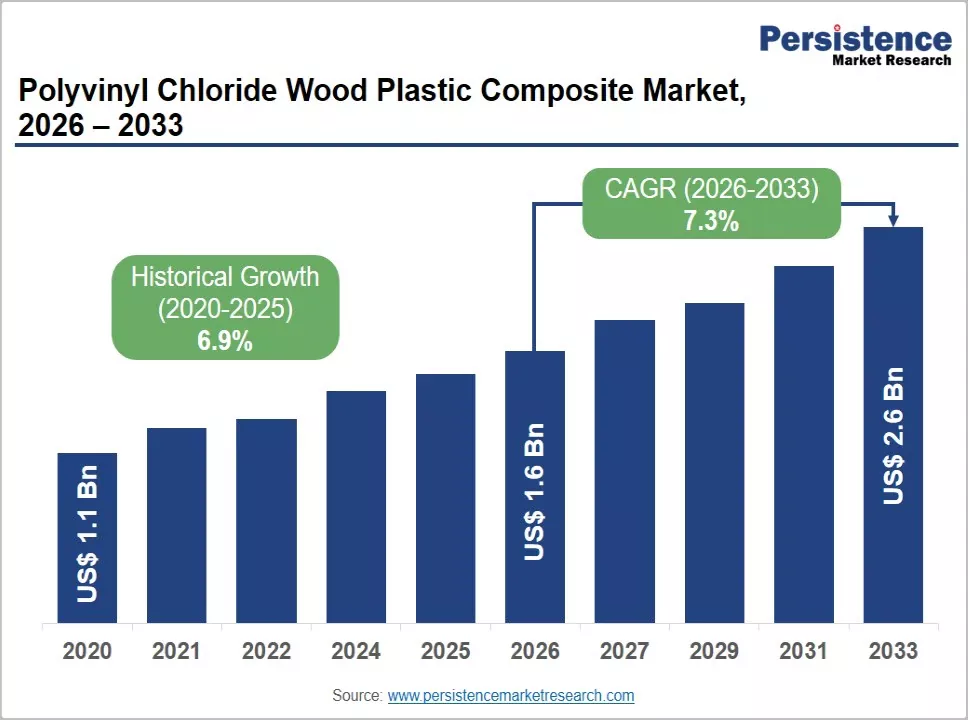
The global polyvinyl chloride wood plastic composite market size is likely to be valued at US$ 1.6 billion in 2026 and is expected to reach US$ 2.6 billion by 2033, growing at a CAGR of 7.3% between 2026 and 2033, driven by rising demand for low-maintenance exterior building materials, stricter fire-safety requirements, and wider use of recycled wood fiber and plastic content.
Polyvinyl chloride (PVC) wood plastic composites combine wood flour or fiber with a PVC polymer matrix, offering moisture resistance, termite resistance, dimensional stability, and inherent flame retardancy. Manufacturers are expanding capped and co-extruded products for decking, cladding, and fencing, while molded components are gaining use in automotive interiors and industrial products.
Key Industry Highlights
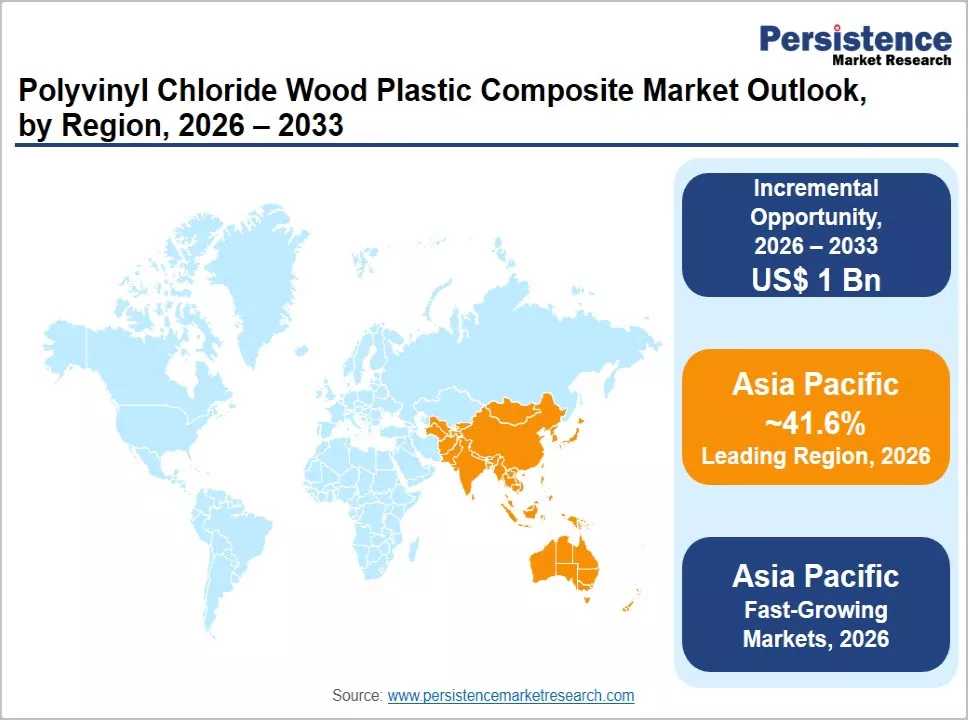
- Leading Region: Asia Pacific, anticipated to account for approximately 41.6% of the market share, supported by large-scale WPC manufacturing capacity, expanding urban housing, and export-oriented production in China.
- Fastest-growing Region: Asia Pacific, driven by urbanization, infrastructure investment, rising adoption of green building materials, and expanding domestic demand in India and ASEAN countries.
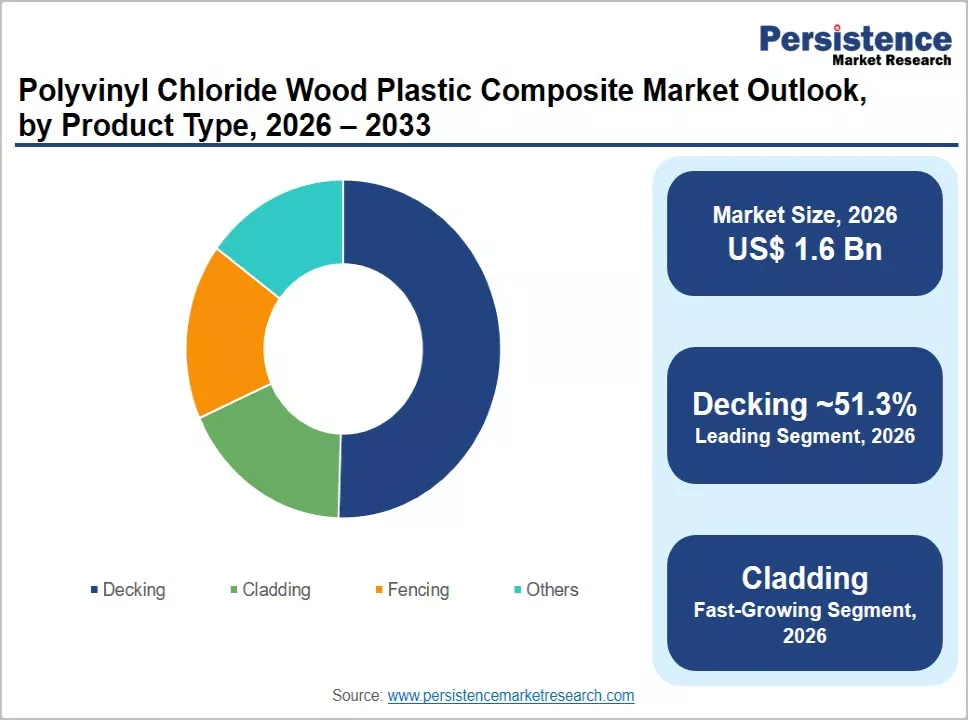
- Dominant Product Type: Decking, anticipated to hold 51.3% of the market share in 2026, driven by outdoor living demand, deck replacement activity, and the shift away from treated timber.
- Leading Application: Building & construction, anticipated to account for 62.4% of the market share, supported by residential remodeling, facade upgrades, and fire-safety requirements for exterior materials.
DRO Analysis
Drivers - Demand for Low-Maintenance, Moisture-Resistant Exterior Materials Is Replacing Treated Timber
Builders and homeowners are increasingly replacing treated timber with engineered materials that avoid annual staining, sealing, and replacement of rotted boards. PVC wood plastic composites resist moisture absorption, fungal decay, and termite damage, which makes them well suited to decks, fences, and exterior wall systems in humid and coastal climates.
Residential demand anchors this trend, with the residential end user segment accounting for 58.3% of the market. Extrusion, which represents 71.8% of production volume, supports efficient manufacture of long, uniform profiles with capped surfaces and wood-grain finishes. Lower lifetime maintenance costs are anticipated to sustain conversion from wood to composite products through 2033.
Fire-Safety Requirements and Building Code Alignment Are Strengthening Demand for PVC-Based Products
Wildfire exposure and tighter exterior-material codes are shifting specifications toward products with tested fire performance. PVC contains chlorine, which gives the polymer inherent resistance to ignition compared with wood and polyolefin-based alternatives. In January 2026, Trex introduced Refuge, an ignition-resistant PVC decking line that meets ASTM E84 Class A flame spread requirements and ASTM E2768 ignition resistance standards for wildland-urban interface areas.
The launch reflects a shift among North American producers toward PVC formulations in regions with heightened fire-safety rules. As building codes in the U.S., Europe, and Asia Pacific place greater emphasis on exterior fire performance, PVC wood plastic composites are likely to gain specification share in cladding and decking.
Restraint - Raw Material Cost Volatility and Environmental Scrutiny of PVC Increase Adoption Challenges
Raw material costs remain a structural challenge for the market. PVC resin, stabilizers, impact modifiers, and wood fiber prices fluctuate with energy costs, feedstock availability, and construction activity, creating margin exposure for producers that purchase virgin resin. In May 2026, Trex reported no impact on first-quarter gross margins from higher oil prices, which illustrates the cost insulation available to producers with controlled material sourcing.
Environmental scrutiny of PVC adds a second constraint. Chlorine-based chemistry, additive regulation, and limited end-of-life recycling infrastructure influence procurement decisions among sustainability-focused builders and public-sector buyers. Competition from polyethylene-based composites, cellular PVC, aluminum, and fiber cement also limits pricing power, particularly in North America.
Opportunities - Automotive and Industrial Applications Create New Demand for Molded PVC Wood Composites
Automotive is the fastest-growing application, projected to expand at a CAGR of 8.1%. Vehicle manufacturers are seeking lightweight, recyclable, and low-emission interior materials for door panels, load floors, and trim components. PVC wood plastic composites offer dimensional stability, paintability, and lower weight than some conventional reinforced plastics.
Injection molding, the fastest-growing manufacturing process at a CAGR of 8.4%, supports this shift by enabling complex parts with consistent tolerances. Industrial and consumer goods applications, including pallets, furniture components, garden products, and appliance parts, offer additional volume for producers with molding capabilities.
Asia Pacific Offers Strong Expansion Potential through Urbanization and Manufacturing Capacity
Asia Pacific presents substantial growth potential because of expanding urban housing, infrastructure programs, and a deep supply base of WPC extruders. China hosts a large concentration of exporters and domestic producers, including NewTechWood, KR WPC, and Zhejiang New Insight, which supply decking, cladding, and fencing to domestic and international buyers.
India and ASEAN countries are increasing demand through residential construction, hospitality development, and a shift toward termite-resistant, low-maintenance materials. Local production, recycled material use, and co-extruded capped products are expected to improve cost competitiveness and widen adoption across commercial and public projects.
Category-wise Analysis
Product Type Insights
Decking is anticipated to account for 51.3% of the market share in 2026. The segment includes solid and hollow boards, tiles, and capped co-extruded profiles used in residential patios, commercial terraces, pool surrounds, and boardwalks. For example, homeowners replacing aging timber decks select PVC composite boards for slip resistance, color retention, and reduced maintenance. Extrusion, which accounts for 71.8% of production volume, supports high-throughput manufacture of decking profiles. Fire-rated product introductions, such as Trex Refuge in 2026, further strengthen demand in regions with strict exterior fire codes.
Cladding is anticipated to be the fastest-growing product type, expanding at a CAGR of 7.8%. Growth is driven by facade renovation, rainscreen systems, and the use of wood-look wall panels in residential and commercial buildings. For example, KR WPC introduced an ASA/PVC co-extruded WPC line in May 2026 for outdoor applications, reflecting the focus on weather-resistant capped surfaces. Fencing and other products, including railings, pergola components, and window and door profiles, provide additional volume.
Application Insights
Building & construction is anticipated to account for 62.4% of the market share. The segment covers residential decks, fences, wall cladding, door and window components, and commercial exterior systems. For example, a multifamily developer specifying composite balcony decking and fence panels reduces recurring maintenance obligations across a property portfolio. The residential end user segment accounts for 58.3% of demand, supported by remodeling activity and outdoor living investment, while commercial projects are the fastest-growing end user at a CAGR of 8.2%, supported by hospitality, retail, and mixed-use developments.
Automotive is anticipated to be the fastest-growing application, expanding at a CAGR of 8.1%. Molded PVC wood composites are used in interior panels, load floors, and trim parts where weight reduction, recycled content, and dimensional stability are priorities. For example, injection-molded components allow automakers to integrate texture, color, and mounting features in a single part. Industrial and consumer goods applications, including pallets, furniture parts, and garden products, add further diversification.
Regional Insights
North America Polyvinyl Chloride Wood Plastic Composite Market Trends
North America is anticipated to account for approximately 26.7% of the market share, with the U.S. representing around 84.7% of regional demand. A large residential remodeling base, an established deck-building culture, and strong retail and dealer distribution support demand for composite decking, railing, and cladding. Fire-safety codes in wildfire-prone states and growing interest in PVC-based products are broadening the product mix beyond polyethylene-based composites.
U.S. Polyvinyl Chloride Wood Plastic Composite Market Trends
The U.S. remains the dominant market in North America due to its large housing stock, high outdoor living spending, and well-developed composite decking brands. In July 2025, James Hardie completed its acquisition of The AZEK Company in a transaction valued at US$8.75 billion including net debt, combining fiber cement siding with TimberTech and AZEK Exteriors products.
In January 2026, Trex launched Refuge, an ignition-resistant PVC decking line, in select regions, and in March 2026 expanded distribution across northeast markets. Trex also reported in May 2026 that it was completing its new Little Rock, Arkansas facility, a project estimated at US$400 million.
Canada Polyvinyl Chloride Wood Plastic Composite Market Trends
Canada represents an important secondary market, supported by residential renovation, cold-climate durability requirements, and demand for materials resistant to freeze-thaw cycles and moisture. Builders and homeowners are increasingly selecting capped composite decking, fencing, and cladding to reduce seasonal maintenance. Cross-border distribution from U.S. manufacturers and growing availability of PVC-based products are widening product choice for Canadian dealers and contractors.
Europe Polyvinyl Chloride Wood Plastic Composite Market Trends
Europe is characterized by mature timber-alternative demand, strong sustainability regulation, and growing use of recycled-content materials. The revised EU Construction Products Regulation, which entered into force in January 2025, is expected to increase attention to product environmental performance and product information, supporting demand for certified composite materials.
Germany Polyvinyl Chloride Wood Plastic Composite Market Trends
Germany represents a major European market because of its large residential renovation sector, strong building standards, and established distribution of terrace decking and facade products. Consumers favor products with certified material composition, low maintenance requirements, and long service life.
German buyers place significant importance on fire classification, recycled content, and product durability. This is supporting demand for co-extruded and capped boards and for PVC-based profiles used in cladding and fencing, particularly in urban housing and commercial refurbishment projects.
U.K. Polyvinyl Chloride Wood Plastic Composite Market Trends
The U.K. is an important market for decking, fencing, and cladding products, supported by strong garden improvement spending and a large timber replacement base. Producers position composite products around recycled plastic content, long warranties, and low maintenance. Fire-safety requirements for external wall materials in building regulations continue to influence cladding specifications.
For example, EnviroBuild's Hyperion Sentinel wood-polymer cladding system is specified to a Class B fire rating under EN 13501-1 and is supported by an environmental product declaration based on EN 15804. This reflects the shift toward documented fire and environmental performance in the UK market.
Asia Pacific Polyvinyl Chloride Wood Plastic Composite Market Trends
Asia Pacific is anticipated to be the leading and fastest-growing regional market, accounting for approximately 41.6% of the global share, due to rapid urbanization, large-scale manufacturing capacity, and expanding infrastructure investment. The region is both the largest production base and a growing consumption market for WPC decking, cladding, fencing, and molded products.
India Polyvinyl Chloride Wood Plastic Composite Market Trends
India is emerging as a major growth market because of expanding residential construction, urban infrastructure development, and rising awareness of termite-resistant, moisture-resistant alternatives to timber. Growth in hospitality and commercial real estate is increasing demand for durable panels, door frames, partitions, and fences.
The limited availability and rising cost of quality timber support substitution in door frames, partitions, and fencing. Local extrusion capacity, wider dealer networks, and improved availability of PVC resin are anticipated to strengthen penetration in tier-two and tier-three cities.
China Polyvinyl Chloride Wood Plastic Composite Market Trends
China remains the largest producer and exporter of WPC products, supported by a dense manufacturing base in Zhejiang, Anhui, Jiangsu, and Guangdong provinces. Companies such as NewTechWood, Zhejiang New Insight, and KR WPC supply decking, cladding, and fencing to North American, European, and domestic buyers. Domestic demand is supported by green building policies, urban renewal projects, and growth in landscaping and municipal construction.
In May 2026, KR New Materials, headquartered in Xuancheng, introduced an ASA/PVC co-extruded WPC line for durable outdoor applications. Producers are increasingly moving toward capped, co-extruded structures that improve weathering performance, color retention, and stain resistance, helping Chinese suppliers address premium export segments.
Competitive Landscape
The global polyvinyl chloride wood plastic composite market is fragmented, with competition among North American composite decking brands, diversified building product companies, European profile specialists, and a large group of Asian manufacturers. Major companies compete based on product performance, capped surface technology, fire and weather ratings, recycled content, distribution reach, brand strength, and warranty coverage. Trex, James Hardie, Fiberon, Deckorators, and Deceuninck hold strong positions through retail partnerships and established dealer networks, while Chinese producers compete on manufacturing scale, customization, and export pricing.
Leading companies are focusing on fire-rated and PVC product introductions, capacity expansion, recycled material integration, and portfolio expansion through acquisitions. Competitive differentiation increasingly depends on surface durability, color stability, certified environmental performance, and channel access. Companies are also introducing co-extruded structures, mid-priced product tiers, and regional product lines to reach a broader range of builders, remodelers, and distributors.
Key Industry Developments
- In January 2026, Trex launched Refuge, an ignition-resistant PVC decking line meeting ASTM E84 Class A flame spread and ASTM E2768 ignition resistance standards, and in March 2026 expanded the limited release into northeast markets in the U.S..
- In May 2026, KR New Materials Co., Ltd. launched an ASA/PVC co-extruded wood-plastic composite line for outdoor applications, strengthening its decking, cladding, and fencing portfolio for export and domestic buyers.
Companies Covered in Polyvinyl Chloride Wood Plastic Composite Market
- Trex Company, Inc.
- James Hardie Industries plc
- Fortune Brands Innovations, Inc. (Fiberon)
- UFP Industries, Inc. (Deckorators)
- Oldcastle APG (CRH plc)
- Deceuninck NV
- UPM-Kymmene Corporation (UPM ProFi)
- NewTechWood
- Zhejiang New Insight Wood Composite Co., Ltd.
- Anhui Sentai WPC Group Co., Ltd.
- Jiangsu Kentier Wood Plastic Composite Co., Ltd.
- KR New Materials Co., Ltd.
- Terratsa New Material (Liaoning) Co., Ltd.
- Green Bay Decking LLC
Frequently Asked Questions
The global polyvinyl chloride wood plastic composite market is projected to be valued at US$ 1.6 billion in 2026.
The market is expected to reach US$ 2.6 billion by 2033.
Key trends include growing adoption of low-maintenance and fire-resistant exterior materials, co-extruded capped boards, recycled material use, expansion of cladding and facade applications, and rising use of molded WPC components in automotive and industrial products.
Decking is anticipated to remain the leading product type segment, accounting for approximately 51.3% of the market in 2026.
The market is projected to expand at a CAGR of 7.3% between 2026 and 2033.
Major companies include Trex Company, James Hardie Industries, Fortune Brands Innovations (Fiberon), UFP Industries (Deckorators), and Deceuninck.


