




- Nutraceuticals & Functional Foods
- Plant Extracts Market
Plant Extracts Market Size, Share, and Growth Forecast 2026–2033
Plant Extracts Market by Product (Oleoresins, Essential Oils), Application (Food & Beverages, Pharmaceuticals), Source (Fruits & Vegetables, Herbs & Spices), Form (Dry, Liquid), and Regional Analysis, 2026–2033

Plant Extracts Market Size and Trend Analysis
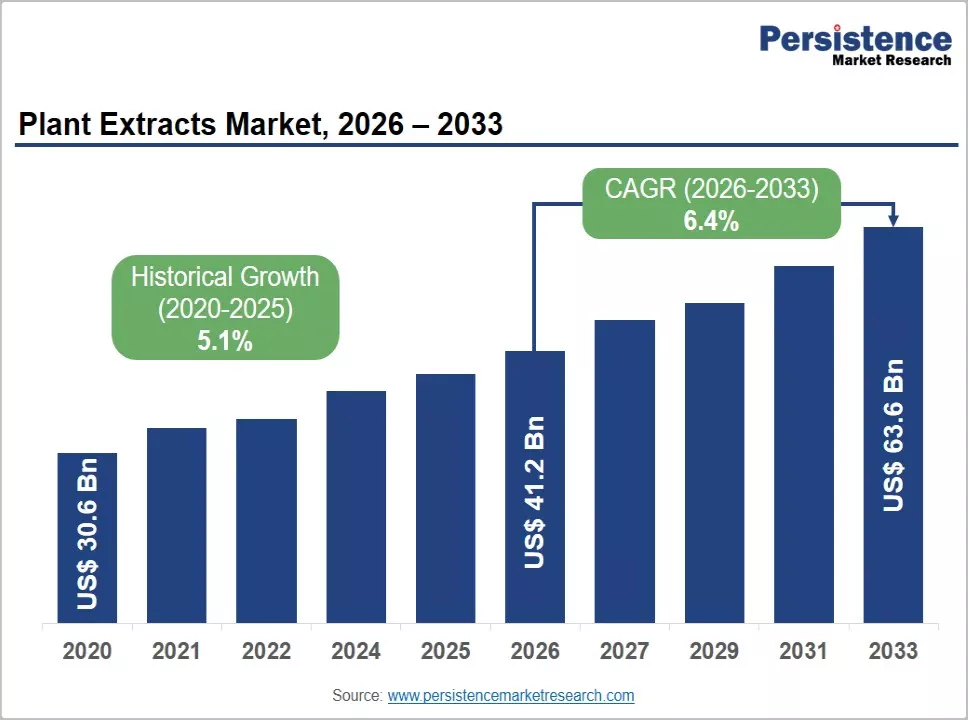
The global plant extracts market size is likely to be valued at US$ 41.2 billion in 2026, and is estimated to reach US$ 63.6 billion by 2033, growing at a CAGR of 6.4% during the forecast period 2026–2033. Growth is underpinned by the accelerating shift toward clean-label foods and beverages, rising demand for botanical ingredients in nutraceuticals and pharmaceuticals, and the replacement of synthetic additives with natural colors, flavors, and antioxidants across developed and emerging economies.
The market recorded a historical CAGR of 5.1% during 2020–2025, reflecting supply chain disruptions and raw material cost volatility. However, the forecast period anticipates stronger momentum as regulators encourage the phase-out of synthetic dyes, processors invest in green extraction technologies, and consumers increasingly prefer plant-derived ingredients with traceable origins and functional benefits.
Key Industry Highlights
- Dominant Product: Essential oils are set to command around 56% of the revenue share in 2026, while oleoresins are likely to grow the fastest at 7.1% CAGR through 2033, as food processors adopt natural colors and standardized spice flavors.
- Leading Application: Food and beverages are expected to lead with 61% in 2026, while pharmaceuticals are likely to be the fastest-growing application at about 7.8% CAGR during 2026–2033, reflecting rising interest in botanical drug and supplement formulations.
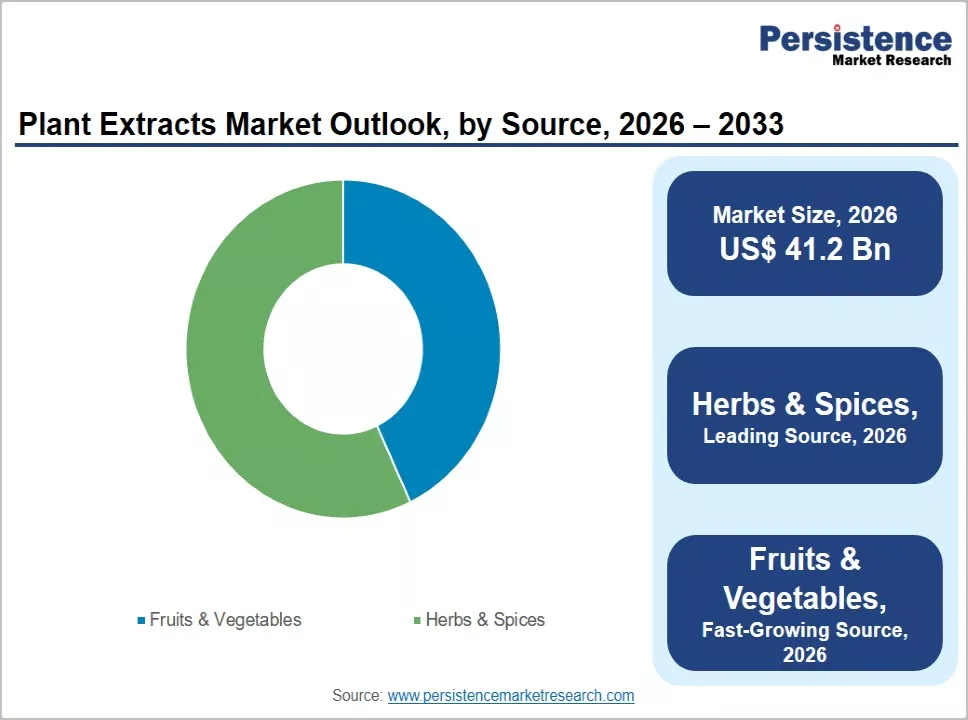
- Dominant Source: Herbs and spices are anticipated to lead with an estimated 53% share in 2026, while fruits and vegetables are slated to represent the fastest-growing source segment at 7.4% CAGR from 2026 to 2033.
- Leading Form: Dry extracts are projected to account for around 59% of the market in 2026, while liquid extracts are expected to expand at 7.2% CAGR through 2033, supported by beverage and flavor applications.
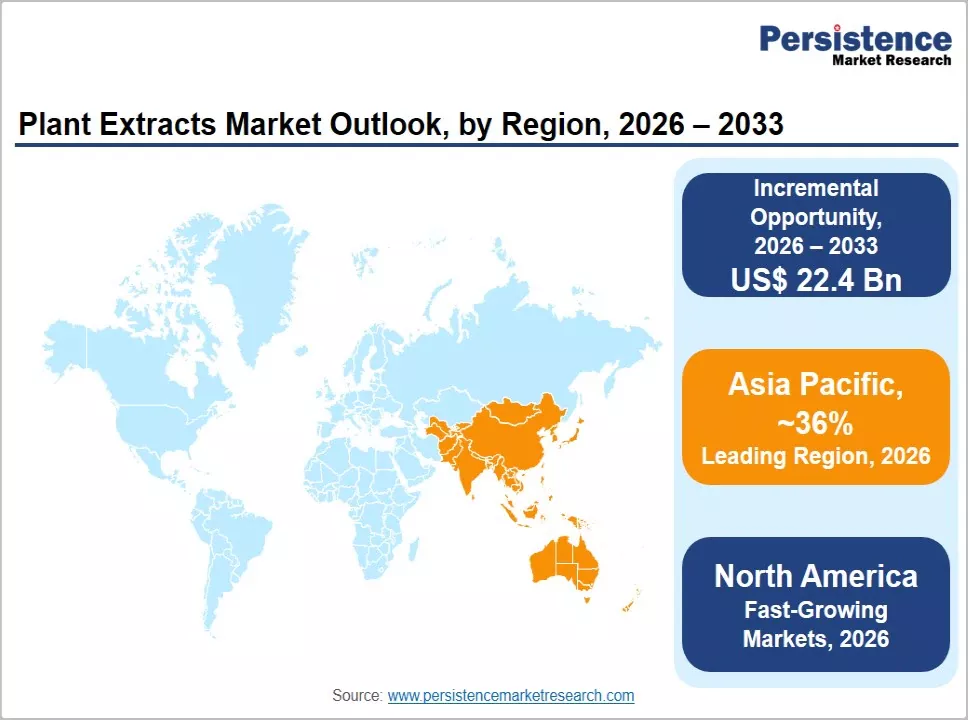
- Regional Leadership: Asia Pacific is poised to dominate with an estimated 36% share in 2026 and register a 7.7% CAGR through 2033, led by the strong raw material base and processing capacity in India and China.
- Competitive Environment: Competitive dynamics include portfolio-reshaping acquisitions, private-equity-backed consolidation, and expansion into botanical and functional extracts for nutraceutical markets.
DRO Analysis
Drivers: Clean-Label Reformulation and Natural Color Transition as Primary Growth Catalyst
The shift away from synthetic additives is the leading force driving the plant extracts market growth, as food, beverage, personal care, and supplement manufacturers reformulate products with recognizable, plant-derived ingredients. Regulatory and policy momentum is reinforcing this trend, including the U.S. plan announced in 2025 to phase out petroleum-based synthetic food dyes by the end of 2026, along with state-level restrictions and the revocation of authorization for a widely used red dye.
Manufacturers are replacing synthetic colors with extracts such as paprika, turmeric, and anthocyanin-rich fruit and vegetable concentrates. Natural antioxidants, such as rosemary and green tea extracts, are also gaining adoption as preservatives, giving processors a clean-label route to extend shelf life while meeting retailer ingredient standards.
Nutraceutical Growth and Green Extraction Technologies
Expanding nutraceutical and dietary supplement demand is strengthening the market, particularly for adaptogens, polyphenols, and standardized herbal actives supported by clinical evidence. Extraction technologies including supercritical carbon dioxide, ultrasound-assisted, and enzymatic methods are improving yield, purity, and solvent sustainability, enabling suppliers to offer standardized, branded ingredients at consistent quality. This convergence of regulatory support, consumer preference, and technological advancement is expected to sustain demand across multiple end-use industries.
Restraints: Raw Material Volatility and Regulatory Fragmentation
Plant extract producers depend on agricultural raw materials whose availability and prices are affected by weather, crop disease, harvest cycles, and geopolitical factors. Climate variability has repeatedly disrupted supplies of spices, citrus, and medicinal herbs, causing price spikes that are difficult to pass on to long-term customers. Quality inconsistency and adulteration risks, especially in widely traded botanicals, further require extensive testing, supplier audits, and traceability systems, raising operating costs for processors that serve food and pharmaceutical customers.
Compliance Costs and Stability Challenges
Regulatory requirements differ widely across regions, with distinct rules for novel foods in Europe, dietary ingredients in the U.S., natural health products in Canada, and traditional medicine in Asia. Meeting residual solvent, pesticide, heavy metal, and labeling standards in multiple jurisdictions increases compliance burdens, particularly for small and mid-sized suppliers. In addition, natural extracts can face stability limitations in acidic, high-temperature, or light-exposed applications, and their higher costs relative to synthetic alternatives may restrain adoption in price-sensitive categories.
Opportunities: Functional Ingredients, Emerging Sourcing Regions, and Sustainable Extraction
Rising demand for functional foods, sports nutrition, and personalized supplements is opening new opportunities for specialized botanical extracts with documented bioactivity. Brazil, India, Sri Lanka, and several African countries are investing in value-added processing of spices, herbs, and fruits, supported by export promotion programs and foreign investment. Recent transactions, such as the acquisition of a Brazilian botanical extracts producer by a global ingredient group, illustrate how multinational firms are securing diversified, traceable sourcing.
Circular Economy and Value-Added Upcycling
Upcycling fruit pomace, citrus peels, and spice residues into extracts and fibers is creating additional revenue streams while aligning with sustainability goals. Producers that combine regenerative sourcing, transparent supply chains, and clinically supported branded ingredients are expected to command premium pricing. Partnerships between ingredient suppliers, beverage companies, and nutraceutical brands are likely to accelerate commercialization of new extract-based formats through 2033.
Category-wise Insights
Product Analysis
Why Do Essential Oils Lead the Plant Extracts Market?
Essential oils are the leading product segment, expected to hold about 56% of the plant extracts market revenue share in 2026. Citrus, mint, eucalyptus, and spice-derived oils are used extensively in flavors, fragrances, oral care, household products, and aromatherapy. Their versatility across food, personal care, and home applications supports broad, recurring demand. Established distillation and cold-pressing infrastructure, particularly for citrus oils, ensures dependable supply, while consolidation among flavor and fragrance suppliers continues to shape pricing and availability.
Oleoresins are likely to grow the fastest through 2033, at about 7.1% CAGR. These concentrated extracts, such as paprika, turmeric, black pepper, and capsicum oleoresins, deliver standardized color and pungency and are well suited to meat, snack, sauce, and convenience food applications. The transition to natural colors and the need for consistent flavor intensity across large production runs are driving adoption. Oleoresins also offer microbial safety and storage advantages over whole spices, which supports their use in industrial food manufacturing.
Application Analysis
Which Application Dominates the Plant Extracts Market?
Food and beverages dominate the application segment, projected to capture about 61% of the revenue share in 2026. Plant extracts provide natural colors, flavors, sweeteners, antioxidants, and functional ingredients across beverages, bakery, dairy, confectionery, and savory products. Clean-label expectations from retailers and consumers are encouraging processors to reformulate, while the growth of functional beverages and plant-based foods continues to expand volumes. Established relationships between extract suppliers and large food manufacturers help sustain stable, long-term demand.
Pharmaceuticals represent the fastest-growing application, anticipated to achieve about 7.8% CAGR during the 2026–2033 period. Botanical extracts are used in herbal medicines, over-the-counter remedies, and adjunct formulations, supported by growing interest in evidence-based plant therapeutics and traditional medicine systems such as Ayurveda and traditional Chinese medicine. Stricter quality standards, including standardized marker compounds and validated analytical methods, favor suppliers with advanced testing and documentation capabilities. Higher-value, specification-driven contracts also support better margins than commodity food applications.
Source Analysis
Why Do Herbs and Spices Lead Plant Extract Sources?
Herbs and spices are poised to lead with an estimated 53% share in 2026, reflecting the extensive use of turmeric, ginger, pepper, rosemary, and other botanicals in food, supplement, and traditional medicine applications. Major producing countries, including India, China, Vietnam, and Indonesia, provide large and cost-competitive raw material bases. The segment benefits from established trade networks, long-standing processing know-how, and rising demand for immunity and wellness-oriented products, although climate-related supply risk requires careful sourcing management.
Fruits and vegetables are the fastest-growing source segment, expected to exhibit an approximate 7.4% CAGR through 2033. Extracts from citrus, berries, grapes, carrots, purple sweet potato, and other produce supply natural colors, polyphenols, and fiber-rich ingredients. Valorization of processing by-products, including pomace and peels, lowers raw material costs and supports sustainability claims. Beverage and confectionery makers are adopting fruit- and vegetable-based colors and flavors rapidly as synthetic dyes face regulatory and consumer scrutiny.
Form Analysis
Which Form Leads the Plant Extracts Market?
Dry extracts, including powders and granules, are expected to hold around 59% of the market in 2026. Their longer shelf life, easier transport, and compatibility with tablets, capsules, dry mixes, and seasoning blends make them the preferred format for supplements and processed foods. Spray-drying and carrier technologies are improving solubility and flowability, helping formulators integrate extracts into diverse product matrices at predictable dosage levels.
Liquid extracts are anticipated to grow at an estimated 7.2% CAGR through 2033. They are favored in beverages, tinctures, flavorings, and cosmetic formulations, where rapid dispersion and ease of dosing are important. Water-soluble and emulsified liquid systems, including nano-emulsions, are enabling cleaner, more stable products, though cold-chain, preservation, and shipping costs remain considerations. Innovation in beverage-ready formats is expected to support continued gains.
Regional Insights
North America Plant Extracts Market Trends and Insights
North America is anticipated to account for an estimated 27% of the global plant extracts market in 2026. The region's plant extracts industry is likely to benefit from the clean-label movement, strong dietary supplement consumption, and regulatory pressure on synthetic dyes. Private-equity-backed consolidation among botanical suppliers, including recent deals involving specialty botanical companies, is reshaping the competitive environment. Demand for adaptogens, sports nutrition ingredients, and natural preservatives is expected to remain robust, while tariffs and sourcing diversification are likely to influence supply chains through 2033.
U.S. Plant Extracts Market Size
The U.S. is estimated to account for approximately 79% of the North America plant extracts market in 2026. Market growth is likely to be supported by the federal and state-level push away from petroleum-based dyes, rising supplement usage, and rapid growth in functional beverages. Food manufacturers are accelerating reformulation toward colors derived from spirulina, paprika, turmeric, and vegetable juices, and natural antioxidants are gaining share in meat and bakery preservation. Domestic ingredient firms are also investing in capacity expansions and acquisitions to secure botanical supply and expand clinically supported branded extracts.
Canada Plant Extracts Market Size
Canada is projected to represent approximately 8% of the North America plant extracts market in 2026. Market expansion is expected to be driven by the country's regulatory framework for natural health products, growing interest in plant-based nutrition, and a strong personal care sector. Canadian processors are exploring cold-climate botanicals, including berries, sea buckthorn, and hemp-derived extracts, for functional foods and wellness products. Imports of spice and herb extracts remain significant, and trade relationships with the U.S. and Asia are expected to influence pricing and supply stability through 2033.
Europe Plant Extracts Market Trends and Insights
Europe is estimated to account for approximately 15% of the global plant extracts market in 2026. The region's market is expected to benefit from strong consumer preference for natural and organic ingredients, a sophisticated flavor and fragrance industry, and rigorous quality frameworks. Novel food authorizations and the European Green Deal's sustainability objectives are encouraging investment in traceable sourcing and environmentally responsible extraction. Established ingredient groups headquartered in the region are leveraging acquisitions and partnerships to extend their botanical portfolios, while compliance with pesticide residue and labeling rules supports quality differentiation.
Germany Plant Extracts Market Size
Germany is anticipated to account for approximately 23% of the Europe plant extracts market in 2026. Demand is expected to be supported by a large herbal medicine tradition, a leading pharmaceutical and nutraceutical sector, and the presence of major flavor and ingredient manufacturers. Phytopharmaceuticals, tea, and functional food applications provide stable demand, while sustainability-focused procurement and organic certification are increasingly important purchasing criteria. Investments in advanced extraction and analytical capabilities, together with strong export links across the European Union, are projected to support market expansion through 2033.
Why Is Asia Pacific Expected to Lead the Plant Extracts Market?
Asia Pacific is projected to account for approximately 36% of the global plant extracts market in 2026, making it the largest regional market. The region is also anticipated to register the fastest growth, expanding at an estimated CAGR of 7.7% through 2033. Market expansion is likely to be driven by abundant raw material availability, competitive processing costs, and strong domestic demand from traditional medicine, food, and personal care industries. India and China are expected to remain primary supply and demand centers, while Southeast Asian countries are strengthening export-oriented extraction capacity for spices, herbs, and fruits.
China Plant Extracts Market Size
China is estimated to represent approximately 33% of the Asia Pacific plant extracts market in 2026. The country's market is expected to benefit from a vast botanical resource base, traditional Chinese medicine, and large-scale extraction capacity serving global food, supplement, and cosmetic customers. Government support for herbal medicine standardization and modern manufacturing is likely to improve quality and export competitiveness. Domestic demand for functional foods and health supplements is also rising, though environmental regulation and rising labor costs may influence production economics through 2033.
India Plant Extracts Market Size
India is projected to account for approximately 25% of the Asia Pacific plant extracts market in 2026. The market is expected to witness strong expansion, supported by the country's position as a leading producer of spices, medicinal herbs, and essential oils, and by growing global interest in Ayurveda-based ingredients. Export-oriented producers are investing in oleoresin, curcumin, and standardized herbal extract capacity, while domestic nutraceutical and personal care brands increase local demand. Government initiatives to promote spice quality, traceability, and value-added exports are likely to strengthen competitiveness through 2033.
Competitive Landscape
The global plant extracts market structure is moderately fragmented, with the top vendors, including Givaudan, Symrise, Kerry Group, and DSM-Firmenich, controlling around one-third of the revenue share. These established players leverage extensive raw material networks, global application laboratories, and integrated flavor, color, and nutrition platforms. They are also known to invest in sustainable sourcing, green extraction technologies, and bolt-on acquisitions to broaden botanical portfolios.
Regional and specialty competitors such as Indena, Martin Bauer, Synthite Industries, and Döhler are focusing on standardized botanical actives, spice extracts, and natural color systems. Barriers such as quality certification, traceable sourcing, and regulatory documentation limit new entrants, while private-equity investors are actively consolidating mid-sized botanical suppliers. Market consolidation is expected to continue as portfolio-reshaping divestitures by large groups create opportunities for focused specialists, while collaborations between ingredient suppliers and consumer brands accelerate innovation.
Key Market Developments
- In July 2026, SuanNutra, a portfolio company of Carbyne Equity Partners, agreed to acquire IFF's botanical extracts, fermented vitamins and minerals, plant-derived natural colors, antioxidants, and flavor activities, creating a combined group of about 700 employees, with completion expected by the end of 2026.
- In July 2026, Tradebe acquired CitraSource, a Florida-based producer of natural citrus oils and extracts, from IFF to strengthen its ingredients platform within its Life Sciences division.
- In March 2026, Prodalim acquired Sylvestre, a Brazilian producer of botanicals and functional extracts for the nutraceutical market, to expand its specialty ingredients and solutions business.
Companies Covered in Plant Extracts Market
- Givaudan SA
- Symrise AG
- Kerry Group plc
- DSM-Firmenich AG
- Archer-Daniels-Midland Company
- Sensient Technologies Corporation
- Döhler GmbH
- Martin Bauer Group
- Indena S.p.A.
- Synthite Industries Ltd.
Frequently Asked Questions
The global plant extracts market is valued at US$ 41.2 billion in 2026 and is projected to reach US$ 63.6 billion by 2033, expanding at a CAGR of 6.4% during 2026–2033.
The shift toward clean-label products, replacement of synthetic dyes and additives with natural alternatives, and rising nutraceutical and pharmaceutical demand for botanical ingredients are driving the market.
Essential oils lead products with about 56% share, food and beverages lead applications with about 61%, herbs and spices lead sources with an estimated 53%, and dry extracts lead forms with about 59% in 2026.
Asia Pacific dominates the market with an estimated 36% share in 2026 and is projected to register a 7.7% CAGR through 2033, supported by abundant raw materials and processing capacity in India and China.
Growing demand for functional ingredients, value-added sourcing in emerging economies, sustainable extraction technologies, and upcycling of fruit and spice by-products are key market opportunities.


