




- Nutraceuticals & Functional Foods
- Nutraceutical Excipients Market
Nutraceutical Excipients Market Size, Share, and Growth Forecast 2026–2033
Nutraceutical Excipients Market by Functionality (Binders, Fillers, Lubricants, Disintegrants), Source (Natural, Synthetic, Semi-Synthetic), Formulation Type (Tablets, Capsules), End Use Industry (Pharmaceuticals, Food & Beverages, Cosmetics), and Regional Analysis, 2026–2033

Nutraceutical Excipients Market Size and Trend Analysis
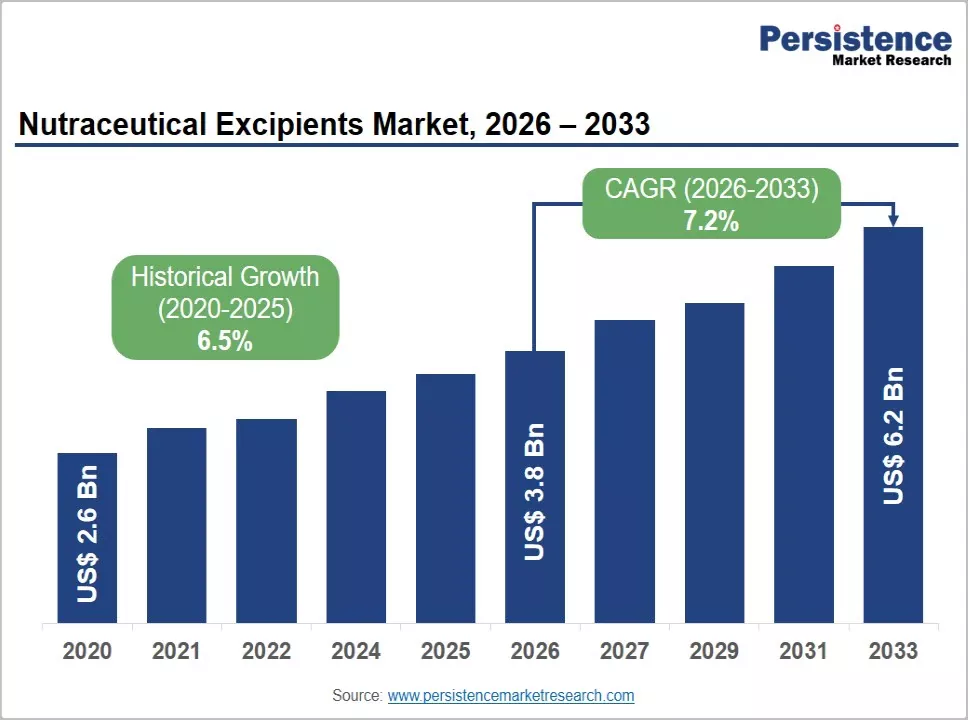
The global nutraceutical excipients market size is likely to be valued at US$ 3.8 billion in 2026, and is estimated to reach US$ 6.2 billion by 2033, growing at a CAGR of 7.2% during the forecast period 2026–2033. Growth is underpinned by the expanding consumption of dietary supplements and functional products, rising demand for label-friendly and plant-derived formulation aids, and the shift toward convenient dosage formats across developed and emerging economies.
The market recorded a historical CAGR of 6.5% during 2020–2025, supported by post-pandemic wellness spending and steady capacity additions by supplement manufacturers. However, the forecast period anticipates faster expansion as brands reformulate away from synthetic additives, contract manufacturers scale high-speed tablet and capsule production, and excipient suppliers introduce multifunctional ingredients that improve flow, compressibility, and stability.
Key Industry Highlights
- Dominant Functionality: Fillers are set to command around 34% of the revenue share in 2026, while lubricants are likely to grow the fastest at 8.6% CAGR through 2033, as manufacturers seek organic alternatives to conventional magnesium stearate.
- Leading Source: Semi-synthetic excipients are expected to lead with 42% in 2026, while natural excipients are likely to be the fastest-growing source at about 8.7% CAGR during 2026–2033, reflecting clean-label reformulation.
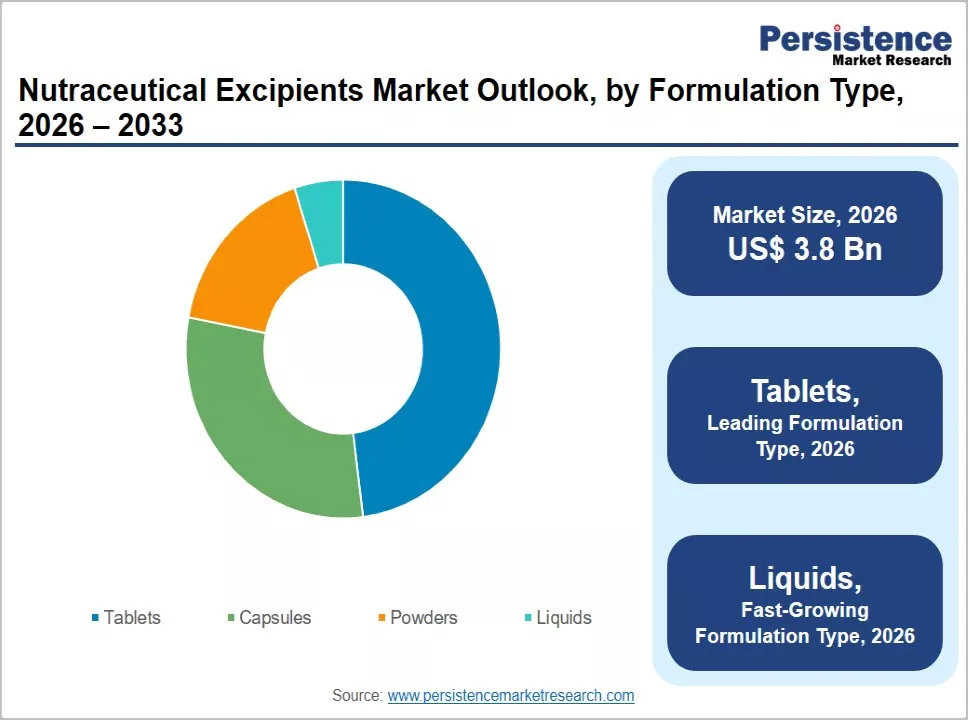
- Dominant Formulation Type: Tablets are anticipated to lead with an estimated 43% share in 2026, while capsules are slated to represent the fastest-growing formulation at 8% CAGR from 2026 to 2033.
- Leading End Use Industry: Pharmaceuticals are poised to command around 49% share in 2026, while food and beverages are expected to register the fastest growth at 8.2% CAGR through 2033, led by functional and fortified product launches.
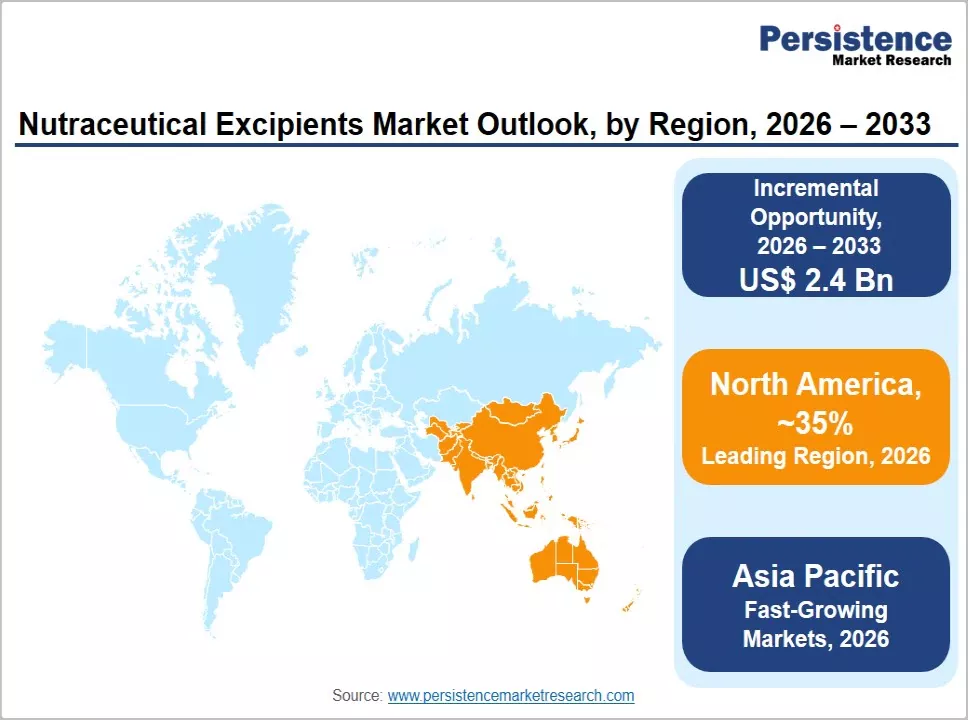
- Regional Leadership: North America is poised to dominate with an estimated 35% share in 2026, while Asia Pacific is projected to register the fastest growth at 8.5% CAGR through 2033, led by supplement manufacturing in China and India.
- Competitive Environment: Competitive dynamics include clean-label excipient launches, capacity and technology investments, and portfolio expansion through acquisitions and application-focused innovation.
DRO Analysis
Drivers: Dietary Supplement Expansion and Clean-Label Formulation as Primary Growth Catalyst
Growth in dietary supplements and functional nutrition is the leading force driving the nutraceutical excipients market, as every tablet, capsule, powder, and gummy depends on binders, fillers, lubricants, and disintegrants to deliver consistent dose and manufacturability. Rising health awareness, aging populations, and preventive wellness trends are lifting supplement volumes worldwide, while contract manufacturers are scaling high-speed production lines that require excipients with dependable flow and compression behavior.
Brands are also removing synthetic additives to meet retailer and consumer expectations, creating demand for plant-derived, organic, and allergen-friendly ingredients. Regulatory actions such as the European Union's ban on titanium dioxide as a food additive have further accelerated reformulation of coatings and whitening agents.
Multifunctional Excipients and Process Efficiency
Excipient suppliers are responding with multifunctional products that combine lubrication, flow, and compression support in a single addition, reducing the number of ingredients and simplifying label declarations. Rice-bran-derived and other plant-based lubricants, direct-compression grades of cellulose, and starch-based systems are enabling higher output, fewer defects, and cleaner labels.
These advances, together with stronger quality expectations around good manufacturing practices, support sustained demand for higher-value excipient grades. Excipient makers are also investing in moisture-protective grades and improved particle engineering to help manufacturers handle sensitive actives such as probiotics, omega-3 powders, and botanical extracts without compromising shelf life.
Restraints: Higher Costs of Specialty Grades and Raw Material Dependence
Clean-label, organic, and application-specific excipients typically cost more than conventional synthetic options, which can limit adoption among price-sensitive supplement brands and private-label manufacturers. Many natural and semi-synthetic excipients rely on agricultural or wood-pulp feedstocks, including cellulose, starch, rice, and corn, whose prices and availability fluctuate with crop conditions, energy costs, and trade policy. These variations make long-term pricing difficult and can squeeze margins for formulators operating on tight contract terms.
Regulatory Complexity and Compatibility Challenges
Excipient requirements differ between pharmacopeial standards, food regulations, and supplement rules, forcing suppliers to maintain multiple grades and documentation packages. Substitution of established ingredients also demands stability, dissolution, and compatibility testing, which lengthens development timelines and raises costs, especially for small and mid-sized brands. Moisture-sensitive actives, high-dose botanicals, and probiotics add technical challenges that can limit the use of certain natural excipients without additional processing or protective coatings.
Opportunities: Vegan Formats, Delivery Innovation, and Emerging Market Manufacturing
The rapid growth of vegan capsules, delayed-release delivery systems, and gummy and chewable formats is creating opportunities for specialized excipients. Capsule materials such as hypromellose and pullulan, enteric systems for probiotics and acid-sensitive actives, and taste-masking agents are in high demand as brands differentiate through convenience and tolerability. Suppliers that can pair excipients with coating and capsule technologies are well positioned to serve integrated nutraceutical development needs.
Regional Manufacturing and Contract Development Growth
Asia Pacific, the Middle East, and Latin America are expanding supplement production capacity, supported by rising domestic consumption and export-oriented contract manufacturers. Local technical support, application laboratories, and regional distribution hubs allow excipient suppliers to shorten lead times and tailor solutions to local formulation preferences.
Growing interest in personalized nutrition and condition-specific supplements is also expected to increase the number of small-batch formulations, supporting demand for flexible, multifunctional excipient systems. Digital formulation tools and application-support services offered by leading suppliers are expected to shorten development cycles for these smaller, more varied product runs.
Category-wise Insights
Functionality Analysis
Why Do Fillers Lead the Nutraceutical Excipients Market?
Fillers are the leading functionality segment, expected to hold about 34% of the nutraceutical excipients market revenue share in 2026. Supplement actives such as vitamins, botanicals, and minerals are often potent or irregular in size, requiring bulking agents to achieve workable tablet and capsule weights. Microcrystalline cellulose, dicalcium phosphate, mannitol, and starches are widely used because they are well characterized, cost-effective, and compatible with many actives. Their high usage volumes per dosage unit give the segment the largest revenue contribution.
Lubricants are likely to grow the fastest through 2033, at about 8.6% CAGR. Lubricants reduce friction during compression and encapsulation, preventing sticking and equipment wear, and brands are seeking organic, label-friendly alternatives to conventional magnesium stearate. New plant-based lubricants that also support flow and compression have been introduced recently, strengthening adoption. Binders and disintegrants remain essential, with binders ensuring tablet integrity and disintegrants supporting dissolution and bioavailability, and both benefit from continued innovation in natural and modified starches and celluloses.
Source Analysis
Which Source Dominates Nutraceutical Excipients?
Semi-synthetic excipients dominate the source segment, projected to capture about 42% of the revenue share in 2026. Modified celluloses, hypromellose, and processed starches combine plant-derived origins with controlled performance characteristics, delivering consistency in particle size, flow, and binding strength. Their extensive regulatory acceptance and well-established supply chains make them the default choice for large-scale tablet and capsule manufacturing. Synthetic excipients remain relevant for cost-sensitive and specialty applications, though their share is gradually moderating.
Natural excipients represent the fastest-growing source segment, anticipated to achieve about 8.7% CAGR during the 2026–2033 period. Consumer preference for recognizable ingredients is encouraging brands to adopt rice-based, citrus-fiber, plant-starch, and gum-based systems. Suppliers are improving the performance of natural materials through processing and blending to overcome variability in flow and compressibility. Vegan, non-GMO, and allergen-free claims further support adoption, though higher costs and supply consistency remain important considerations.
Formulation Type Analysis
Why Do Tablets Lead Formulation Types?
Tablets are poised to lead with an estimated 43% share in 2026, favored for their low manufacturing cost, dose precision, stability, and compatibility with high-speed production. Tablets require the broadest range of excipients, including binders, fillers, disintegrants, glidants, lubricants, and coatings, which supports high value per unit. Multivitamins, minerals, and botanical supplements continue to be dominated by tablet formats, and innovations in direct compression and coating systems are improving swallowability and appearance.
Capsules are the fastest-growing formulation type, expected to showcase an approximate 8% CAGR through 2033. Vegetarian capsules, delayed-release systems, and liquid-filled formats appeal to brands targeting probiotics, botanicals, and sensitive actives. Powders and liquids serve sports nutrition, beverages, and pediatric products, with excipients playing a role in dispersibility, taste masking, and stability. Growth in stick packs and ready-to-mix formats is also expanding use of flow agents and carriers in powder formulations.
End Use Industry Analysis
Which End Use Industry Leads Nutraceutical Excipients?
Pharmaceuticals lead the end use segment, expected to account for around 49% of the market in 2026. Pharmaceutical-grade quality, long-standing supplier qualification, and use of the same excipient families across drugs and supplements support this position. Over-the-counter vitamins, minerals, and herbal medicines produced in pharmaceutical-style facilities rely on high-specification excipients and rigorous documentation, which sustains demand for premium grades.
Food and beverages are expected to grow the fastest at about 8.2% CAGR through 2033, driven by functional foods, fortified beverages, gummies, and powdered drink mixes. Excipients function as carriers, anti-caking agents, stabilizers, and texturizers in these formats. Cosmetics and nutricosmetics, including beauty supplements, represent a smaller but expanding application, supported by interest in ingestible skin and hair health products.
Regional Insights
Why Is North America Expected to Lead the Nutraceutical Excipients Market?
North America is anticipated to account for an estimated 35% of the global nutraceutical excipients market in 2026, making it the largest regional market. The region's industry is likely to benefit from high supplement consumption, an extensive network of contract manufacturers, and strict quality standards under current good manufacturing practice requirements. Leading excipient suppliers are launching label-friendly lubricants, binders, and coating systems, and presenting them at major industry events, which supports innovation. Demand for gummies, vegan capsules, and probiotic formats is expected to sustain growth through 2033.
U.S. Nutraceutical Excipients Market Size
The U.S. is estimated to account for approximately 85% of the North America nutraceutical excipients market in 2026. Market growth is likely to be supported by widespread supplement use, retailer demand for clean labels, and a large base of contract manufacturers and private-label brands. Recent introductions of organic lubricants intended to replace magnesium stearate illustrate the push toward label-friendly formulation. Compliance with dietary supplement manufacturing regulations and third-party certification programs further favors suppliers with documented quality systems and application support. Growth of gummy and chewable supplements is also opening demand for new carriers, sweeteners, and texturizing agents.
Canada Nutraceutical Excipients Market Size
Canada is projected to represent approximately 7% of the North America nutraceutical excipients market in 2026. Market expansion is expected to be driven by the country's natural health product regulatory framework, which requires product licensing and quality documentation, and by consumer interest in plant-based and vitamin supplements. Canadian manufacturers and brands depend on imported excipients, and close integration with U.S. supply chains influences availability and pricing. Growth in vegan capsules and probiotic products is anticipated to support demand through 2033. Licensing timelines and labeling requirements encourage suppliers to provide complete technical dossiers alongside their ingredients.
Europe Nutraceutical Excipients Market Trends and Insights
Europe is estimated to account for approximately 18% of the global nutraceutical excipients market in 2026. The region's market is expected to benefit from established pharmaceutical excipient manufacturing, strong consumer interest in natural and organic products, and stringent food and supplement regulations. The prohibition of titanium dioxide in food and supplements has encouraged development of alternative opacifiers and coating systems. Sustainability objectives under the European Green Deal are also encouraging use of renewable, traceable raw materials, supporting plant-based excipients and recyclable packaging integration. Brands in the region are also expanding gummy and chewable offerings that call for novel carriers and texturizing agents.
Germany Nutraceutical Excipients Market Size
Germany is anticipated to account for approximately 24% of the Europe nutraceutical excipients market in 2026. Demand is expected to be supported by a strong chemical and pharmaceutical industry, leading excipient producers, and a large consumer base for vitamins and mineral supplements. Manufacturers are investing in cellulose, starch, and specialty excipient capacity and application laboratories to support formulators across the region. Quality standards, pharmacopeial compliance, and sustainable sourcing are projected to remain key purchasing criteria through 2033. Collaboration between local formulators and global suppliers is expected to accelerate the adoption of multifunctional, label-friendly products in domestic and export markets.
Asia Pacific Nutraceutical Excipients Market Trends and Insights
Asia Pacific is projected to account for approximately 24% of the global nutraceutical excipients market in 2026, and is anticipated to register the fastest growth at an estimated CAGR of 8.5% through 2033. Market expansion is likely to be driven by rising disposable incomes, growing health awareness, and expanding supplement production in China, India, Japan, South Korea, and Southeast Asia. Domestic contract manufacturers are scaling capacity for both local brands and exports, while regulators in several countries are strengthening quality frameworks for nutraceuticals, encouraging the use of higher-grade excipients.
China Nutraceutical Excipients Market Size
China is estimated to represent approximately 34% of the Asia Pacific nutraceutical excipients market in 2026. The country's market is expected to benefit from a large manufacturing base for vitamins, botanicals, and health foods, along with strong domestic demand for wellness products. Local excipient producers are expanding capacity for cellulose derivatives, starches, and sugar alcohols, while multinational suppliers continue to serve premium segments. Evolving health food registration and quality requirements are likely to raise formulation standards and encourage adoption of specialized excipients through 2033. Cross-border e-commerce supplement sales are also raising expectations for stability, labeling accuracy, and clean ingredient declarations.
India Nutraceutical Excipients Market Size
India is projected to account for approximately 21% of the Asia Pacific nutraceutical excipients market in 2026. The market is expected to witness strong expansion, supported by a growing domestic supplement market, an established pharmaceutical manufacturing base, and rising exports of nutraceutical products. Food safety regulations for nutraceuticals and increasing consumer interest in immunity and metabolic health are encouraging brands to improve formulation quality. Investments by global excipient suppliers in local distribution and technical support are likely to strengthen market access through 2033. Export-oriented contract manufacturers serving North American and European brands are also expected to specify higher-quality, documented excipients to meet buyer audits.
Competitive Landscape
The global nutraceutical excipients market structure is moderately consolidated, with the top vendors, including Roquette, Colorcon, Ashland, and DFE Pharma, controlling close to half of the revenue share. These established players leverage broad excipient portfolios, application laboratories, and long-standing relationships with contract manufacturers and brand owners. They are also known to invest in clean-label innovation, multifunctional ingredients, and capacity expansion to maintain technological leadership.
Regional and niche competitors such as JRS Pharma, Gattefossé, and Lubrizol are focusing on specialized segments, including cellulose-based systems, lipid-based delivery, and polymer technologies for solubility enhancement. Barriers such as quality certification, regulatory documentation, and customer qualification cycles limit new entrants, while formulators increasingly seek suppliers that can offer integrated excipient, coating, and capsule solutions. Strategic collaborations with equipment makers and contract development organizations are also helping suppliers demonstrate performance on commercial-scale production lines. Market consolidation is expected to increase gradually as global leaders broaden portfolios through acquisitions and partnerships.
Key Market Developments
- In October 2026, Colorcon launched Nutracore LFP, an organic, label-friendly lubricant for nutraceutical capsule and tablet manufacturing that combines lubrication, flow, and compression support, at SupplySide Global in Las Vegas.
- In February 2026, Roquette showcased clean-label, vegan-friendly coating systems, delayed-release capsule technology, and tablet excipients at Vitafoods India in Mumbai to support next-generation nutraceutical formats.
- In September 2025, Lubrizol announced its excipient and nutraceutical ingredient showcase at CPHI Frankfurt, highlighting technologies enabling high drug loading and stable amorphous solid dispersions for poorly soluble actives.
Companies Covered in Nutraceutical Excipients Market
- Roquette Frères
- Colorcon, Inc.
- Ashland Inc.
- DFE Pharma GmbH & Co. KG
- BASF SE
- Evonik Industries AG
- JRS Pharma GmbH & Co. KG
- International Flavors & Fragrances Inc. (IFF)
- Gattefossé SAS
- The Lubrizol Corporation
- Archer-Daniels-Midland Company
Frequently Asked Questions
The global nutraceutical excipients market is valued at US$ 3.8 billion in 2026 and is projected to reach US$ 6.2 billion by 2033, expanding at a CAGR of 7.2% during 2026–2033.
Expanding dietary supplement consumption, demand for clean-label and plant-derived formulation aids, and the shift toward convenient dosage formats across developed and emerging economies are driving the market.
Fillers lead functionality with about 34% share, semi-synthetic excipients lead sources with about 42%, tablets lead formulation types with an estimated 43%, and pharmaceuticals lead end uses with about 49% in 2026.
North America dominates the market with an estimated 35% share in 2026, supported by high supplement consumption and an extensive contract manufacturing base, while Asia Pacific is projected to register the fastest growth at an 8.5% CAGR through 2033.
Growth of vegan capsules and delayed-release formats, multifunctional and organic excipients, and expanding supplement manufacturing in emerging regions are key market opportunities.


